Virginia Bill of Sale
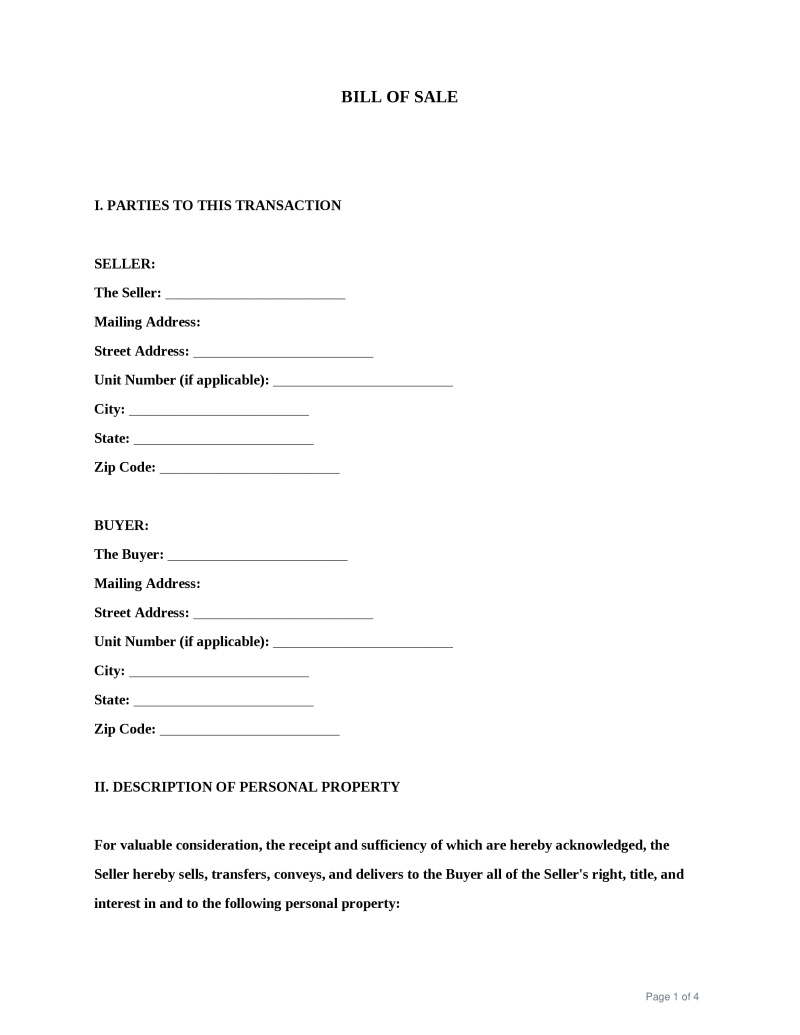
A Virginia Bill of Sale is a legal document that records the transfer of ownership of personal property, such as a vehicle or vessel, from a seller to a buyer within the Commonwealth of Virginia.
Asset Type
Choose the category that best describes the item. This helps include the right identifying details, such as VIN, hull number, serial number, or livestock identifiers.
Use this when the item does not fit one of the listed categories.
Table of Contents
What is a Virginia Bill of Sale?
A Virginia Bill of Sale is a legal document used to record the transfer of ownership of personal property from a seller to a buyer. This document acts as a formal receipt, detailing the terms of the transaction, the purchase price, and the identities of both parties. It provides important evidence of the transfer for taxation, registration, and liability purposes in the Commonwealth of Virginia. Buyers and sellers utilize this record to protect themselves against future disputes or misunderstandings regarding the condition of the item at the time of sale.
Types of Virginia Bills of Sale
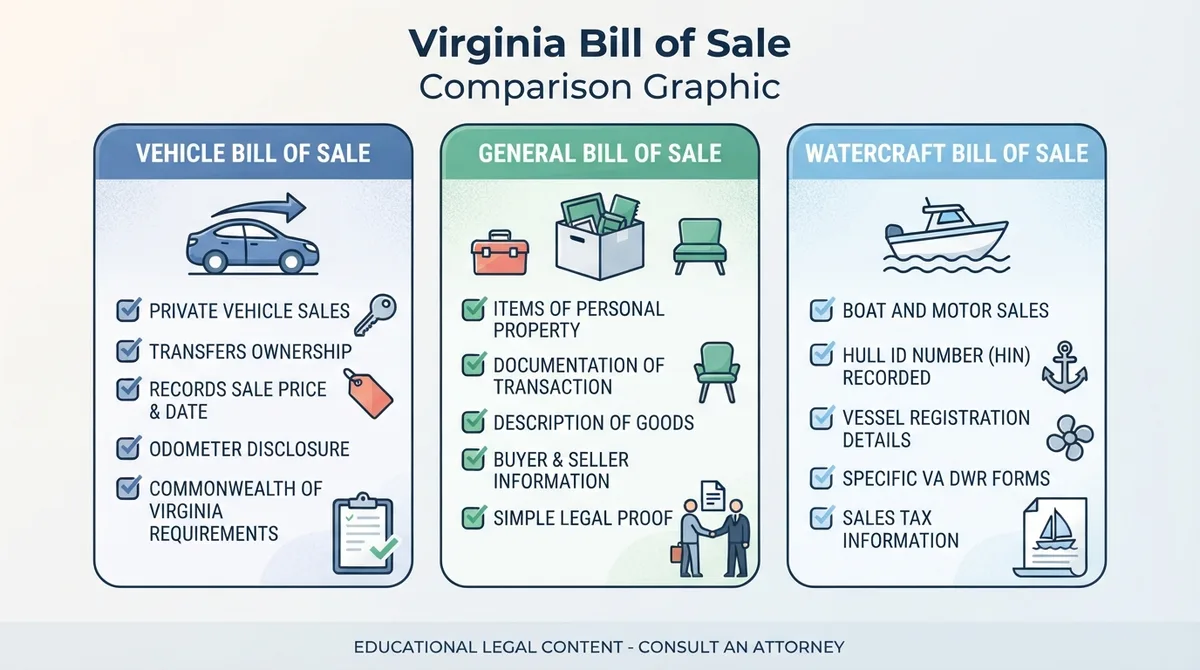
Different transactions require specific documentation to satisfy state rules. Using the correct form ensures that the transaction complies with state guidelines and is processed smoothly by relevant state agencies. The following are the standard types of bills of sale used in Virginia:
- Vehicle Bill of Sale - Documents the transfer of motor vehicles, including cars, trucks, and motorcycles, and is used to verify the purchase price for state tax assessments.
- General Bill of Sale - Records the sale of generic personal property, such as electronics, appliances, or furniture, where no official state registration is required.
- Secondhand Article Bill of Sale - Serves as the legally required receipt for transactions involving secondhand goods, protecting buyers and verifying the origin of the items.
Requirements for Vehicle Sales
Selling a motor vehicle in Virginia involves specific administrative steps to ensure the transfer of ownership is legally recognized. The Virginia Department of Motor Vehicles outlines the necessary actions for both parties to complete the transaction successfully and avoid processing delays at local offices:
- Title Assignment - The seller must sign the vehicle title over to the buyer at the time of the transaction.
- Odometer Disclosure - The seller must record the current odometer reading on the title to certify the mileage of the vehicle.
- Buyer Information - The document must include the full legal name and physical address of the buyer.
- Sale Price Specification - The transaction record must clearly state the exact purchase price or note that the vehicle is a gift.
Sales and Use Tax Requirements
The state of Virginia imposes financial regulations on vehicle transfers, relying on documented transaction details to calculate the appropriate taxes. Accurate recording of the purchase price ensures that the state collects the correct tax revenue during the vehicle registration process:
- Sales and Use Tax Rate - Imposes a 4.15% tax on vehicle transactions based on the sale price or fair market value at the time of titling (Code of Virginia § 58.1-2402).
- Minimum Tax Requirement - Dictates a minimum seventy-five dollar tax on vehicle transactions when the sales price is low (Code of Virginia § 58.1-2402).
- Family Transfer Exemptions - Allows for tax exemptions or special rates when transferring a vehicle between immediate family members.
Secondhand Article Transactions
Virginia state law establishes strict documentation rules for individuals or businesses purchasing secondhand merchandise to prevent fraud and track property. These statutes ensure that transactions involving used goods are transparent and traceable by law enforcement if necessary:
- Secondhand Article Documentation - Mandates that buyers of designated secondhand goods obtain a signed, dated receipt or bill of sale from the seller (Code of Virginia § 59.1-126).
- Seller Identity Requirements - Requires the seller to provide their signature, full name, and physical address on the transaction record (Code of Virginia § 59.1-126).
- Record Retention - Obligates buyers to keep these records to prove legal acquisition of the merchandise.
Essential Elements of a Virginia Bill of Sale
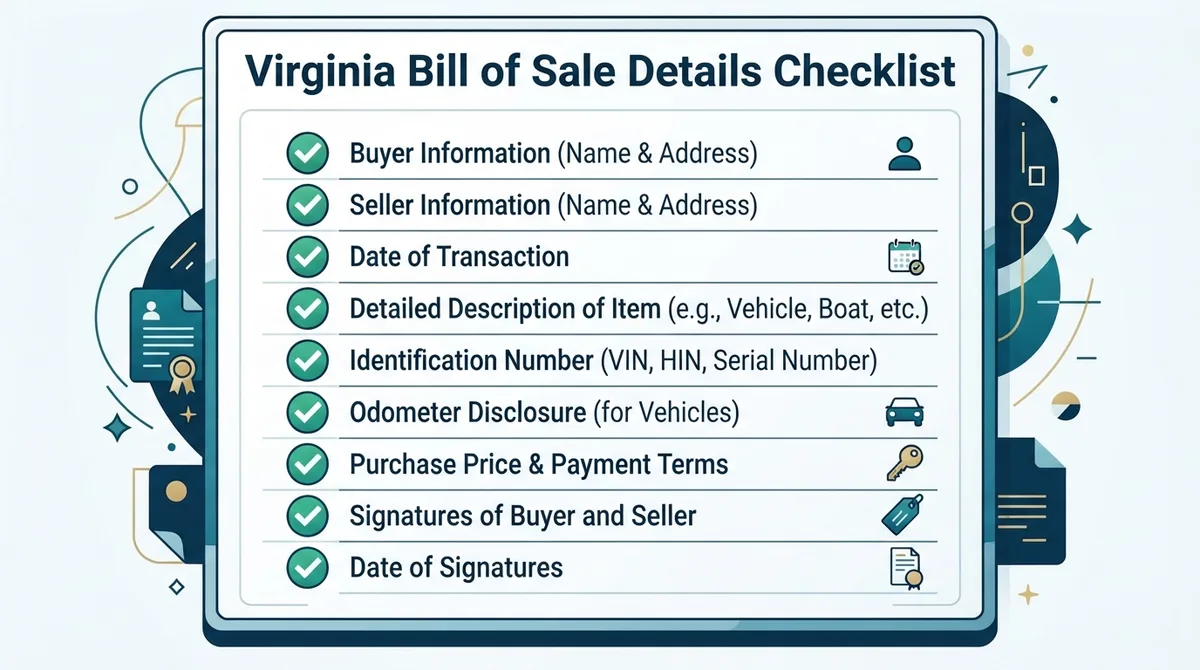
To ensure a bill of sale is legally useful and accepted by state agencies, it should contain several core pieces of information. A complete document serves as an indisputable record of the agreement made between the buyer and the seller:
- Identities of the Parties - The full legal names, physical addresses, and contact information of both the buyer and the seller.
- Detailed Description - Specific identifying details of the property, such as make, model, year, and serial numbers or Vehicle Identification Numbers.
- Payment Terms - The total agreed-upon purchase price, the date the funds were exchanged, and the method of payment.
- As-Is Provision - A clause indicating the property is sold in its current condition with no warranties, protecting the seller from future claims.
Sources
- Virginia Department of Motor Vehicles: Buying/Selling a Vehicle - Provides guidance on the process of buying and selling vehicles in Virginia, including the use of bills of sale.
- Virginia Department of Motor Vehicles: Motor Vehicle Sales and Use Tax - Details the sales and use tax requirements for vehicle transactions in Virginia, including the role of bills of sale in tax calculations.
- Code of Virginia: § 59.1-126. Receipt or bill of sale to be taken by buyer; sales procedures - Outlines the requirements for receipts or bills of sale in transactions involving secondhand articles in Virginia.
Bill of Sale in other states
Not the form you're looking for?
Try our legal document generator to create a custom document
Disclaimer: The templates available on this website are provided for general informational purposes only and do not constitute legal advice. They are not intended to be, and should not be interpreted as, compliant with any specific legal, regulatory, or privacy requirements. These templates are not a replacement for professional legal guidance and should not be relied upon for any particular matter or circumstance. Users are strongly encouraged to seek advice from a qualified attorney licensed in their jurisdiction before using, modifying, or relying on any template.
All templates are provided on an "as is," "with all faults," and "as available" basis. The provider disclaims any and all warranties of any kind, whether express, implied, statutory, or otherwise, including without limitation warranties of merchantability, fitness for a particular purpose, title, or non-infringement.
LegalTemplates.com makes no guarantees or representations regarding the accuracy, completeness, expected outcomes, or reliability of the materials contained in these templates or any materials referenced or linked from them.