Kansas Bill of Sale
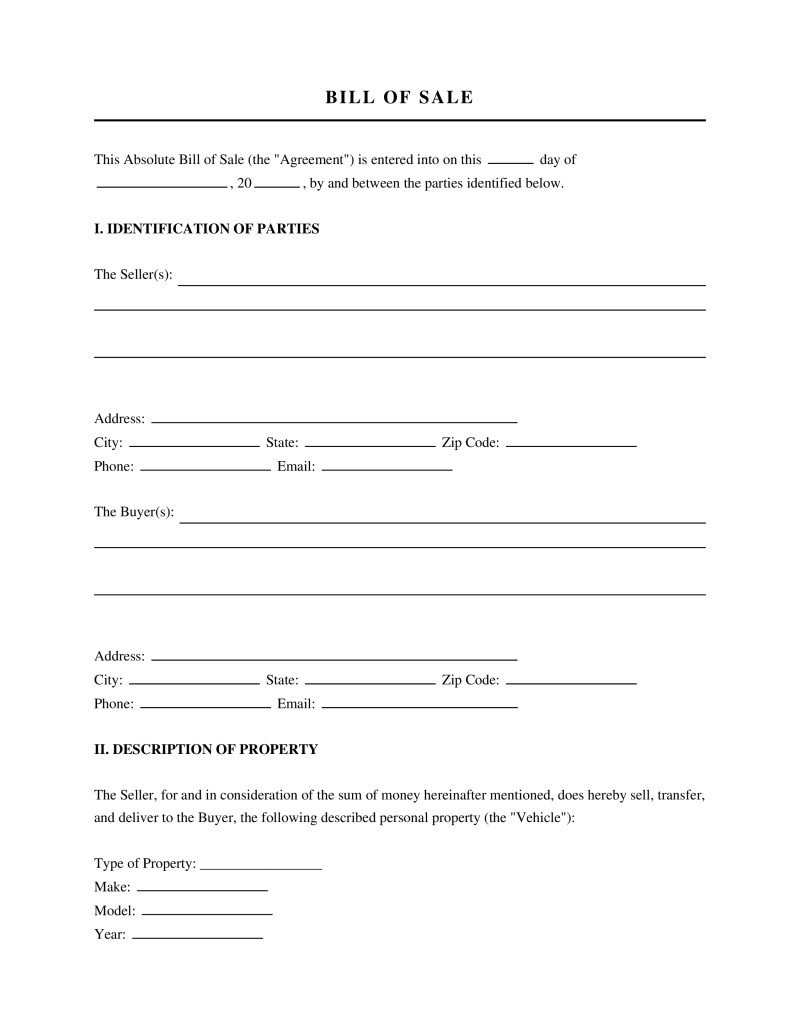
A Kansas Bill of Sale is a legal document that formally records the transfer of ownership of personal property from a seller to a buyer within the state of.
Asset Type
Choose the category that best describes the item. This helps include the right identifying details, such as VIN, hull number, serial number, or livestock identifiers.
Use this when the item does not fit one of the listed categories.
Table of Contents
What is a Kansas Bill of Sale?
A Kansas bill of sale is a legal document that records the transfer of ownership of personal property from one party, the seller, to another, the buyer, within the state of Kansas. This instrument serves as proof of purchase and sale, detailing the transaction's specifics, including the identity of the parties, a description of the item being sold, the purchase price, and the date of the transfer. It is commonly used for the sale of vehicles, boats, firearms, and other valuable personal goods, providing an essential record for both parties for tax, registration, and liability purposes.
Legal Requirements
For a Kansas bill of sale to be legally valid and enforceable, it must accurately reflect the agreement between the buyer and seller and comply with fundamental contract principles. While a bill of sale for most personal property does not always require notarization in Kansas, certain transactions, particularly those involving motor vehicles for titling purposes, may require specific forms or additional documentation for state agencies. The document primarily acts as a record of the transaction, establishing a clear chain of ownership.
Key aspects contributing to the legal validity of a Kansas bill of sale include:
- Mutual Assent - Both the buyer and seller must agree to the terms of the sale, demonstrating a 'meeting of the minds.'
- Consideration - There must be an exchange of value, typically the payment of money for the property, though other forms of consideration can be valid.
- Legal Purpose - The transaction must involve legal goods and be for a lawful purpose.
- Competent Parties - Both parties must be of legal age and sound mind, not under duress or undue influence, to enter into a binding agreement.
- Accurate Information - All details regarding the parties and the property must be precise and truthful to avoid disputes or allegations of fraud.
Required Elements of a Valid Kansas Bill of Sale
To ensure a Kansas bill of sale is comprehensive and legally sound, it should include specific information that clearly identifies the transaction and the property involved:
- Date of Sale - The exact date on which the ownership transfer occurs.
- Seller's Information - The full legal name, current address, and contact details of the individual or entity selling the property.
- Buyer's Information - The full legal name, current address, and contact details of the individual or entity purchasing the property.
- Detailed Property Description - A clear and unambiguous description of the item being sold, including make, model, year, color, and any unique identifiers such as a Vehicle Identification Number (VIN) for automobiles, Hull Identification Number (HIN) for boats, or serial numbers for other equipment.
- Purchase Price - The agreed-upon amount of money or other consideration exchanged for the property, stated in both numerical and written form.
- Method of Payment - How the payment was made (e.g., cash, check, money order, bank transfer).
- Warranty Statement - A declaration regarding the condition of the property, often stating whether it is sold "as-is" with no warranties, or if any express warranties are provided.
- Signatures of Parties - The legal signatures of both the seller and the buyer, affirming their agreement to the terms.
- Witness Signatures (Optional) - While not always legally required, signatures from one or more impartial witnesses can add an extra layer of verification to the transaction.
- Notary Acknowledgment (Optional, but often required for vehicles) - For certain high-value items or those requiring state registration, a notary public's acknowledgment may be necessary to authenticate the signatures.
How to Complete a Kansas Bill of Sale
Completing a Kansas bill of sale involves several steps to ensure all necessary information is accurately recorded and the transfer of ownership is legally sound.
- Gather Essential Information - Begin by collecting all pertinent details for both the buyer and the seller, including their full legal names, current residential or business addresses, and contact phone numbers. For the item being sold, compile its complete description, such as the make, model, year, color, and any unique identification numbers like a VIN for vehicles or a serial number for other goods.
- Specify the Purchase Price and Payment Terms - Clearly state the exact amount of the agreed-upon purchase price in both numerical and written format to prevent any ambiguity. Additionally, detail the method of payment used, such as cash, check, money order, or electronic transfer, and confirm the date the payment was received or will be received.
- Outline the Condition and Warranty - Indicate the condition of the property at the time of sale. It is common practice to include an "as-is" clause, which signifies that the buyer accepts the item in its current state without any warranties from the seller. If any specific warranties are being offered, these must be explicitly stated within this section of the bill of sale.
- Execute the Document with Signatures - Both the buyer and the seller must sign and date the bill of sale to legally execute the document. It is advisable to have the signatures witnessed by an impartial third party, though this is not always a legal requirement, as witness signatures can provide additional verification in case of future disputes.
- Consider Notarization and Copies - While not mandatory for all personal property sales, notarization is often required for motor vehicle titles in Kansas and can add legal weight to any transaction. After all parties have signed, and if applicable, the document has been notarized, ensure that both the buyer and the seller receive original copies of the completed and signed bill of sale for their records.
Rights and Obligations of Parties Involved
The Kansas bill of sale establishes a clear framework of rights and obligations for both the buyer and the seller, impacting their responsibilities and expectations regarding the transaction.
For the seller, key obligations and rights include:
- Delivery of Property - The seller is obligated to deliver the property to the buyer as agreed upon in the bill of sale, ensuring it matches the description provided.
- Transfer of Clear Title - The seller must transfer legal ownership of the property to the buyer, free from any undisclosed liens, encumbrances, or claims by third parties.
- Truthful Disclosure - The seller has a duty to disclose any known material defects or issues with the property that would not be apparent upon reasonable inspection, unless the property is explicitly sold "as-is."
- Right to Payment - The seller has the right to receive the agreed-upon purchase price from the buyer.
For the buyer, key obligations and rights include:
- Payment of Purchase Price - The buyer is obligated to pay the agreed-upon purchase price to the seller.
- Acceptance of Property - The buyer is expected to accept the property if it conforms to the terms of the sale and is free from undisclosed defects.
- Right to Receive Clear Title - The buyer has the right to receive full and clear legal title to the property upon payment.
- Right to Conforming Goods - The buyer has the right to receive the property as described in the bill of sale and in the condition represented by the seller.
Applicable Federal and State Laws
The creation and enforcement of a Kansas bill of sale are governed by a combination of state and, to a lesser extent, federal laws. These legal frameworks ensure fairness, define responsibilities, and provide recourse in case of disputes.
Federal Laws
While most aspects of a Kansas bill of sale fall under state jurisdiction, certain federal statutes may apply, particularly in consumer transactions:
- Magnuson-Moss Warranty Act - Governs written warranties on consumer products, ensuring clear disclosure of warranty terms and providing remedies for consumers (15 U.S.C. § 2301 et seq.).
- Federal Trade Commission Act - Prohibits unfair methods of competition and unfair or deceptive acts or practices in commerce, which can apply to misrepresentations in the sale of goods (15 U.S.C. § 41 et seq.).
State Laws and Requirements
Kansas state statutes provide the primary legal framework for bills of sale and the transactions they document:
- Kansas Uniform Commercial Code (UCC) - Article 2 (Sales) - Governs the sale of goods in Kansas, covering aspects such as contract formation, warranties (express and implied), risk of loss, and remedies for breach (K.S.A. Chapter 84, Article 2).
- Motor Vehicle Registration and Titling - Outlines the requirements for transferring ownership of motor vehicles, which often necessitate a bill of sale for the buyer to obtain a new certificate of title and registration (K.S.A. Chapter 8, Article 1, e.g., K.S.A. 8-135).
- Boating Act - Establishes requirements for titling and registration of watercraft, where a bill of sale is typically a crucial document for proving ownership transfer (K.S.A. Chapter 32, Article 11, e.g., K.S.A. 32-1111).
- Statute of Frauds - Requires that contracts for the sale of goods for a price of $500 or more must be in writing to be enforceable (K.S.A. 84-2-201).
- General Contract Law - Principles related to contract formation, capacity, consideration, and legality, which underpin any valid bill of sale (K.S.A. Chapter 16).
Penalties for Non-Compliance
Failure to comply with the legal requirements associated with a Kansas bill of sale can lead to various civil and, in some cases, criminal penalties:
- Contract Disputes - An improperly completed or fraudulent bill of sale can lead to legal disputes between the buyer and seller, potentially requiring court intervention to resolve ownership claims or monetary damages.
- Fraud and Misrepresentation - Intentionally providing false information on a bill of sale, such as misrepresenting the condition of the property or concealing liens, can result in civil lawsuits for fraud, leading to significant financial penalties or even criminal charges depending on the severity and intent.
- Failure to Transfer Title/Registration - For vehicles, boats, or other titled property, an invalid or incomplete bill of sale can prevent the buyer from legally registering the item in their name, potentially incurring fines or legal issues for operating an unregistered or improperly titled vehicle.
- Tax Evasion - Understating the purchase price on a bill of sale to reduce sales tax or property transfer fees constitutes tax evasion and can result in significant fines, penalties, and interest from state tax authorities.
Frequently Asked Questions
Bill of Sale in other states
Not the form you're looking for?
Try our legal document generator to create a custom document
Disclaimer: The templates available on this website are provided for general informational purposes only and do not constitute legal advice. They are not intended to be, and should not be interpreted as, compliant with any specific legal, regulatory, or privacy requirements. These templates are not a replacement for professional legal guidance and should not be relied upon for any particular matter or circumstance. Users are strongly encouraged to seek advice from a qualified attorney licensed in their jurisdiction before using, modifying, or relying on any template.
All templates are provided on an "as is," "with all faults," and "as available" basis. The provider disclaims any and all warranties of any kind, whether express, implied, statutory, or otherwise, including without limitation warranties of merchantability, fitness for a particular purpose, title, or non-infringement.
LegalTemplates.com makes no guarantees or representations regarding the accuracy, completeness, expected outcomes, or reliability of the materials contained in these templates or any materials referenced or linked from them.