Nebraska Bill of Sale
A Nebraska Bill of Sale is a legal document that records the transfer of ownership of personal property, such as a vehicle or vessel, from a seller to a buyer within the state of Nebraska.
Asset Type
Choose the category that best describes the item. This helps include the right identifying details, such as VIN, hull number, serial number, or livestock identifiers.
Use this when the item does not fit one of the listed categories.
What is a Nebraska Bill of Sale?
A Nebraska Bill of Sale is a formal legal document used to record the transfer of ownership of personal property from a seller to a buyer. It acts as a detailed transaction receipt, documenting the purchase price, the date of the sale, and the specific identities of both parties. In Nebraska, this document is a vital component of the vehicle registration and titling process. The Nebraska Department of Motor Vehicles requires a completed bill of sale or an authorized tax transaction form to establish legal ownership transfer.
Required Uses in Motor Vehicle Transactions
Nebraska regulations mandate the use of a bill of sale for specific motor vehicle transactions. The document serves as legal proof of purchase and is necessary for administrative processing at the county level:
- In-State Transfer of Ownership - Sellers must provide buyers with a notarized bill of sale or a completed Nebraska Department of Revenue Form 6 to legally transfer a motor vehicle.
- Out-of-State Vehicle Titling - Buyers bringing a vehicle from another state into Nebraska must present a bill of sale or a completed Form 6 to obtain a Nebraska title.
- Sales Tax Assessment - The county treasurer uses the purchase price listed on the document to calculate the appropriate motor vehicle sales tax.
Types of Nebraska Bills of Sale
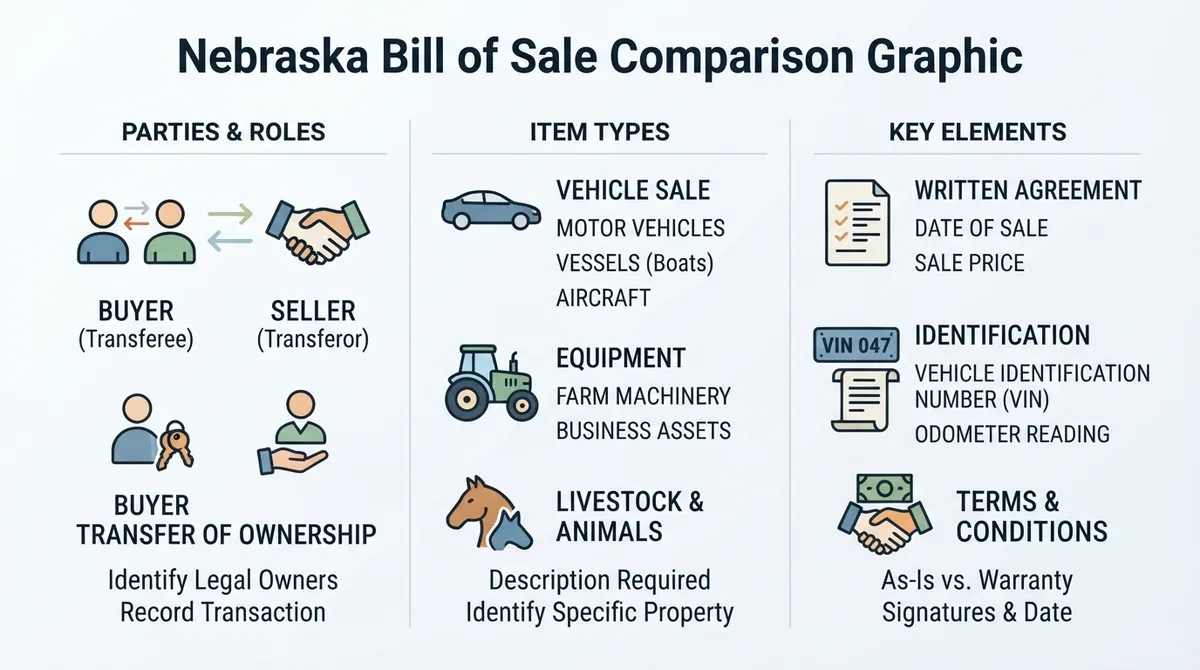
Nebraska utilizes different bills of sale depending on the nature of the property being transferred:
- Motor Vehicle Bill of Sale - Used specifically for cars, trucks, motorcycles, and other road vehicles, requiring notarization or a Form 6 equivalent.
- Boat and Watercraft Bill of Sale - Document used to record the transfer of motorized vessels and trailers for registration with the state.
- General Bill of Sale - Utilized for personal property transactions such as electronics, furniture, or equipment where official state registration is not mandatory.
Essential Elements of the Document
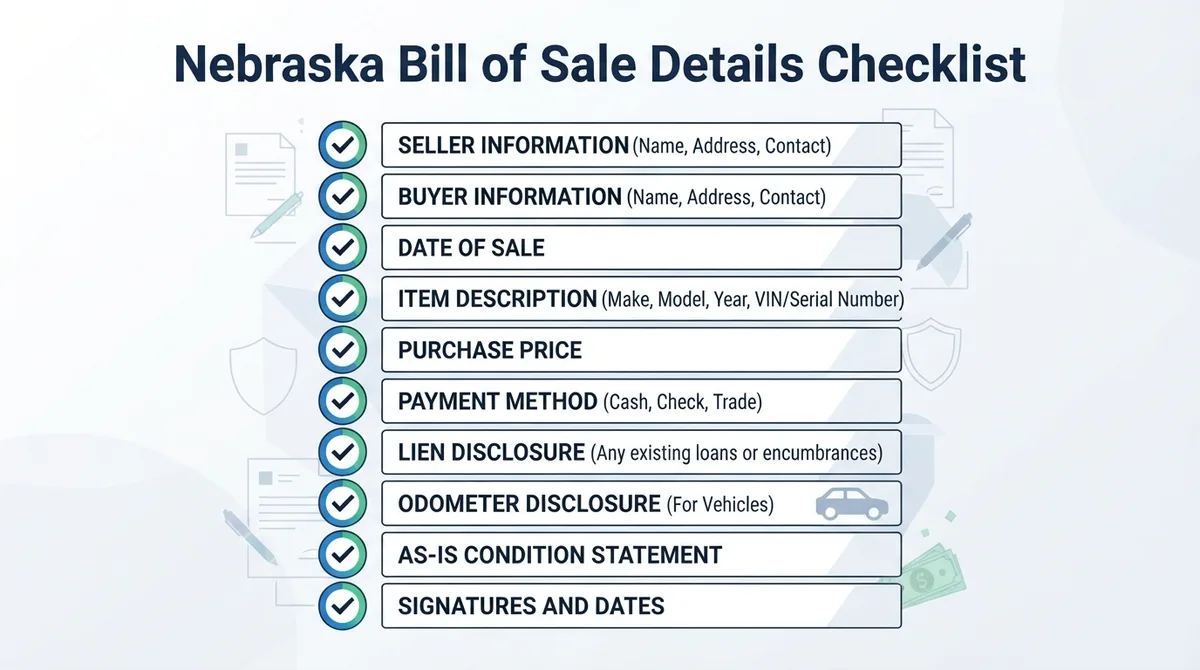
A valid Nebraska Bill of Sale must contain specific details to be recognized by county officials and the Department of Motor Vehicles:
- Buyer and Seller Information - Full legal names, physical addresses, and signatures of both parties involved in the transaction.
- Vehicle Description - Comprehensive details of the vehicle, including the make, model, year, body type, and Vehicle Identification Number.
- Odometer Reading - The exact mileage displayed on the vehicle dashboard at the moment of the transfer.
- Purchase Price and Date - The final agreed-upon sale price and the exact calendar date the transaction occurred.
- Notary Public Block - A dedicated section for a notary public to witness the seller signature, which is required unless a Form 6 is used.
Notarization and Alternative Filing Options
Nebraska enforces strict verification standards for vehicle ownership transfers. Parties must adhere to specific documentation alternatives to ensure the transaction is legally recognized:
- Notarized Bill of Sale Requirement - The official Nebraska Department of Motor Vehicles Bill of Sale form requires the seller signature to be notarized to be valid for title transfers.
- Nebraska Department of Revenue Form 6 - An authorized alternative to the bill of sale, also known as the Nebraska Sales/Use Tax and Transaction Statement, which does not require notarization.
- County Treasurer Submission - The completed and signed document must be submitted to the local county treasurer office where the vehicle will be registered.
The Vehicle Registration and Title Transfer Process
Completing the transaction involves several sequential steps to update state records. The buyer must navigate the registration process within a specific timeframe:
- Complete the Document - The buyer and seller fill out the official Department of Motor Vehicles form, ensuring all vehicle identifiers are accurate.
- Obtain Notarization - The seller signs the document in the presence of a licensed notary public to validate their identity.
- Exchange Funds and Title - The buyer provides the agreed payment, and the seller signs over the physical vehicle title.
- Submit to the County Treasurer - The buyer brings the notarized bill of sale, the signed title, and proof of insurance to their local county treasurer office.
- Pay Fees and Taxes - The buyer pays the required registration fees and sales taxes based on the purchase price recorded on the bill of sale.
Sources
- Bill of Sale Form - Nebraska Department of Motor Vehicles - Provides the official Bill of Sale form for motor vehicles in Nebraska.
- Transfer of Ownership - Nebraska Department of Motor Vehicles - Details the requirements for transferring ownership of a motor vehicle in Nebraska, including the necessity of a Bill of Sale.
- Out-of-State Titles - Nebraska Department of Motor Vehicles - Explains the process for titling out-of-state vehicles in Nebraska, including the requirement of a Bill of Sale.
Bill of Sale in other states
Not the form you're looking for?
Try our legal document generator to create a custom document
Disclaimer: The templates available on this website are provided for general informational purposes only and do not constitute legal advice. They are not intended to be, and should not be interpreted as, compliant with any specific legal, regulatory, or privacy requirements. These templates are not a replacement for professional legal guidance and should not be relied upon for any particular matter or circumstance. Users are strongly encouraged to seek advice from a qualified attorney licensed in their jurisdiction before using, modifying, or relying on any template.
All templates are provided on an "as is," "with all faults," and "as available" basis. The provider disclaims any and all warranties of any kind, whether express, implied, statutory, or otherwise, including without limitation warranties of merchantability, fitness for a particular purpose, title, or non-infringement.
LegalTemplates.com makes no guarantees or representations regarding the accuracy, completeness, expected outcomes, or reliability of the materials contained in these templates or any materials referenced or linked from them.