Hawaii Bill of Sale
A Hawaii Bill of Sale is a legal document used to formally transfer ownership of personal property from a seller to a buyer within the jurisdiction of Hawaii.
Asset Type
Choose the category that best describes the item. This helps include the right identifying details, such as VIN, hull number, serial number, or livestock identifiers.
Use this when the item does not fit one of the listed categories.
Table of Contents
What is a Hawaii Bill of Sale?
A Hawaii bill of sale is a legal document used to record the transfer of ownership of personal property from a seller to a buyer. This instrument acts as a written receipt and proof of purchase, detailing specific information about the transaction such as the purchase price, date of sale, and a comprehensive description of the item being transferred. Residents of Hawaii frequently utilize this form for transactions involving motor vehicles, vessels, firearms, and general personal property to establish a clear chain of title and protect the legal interests of both parties involved in the exchange.
Legal Requirements for Vehicle Transactions
The State of Hawaii enforces specific regulations regarding the transfer of motor vehicles between private parties. Unlike many states where a bill of sale is optional if the title is available, Hawaii counties often mandate a bill of sale or a specific release of liability to accompany the certificate of title. This is particularly relevant when the certificate of title lacks sufficient space for the necessary information or when the vehicle is being registered in a different county from where it was purchased.
Hawaii operates its vehicle registration system at the county level rather than through a centralized state agency. The City and County of Honolulu, County of Maui, County of Hawaii, and County of Kauai each maintain distinct Departments of Motor Vehicles (DMV) or Treasury divisions responsible for processing these documents. A valid bill of sale generally requires the notarized signature of the seller to be accepted by these county agencies for title transfer purposes.
Relevant Hawaii Statutes and Regulations
The governance of property transfers, specifically regarding vehicles and vessels, falls under various sections of the Hawaii Revised Statutes (HRS). These laws dictate the procedures for registration, safety, and ownership transfer.
- Procedure for Transfer of Title - Mandates that the owner of a registered vehicle must endorse the certificate of title and deliver it to the new owner upon transfer of interest (HRS § 286-52).
- Vessel Registration and Numbering - Requires all undocumented vessels to be registered and numbered in accordance with state rules before operating in state waters (HRS § 200-31).
- Odometer Responsibility - Prohibits the disconnection, resetting, or altering of a motor vehicle odometer with the intent to change the mileage registered (HRS § 486-81).
- Notary Public Powers - Authorizes notaries to administer oaths and take acknowledgments, which is a standard requirement for vehicle bills of sale in Hawaii (HRS § 456-14).
- Federal Odometer Disclosure - Requires sellers to provide a written disclosure of the mileage for vehicles under 10 years old (49 C.F.R. § 580.5).
How to Complete a Hawaii Bill of Sale
Completing a bill of sale in Hawaii involves gathering accurate information and following specific procedural steps to ensure the document is legally binding and acceptable for registration purposes.
- Information Collection - The seller must compile all necessary data regarding the property. For vehicles, this includes the Vehicle Identification Number (VIN), license plate number, make, model, year, and current odometer reading. For vessels, the Hull Identification Number (HIN) and registration number are necessary. Both parties must provide their full legal names and current mailing addresses.
- Terms Negotiation - The parties agree upon the purchase price and the method of payment. If the item is being sold "as-is," this condition must be clearly stated in the document to indicate that no warranties are provided regarding the condition of the property. Any payment plans or trade-in agreements should be detailed in this section.
- Document Execution - The form is filled out using the collected information. No fields should be left blank. If a specific section does not apply, it should be marked as "N/A." The odometer disclosure statement must be completed accurately to comply with state and federal laws regarding mileage reporting.
- Notarization - The seller and buyer sign the document. For motor vehicle transactions in Hawaii, the seller's signature typically requires notarization to prevent fraud and satisfy county DMV requirements. The parties should appear before a notary public with valid government-issued identification to complete this step.
- Exchange and Registration - The buyer provides the funds, and the seller delivers the property along with the bill of sale and the certificate of title. The buyer then takes these documents to their respective county director of finance or DMV office within 30 days to transfer the registration and title into their name.
Vessel and Boat Transfer Requirements
Hawaii has a robust maritime culture, and the transfer of vessel ownership is strictly regulated by the Department of Land and Natural Resources (DLNR), Division of Boating and Ocean Recreation (DOBOR). A bill of sale is a critical component of this process. The document serves as proof of ownership when the new owner applies for a vessel registration or transfers an existing registration.
The state requires specific details for vessel transactions:
- Vessel Description - The document must include the Hull Identification Number (HIN), year built, make, length, and material of the hull.
- Registration Timeframe - New owners must apply for the transfer of registration within seven days of the purchase date.
- Notice of Transfer - Sellers are obligated to notify the DLNR within seven days of selling or transferring their interest in a vessel.
- Proof of Ownership - A notarized bill of sale is often requested by DOBOR to substantiate the transfer of ownership, especially for used vessels.
Required Elements of a Valid Hawaii Bill of Sale
To ensure acceptance by county and state agencies, a bill of sale drafted in Hawaii must contain specific data points. Missing information can lead to delays in registration or the rejection of the application.
- Date of Sale - The specific day, month, and year the transaction took place.
- Seller and Buyer Information - Full printed names, addresses, and signatures of all parties involved.
- Detailed Property Description - Comprehensive identification of the item, including serial numbers, colors, and distinguishing marks.
- Consideration - The exact amount of money paid or the value of items traded for the property.
- Encumbrance Disclosure - A statement indicating whether the property is free of liens or if there are outstanding loans.
- Notary Acknowledgment - A section for the notary public to affix their seal and signature, confirming the identity of the signatories.
Firearm Transfer Regulations
Hawaii maintains some of the strictest firearm laws in the United States. While a bill of sale records the transaction between private parties, it does not replace the mandatory registration and permitting processes overseen by county police departments. All firearms brought into the state or acquired within the state must be registered.
Key regulations regarding firearm transfers include:
- Permit to Acquire - Buyers must obtain a permit from the county chief of police before acquiring ownership of a firearm (HRS § 134-2).
- Registration Requirements - All firearms must be registered with the county police department within five days of acquisition (HRS § 134-3).
- Private Transfer Restrictions - Direct transfers between private individuals are heavily regulated, and parties must verify that the recipient possesses a valid permit to acquire.
- Background Checks - Comprehensive background checks are mandatory for all firearm permits.
Frequently Asked Questions
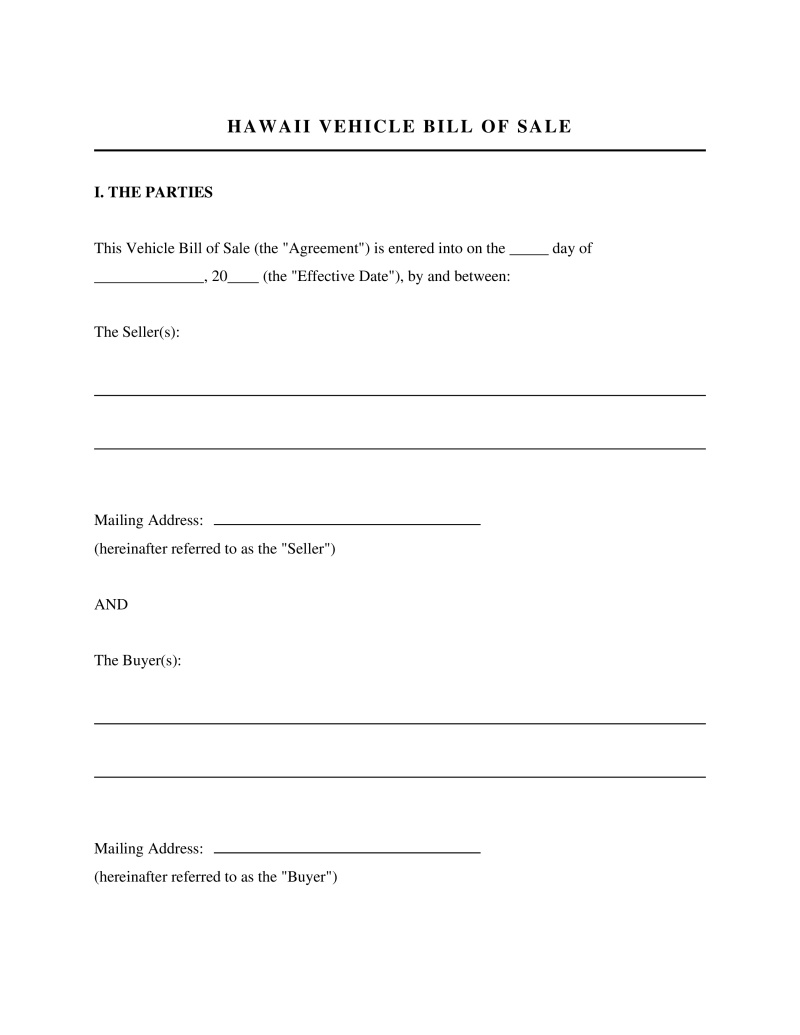
Hawaii Bill of Sale Sample
Bill of Sale in other states
Not the form you're looking for?
Try our legal document generator to create a custom document
Disclaimer: The templates available on this website are provided for general informational purposes only and do not constitute legal advice. They are not intended to be, and should not be interpreted as, compliant with any specific legal, regulatory, or privacy requirements. These templates are not a replacement for professional legal guidance and should not be relied upon for any particular matter or circumstance. Users are strongly encouraged to seek advice from a qualified attorney licensed in their jurisdiction before using, modifying, or relying on any template.
All templates are provided on an "as is," "with all faults," and "as available" basis. The provider disclaims any and all warranties of any kind, whether express, implied, statutory, or otherwise, including without limitation warranties of merchantability, fitness for a particular purpose, title, or non-infringement.
LegalTemplates.com makes no guarantees or representations regarding the accuracy, completeness, expected outcomes, or reliability of the materials contained in these templates or any materials referenced or linked from them.