California Bill of Sale
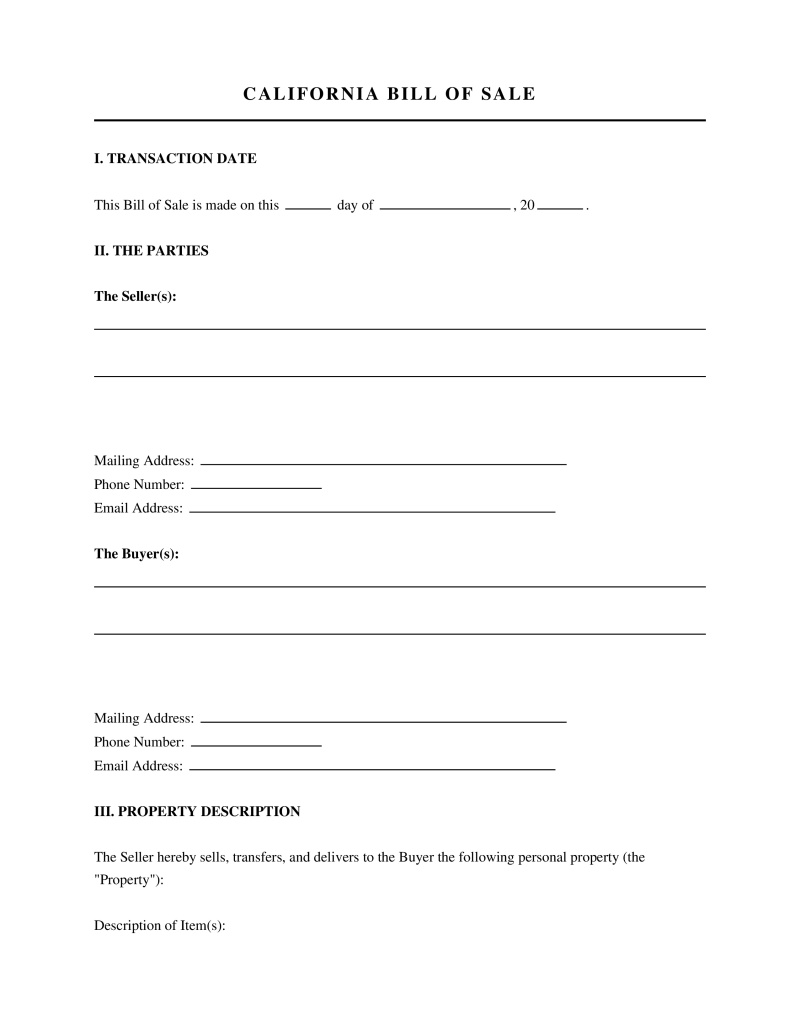
A California Bill of Sale is a written legal instrument that formally documents the sale and transfer of personal property from a seller to a buyer within the State of California. It serves as proof of ownership change and outlines key transaction details, including the identities of the parties, a description of the property, and the terms of the sale.
Asset Type
Choose the category that best describes the item. This helps include the right identifying details, such as VIN, hull number, serial number, or livestock identifiers.
Use this when the item does not fit one of the listed categories.
Table of Contents
What is a California Bill of Sale?
A California Bill of Sale serves as a legal document recording the transfer of ownership of personal property from a seller to a buyer within the state. This instrument functions primarily as a receipt that outlines the specifics of the transaction, including the purchase price, date of sale, and detailed description of the item being transferred. Individuals and businesses utilize this form to establish proof of ownership for registration purposes and to release the seller from liability after the transaction concludes.
Types of California Bill of Sale
Various forms exist to accommodate specific categories of property transfers:
- Vehicle Bill of Sale (Form REG 135) - Documents the sale of a motor vehicle and is officially recognized by the California Department of Motor Vehicles (DMV) for registration purposes.
- Vehicle/Vessel Transfer and Reassignment (Form REG 262) - Functions as a combined odometer disclosure, power of attorney, and bill of sale that must be printed on security paper compliant with state regulations.
- Vessel Bill of Sale - Records the transfer of ownership for watercraft, including boats and jet skis, requiring specific Hull Identification Numbers (HIN).
- Firearm Bill of Sale - Captures the details of a gun transaction, though California law mandates that most firearm transfers must proceed through a licensed dealer.
State Laws and Regulations
California statutes impose specific requirements regarding property transfers and documentation:
- Transfer of Title Requirements - Mandates the delivery of the certificate of ownership to the buyer or the Department of Motor Vehicles to finalize a transfer (Cal. Veh. Code § 5600).
- Odometer Disclosure - Requires sellers of vehicles under a certain age to provide an accurate reading of the odometer at the time of sale (Cal. Veh. Code § 5900).
- Smog Certification - Obligates the seller to provide a valid smog certification to the buyer prior to or at the time of the sale, with limited exceptions (Cal. Veh. Code § 4000.1).
- Notice of Transfer and Release of Liability - Requires sellers to notify the DMV within five days of selling or transferring a vehicle to avoid civil or criminal liability for the vehicle (Cal. Veh. Code § 5900).
- Use Tax Obligations - Imposes a use tax on the storage, use, or other consumption of tangible personal property purchased from a retailer (Cal. Rev. & Tax. Code § 6201).
Required Elements of a Valid California Bill of Sale
A legally binding document must contain specific information to be accepted by state agencies:
- Parties' Information - Full legal names and physical addresses of both the buyer and the seller.
- Property Description - Detailed identification including Make, Model, Year, VIN (for vehicles), HIN (for vessels), or serial numbers.
- Transaction Details - The agreed-upon purchase price and the specific date of the transaction.
- Odometer Reading - The exact mileage displayed on the vehicle dashboard at the moment of transfer (required for most vehicle sales).
- Signatures - Written acknowledgement from the seller (and often the buyer) confirming the accuracy of the information.
- Gift Indication - A clear statement indicating if the property is a gift, which affects tax calculations.
How to Complete a California Vehicle Bill of Sale
Completing the transfer of a vehicle involves several distinct actions:
Step 1: Negotiate Terms - The buyer and seller agree on the price and terms of the sale, such as whether the item is sold "as-is."
Step 2: Obtain Smog Certification - The seller secures a smog certificate if the vehicle is more than four model years old, unless a valid exemption applies.
Step 3: Complete Form REG 135 - Parties fill out the specific DMV Bill of Sale form, ensuring the Vehicle Identification Number (VIN) matches the title exactly.
Step 4: Execute Odometer Disclosure - The seller records the current mileage on the title or Form REG 262 if the title does not have a designated space.
Step 5: Sign and Exchange - Both parties sign the relevant documents, and the buyer provides payment while the seller provides the title and bill of sale.
Step 6: Submit Notice of Transfer - The seller files the Notice of Transfer and Release of Liability (NRL) with the DMV immediately to prevent future liability.
Seller and Buyer Obligations
The transfer of ownership imposes distinct duties on each party involved in the transaction. The seller holds the primary responsibility for providing specific disclosures and ensuring the vehicle meets emission standards. California law requires the seller to provide a smog certificate valid within 90 days of the sale date. The seller must also formally notify the DMV of the sale to release themselves from responsibility for parking tickets or accidents involving the vehicle post-sale.
The buyer assumes responsibility for finalizing the legal transfer of ownership. This process involves visiting the DMV or using online services to pay the transfer fee and any applicable use tax. The buyer typically has 10 days from the date of purchase to complete the registration transfer. Failure to register within this window may result in financial penalties added to the registration fees.
Federal Statutes
Certain federal regulations impact the sale of specific types of property:
- Federal Odometer Act - Prohibits the disconnection, resetting, or alteration of a vehicle's odometer with intent to change the number of miles indicated (49 U.S.C. § 32703).
- Gun Control Act - Regulates the transfer of firearms and prohibits sales to certain restricted categories of individuals (18 U.S.C. § 922).
FAQs
California Bill of Sale Sample
Bill of Sale in other states
Not the form you're looking for?
Try our legal document generator to create a custom document
Disclaimer: The templates available on this website are provided for general informational purposes only and do not constitute legal advice. They are not intended to be, and should not be interpreted as, compliant with any specific legal, regulatory, or privacy requirements. These templates are not a replacement for professional legal guidance and should not be relied upon for any particular matter or circumstance. Users are strongly encouraged to seek advice from a qualified attorney licensed in their jurisdiction before using, modifying, or relying on any template.
All templates are provided on an "as is," "with all faults," and "as available" basis. The provider disclaims any and all warranties of any kind, whether express, implied, statutory, or otherwise, including without limitation warranties of merchantability, fitness for a particular purpose, title, or non-infringement.
LegalTemplates.com makes no guarantees or representations regarding the accuracy, completeness, expected outcomes, or reliability of the materials contained in these templates or any materials referenced or linked from them.