Child Medical Consent Form
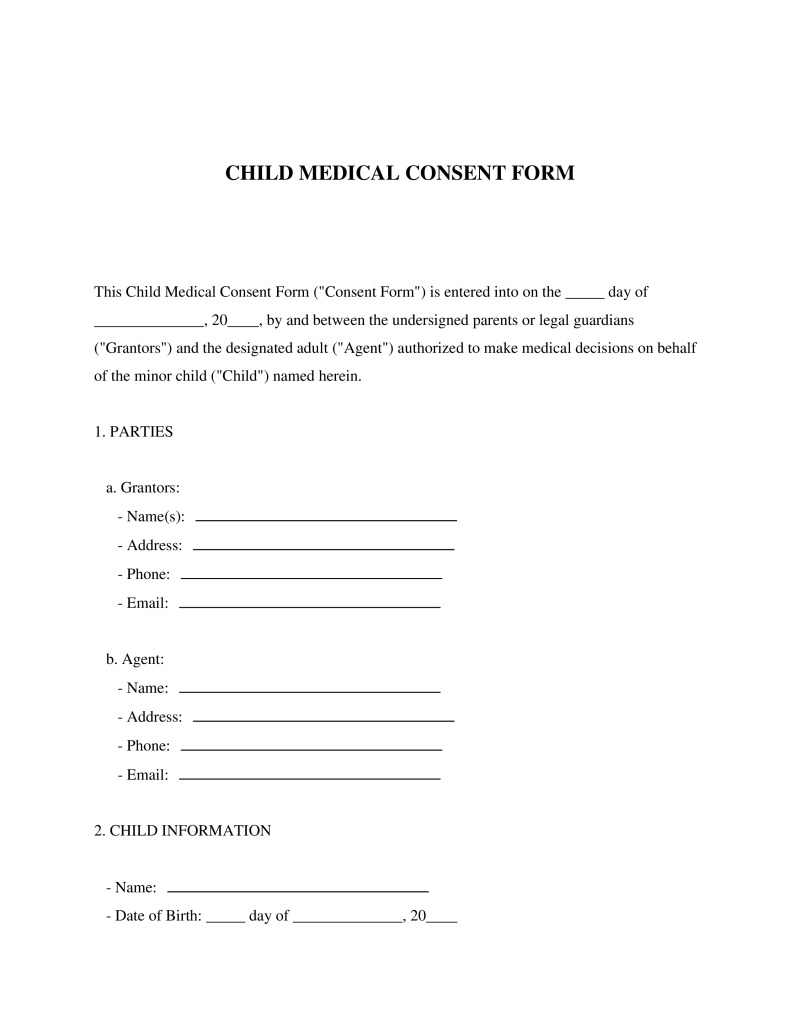
A Child Medical Consent Form is a legal instrument that confers temporary authority upon a designated caregiver to make medical decisions for a minor.
Giving Consent
Select the option that best describes who is giving consent for this document. Choose "One Parent" if only one parent is consenting, "One Legal Guardian" if only one legal guardian is involved, "Two Parents" if both parents are consenting together, or "Two Legal Guardians" if both legal guardians are involved. This information is important as it determines who has the legal authority to give consent on behalf of the child or individual in question.
Table of Contents
What is a Child Medical Consent Form?
A Child Medical Consent Form is a crucial legal document that grants temporary authority to a designated caregiver, relative, or other trusted adult to make medical decisions for a minor child in the absence of the child's parents or legal guardians. Its primary purpose is to ensure that a child can receive necessary medical treatment, including emergency care, routine check-ups, and specific procedures, without delay when the primary guardians are unavailable. This document is widely used by parents entrusting their children to others for travel, extended visits, school trips, or temporary guardianship, providing healthcare providers with the necessary authorization to proceed with care.
Legal Requirements
The legal validity of a Child Medical Consent Form hinges on several factors, primarily the capacity of the parent or guardian to grant consent and the clarity of the authority delegated. While specific requirements can vary by state, general principles apply across jurisdictions to ensure the document is enforceable and protects all parties involved. Healthcare providers rely on these forms to avoid potential liability for treating a minor without proper authorization.
- Parental/Guardian Capacity - The individual signing the consent form must be the child's legal parent or guardian and possess the mental capacity to make such decisions.
- Age of Majority - Consent for minors is generally required because individuals under the age of majority (typically 18 years old) are deemed legally incapable of providing informed consent for their own medical treatment, with certain exceptions.
- Clarity and Specificity - The form must clearly identify the minor, the parent/guardian, the authorized caregiver, and the scope of medical decisions permitted. Ambiguity can render the form ineffective.
- Duration of Consent - A valid form typically specifies the period during which the delegated authority is effective, preventing indefinite or unintended authorizations.
- Revocation - The parent or legal guardian retains the right to revoke the consent at any time, provided the revocation is communicated clearly to all relevant parties.
How to Complete
Creating a legally sound Child Medical Consent Form requires careful attention to detail to ensure it effectively serves its purpose. Following a structured process helps prevent omissions that could invalidate the document or cause delays in care.
- Identify All Parties - Begin by clearly stating the full legal names, dates of birth, and contact information for the minor child, the parent(s) or legal guardian(s) granting consent, and the designated caregiver(s) receiving the authority. Include emergency contact information for all parents/guardians.
- Specify the Scope of Authority - Clearly define the types of medical treatment and decisions the caregiver is authorized to make. This can range from general emergency care to routine medical appointments, administration of medications, or specific procedures. Indicate any limitations or treatments that are expressly excluded from the caregiver's authority.
- Provide Medical Information - Include essential medical details about the child, such as known allergies (medications, food, environmental), existing medical conditions (e.g., asthma, diabetes), current medications, and any special dietary needs. Also, specify the child's primary care physician and their contact information, along with health insurance details.
- Determine the Effective Period - Clearly state the start and end dates for which the consent is valid. This ensures the authority is temporary and aligns with the period the child will be under the caregiver's supervision. If the duration is indefinite but subject to a specific event, clarify that condition.
- Sign and Notarize the Form - The parent(s) or legal guardian(s) must sign and date the form. While not always legally mandated, having the form notarized is highly recommended. Notarization adds an extra layer of legal validity by verifying the identity of the signatory and confirming that the signature was made voluntarily, which can be crucial for healthcare providers.
Required Elements
For a Child Medical Consent Form to be legally effective and readily accepted by healthcare providers, it must contain several key pieces of information and adhere to specific formatting. These elements ensure clarity, authorization, and accountability.
- Patient's full legal name and date of birth
- Full legal names and contact information of parent(s) or legal guardian(s)
- Full legal names and contact information of the authorized caregiver(s)
- Clear statement granting consent for medical treatment
- Description of the scope of treatment covered (e.g., emergency, routine, specific procedures)
- Effective dates of the consent
- Relevant medical history, allergies, and current medications of the child
- Health insurance information
- Signature(s) of parent(s) or legal guardian(s)
- Date of signing
- Notary public's signature and seal (highly recommended)
Rights and Obligations of Parties
A Child Medical Consent Form establishes a framework of rights and obligations for all parties, ensuring the child's welfare is prioritized while maintaining legal boundaries. Understanding these roles is essential for effective use of the document.
- Parents/Legal Guardians - Parents retain ultimate authority over their child's medical care and the right to revoke consent at any time. They are obligated to provide accurate and complete medical information and clearly define the scope of authority granted to the caregiver.
- Designated Caregiver - The caregiver is granted the authority to make medical decisions as outlined in the form and is obligated to act in the child's best interest. They must present the form to medical providers and communicate any significant medical events or decisions back to the parents.
- Healthcare Providers - Medical professionals are obligated to verify the validity of the consent form and the identity of the caregiver. They must provide care within the scope defined by the document, adhere to professional standards, and act in the child's best medical interest. They also have a duty to attempt to contact parents in serious situations, even with consent in place.
Federal and State Laws
The landscape of child medical consent is shaped by a combination of federal mandates, state statutes, and common law principles. These laws aim to protect patient privacy, ensure access to emergency care, and define the rights of parents and minors in healthcare decisions.
Federal Statutes
Several federal laws have implications for child medical consent forms, primarily focusing on patient privacy and emergency care access:
- Health Insurance Portability and Accountability Act (HIPAA) - Establishes national standards for the protection of certain health information, requiring covered entities to obtain written authorization for disclosure of protected health information, though parents generally have access to their minor child's records (45 CFR § 164.508).
- Emergency Medical Treatment and Labor Act (EMTALA) - Requires hospitals to provide medical screening examinations and stabilizing treatment for emergency medical conditions, regardless of a patient's ability to pay or provide consent (42 US.C. § 1395dd). This ensures minors receive necessary emergency care even without immediate parental consent.
State Laws and Requirements
State laws play a significant role in defining the specifics of child medical consent, addressing parental rights, minor's consent for specific treatments, and the concept of mature minors:
- Parental Rights Statutes - Most states have laws affirming the fundamental right of parents to make decisions regarding the upbringing, education, and healthcare of their minor children (e.g., Fla. Stat. § 743.0645). These statutes underpin the necessity of a child medical consent form.
- Minor Consent Laws - Many states permit minors to consent to certain types of medical treatment without parental consent, particularly for sensitive issues such as reproductive health services, mental health counseling, or substance abuse treatment (e.g., Cal. Fam. Code § 6924 for mental health services for minors 12 and older; Tex. Fam. Code § 32.003 for minor's consent to medical treatment).
- Mature Minor Doctrine - This common law doctrine, adopted by some states, allows certain minors who demonstrate sufficient maturity and understanding to consent to their own medical treatment, particularly for non-emergency situations. The application of this doctrine often depends on a judicial determination or specific statutory provisions.
- Emancipation Statutes - State laws allow minors to petition for emancipation, which grants them the legal rights and responsibilities of an adult, including the ability to consent to their own medical care (e.g., N.Y. Dom. Rel. Law § 240).
- Uniform Anatomical Gift Act (UAGA) - While primarily for adults, some states' versions of the UAGA address parental consent for organ donation from minors, which can be a consideration in extreme medical emergencies (e.g., Uniform Anatomical Gift Act, 2006).
Consequences of Non-Compliance
Failure to adhere to the legal requirements surrounding child medical consent can lead to significant legal and ethical repercussions for all parties involved. Healthcare providers face potential liability for battery if they treat a minor without proper consent, or for negligence if they delay necessary treatment due to a lack of clear authorization.
Caregivers who act outside the scope of a valid consent form, or without one when required, may face legal challenges from parents, including claims of unauthorized decision-making or even child endangerment in severe cases. Parents who fail to provide necessary consent or information might inadvertently delay critical care for their child, potentially leading to adverse health outcomes. The legal system prioritizes the child's well-being, and any actions or inactions that compromise this can carry serious penalties.
Frequently Asked Questions
Not the form you're looking for?
Try our legal document generator to create a custom document
Disclaimer: The templates available on this website are provided for general informational purposes only and do not constitute legal advice. They are not intended to be, and should not be interpreted as, compliant with any specific legal, regulatory, or privacy requirements. These templates are not a replacement for professional legal guidance and should not be relied upon for any particular matter or circumstance. Users are strongly encouraged to seek advice from a qualified attorney licensed in their jurisdiction before using, modifying, or relying on any template.
All templates are provided on an "as is," "with all faults," and "as available" basis. The provider disclaims any and all warranties of any kind, whether express, implied, statutory, or otherwise, including without limitation warranties of merchantability, fitness for a particular purpose, title, or non-infringement.
LegalTemplates.com makes no guarantees or representations regarding the accuracy, completeness, expected outcomes, or reliability of the materials contained in these templates or any materials referenced or linked from them.