Massachusetts Bill of Sale
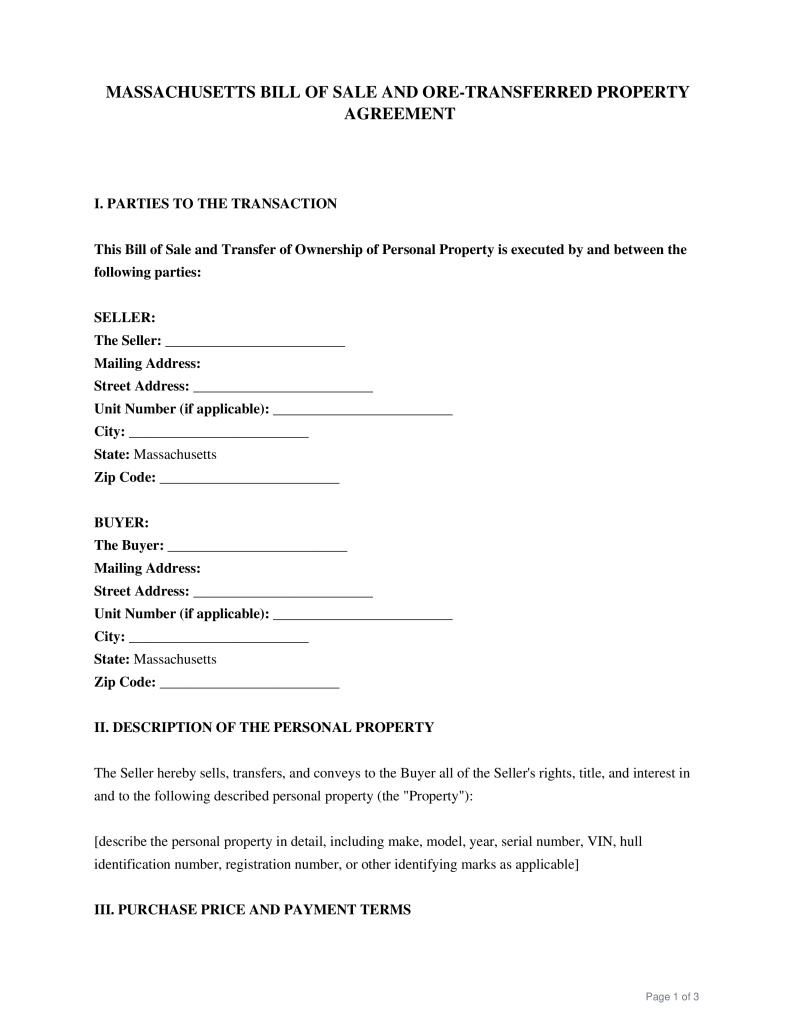
A Massachusetts Bill of Sale is a formal legal document that records the transfer of ownership of personal property from a seller to a buyer within the Commonwealth of Massachusetts.
Asset Type
Choose the category that best describes the item. This helps include the right identifying details, such as VIN, hull number, serial number, or livestock identifiers.
Use this when the item does not fit one of the listed categories.
Table of Contents
What is a Massachusetts Bill of Sale?
A Massachusetts Bill of Sale is a formal legal document that records the transfer of ownership of personal property from a seller to a buyer. It serves as a receipt of the transaction, detailing the specific terms of the transfer, the purchase price, and the identities of both parties involved. While the document is commonly associated with motor vehicle transactions, it is also utilized for various other types of personal property, including vessels, trailers, and general consumer goods. This document provides critical proof of purchase for the buyer and releases the seller from liability regarding the property after the sale is finalized.
Types of Massachusetts Bills of Sale
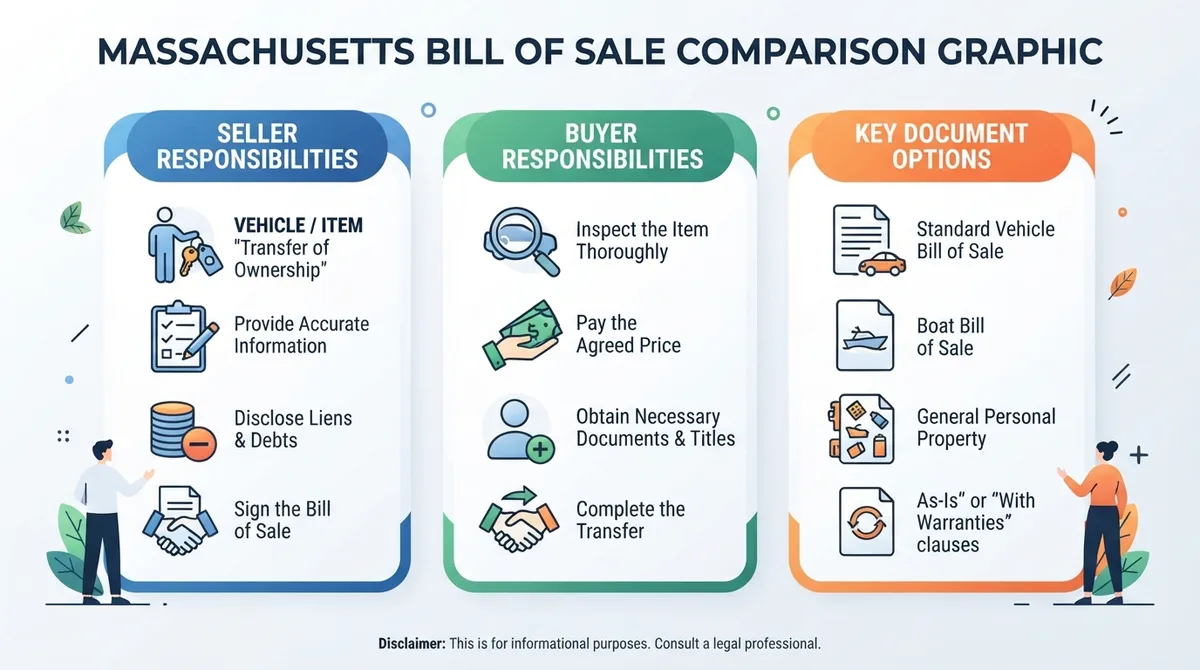
Different transactions require specific documentation to satisfy state registration and record-keeping standards:
- Motor Vehicle Bill of Sale - Used to document the transfer of cars, trucks, or motorcycles, serving as supporting documentation for registration and titling when a title is unavailable or exempt due to the age of the vehicle.
- ATV and Snowmobile Bill of Sale - Required for registering off-highway vehicles and snowmobiles, containing specific seller credentials and transaction details.
- Catalytic Converter Bill of Sale - Mandated for transactions involving the purchase of catalytic converters by licensed entities to prevent illegal sales and track metal transactions.
- General Bill of Sale - Utilized for everyday personal property transactions, such as electronics, furniture, or tools, where specialized state registration is not required.
State Laws and Requirements
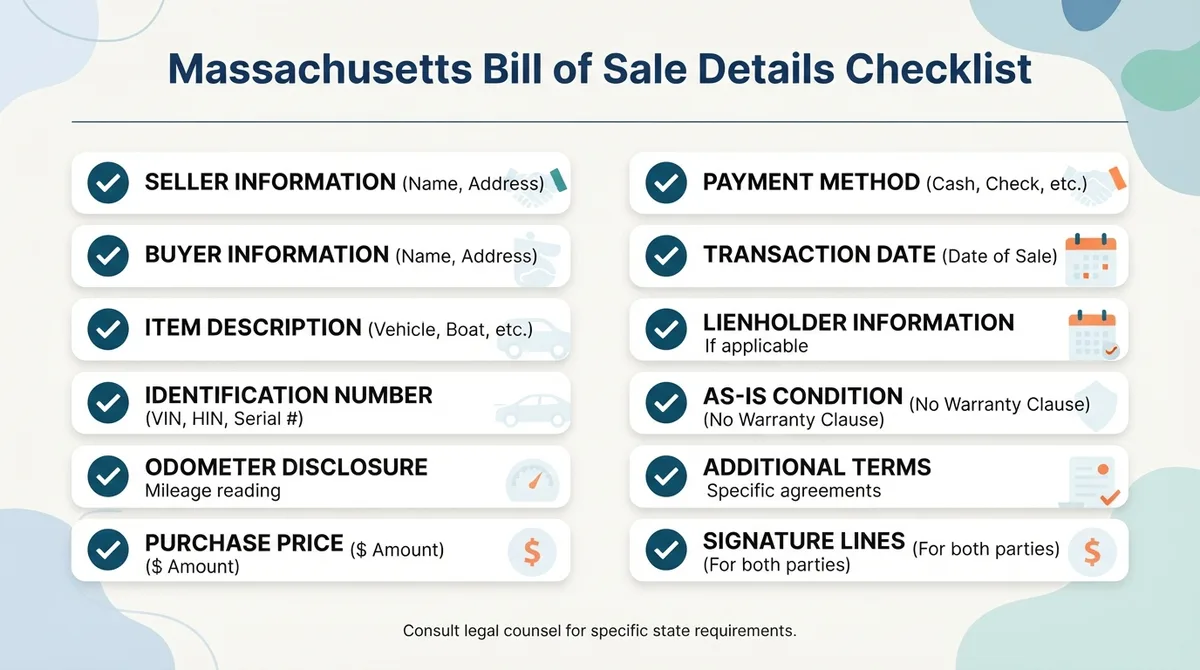
Massachusetts law governs the use of bills of sale across various transactions, establishing specific record-keeping and registration mandates:
- Catalytic Converter Documentation - Mandates that licensed entities must obtain proof of identification and a bill of sale when purchasing catalytic converters (Mass. General Laws c.266 § 148).
- Transaction Record Retention - Requires licensed entities to maintain detailed records of catalytic converter transactions for a minimum of three years (Mass. General Laws c.266 § 148).
- Sales Tax Exemptions - Outlines specific transactions and entities that are exempt from paying sales tax on transfers of tangible personal property (Mass. General Laws c.64H § 6).
- Vehicle Registration Requirements - Establishes that registering a vehicle purchased from an individual requires a completed Registration and Title Application along with the previous owner's certificate of title or a bill of sale for exempt vehicles (Massachusetts Registry of Motor Vehicles Guidelines).
- Recreational Vehicle Registration - Dictates that first-time registrations of all-terrain vehicles and snowmobiles require a bill of sale containing the seller's signature and contact details (Massachusetts Environmental Police Regulations).
Required Elements of a Massachusetts Bill of Sale
To ensure a Massachusetts Bill of Sale is legally useful and accepted by state agencies, the document should contain complete and accurate details:
- Buyer Information - The full legal name, physical address, and contact information of the individual or entity purchasing the item.
- Seller Information - The legal name, physical address, signature, and contact details of the party transferring ownership.
- Property Description - Specific identifying details of the item being sold, such as make, model, year, serial number, or Vehicle Identification Number.
- Transaction Terms - The exact purchase price agreed upon by both parties, the date of the transaction, and the payment method utilized.
- Business Letterhead - The requirement that any bill of sale issued by a commercial business for recreational vehicles must be printed on the official letterhead of that business.
Vehicle Registration and Titling Procedures
The Registry of Motor Vehicles does not provide an official bill of sale template for general public use. Buyers and sellers must draft their own document or obtain a standard template from a law library. When registering a vehicle purchased from a private party, the buyer must present the completed Registration and Title Application alongside the prior certificate of title. For older vehicles that are exempt from titling requirements under state guidelines, the bill of sale serves as the primary document to establish the transfer of ownership. Recreational vehicles, such as snowmobiles and all-terrain vehicles, always require a completed bill of sale for their initial registration process through the state environmental police.
Frequently Asked Questions
Sources
- Massachusetts law about automobiles - Provides information on the lack of an official RMV bill of sale form and references a sample form available through law libraries.
- First-time ATV and snowmobile registration - Details the requirements for registering ATVs and snowmobiles, including the necessity of a bill of sale with specific information.
- Apply for a registration and title for a vehicle purchased from an individual - Outlines the process for registering and titling a vehicle purchased from an individual, including the need for a completed Registration and Title Application and the previous owner's certificate of title or bill of sale
- Mass. General Laws c.266 § 148 - Addresses the sale of vehicle catalytic converters, specifying requirements for documentation such as a bill of sale and identification for transactions involving catalytic converters.
- Mass. General Laws c.64H § 6 - Lists exemptions from sales tax, which may be relevant when considering the tax implications of a bill of sale in certain transactions.
Bill of Sale in other states
Not the form you're looking for?
Try our legal document generator to create a custom document
Disclaimer: The templates available on this website are provided for general informational purposes only and do not constitute legal advice. They are not intended to be, and should not be interpreted as, compliant with any specific legal, regulatory, or privacy requirements. These templates are not a replacement for professional legal guidance and should not be relied upon for any particular matter or circumstance. Users are strongly encouraged to seek advice from a qualified attorney licensed in their jurisdiction before using, modifying, or relying on any template.
All templates are provided on an "as is," "with all faults," and "as available" basis. The provider disclaims any and all warranties of any kind, whether express, implied, statutory, or otherwise, including without limitation warranties of merchantability, fitness for a particular purpose, title, or non-infringement.
LegalTemplates.com makes no guarantees or representations regarding the accuracy, completeness, expected outcomes, or reliability of the materials contained in these templates or any materials referenced or linked from them.