Proof of Funds Letter
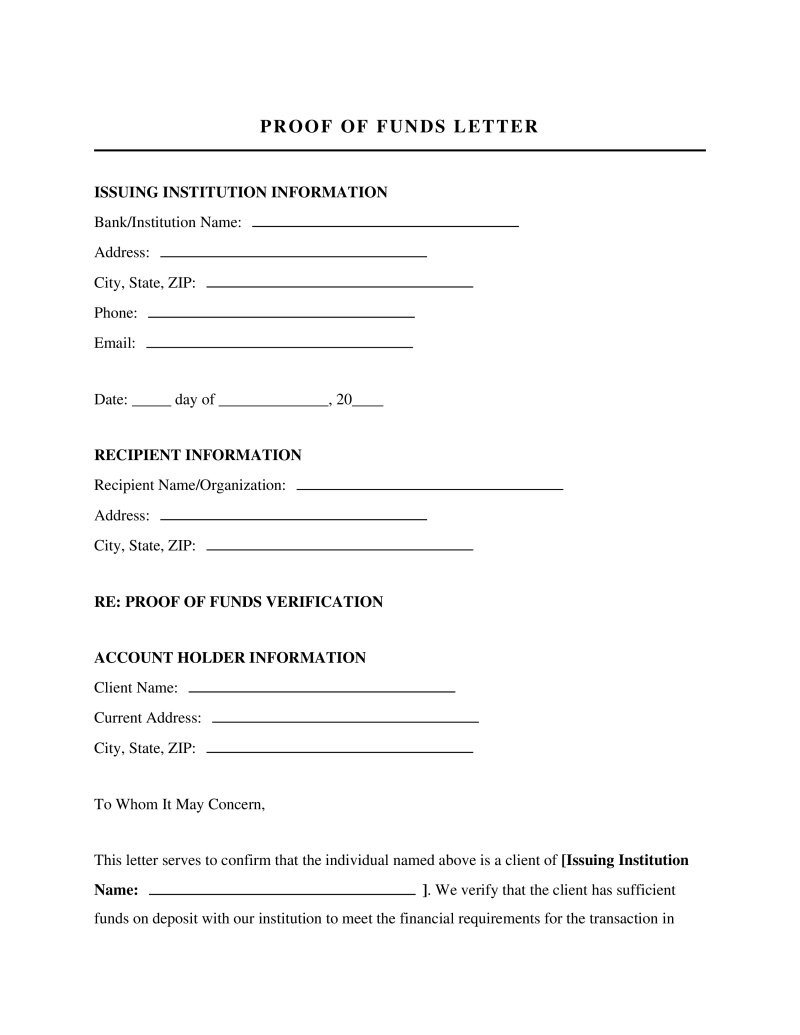
A Proof of Funds Letter is a document provided by a financial institution verifying that an individual or entity has sufficient funds to complete a transaction.
Funds Statement Type
Many banks prefer stating a minimum verified balance rather than an exact balance for privacy and fraud-prevention reasons.
Table of Contents
What is a Proof of Funds Letter?
A Proof of Funds Letter is a formal document issued by a financial institution that validates an individual's or entity's ability to cover the costs of a specific transaction using liquid assets. This document serves as official verification that the account holder possesses sufficient accessible money to complete a purchase, such as buying real estate with cash or funding a business investment, without relying on external financing. Sellers, government agencies, and commercial entities request this letter to ensure the buyer has the financial capacity to close the deal immediately, thereby reducing the risk of a transaction failing due to lack of capital.
Purpose and Function in Transactions
Financial verification plays a critical role in high-stakes exchanges where time and certainty are paramount. Sellers in real estate markets prioritize offers accompanied by a Proof of Funds Letter because it eliminates the uncertainty associated with mortgage underwriting and loan denials. The document demonstrates that the buyer has immediate access to the necessary capital, which streamlines the closing process and strengthens the buyer's negotiating position.
Immigration processes frequently utilize this form of documentation. Government authorities require visa applicants, particularly students and retirees, to demonstrate financial self-sufficiency to ensure they will not become a public charge. Universities request these letters from international students to verify they can cover tuition and living expenses for the duration of their studies. In the commercial sector, suppliers may demand proof of funds before engaging in large-scale manufacturing contracts to guarantee payment capability.
Distinction Between Proof of Funds and Bank Statements
A Proof of Funds Letter differs significantly from a standard monthly bank statement in terms of privacy and formality. A bank statement provides a comprehensive history of all transactions, including deposits, withdrawals, and merchant names, which exposes the account holder's spending habits and private financial activities. A Proof of Funds Letter acts as a sanitized document that confirms only the necessary information: the account holder's name, the current balance, and the bank's affirmation that the funds are available.
Security protocols favor the use of a formal letter over raw statements. Providing a full bank statement to a seller or real estate agent increases the risk of identity theft and financial fraud, as statements often contain account numbers and routing information. The Proof of Funds Letter mitigates this risk by limiting the disclosed data to what is strictly required for the transaction. Financial institutions generate these letters on official letterhead, often signed by a branch manager, which adds a layer of authentication that a printed online statement lacks.
Required Elements of a Valid Proof of Funds Letter
For a Proof of Funds Letter to be accepted by sellers or government agencies, it must contain specific data points that establish its authenticity. Missing information can lead to the rejection of an offer or a delay in application processing.
- Official Bank Letterhead - The document must appear on the financial institution's stationery, including the bank's logo and physical address.
- Account Holder Information - The legal name of the buyer or applicant must match the name on the purchase agreement or application.
- Date of Issuance - The letter must be recent, typically dated within the last 30 to 60 days, to ensure the financial status is current.
- Authorized Signature - A bank official or branch manager must sign the document to attest to its validity.
- Contact Information - Direct contact details for the bank representative allow the recipient to verify the document's authenticity.
- Balance Confirmation - The letter must clearly state that the account holds a balance equal to or exceeding the required transaction amount.
Proof of Funds vs. Pre-Approval Letter
Buyers often confuse Proof of Funds Letters with Pre-Approval Letters, but these documents serve different functions and represent different financial positions. A Proof of Funds Letter verifies the existence of liquid cash currently sitting in a bank account. It is used primarily for cash offers where no borrowing is involved. The funds are tangible, accessible, and ready for immediate transfer.
A Pre-Approval Letter indicates a lender's willingness to loan a specific amount of money to a buyer based on a preliminary review of creditworthiness and income. This document does not prove the buyer has the cash; rather, it proves the buyer has the potential to borrow the cash. Real estate transactions involving mortgages require a Pre-Approval Letter, while all-cash transactions require a Proof of Funds Letter. Some hybrid transactions may require both if the buyer is making a significant down payment in cash while financing the remainder.
How to Obtain a Proof of Funds Letter
Securing this documentation requires coordination with a financial institution and proper preparation of assets. The process involves ensuring funds are liquid and formally requesting the verification.
- Consolidate Liquid Assets - Move the necessary funds into a single accessible account before requesting the letter. Funds spread across multiple accounts or locked in non-liquid assets like stocks or bonds may not satisfy the requirement until they are sold and the cash settles in a checking or savings account.
- Contact the Financial Institution - Visit a local branch or contact the bank's customer service department to request an official Proof of Funds Letter. Online banking portals sometimes offer this feature, but a letter signed by a branch manager carries more weight in formal transactions.
- Specify the Required Information - Instruct the bank representative regarding exactly what information must appear on the letter. Request that they omit sensitive details like full account numbers while ensuring the total balance or a specific "funds available" statement is included.
- Review for Accuracy - Verify all details immediately upon receipt, paying close attention to the spelling of names and the reported balance. Even minor clerical errors can cause hesitation from sellers or rejection by immigration authorities.
Federal and State Legal Regulations
The issuance and use of Proof of Funds Letters operate under a framework of federal and state laws designed to protect consumer privacy, prevent fraud, and ensure fair lending practices. Financial institutions must adhere to strict guidelines when disclosing client information.
- Gramm-Leach-Bliley Act - Mandates that financial institutions explain their information-sharing practices to their customers and safeguard sensitive data (15 U.S.C. § 6801 et seq.).
- Bank Secrecy Act - Requires financial institutions to assist U.S. government agencies in detecting and preventing money laundering, which impacts how large deposits are verified (31 U.S.C. § 5311 et seq.).
- Fair Credit Reporting Act - Regulates the collection, dissemination, and use of consumer information, ensuring that the verification process does not unfairly impact a consumer's credit profile (15 U.S.C. § 1681 et seq.).
- Right to Financial Privacy Act - Establishes specific procedures that federal government authorities must follow to obtain information from financial records of individuals (12 U.S.C. § 3401 et seq.).
- Uniform Commercial Code Article 4 - Governs bank deposits and collections, establishing the legal relationship between the bank and the account holder regarding fund availability (U.C.C. § 4-101 et seq.).
- Truth in Savings Act - Requires clear disclosure of the terms and conditions of deposit accounts, which influences how available balances are calculated and reported (12 U.S.C. § 4301 et seq.).
Frequently Asked Questions
Proof of Funds Letter Sample
Not the form you're looking for?
Try our legal document generator to create a custom document
Disclaimer: The templates available on this website are provided for general informational purposes only and do not constitute legal advice. They are not intended to be, and should not be interpreted as, compliant with any specific legal, regulatory, or privacy requirements. These templates are not a replacement for professional legal guidance and should not be relied upon for any particular matter or circumstance. Users are strongly encouraged to seek advice from a qualified attorney licensed in their jurisdiction before using, modifying, or relying on any template.
All templates are provided on an "as is," "with all faults," and "as available" basis. The provider disclaims any and all warranties of any kind, whether express, implied, statutory, or otherwise, including without limitation warranties of merchantability, fitness for a particular purpose, title, or non-infringement.
LegalTemplates.com makes no guarantees or representations regarding the accuracy, completeness, expected outcomes, or reliability of the materials contained in these templates or any materials referenced or linked from them.