Motion in Limine
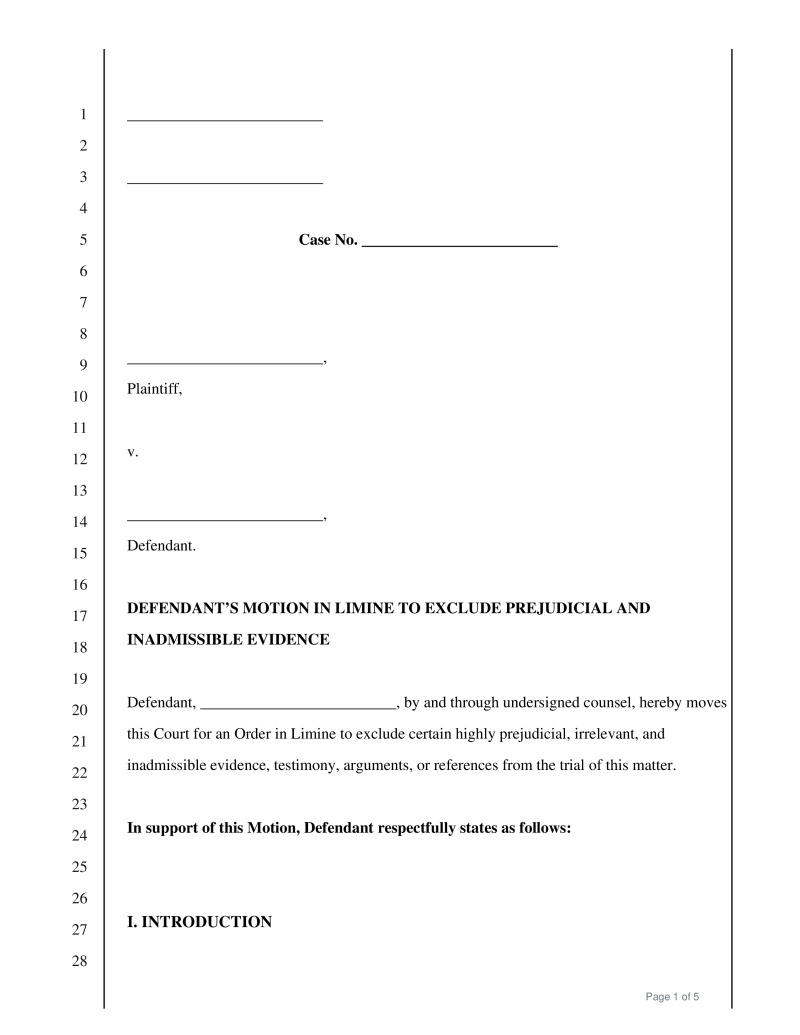
A Motion in Limine is a pretrial motion filed by a party to a lawsuit requesting that the court exclude certain evidence, testimony, or arguments from being presented during the trial.
Motion Objective
A motion in limine may ask the court to exclude improper material, admit disputed material, or limit how evidence or argument may be used at trial.
Use this if the requested relief does not fit one of the listed categories.
Table of Contents
What is a Motion in Limine?
A motion in limine is a pretrial motion filed by a party in a lawsuit that seeks the exclusion of specific evidence or arguments from being presented during a trial. This legal tool allows parties to address potentially prejudicial, irrelevant, or inadmissible evidence before the jury is seated. Litigants in both civil and criminal cases use this motion to streamline trial proceedings and prevent the jury from hearing highly sensitive or improper information. By resolving these evidentiary issues in advance, the court can avoid frequent interruptions and sidebar conferences during the trial itself.
Purpose and Strategic Objectives
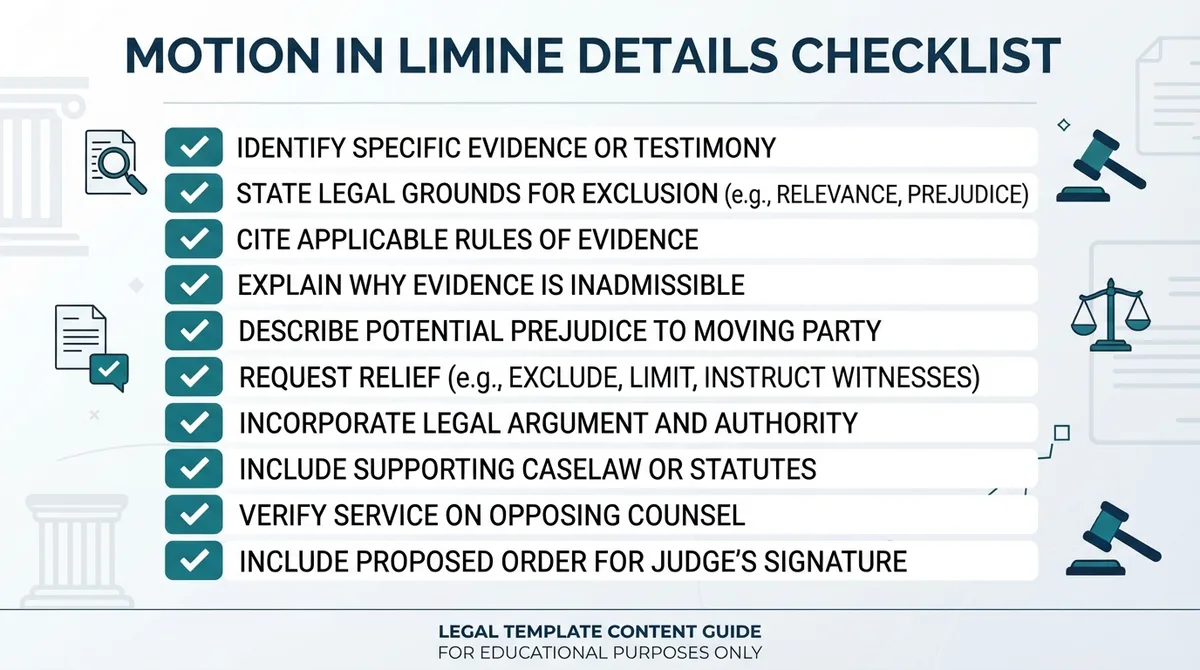
The primary goal of a motion in limine is to secure a ruling on the admissibility of evidence before the trial begins. This proactive approach serves several strategic and procedural functions in the courtroom:
- Prevention of Prejudice - Keeps highly sensitive, inflammatory, or irrelevant information from reaching the ears of the jury.
- Trial Efficiency - Reduces the need for objections, sidebar discussions, and recess periods during the actual trial proceedings.
- Clarity in Strategy - Allows attorneys to plan their opening statements and witness examinations with certainty regarding what evidence is permitted.
- Preservation of the Record - Establishes a clear record of the evidentiary objection and the judge's ruling for potential appellate review.
Types of Motions in Limine
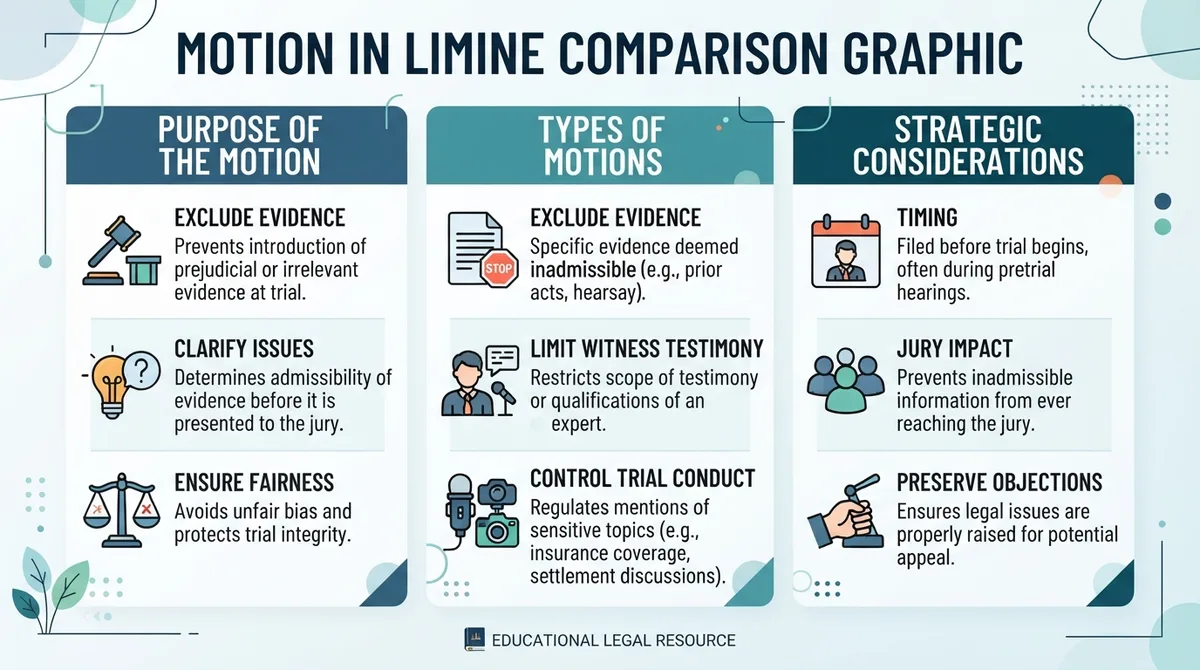
Parties may file different types of motions in limine depending on whether they seek to exclude evidence or obtain a preliminary ruling on admissibility. The primary categories include:
- Prohibitive Motion in Limine - Requests a court order forbidding the opposing party from mentioning or introducing specific evidence during trial.
- Assertive Motion in Limine - Seeks a preliminary ruling from the court confirming that certain evidence is admissible and can be presented at trial.
- Conditional Motion in Limine - Requests that certain evidence be excluded unless specific conditions or foundational requirements are met by the offering party during the trial.
Common Grounds for Evidentiary Exclusion
Attorneys base motions in limine on established rules of evidence. The arguments typically focus on why the jury should not be exposed to specific facts or testimonies:
- Prejudicial Impact - Argues that the probative value of the evidence is substantially outweighed by the danger of unfair prejudice to a party.
- Hearsay Violations - Seeks to exclude out-of-court statements offered to prove the truth of the matter asserted without a valid exception.
- Character Evidence Limitations - Prevents the introduction of prior bad acts or character traits to show that a person acted in conformity therewith on a particular occasion.
- Lack of Relevance - Asserts that the evidence has no bearing on any fact of consequence in determining the action.
- Unqualified Expert Testimony - Challenges the qualifications or methodology of an opposing expert witness before they testify.
Procedural Rules and Filing Timelines
The timing and procedures for filing a motion in limine are governed by federal, state, and local court rules. Failure to adhere to these rules can result in the waiver of the right to object to the evidence:
- Pretrial Filing Deadlines - Requires parties to submit motions well in advance of the trial date to allow for briefing and oral arguments.
- Northern District of Indiana Local Rule - Mandates that motions in limine must be filed at least 20 days before the final pretrial conference (U.S. District Court for the Northern District of Indiana Local Rules).
- Written Submission Requirements - Demands a formal written motion accompanied by a supporting memorandum of law detailing the legal authorities supporting the exclusion.
- Response and Reply Briefs - Permits the opposing party to file a written response arguing for the admissibility of the challenged evidence before the court rules.
Court Rulings and Legal Effect
A judge's decision on a motion in limine can take several forms, each carrying distinct legal implications for the trial. These rulings are often preliminary and subject to change as the trial unfolds:
- Granting the Motion - Prohibits the opposing party from referencing the excluded evidence in front of the jury, requiring counsel to seek permission outside the jury's presence before attempting to introduce it.
- Denying the Motion - Permits the opposing party to introduce the evidence, though the objecting party must still make timely objections during trial to preserve the issue for appeal.
- Deferring the Ruling - Postpones a final decision until the evidence is presented in context during the trial proceedings.
- Provisional Nature of Decisions - Allows the trial judge to alter the ruling during the trial if the evidence or testimony develops in an unexpected manner.
Sources
- Motion in Limine | United States Courts - Provides an overview of motions in limine, including their purpose and usage in federal courts.
- Judge Brady: Motions in Limine | Northern District of Indiana - Outlines the local rules and procedures for filing motions in limine in the Northern District of Indiana.
Not the form you're looking for?
Try our legal document generator to create a custom document
Disclaimer: The templates available on this website are provided for general informational purposes only and do not constitute legal advice. They are not intended to be, and should not be interpreted as, compliant with any specific legal, regulatory, or privacy requirements. These templates are not a replacement for professional legal guidance and should not be relied upon for any particular matter or circumstance. Users are strongly encouraged to seek advice from a qualified attorney licensed in their jurisdiction before using, modifying, or relying on any template.
All templates are provided on an "as is," "with all faults," and "as available" basis. The provider disclaims any and all warranties of any kind, whether express, implied, statutory, or otherwise, including without limitation warranties of merchantability, fitness for a particular purpose, title, or non-infringement.
LegalTemplates.com makes no guarantees or representations regarding the accuracy, completeness, expected outcomes, or reliability of the materials contained in these templates or any materials referenced or linked from them.