Delaware Bill of Sale
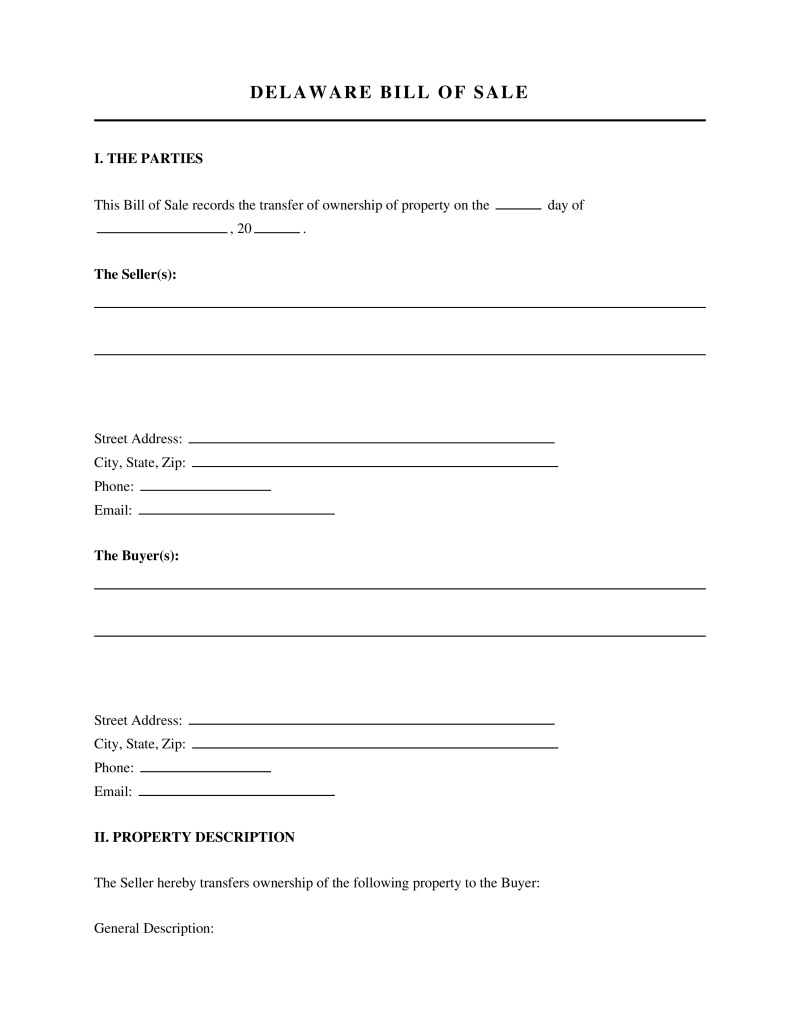
A Delaware Bill of Sale is a legal instrument that formally records the transfer of personal property ownership from a seller to a buyer in the state.
Asset Type
Choose the category that best describes the item. This helps include the right identifying details, such as VIN, hull number, serial number, or livestock identifiers.
Use this when the item does not fit one of the listed categories.
Table of Contents
What is a Delaware Bill of Sale?
A Delaware Bill of Sale serves as a legal instrument recording the transfer of ownership of personal property from a seller to a buyer. This document outlines specific details regarding the transaction, including the identities of the parties, a description of the item being sold, the purchase price, and the date of transfer. Residents and entities in Delaware utilize this form for various exchanges involving motor vehicles, vessels, firearms, and general personal effects to establish proof of purchase. The document acts as a receipt for the buyer while providing the seller with evidence that they have relinquished possession and liability for the item.
Legal Requirements
For a bill of sale to be legally binding in Delaware, it must adhere to specific standards regarding contract law and property transfer. The document must clearly identify the seller and the buyer with their full legal names and addresses. A comprehensive description of the property is necessary to distinguish it from similar items. The agreement must state the consideration, or the amount paid for the item, and the method of payment. Both parties must sign the document to indicate their mutual assent to the terms. While notarization is not always mandatory for every type of private sale in Delaware, having the document notarized adds a layer of verification regarding the identity of the signatories.
Delaware Laws and Statutes
State and federal laws govern the transfer of property and the requirements for documentation:
- Uniform Commercial Code (Sales) - Governs contracts for the sale of goods and establishes the rights of buyers and sellers (6 Del. C. § 2-101 et seq.).
- Statute of Frauds - Requires contracts for the sale of goods priced at $500 or more to be in writing to be enforceable (6 Del. C. § 2-201).
- Motor Vehicle Registration - Mandates that owners obtain a certificate of title and registration for vehicles operated on public highways (21 Del. C. § 2101 et seq.).
- Odometer Disclosure Requirements - Federal law requires the disclosure of mileage upon the transfer of ownership for vehicles under a certain age (49 U.S.C. § 32705).
- Private Firearm Transfer Laws - Requires background checks for most private sales and transfers of firearms between unlicensed individuals (11 Del. C. § 1448B).
- Vessel Registration and Titling - Outlines the requirements for registering and numbering vessels used on Delaware waters (23 Del. C. § 2113).
Required Elements of a Valid Delaware Bill of Sale
To ensure the document is accepted by state agencies like the Division of Motor Vehicles (DMV) or the Department of Natural Resources and Environmental Control (DNREC), it should contain specific data points:
- Party Information - Full legal names, physical addresses, and contact information for both the buyer and the seller.
- Property Description - Detailed identification including serial numbers, VINs, HINs, make, model, year, and color.
- Transaction Details - The exact purchase price, date of sale, and payment method (cash, check, trade).
- Odometer Disclosure - A statement of the vehicle's mileage at the time of transfer for automotive sales.
- Warranty Information - A clause stating whether the item is sold "as-is" or if specific warranties are included.
- Signatures - Dated signatures from all parties involved in the transaction.
Vehicle Registration Process in Delaware
New owners of motor vehicles must complete several steps to legally operate their purchase on state roads:
- Step 1: Obtain Liability Insurance - The buyer must secure valid Delaware auto insurance before applying for registration.
- Step 2: Vehicle Inspection - The vehicle must pass a safety and emission inspection at a Delaware DMV inspection lane.
- Step 3: Title Application - The buyer submits the signed-over title and the bill of sale to the DMV.
- Step 4: Odometer Disclosure - The seller must disclose the mileage on the back of the title or a separate form if the title lacks space.
- Step 5: Fee Payment - The owner pays applicable title fees, registration fees, and document fees based on the vehicle's purchase price or value.
Boat Registration Requirements
The Delaware Department of Natural Resources and Environmental Control (DNREC) oversees vessel registration. A bill of sale is critical when registering a boat purchased from a private seller. The document proves ownership and establishes the purchase price for tax or fee calculations. If the vessel was previously titled in Delaware, the seller must provide the registration card and a notarized bill of sale if there is no title. For boats coming from non-titling states, the bill of sale serves as the primary proof of ownership required to issue a new Delaware registration.
FAQs
Delaware Bill of Sale Sample
Bill of Sale in other states
Not the form you're looking for?
Try our legal document generator to create a custom document
Disclaimer: The templates available on this website are provided for general informational purposes only and do not constitute legal advice. They are not intended to be, and should not be interpreted as, compliant with any specific legal, regulatory, or privacy requirements. These templates are not a replacement for professional legal guidance and should not be relied upon for any particular matter or circumstance. Users are strongly encouraged to seek advice from a qualified attorney licensed in their jurisdiction before using, modifying, or relying on any template.
All templates are provided on an "as is," "with all faults," and "as available" basis. The provider disclaims any and all warranties of any kind, whether express, implied, statutory, or otherwise, including without limitation warranties of merchantability, fitness for a particular purpose, title, or non-infringement.
LegalTemplates.com makes no guarantees or representations regarding the accuracy, completeness, expected outcomes, or reliability of the materials contained in these templates or any materials referenced or linked from them.