Debt Validation Letter Create a Debt Validation Letter

Debt Validation Letter

Published Mar 12, 2026
1 Downloads

A Debt Validation Letter is a formal legal document sent to a debt collector, challenging the validity of an alleged debt and requesting substantiating.
Debt Collector Type

Choose whether the debt collector is an individual (a single person) or a business entity (a company or organization). This information helps determine the legal obligations and protections you may have in your situation. Select the option that best fits the debt collector you are dealing with.

Enter the name of the individual or authorized representative.

Enter the full legal name of the debt collection agency.

Start typing to see address suggestions

Provide the official mailing address of the debt collector.

Enter a contact phone number for the debt collector (optional).

Debt Validation Letter Preview
View Document
Create
Download PDF

Table of Contents

What is a Debt Validation Letter?

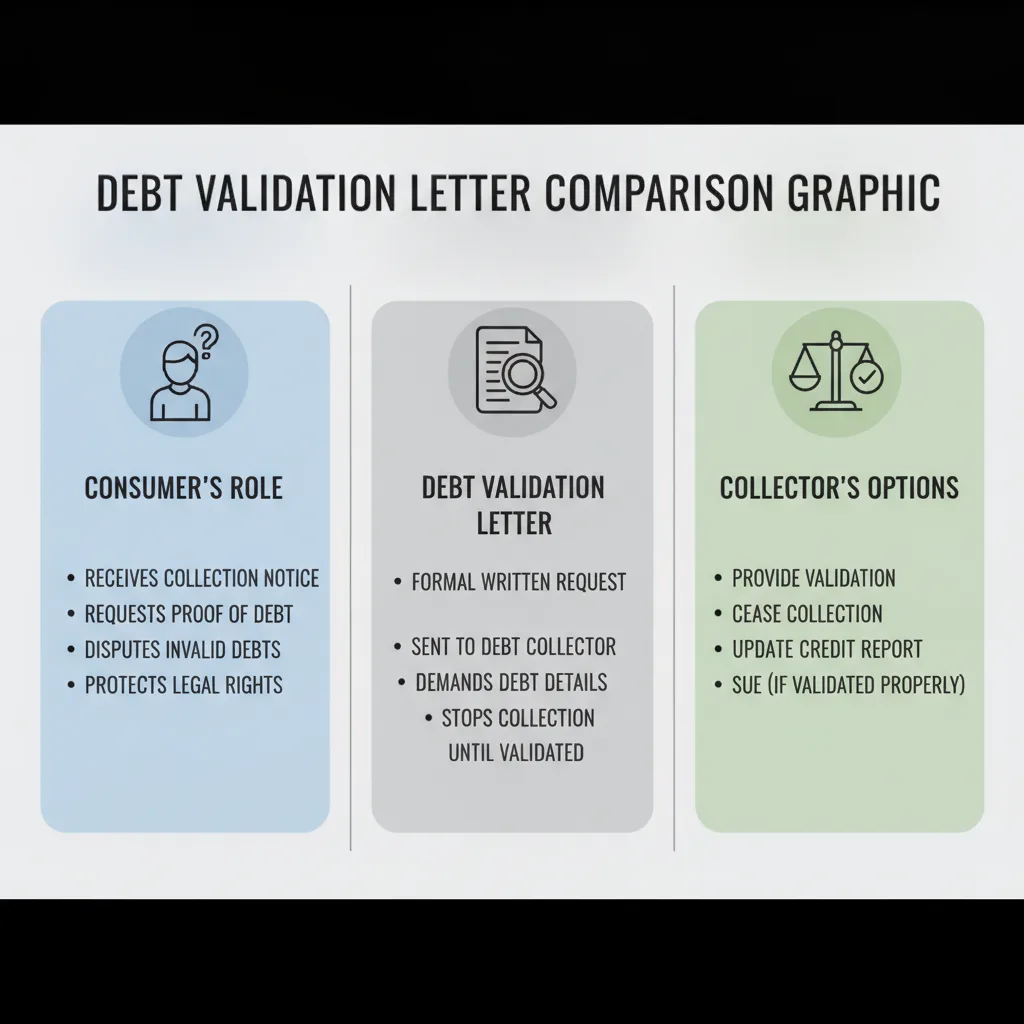
A Debt Validation Letter is a formal written request sent by a consumer to a debt collector, challenging the legitimacy of a debt that the collector is attempting to collect. Its primary purpose is to compel the debt collector to provide verifiable proof that the debt is owed, that the amount is accurate, and that the collector has the legal right to collect it. Consumers typically use this letter within a specific timeframe after receiving initial communication from a debt collector, exercising their rights under federal consumer protection laws.

Legal Requirements

The effectiveness and legal standing of a Debt Validation Letter hinge on its adherence to certain requirements and timelines, primarily dictated by federal law. When a consumer sends a valid Debt Validation Letter, it triggers specific obligations for the debt collector. The letter itself does not need to be complex but must clearly express a dispute regarding the debt.

Key aspects governing its validity and impact include:

  • Timeliness of Dispute - A consumer must send the Debt Validation Letter within 30 days of receiving the initial communication from the debt collector. This 30-day period is crucial as it activates the debt collector's legal obligation to cease collection activities until the debt is validated.
  • Clear Statement of Dispute - The letter must explicitly state that the consumer disputes the debt or a portion thereof. While not legally required, providing specific reasons for the dispute (e.g., "I don't recognize this debt," "The amount is incorrect," "This debt is not mine") can be helpful.
  • Cessation of Collection Activities - Upon timely receipt of a Debt Validation Letter, the debt collector is legally required to stop all collection efforts, including calls, letters, and reporting to credit bureaus, until they provide validation of the debt.
  • Verification of Debt - The validation provided by the debt collector must include information such as the name and address of the original creditor, the amount of the debt, and other details sufficient to show that the consumer is indeed the debtor and that the debt is legitimate.
  • Resumption of Collection - Collection activities can only resume after the debt collector has mailed the requested validation information to the consumer. If validation is not provided, the debt collector cannot continue collection efforts.

How to Complete a Debt Validation Letter

Crafting an effective Debt Validation Letter involves several practical steps to ensure it meets legal requirements and protects the consumer's rights. The process focuses on clarity, documentation, and proper delivery.

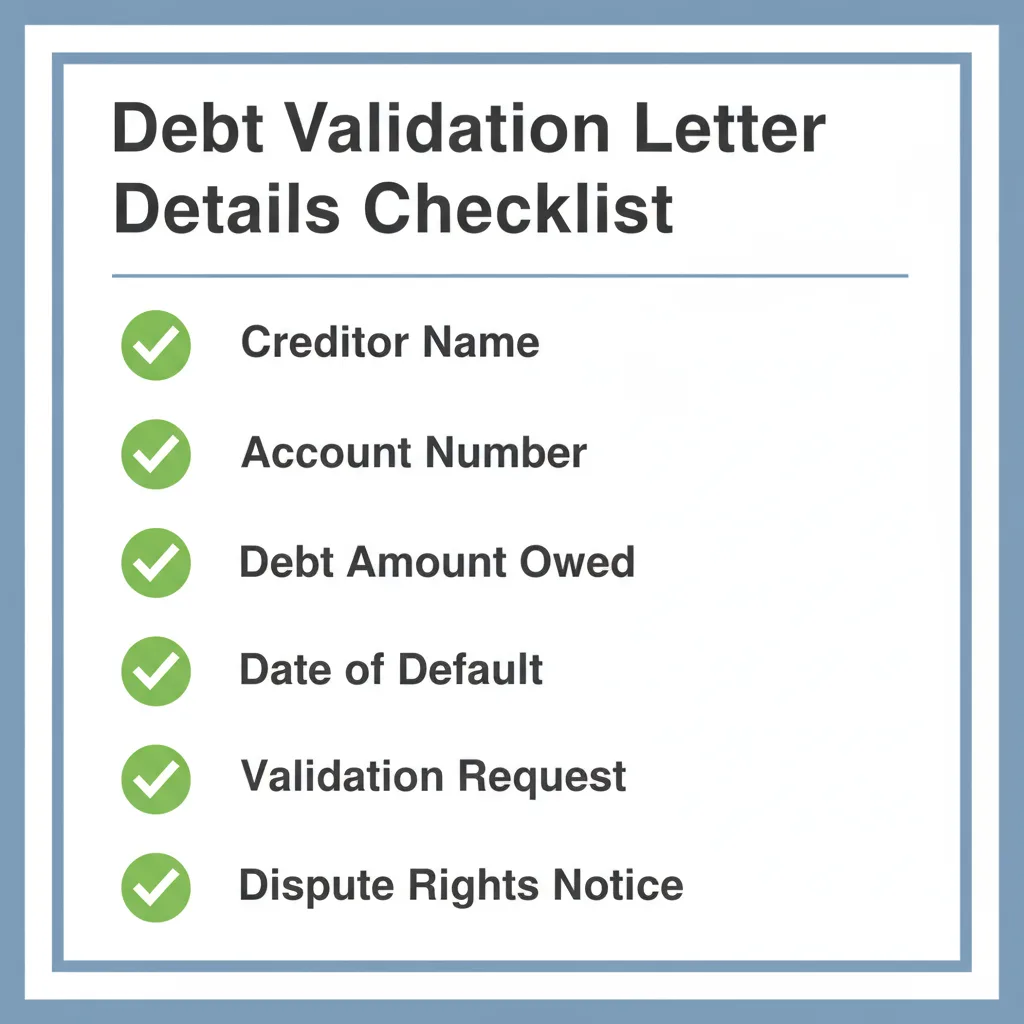
  1. Gather Information - Before writing, compile all relevant details related to the debt. This includes the name of the original creditor, the account number associated with the debt, the alleged amount, the date of the last payment made (if any), and the full name and address of the debt collection agency that contacted you. Also, locate the initial collection notice or letter you received, as it often contains key identifiers.
  2. Draft the Letter Clearly - Begin by stating your full legal name, current address, and the account number provided by the debt collector. Clearly and concisely state that you dispute the debt in question and demand verification of the debt. Reference your rights under the Fair Debt Collection Practices Act (FDCPA), specifically citing your right to debt validation within 30 days of initial communication. Maintain a professional and firm tone, avoiding any emotional language or admissions of guilt.
  3. Specify Required Validation Information - Detail the specific information you require for validation. This typically includes documentation proving you owe the debt, such as a copy of the original credit agreement or contract with your signature, a detailed payment history, the name and address of the original creditor, and proof that the collector has the legal right to collect the debt (e.g., assignment or purchase agreement). Requesting this specific documentation helps ensure the collector provides meaningful proof rather than just a general statement.
  4. Mail the Letter via Certified Mail - Send the Debt Validation Letter through certified mail with a return receipt requested. This provides undeniable proof that you sent the letter and that the debt collector received it, along with the date of receipt. This documentation is critical if there are future disputes or legal actions regarding the debt, as it establishes the precise start date of the collector's 30-day validation period.
  5. Keep Thorough Records - Before mailing, make a copy of the signed Debt Validation Letter for your personal records. Also, keep the certified mail receipt, the return receipt when it arrives, and a copy of the original collection notice. Maintaining a complete file of all correspondence and documentation related to the debt is essential for protecting your rights and for reference in case the debt collector fails to comply with the law.

Rights and Obligations of Parties Involved

The Debt Validation Letter process establishes clear rights and obligations for both the consumer and the debt collector, primarily under federal consumer protection statutes.

Consumer's Rights:

  • Right to Dispute Debt - Consumers have the right to dispute the validity of a debt or any portion of it within 30 days of receiving the initial communication from a debt collector (15 U.S.C. § 1692g(a)).
  • Right to Cease Collection Activities - Upon timely receipt of a written dispute, debt collectors must cease all collection efforts until they have provided validation of the debt (15 U.S.C. § 1692g(b)).
  • Right to Specific Information - Consumers can demand verification of the debt, including the name and address of the original creditor (15 U.S.C. § 1692g(a)(1-5)).
  • Protection from Unfair Practices - Consumers are protected from various unfair, deceptive, or abusive debt collection practices, such as harassment, false statements, or threats (15 U.S.C. § 1692d-f).
  • Right to Accurate Credit Reporting - If a debt is disputed, the debt collector cannot report it to credit bureaus as undisputed (15 U.S.C. § 1692e(8)).

Debt Collector's Obligations:

  • Provide Initial Notice - Debt collectors must send a written notice within five days of their initial communication, containing specific information about the debt and the consumer's validation rights (15 U.S.C. § 1692g(a)).
  • Suspend Collection Upon Dispute - If a consumer sends a written dispute within the 30-day window, the collector must immediately stop all collection activities until they mail validation information (15 U.S.C. § 1692g(b)).
  • Provide Debt Validation - When a debt is disputed, the collector must obtain and mail verification of the debt to the consumer, including the name of the original creditor if different from the current one. This validation must be sufficient to substantiate the debt (15 U.S.C. § 1692g(b)).
  • Accurate Credit Reporting - If the debt collector reports the debt to a credit bureau, and the consumer has disputed the debt, the collector must also report that the debt is disputed (15 U.S.C. § 1692e(8)).
  • Adherence to FDCPA - Debt collectors must comply with all provisions of the Fair Debt Collection Practices Act, which prohibits various abusive and deceptive practices (15 U.S.C. § 1692d-f).

Federal and State Laws

The framework for debt validation and collection practices is primarily established by federal law, with state statutes often providing additional or stronger protections for consumers.

Federal Statutes

Several federal laws directly govern debt collection practices and consumer rights related to debt validation:

  • Fair Debt Collection Practices Act (FDCPA) - This is the cornerstone federal law that regulates third-party debt collectors. It prohibits abusive, deceptive, and unfair debt collection practices and establishes the consumer's right to debt validation and the corresponding obligations of debt collectors (15 U.S.C. § 1692 et seq.).
  • Fair Credit Reporting Act (FCRA) - This act governs the collection, dissemination, and use of consumer credit information. It provides consumers with rights regarding the accuracy and privacy of information in their credit reports, including the right to dispute inaccurate information reported by debt collectors (15 U.S.C. § 1681 et seq.).
  • Consumer Financial Protection Act (CFPA) - Enacted as part of the Dodd-Frank Wall Street Reform and Consumer Protection Act, the CFPA established the Consumer Financial Protection Bureau (CFPB), which is responsible for enforcing the FDCPA and other federal consumer financial laws (12 U.S.C. § 5481 et seq.).

State Laws and Requirements

Many states have enacted their own debt collection laws, which often supplement or expand upon the protections offered by the FDCPA. These state laws can provide additional remedies or impose stricter requirements on debt collectors operating within their jurisdiction.

  • State Debt Collection Acts - Numerous states have specific statutes governing debt collection practices, which may cover original creditors in addition to third-party collectors (e.g., California's Rosenthal Fair Debt Collection Practices Act, New York's General Business Law Article 29-H).
  • Statutes of Limitations - State laws define the maximum period during which legal action can be taken to collect a debt. While a Debt Validation Letter does not reset this period, understanding the statute of limitations is crucial for consumers when evaluating a debt (varies by state and debt type).
  • Licensing Requirements - Some states require debt collectors to be licensed to operate within their borders, imposing additional regulatory oversight and consumer protections.

Penalties for Non-Compliance

Debt collectors who violate the FDCPA or analogous state laws face significant penalties, which serve to deter unlawful practices and provide recourse for consumers:

  • Statutory Damages - Consumers may be awarded up to $1,000 in statutory damages for FDCPA violations, regardless of whether they suffered actual financial harm (15 U.S.C. § 1692k(a)(2)(A)).
  • Actual Damages - Consumers can recover actual damages, which include monetary losses (e.g., lost wages, medical bills) and emotional distress caused by the debt collector's illegal actions (15 U.S.C. § 1692k(a)(1)).
  • Attorney's Fees and Court Costs - Successful plaintiffs in FDCPA lawsuits can also recover their reasonable attorney's fees and court costs, making it easier for consumers to pursue legal action (15 U.S.C. § 1692k(a)(3)).
  • Class Action Lawsuits - For widespread violations, consumers can bring class-action lawsuits, with statutory damages capped at the lesser of $500,000 or 1% of the collector's net worth (15 U.S.C. § 1692k(a)(2)(B)).
  • Regulatory Enforcement Actions - Regulatory bodies like the Consumer Financial Protection Bureau (CFPB) and Federal Trade Commission (FTC) can take enforcement actions against debt collectors, resulting in large fines and orders to cease illegal practices.

Frequently Asked Questions

The 30-day window refers to the period after a debt collector's initial communication during which a consumer has the right to send a Debt Validation Letter. Sending the letter within this timeframe legally obligates the collector to cease collection activities until the debt is validated.
If a debt collector fails to respond with validation after receiving a timely Debt Validation Letter, they are legally prohibited from continuing collection efforts on that specific debt. They cannot contact you about it, nor can they report it to credit bureaus as undisputed.
While you can send a Debt Validation Letter after the initial 30-day period, the debt collector is not legally obligated to cease collection activities or provide validation under the FDCPA. However, sending one might still prompt them to provide information or reassess the debt.
Proper debt validation typically includes proof that you owe the debt, such as a copy of the original contract or agreement with your signature, a detailed payment history, and the name and address of the original creditor. It should establish the collector's legal right to collect the debt.
A Debt Validation Letter itself does not automatically stop a lawsuit. However, if a collector sues you after you've sent a timely validation request and they haven't provided validation, you may have a strong defense or counterclaim under the FDCPA.
It is generally advisable not to make any payments on a disputed debt while waiting for validation. Making a payment could be interpreted as an acknowledgment that you owe the debt, potentially weakening your dispute or validation request.
A Debt Validation Letter can still be sent for old debts. While a time-barred debt means the collector cannot sue you, sending a validation letter can still clarify the debt's status and prevent unlawful collection attempts or reporting to credit bureaus.
Sending a Debt Validation Letter directly does not improve your credit score. However, if the debt collector cannot validate the debt, they are prohibited from reporting it as undisputed to credit bureaus, which can prevent further negative impact. If an inaccurate debt is removed from your report, your score may improve.

Debt Validation Letter Sample

0% Complete 0/0 Fields

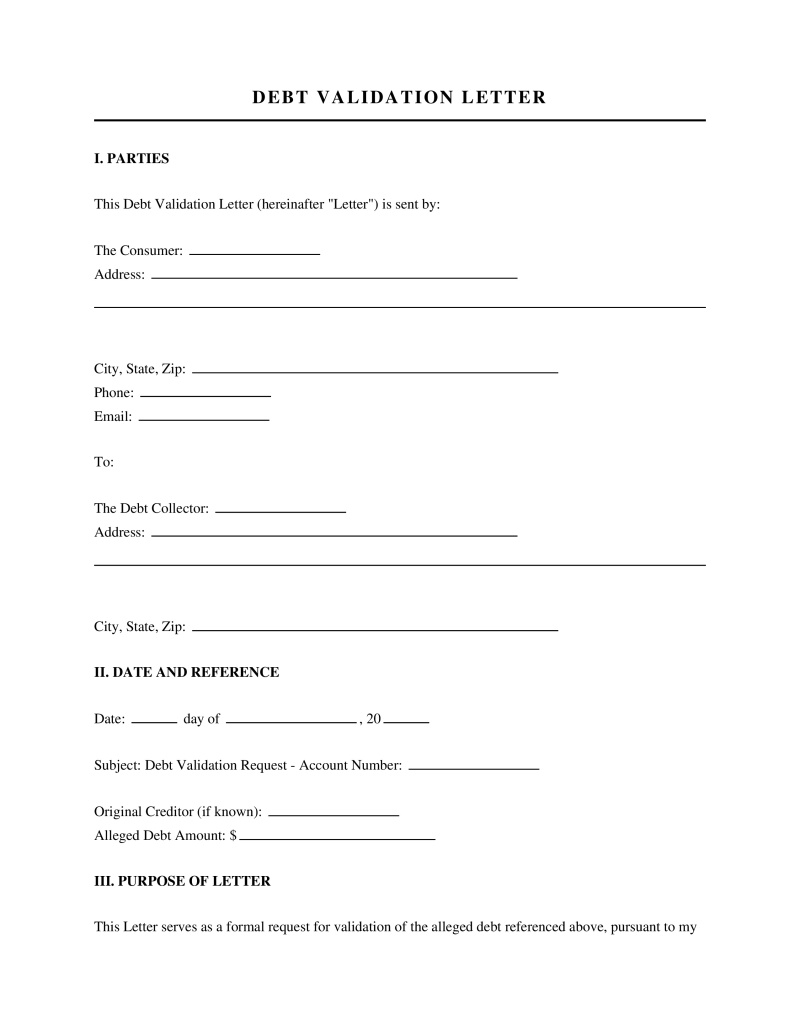
DEBT VALIDATION LETTER

I. PARTIES

This Debt Validation Letter (hereinafter "Letter") is sent by:

The Consumer:
Name:
Address:
Phone:
Email:

To: The Debt Collector:
Name:
Address:

II. DATE AND REFERENCE

Date:

Subject: Debt Validation Request - Account Number:

Original Creditor (if known):

Alleged Debt Amount: $

III. PURPOSE OF LETTER

This Letter serves as a formal request for validation of the alleged debt referenced above, pursuant to my rights under the Fair Debt Collection Practices Act (FDCPA), 15 U.S.C. § 1692g. I am exercising my right to dispute this debt and request verification of its validity.

IV. DEMAND FOR VALIDATION

You are hereby requested to provide the following specific information and documentation to validate the alleged debt:

  1. Proof that I am the party responsible for the alleged debt. This includes, but is not limited to, a copy of the original contract, application, or other instrument bearing my signature, or other legally admissible evidence establishing my liability.
  2. The exact amount of the alleged debt, including an itemized breakdown of the principal balance, interest, fees, and any other charges that comprise the total amount.
  3. The name and address of the original creditor.
  4. Proof that you are legally authorized to collect this debt, including documentation demonstrating the chain of title from the original creditor to your company (e.g., copies of assignment agreements, purchase agreements, or other legal instruments).
  5. If the debt has been reduced to judgment, a copy of the judgment.
  6. The date of the last payment made on the account.
  7. The date the account was opened and the date of charge-off (if applicable).

V. CEASE AND DESIST COLLECTION ACTIVITIES

Until such time as you provide the requested validation and documentation, you must cease all collection activities related to this alleged debt, including but not limited to, making telephone calls, sending letters, or reporting information to credit reporting agencies, as required by 15 U.S.C. § 1692g(b). Any collection activity prior to providing complete validation will be considered a violation of the FDCPA.

VI. FAIR DEBT COLLECTION PRACTICES ACT (FDCPA)

I understand my rights under the FDCPA, 15 U.S.C. § 1692 et seq., which protects consumers from abusive, deceptive, and unfair debt collection practices. This Letter is a formal dispute of the debt, and I expect your full compliance with all applicable federal and state laws.

VII. GOVERNING LAW

This Letter and the rights and obligations of the parties hereunder shall be governed by and construed in accordance with the laws of the United States, specifically the Fair Debt Collection Practices Act (FDCPA), 15 U.S.C. § 1692 et seq.

VIII. NOTICES

All notices, demands, or other communications required or permitted to be given under this Letter shall be in writing and shall be deemed to have been duly given when delivered personally, sent by certified mail, return receipt requested, or by recognized overnight courier service, to the addresses of the parties as set forth in Section I of this Letter.

IX. SEVERABILITY

If any provision of this Letter is held to be invalid, illegal, or unenforceable by a court of competent jurisdiction, such provision shall be severed from this Letter, and the remaining provisions shall remain in full force and effect.

X. ENTIRE AGREEMENT

This Letter constitutes the entire understanding and agreement between the Consumer and the Debt Collector regarding the validation of the alleged debt and supersedes all prior or contemporaneous understandings and agreements, whether written or oral.

XI. WAIVER

No waiver of any provision of this Letter shall be deemed, or shall constitute, a waiver of any other provision, whether or not similar, nor shall any waiver constitute a continuing waiver. No waiver shall be binding unless executed in writing by the party making the waiver.

XII. CONSTRUCTION

The headings used in this Letter are for convenience only and shall not affect the interpretation or construction of this Letter. This Letter shall not be construed against the drafter.

XIII. SUCCESSORS AND ASSIGNS

This Letter shall be binding upon and inure to the benefit of the parties hereto and their respective heirs, successors, and permitted assigns.

Sincerely,

THE CONSUMER
Signature: _________________________
Print Name: _______________
Date:
Address: _______________

Not the form you're looking for?

Try our legal document generator to create a custom document

Ask about a Debt Validation Letter