Restraining Order Form
Create Restraining Order Form
Restraining Order Form
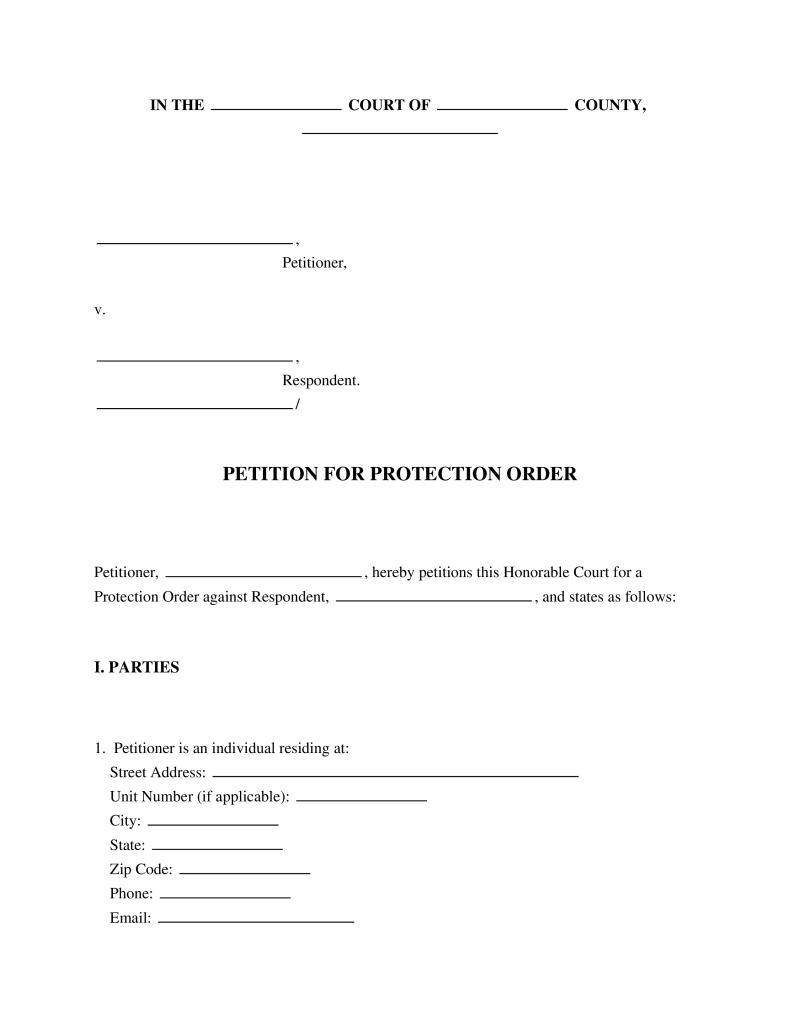
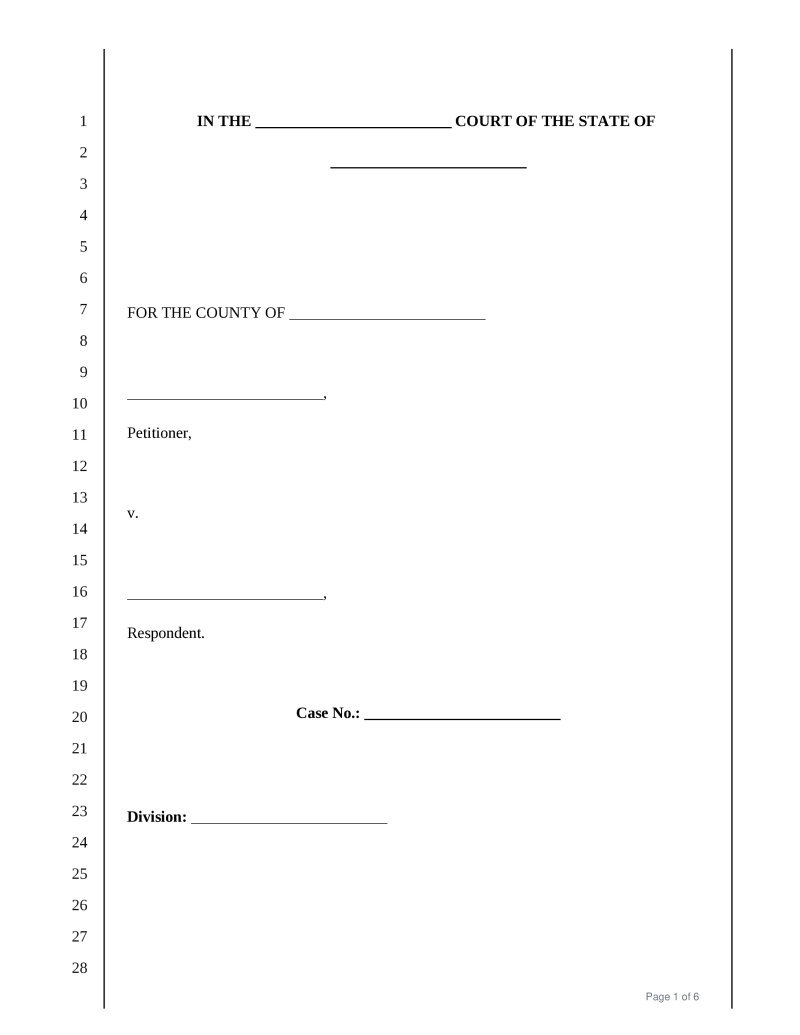
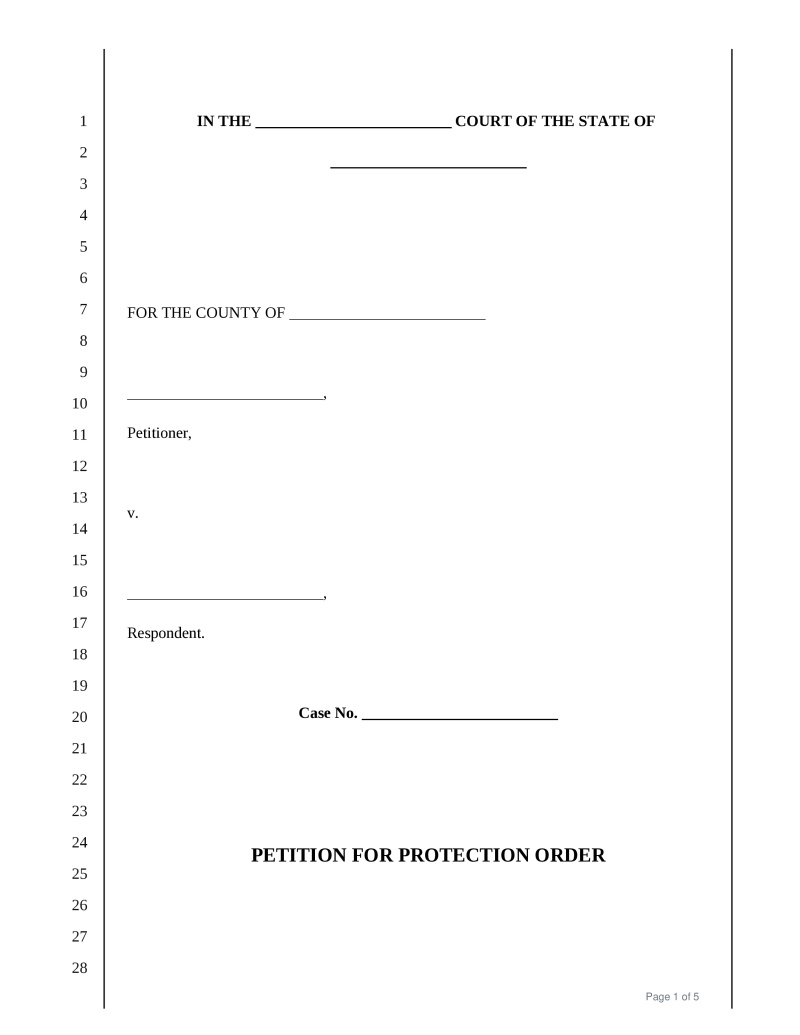
A Restraining Order Form is a legal document template used to petition a court for the issuance of a protective order against harassment or abuse.
Answer the question(s) below to create your Restraining Order Form
Filing Posture
Choose 'New case' if no court case number has been assigned yet. Choose 'Existing case' if there is already a family, civil, criminal, juvenile, divorce, custody, or protection-order case involving these parties.
Enter the number exactly as it appears on prior court papers, if known.
This helps the caption and procedural references match the existing court file.
Use the court's wording if you know it.
Table of Contents
What is a Restraining Order Form?
A restraining order form is a legal document used to initiate the process of obtaining a court order that prohibits one individual (the respondent) from engaging in specific actions against another individual (the petitioner) or protected parties. This formal document serves as the petitioner's official request to the court, outlining the alleged harmful conduct, the individuals requiring protection, and the specific relief sought. It is a critical component in seeking legal protection from domestic violence, harassment, stalking, or other forms of abuse, enabling the judicial system to intervene and establish boundaries for safety.
Legal Basis and Purpose
The legal framework for restraining orders is primarily established at the state level, rooted in each state's civil procedure rules and specific statutes addressing domestic violence, harassment, and stalking. These laws empower courts to issue orders designed to protect individuals from immediate or ongoing harm. The fundamental purpose of submitting a restraining order form is to invoke the court's authority to prevent future abusive behavior, ensuring the safety and peace of mind of the petitioner and any other named protected persons.
The form itself acts as the initial pleading, informing the court of the factual basis for the requested intervention. It must clearly articulate the alleged incidents of abuse, harassment, or threats, providing sufficient detail for a judge to understand the gravity of the situation and determine the appropriate scope of protection. The legal basis hinges on demonstrating a credible threat of harm or a history of abusive conduct that necessitates judicial intervention to maintain safety. Courts consider various factors when evaluating these forms, including the nature of the alleged acts, the relationship between the parties, and the potential for future harm.
Beyond immediate safety, restraining orders also serve to establish clear legal boundaries. Once issued, a violation of the order carries significant legal consequences, often escalating from civil contempt to criminal charges. This deterrent effect is central to the purpose of these orders, providing a legal mechanism to enforce distance and prohibit specific actions that could endanger the protected individual. The process is designed to be accessible to victims, often with resources available through court self-help centers or victim advocacy groups to assist in completing and filing the necessary restraining order form.
How to Complete a Restraining Order Form
Completing a restraining order form requires careful attention to detail and accuracy, as the information provided will be the basis for the court's decision. The process generally involves several key steps:
- Obtain the Correct Form - Secure the specific restraining order forms from your local court's clerk or self-help center. Forms vary by jurisdiction and the type of protection sought (e.g., domestic violence, civil harassment). Ensure you have all necessary pages and instructions for your specific situation.
- Identify Petitioner and Respondent - Clearly state your full legal name, address, and contact information as the petitioner. Provide the full legal name and, if known, the address, date of birth, and any identifying characteristics of the person against whom you are seeking the order (the respondent). Accurate identification is crucial for effective service and enforcement.
- Describe Incidents of Abuse/Harassment - Detail the specific incidents that necessitate the restraining order. Include dates, times, locations, and a factual description of what occurred. Be specific about threats, physical violence, property damage, stalking, or harassment. Use clear, concise language and avoid emotional statements, focusing on verifiable facts. Attach additional pages if necessary, numbering them clearly.
- Specify Requested Orders - Indicate the specific protections you are seeking from the court. This may include orders for the respondent to stay a certain distance away from you, your home, workplace, or children's school; to refrain from contact by any means; to move out of a shared residence; or to surrender firearms. Clearly articulate each requested prohibition.
- Provide Information on Children and Property - If children are involved, provide their names and dates of birth. If you are requesting temporary custody, visitation, or child support, include relevant details. If you share property or debts with the respondent, the form may require information about these assets and liabilities, especially if you are requesting exclusive possession of a residence or vehicle.
- Attach Supporting Evidence - Gather and prepare any supporting documentation, such as police reports, medical records, photographs of injuries or property damage, threatening messages (texts, emails), or witness statements. While these are often submitted separately, the form may ask you to list what evidence you intend to present. Make sure to keep original documents and provide copies to the court.
- Review and Sign Under Penalty of Perjury - Carefully review the entire completed restraining order form for accuracy and completeness. Ensure all sections are filled out truthfully. You will typically be required to sign the form under penalty of perjury, affirming that the information provided is true and correct to the best of your knowledge.
Required Elements
For a restraining order form to be considered valid and processed by the court, it must contain several essential elements:
- Petitioner's Identification - Full legal name, address, and contact information of the person seeking protection.
- Respondent's Identification - Full legal name, and ideally, address, date of birth, and any other identifying details of the person against whom the order is sought.
- Specific Allegations - Detailed, factual descriptions of the alleged acts of abuse, harassment, or threats, including dates, times, and locations.
- Statement of Harm/Fear - A clear statement explaining why the petitioner fears for their safety or the safety of others.
- Requested Relief - A precise list of the specific prohibitions and protections the petitioner is asking the court to order.
- Signature of Petitioner - The petitioner's signature, often made under penalty of perjury, attesting to the truthfulness of the information.
- Date of Filing - The date the form is officially submitted to the court clerk.
- Court Case Number - Once filed, the court will assign a unique case number for tracking purposes.
- Judge's Signature and Court Seal - For a temporary or permanent order to be legally binding, it must bear the signature of a judge and the official seal of the court.
Rights and Obligations of Parties Involved
Both the petitioner and the respondent in a restraining order case have distinct rights and obligations:
- Petitioner's Rights
- Right to Safety - The primary right to seek and receive court-ordered protection from violence, threats, or harassment.
- Right to Due Process - The right to present evidence, testimony, and legal arguments in court to support their request for a restraining order.
- Right to Privacy - In some jurisdictions, the right to maintain confidentiality of their address or other identifying information if disclosure would put them at further risk.
- Right to Modify or Terminate - The ability to request modification or termination of the restraining order if circumstances change.
- Petitioner's Obligations
- Truthfulness - Obligation to provide truthful and accurate information on the restraining order form and in court testimony.
- Compliance with Court Orders - Obligation to adhere to any court orders, including attending hearings and refraining from actions that could violate the spirit of the order.
- Proper Service - Ensuring the respondent is properly served with the restraining order form and any subsequent court orders, typically through a third party like a sheriff or process server.
- Reporting Violations - Obligation to report any violations of the restraining order to law enforcement promptly.
- Respondent's Rights
- Right to Notice - The right to be properly served with the restraining order form, informing them of the allegations and the scheduled court hearing.
- Right to Be Heard - The fundamental right to appear in court, present their defense, offer evidence, and call witnesses to challenge the allegations.
- Right to Legal Representation - The right to retain legal counsel to represent them in court proceedings.
- Right to Due Process - The right to a fair hearing, including the opportunity to cross-examine witnesses.
- Respondent's Obligations
- Compliance with Temporary Orders - Obligation to immediately comply with any temporary restraining order issued by the court upon receiving notice, even before a full hearing.
- Appearance in Court - Obligation to appear at scheduled court hearings to respond to the allegations.
- Adherence to Final Orders - Strict obligation to comply with all terms of a final restraining order if issued, including stay-away distances and no-contact provisions.
- Surrender of Firearms - If ordered, the obligation to surrender any firearms in their possession.
Applicable Federal and State Laws
Restraining orders are primarily governed by state law, which defines the grounds for issuance, procedures, and types of relief available. However, federal law also plays a role, particularly concerning interstate enforcement and firearms restrictions. While significant federal laws like the Health Insurance Portability and Accountability Act (HIPAA) and the Uniform Commercial Code (UCC) are critical in other legal contexts, they generally do not govern the filing or issuance of a restraining order form. HIPAA primarily concerns the privacy of health information (45 CFR § 164.508), and the UCC regulates commercial transactions (e.g., UCC § 2-101 et seq.), neither of which directly applies to protective orders.
Federal Statutes
Several federal laws have implications for restraining orders:
- Violence Against Women Act (VAWA) - This act includes provisions that facilitate the interstate enforcement of protection orders, ensuring that a valid restraining order issued in one state is enforceable in all other states, territories, and tribal lands (18 U.S.C. § 2265).
- Federal Firearms Prohibitions - Under federal law, individuals subject to certain types of domestic violence restraining orders are prohibited from possessing or purchasing firearms or ammunition (18 U.S.C. § 922(g)(8)).
- Full Faith and Credit Clause - Although not a specific statute, the U.S. Constitution's Full Faith and Credit Clause requires states to recognize the public acts, records, and judicial proceedings of every other state, reinforcing the interstate enforceability of restraining orders (U.S. Const. art. IV, § 1).
State Laws and Requirements
State laws provide the specific framework for obtaining and enforcing restraining orders:
- Domestic Violence Prevention Acts - Most states have comprehensive statutes that define domestic violence and provide specific procedures for obtaining protective orders, often including emergency, temporary, and permanent orders (e.g., State Domestic Violence Statute § XXXX.XX).
- Civil Harassment Laws - Many states offer restraining orders for individuals who are not in a domestic relationship but are experiencing harassment, stalking, or threats of violence (e.g., State Civil Procedure Code § YYYY.YY).
- Child Abuse and Neglect Statutes - These laws may allow for protective orders in cases where children are victims of abuse or neglect, often involving child protective services (e.g., State Child Protection Act § ZZZZ.ZZ).
- Court Rules of Procedure - State court rules dictate the specific forms, filing requirements, service of process, and hearing procedures for all civil actions, including restraining order petitions.
Penalties for Non-Compliance
Violation of a restraining order carries serious legal consequences for the respondent, designed to deter further prohibited conduct and protect the petitioner:
- Contempt of Court - A common consequence, where the violating party can face fines, probation, or jail time for disobeying a direct court order.
- Criminal Charges - Many states classify a violation of a restraining order as a criminal offense, ranging from a misdemeanor to a felony, depending on the severity of the violation and the state's laws. This can lead to arrest, criminal prosecution, and incarceration.
- Aggravated Charges - If the violation involves new acts of violence, stalking, or threats, the respondent may face additional, more serious criminal charges alongside the violation of the restraining order.
- Loss of Rights - A violation can result in the loss of certain rights, such as the ability to possess firearms, or can negatively impact child custody and visitation arrangements.
Frequently Asked Questions
A temporary restraining order (TRO) is typically issued quickly, often without the respondent present, to provide immediate protection until a full hearing can be held. A permanent, or "long-term," restraining order is issued after a full court hearing where both parties have the opportunity to present their case, and it can last for several years.
While you are not legally required to have an attorney to file a restraining order form, legal counsel can be highly beneficial. An attorney can help ensure the form is correctly filled out, represent you in court, and navigate complex legal procedures, significantly increasing the likelihood of a successful outcome.
A restraining order must be formally "served" on the respondent to be legally enforceable. This typically involves a sheriff's deputy, a private process server, or another neutral third party personally delivering a copy of the order to the respondent. The petitioner is generally prohibited from serving the order themselves.
If a respondent violates a restraining order, the petitioner should immediately contact law enforcement. Police can arrest the respondent for violating the order, which can lead to criminal charges, fines, and jail time, in addition to potential civil contempt proceedings.
Yes, in many jurisdictions, a restraining order can be issued against a minor, though the process and specific legal considerations may differ. The minor's parents or legal guardians are typically involved in the proceedings, and the order may include specific provisions related to their age.
The duration of a restraining order varies by jurisdiction and the specific type of order. Temporary orders last until a full hearing, usually a few weeks. Permanent orders can last for a specific period, such as one to five years, or in some cases, indefinitely, depending on state law and the court's discretion.
Yes, physical injuries are not always a prerequisite for obtaining a restraining order. Orders can be issued based on credible threats of violence, harassment, stalking, emotional abuse, or property damage, even without evidence of physical harm. The key is demonstrating a reasonable fear for safety or a pattern of abusive behavior.
Restraining Order Form Sample
0% Complete
0/0 Fields
Related Documents
Forms commonly used with Restraining Order Form.
Not the form you're looking for?
Try our legal document generator to create a custom document
Disclaimer: The templates available on this website are provided for general informational purposes only and do not constitute legal advice. They are not intended to be, and should not be interpreted as, compliant with any specific legal, regulatory, or privacy requirements. These templates are not a replacement for professional legal guidance and should not be relied upon for any particular matter or circumstance. Users are strongly encouraged to seek advice from a qualified attorney licensed in their jurisdiction before using, modifying, or relying on any template.
All templates are provided on an "as is," "with all faults," and "as available" basis. The provider disclaims any and all warranties of any kind, whether express, implied, statutory, or otherwise, including without limitation warranties of merchantability, fitness for a particular purpose, title, or non-infringement.
LegalTemplates.com makes no guarantees or representations regarding the accuracy, completeness, expected outcomes, or reliability of the materials contained in these templates or any materials referenced or linked from them.