Release of Liability Form Car Accident
A Release of Liability Form Car Accident is a legal instrument executed between parties in a vehicle collision to resolve claims in exchange for compensation.
Settlement Agreed
Select whether the releasing party is receiving money, repairs, insurance payment, property return, or another benefit in exchange for signing the release.
Table of Contents
What is a Release of Liability Form Car Accident?
A Release of Liability Form Car Accident is a legally binding document signed by parties involved in a motor vehicle collision, typically the injured party (releasor) and the at-fault party or their insurance company (releasee). The primary purpose of this form is to waive the releasor's right to pursue further legal action or claims against the releasee in exchange for a specified settlement amount or other consideration. This document finalizes the resolution of a dispute arising from a car accident, preventing future litigation related to the incident.
Legal Requirements
The validity and enforceability of a Release of Liability from Car Accident are contingent upon meeting several legal requirements rooted in contract law. For a release to be upheld in court, it must demonstrate that both parties entered into the agreement knowingly and voluntarily, without duress or undue influence. The terms of the release must be clear and unambiguous, explicitly outlining what claims are being relinquished and what consideration is being exchanged.
Key aspects contributing to the legal validity of such a release include:
- Mutual Assent - Both the releasor and releasee must agree to the terms of the release, indicating a clear "meeting of the minds" regarding the settlement and waiver of future claims.
- Consideration - There must be an exchange of value between the parties. Typically, this involves a monetary payment from the releasee to the releasor, but it can also include other forms of compensation or a promise to perform an action. Without consideration, a contract, including a release, is generally unenforceable.
- Capacity to Contract - The individuals signing the release must be of legal age (usually 18) and possess the mental capacity to understand the nature and consequences of the document they are signing. Releases signed by minors or individuals lacking mental capacity are often voidable.
- Legality of Purpose - The purpose of the contract must be legal. A release that attempts to waive claims for future gross negligence or intentional torts may be deemed unenforceable as against public policy.
- Clarity and Specificity - The document must clearly identify the parties, the specific accident being released, the claims being waived, and the amount of consideration. Vague or overly broad language can lead to disputes regarding the scope of the release.
The enforceability of a release can also be affected by factors such as fraud, misrepresentation, or mutual mistake. If a party can prove that they were misled or unaware of critical facts when signing the release, a court may set aside the agreement.
Rights and Obligations of Parties Involved
When parties engage in a Release of Liability from Car Accident, they undertake specific rights and obligations that fundamentally alter their legal positions regarding the incident. Understanding these roles is crucial for ensuring a fair and legally sound resolution.
The rights and obligations for each party are as follows:
- Releasor (Injured Party)
- Right to Consideration - The releasor has the right to receive the agreed-upon settlement amount or other specified consideration as outlined in the release document.
- Obligation to Waive Claims - In exchange for the consideration, the releasor is obligated to permanently waive all present and future claims, known and unknown, related to the car accident against the releasee. This includes claims for personal injury, property damage, medical expenses, lost wages, and pain and suffering.
- Obligation to Indemnify (Optional) - Depending on the terms, the releasor may be obligated to indemnify the releasee against any future claims brought by third parties arising from the releasor's injuries or damages.
- Releasee (At-Fault Party or Insurer)
- Right to Finality - The releasee gains the right to be free from any further legal action or financial liability from the releasor concerning the specified car accident. This provides closure and certainty regarding the incident.
- Obligation to Provide Consideration - The releasee is obligated to provide the agreed-upon consideration to the releasor as stipulated in the release agreement.
- Right to Enforce Release - The releasee has the right to present the signed release as a defense against any subsequent attempts by the releasor to file a lawsuit or claim for damages related to the accident.
Both parties have an overarching obligation to act in good faith throughout the negotiation and execution of the release. Any misrepresentation or fraudulent inducement during this process can invalidate the agreement.
How to Complete
Completing a Release of Liability from Car Accident requires careful attention to detail to ensure its legal enforceability and to protect the interests of all involved parties. The process involves several key steps to accurately document the agreement.
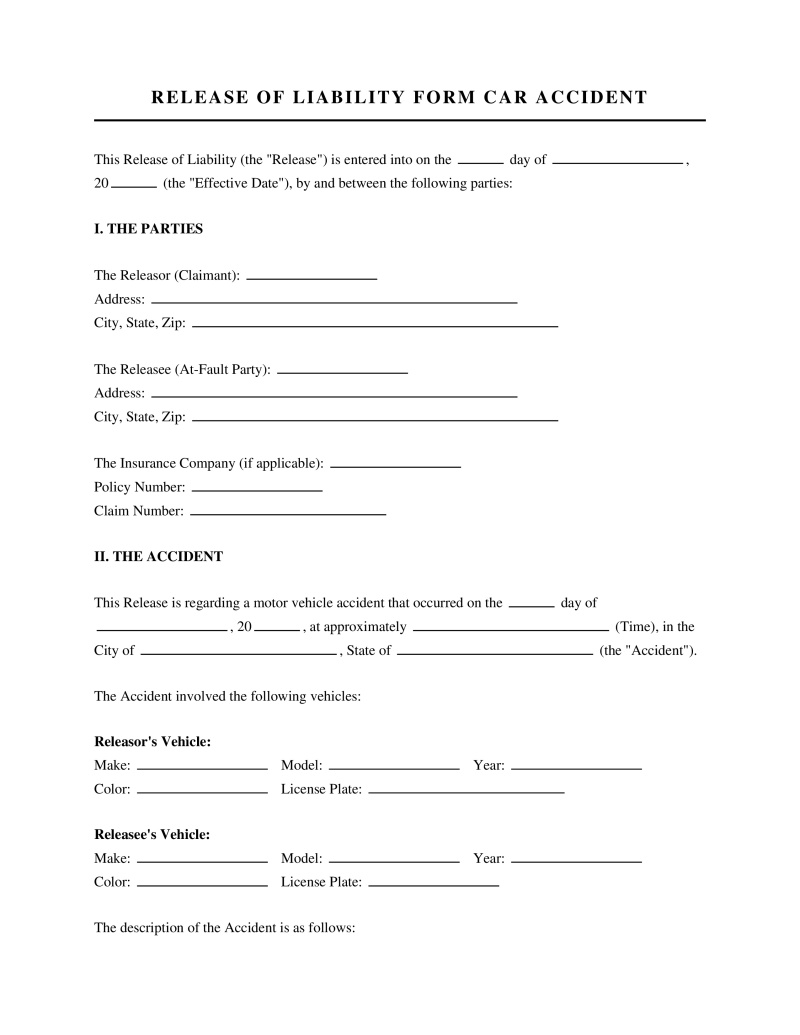
- Identify the Parties - Clearly state the full legal names and addresses of all parties involved in the release. This includes the releasor (the injured party giving up their rights) and the releasee (the party being released from liability, typically the at-fault driver or their insurance company). Ensure all legal entities, such as corporations or insurers, are correctly named.
- Detail the Accident Information - Provide a precise description of the car accident. This should include the date, time, and specific location of the incident. It is also helpful to reference any official police report numbers, claim numbers, or case identifiers to uniquely identify the event being settled.
- Specify the Scope of the Release - Articulate exactly what claims are being released. This typically includes all known and unknown claims for personal injury, property damage, medical expenses, lost wages, pain and suffering, and any other damages arising from the specific accident. The language should be broad enough to cover all potential future claims but specific enough to relate only to the incident in question.
- State the Consideration - Clearly specify the amount of money or other valuable consideration being exchanged for the release. This is the core of the agreement, and its absence or ambiguity can render the release unenforceable. Detail the exact payment amount, method of payment, and any other terms related to the compensation.
- Include Inducement and No Admission of Liability Clauses - Many releases include language stating that the consideration is provided solely as an inducement for the release and does not constitute an admission of liability by the releasee. This protects the at-fault party from having the settlement construed as an admission of wrongdoing.
- Review and Signatures - Both parties must carefully review the entire document to ensure they understand and agree to all terms. The release must then be signed and dated by all releasors and releasees. It is highly advisable for the signatures to be notarized to verify their authenticity, especially for significant settlements.
Required Elements
For a Release of Liability from Car Accident to be legally binding and effective, it must contain several essential components that clearly define the agreement and protect the interests of the parties involved. These elements ensure that the document serves its intended purpose of resolving claims and preventing future litigation.
The critical elements that must be present in a valid release include:
- Identification of Parties - The full legal names and contact information of the releasor(s) and releasee(s) must be explicitly stated. This includes any insurance companies involved.
- Description of the Accident - A clear and concise description of the car accident, including the date, time, and location, as well as any relevant identifiers like police report numbers.
- Statement of Release and Waiver - Explicit language indicating that the releasor is releasing and forever discharging the releasee from all claims, demands, actions, and causes of action arising from the specified accident.
- Consideration - A clear statement of the monetary amount or other valuable consideration being provided by the releasee to the releasor in exchange for the release.
- Scope of Claims Released - Specific language outlining that the release covers all injuries, damages, losses, and expenses, whether known or unknown, foreseen or unforeseen, at the time of signing.
- No Admission of Liability Clause - A provision stating that the payment or consideration is not an admission of liability or fault on the part of the releasee.
- Voluntary and Knowing Assent - A declaration by the releasor that they have read, understood, and voluntarily entered into the agreement without duress or undue influence.
- Signatures and Dates - The dated signatures of all parties involved, indicating their agreement to the terms. Notarization is highly recommended to authenticate signatures.
- Governing Law Clause - A clause specifying which state's laws will govern the interpretation and enforcement of the release.
Applicable Federal and State Laws
While a Release of Liability from Car Accident is primarily governed by state contract law, various federal and state statutes can indirectly or directly influence its enforceability and the underlying claims being settled. Understanding these legal frameworks is essential for drafting and executing a valid release.
Federal Statutes
While no single federal law directly dictates the structure of a car accident liability release, several federal acts may impact associated claims or the legal environment:
- Employee Retirement Income Security Act (ERISA) - Governs most private sector employee benefit plans, including health insurance. If the releasor's medical bills were paid by an ERISA-governed plan, the plan may have subrogation rights, meaning it can seek reimbursement from the settlement (29 U.S.C. § 1001 et seq.).
- Medicare Secondary Payer Act (MSPA) - Establishes Medicare as a secondary payer to other insurance arrangements, meaning Medicare has a right to be reimbursed from settlements or judgments for accident-related medical expenses (42 U.S.C. § 1395y(b)).
- Federal Tort Claims Act (FTCA) - Applies when a federal employee or entity is involved in a car accident. Claims against the U.S. government for torts must follow specific administrative procedures, which may involve releases (28 U.S.C. § 2671 et seq.).
State Laws and Requirements
State laws are the primary drivers of contract validity and personal injury claims, directly impacting a Release of Liability from Car Accident:
- Contract Law Principles - Each state has its own body of contract law that dictates requirements for offer, acceptance, consideration, mutual assent, and capacity, all of which apply to releases.
- Statutes of Limitations - State laws impose strict deadlines for filing personal injury lawsuits (e.g., generally 2-3 years from the date of the accident). A release signed after the statute of limitations has expired may still be valid but often holds less leverage for the releasor.
- Good Faith and Fair Dealing - Many states imply a covenant of good faith and fair dealing in all contracts, requiring parties to act honestly and not to undermine the other party's right to receive the benefits of the contract.
- Minor's Contracts - State laws typically stipulate that contracts entered into by minors are voidable at the minor's option upon reaching majority. Settlements involving minors often require court approval and the appointment of a guardian ad litem.
- Fraud and Misrepresentation Statutes - State laws provide remedies for victims of fraud or misrepresentation in contract formation, which can be grounds to invalidate a release.
- Comparative and Contributory Negligence Laws - These state-specific doctrines determine how fault is allocated in an accident, influencing the value of a claim and thus the settlement amount agreed upon in a release.
Penalties for non-compliance with these laws primarily relate to the enforceability of the release itself. If a release fails to meet state contract law requirements (e.g., lack of consideration, fraud), it may be deemed void or voidable by a court, allowing the releasor to pursue their original claims. Additionally, fraudulent inducement to sign a release could lead to civil penalties, punitive damages, or even criminal charges in severe cases involving intentional deception.
General Release vs. Limited Release
In the context of a Release of Liability from Car Accident, understanding the distinction between a general release and a limited release is crucial for both parties. These two forms differ significantly in the scope of claims they extinguish and the protection they offer.
A general release, often referred to as a "full and final release," is designed to waive all possible claims arising from a specific car accident. This includes not only current and known injuries or damages but also any future or unknown injuries that may manifest later. The language in a general release is typically broad, intending to provide comprehensive protection to the releasee against any and all past, present, and future claims related to the incident. Once signed, a general release makes it extremely difficult, if not impossible, for the releasor to seek further compensation, even if new medical conditions or damages are discovered after the settlement.
Conversely, a limited release, also known as a "specific" or "partial" release, is much narrower in scope. It typically waives only certain specified claims or types of damages, allowing other claims to remain open. For example, a limited release might settle only the property damage claim from a car accident, leaving the personal injury claim open for future negotiation or litigation. Another common use is to release one specific party from liability while preserving the right to pursue claims against other potentially at-fault parties. The language in a limited release is precise, carefully delineating which claims are being settled and which are explicitly reserved. This type of release is often used in complex multi-party accidents or when a party wishes to expedite settlement for certain damages without jeopardizing other potential claims.
Frequently Asked Questions
Release of Liability from Car Accident Sample
Not the form you're looking for?
Try our legal document generator to create a custom document
Disclaimer: The templates available on this website are provided for general informational purposes only and do not constitute legal advice. They are not intended to be, and should not be interpreted as, compliant with any specific legal, regulatory, or privacy requirements. These templates are not a replacement for professional legal guidance and should not be relied upon for any particular matter or circumstance. Users are strongly encouraged to seek advice from a qualified attorney licensed in their jurisdiction before using, modifying, or relying on any template.
All templates are provided on an "as is," "with all faults," and "as available" basis. The provider disclaims any and all warranties of any kind, whether express, implied, statutory, or otherwise, including without limitation warranties of merchantability, fitness for a particular purpose, title, or non-infringement.
LegalTemplates.com makes no guarantees or representations regarding the accuracy, completeness, expected outcomes, or reliability of the materials contained in these templates or any materials referenced or linked from them.