Demand Letter for Account Suspension
A Demand Letter for Account Suspension is a formal legal communication issued to an entity, asserting a claim or dispute regarding the unwarranted suspension of an account, and typically requesting reinstatement or other specified remedies.
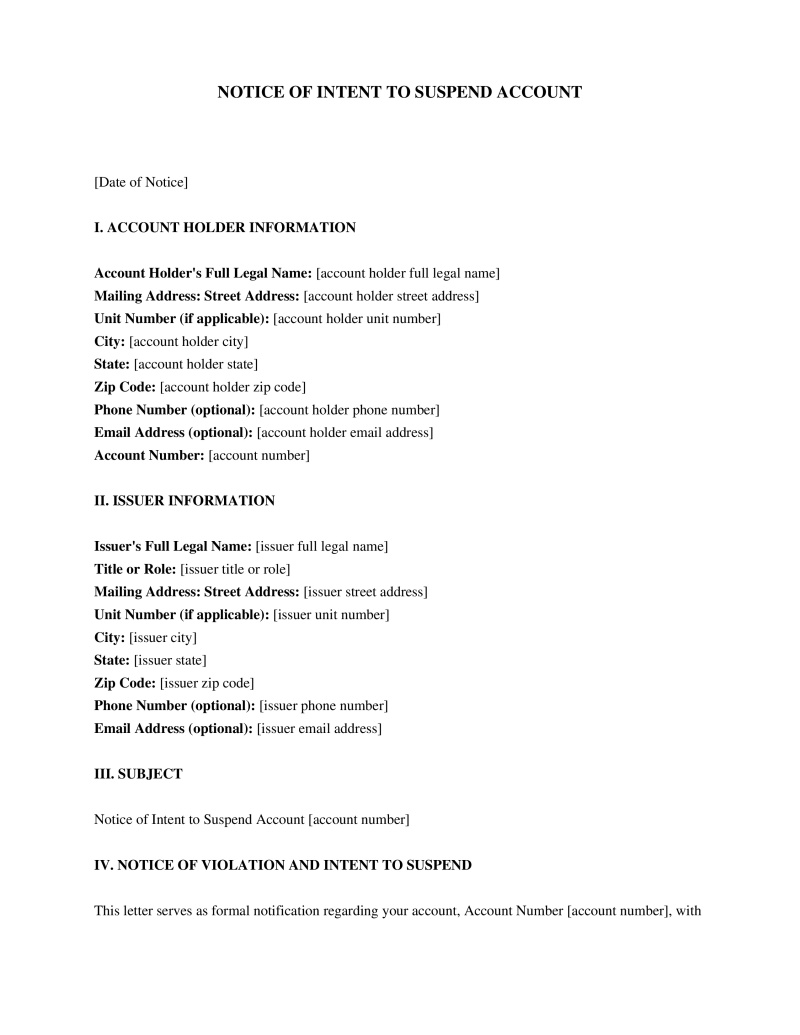
Current Account Status
Choose the closest description of the restriction currently affecting the account.
Table of Contents
What is a Demand Letter for Account Suspension?
A Demand Letter for Account Suspension is a formal written communication sent by an individual or entity to a service provider, platform, or financial institution, requesting the reinstatement of a suspended account. This letter typically outlines the reasons why the account suspension is believed to be unjust or erroneous, demands specific action for its resolution, and may indicate potential legal recourse if the issue remains unaddressed. Its primary purpose is to seek a prompt and satisfactory resolution without resorting to more formal legal proceedings, serving as a clear statement of the aggrieved party's position and expectations.
Purpose and Context of a Demand Letter for Account Suspension
A demand letter for account suspension serves as an initial, formal step in dispute resolution, aiming to resolve a conflict before escalating to litigation. It is commonly used when an account holder believes their account has been suspended unfairly, mistakenly, or without proper justification by a service provider, such as an online platform, e-commerce site, social media network, or financial institution. The letter formally notifies the suspending entity of the account holder's grievance and their expectation for reinstatement.
The core objective is to persuade the recipient to reverse the suspension and restore full account functionality. This is achieved by presenting a clear, concise, and factual summary of the situation, often including supporting evidence. The letter also serves to establish a formal record of communication, which can be crucial if the dispute eventually proceeds to arbitration or court. It demonstrates that the aggrieved party attempted to resolve the matter amicably and provided the suspending entity with an opportunity to rectify the situation.
Key Components of a Demand Letter for Account Suspension
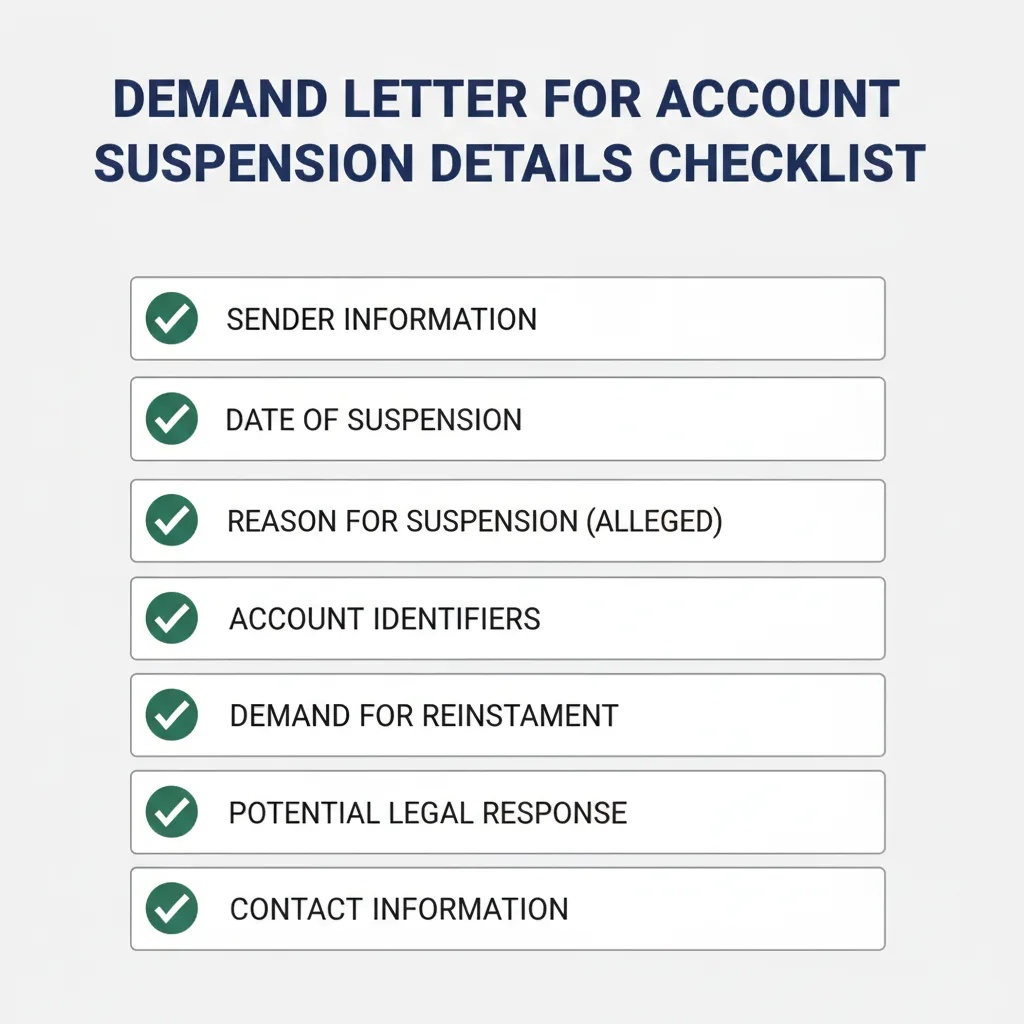
An effective demand letter for account suspension incorporates several critical elements to ensure clarity, formality, and legal weight. While specific content may vary depending on the nature of the account and the reason for suspension, general guidelines for demand letters apply, as outlined by various official sources for similar communications (U.S. Department of the Treasury, California Courts Self-Help Center, Los Angeles County, Bucks County).
Essential components typically include:
- Sender's Information - Full legal name, current address, phone number, and email address of the account holder.
- Recipient's Information - Correct legal name and address of the service provider or institution, directed to the appropriate department or legal counsel if known.
- Date of Letter - The exact date the letter is written and sent.
- Clear Subject Line - A concise and specific subject line that immediately identifies the issue, such as “Demand for Reinstatement of Account [Account Name/ID] – Suspension on [Date].”
- Account Identification - Precise details of the suspended account, including account number, username, associated email address, and any other relevant identifiers.
- Date and Details of Suspension - The exact date the account was suspended and any information provided by the service provider regarding the reason for suspension.
- Factual Summary of Dispute - A chronological and objective narrative of the events leading to the suspension, explaining why the account holder believes the suspension is unwarranted or erroneous. This section should avoid emotional language and focus on verifiable facts.
- Supporting Evidence - Reference to or enclosure of relevant documentation, such as screenshots, communication logs, terms of service, transaction records, or any other proof that supports the account holder's claim.
- Specific Demand - A clear statement of the desired action, primarily the immediate reinstatement of the account and restoration of all associated functionalities.
- Deadline for Resolution - A reasonable timeframe (e.g., 7-14 days) by which the recipient is expected to respond or resolve the issue.
- Statement of Intent - A clear indication of the potential next steps if the demand is not met, which may include pursuing legal action, filing a complaint with regulatory bodies, or seeking mediation.
- Signature - The account holder's handwritten signature above their typed name.
Drafting Considerations for Effectiveness
Crafting an effective demand letter for account suspension requires careful attention to detail, tone, and presentation. The letter should be professional, assertive, and articulate, designed to elicit a serious response from the recipient. Maintaining a formal tone is crucial, even if the account holder feels wronged or frustrated. The language should be precise and unambiguous, avoiding slang or overly casual expressions.
Furthermore, the letter should be concise, presenting the facts without unnecessary embellishment. While it needs to be comprehensive enough to explain the situation fully, it should not be overly lengthy, as this can deter the recipient from reading it thoroughly. All claims made within the letter must be supported by evidence, which should be either attached as exhibits or clearly referenced for easy retrieval. The letter functions as a formal record, so accuracy in dates, names, and account identifiers is paramount. Proofreading for grammatical errors and typos ensures professionalism and credibility.
Types of Account Suspensions Leading to Demand Letters
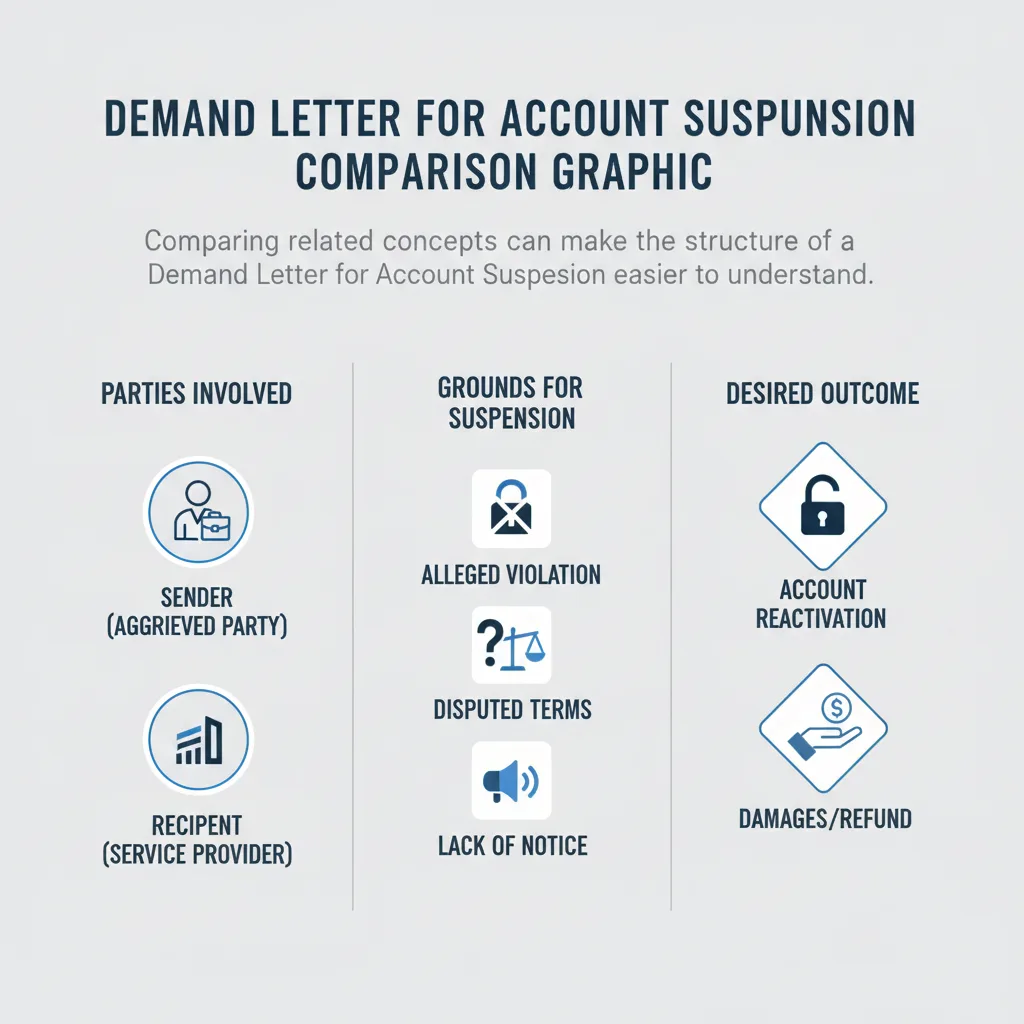
Demand letters for account suspension arise from various scenarios where an account holder believes a suspension is unjustified. These typically fall into several categories:
- Terms of Service Violations - When a service provider alleges a breach of their terms of service, but the account holder disputes the violation or believes it was misinterpreted.
- Security or Fraud Concerns - If an account is suspended due to suspected unauthorized access, fraudulent activity, or security breaches, and the account holder can demonstrate the account is secure or the activity was legitimate.
- Payment or Billing Disputes - Accounts suspended due to payment issues, chargebacks, or billing errors that the account holder believes were resolved or incorrectly applied.
- Identity Verification Issues - When an account is suspended pending identity verification, and the account holder has provided all requested documentation but the suspension persists.
- Mistaken Identity or Technical Errors - Cases where an account is suspended due to an error in the service provider's system, a mix-up with another account, or incorrect automated flagging.
Distinction from Other Legal Communications
While a demand letter for account suspension is a formal communication, it differs in purpose and scope from other legal documents like a general complaint letter or a formal lawsuit complaint. A demand letter is a pre-litigation tool, an attempt to resolve a dispute directly with the opposing party without involving courts. It outlines a grievance and demands a specific remedy, often with a threat of further action if the demand is not met.
A general complaint letter, such as those used for consumer issues (Bucks County, Pennsylvania, offers guidance on drafting complaint letters), typically seeks to inform an entity of dissatisfaction or a problem, often requesting an investigation or a general resolution without necessarily implying legal action. It is usually less formal and does not always set a strict deadline for response. In contrast, a formal lawsuit complaint is a document filed with a court, initiating legal proceedings. It adheres to strict legal formats and rules of civil procedure, formally stating the legal claims, parties, and requested relief, and requires a response from the defendant within a legally mandated timeframe.
Frequently Asked Questions
Sources
- Sample "Bad Check" Demand Letter - Provides a template for a demand letter related to bad checks, which can be adapted for account suspension situations.
- Sample "Stop Payment" Demand Letter - Offers a template for a demand letter concerning stop payment orders, useful for account suspension cases.
- Sample Complaint Letter - Provides guidance on drafting complaint letters, which can be adapted for account suspension demands.
- Demand Letter Checklist - Outlines the necessary components of a demand letter for debt collection, applicable to account suspension scenarios.
- DEMAND LETTER FOR PAYMENT OF BAD CHECK - Offers a template for a demand letter regarding bad checks, adaptable for account suspension cases.
Not the form you're looking for?
Try our legal document generator to create a custom document
Disclaimer: The templates available on this website are provided for general informational purposes only and do not constitute legal advice. They are not intended to be, and should not be interpreted as, compliant with any specific legal, regulatory, or privacy requirements. These templates are not a replacement for professional legal guidance and should not be relied upon for any particular matter or circumstance. Users are strongly encouraged to seek advice from a qualified attorney licensed in their jurisdiction before using, modifying, or relying on any template.
All templates are provided on an "as is," "with all faults," and "as available" basis. The provider disclaims any and all warranties of any kind, whether express, implied, statutory, or otherwise, including without limitation warranties of merchantability, fitness for a particular purpose, title, or non-infringement.
LegalTemplates.com makes no guarantees or representations regarding the accuracy, completeness, expected outcomes, or reliability of the materials contained in these templates or any materials referenced or linked from them.