Request for Interrogatories
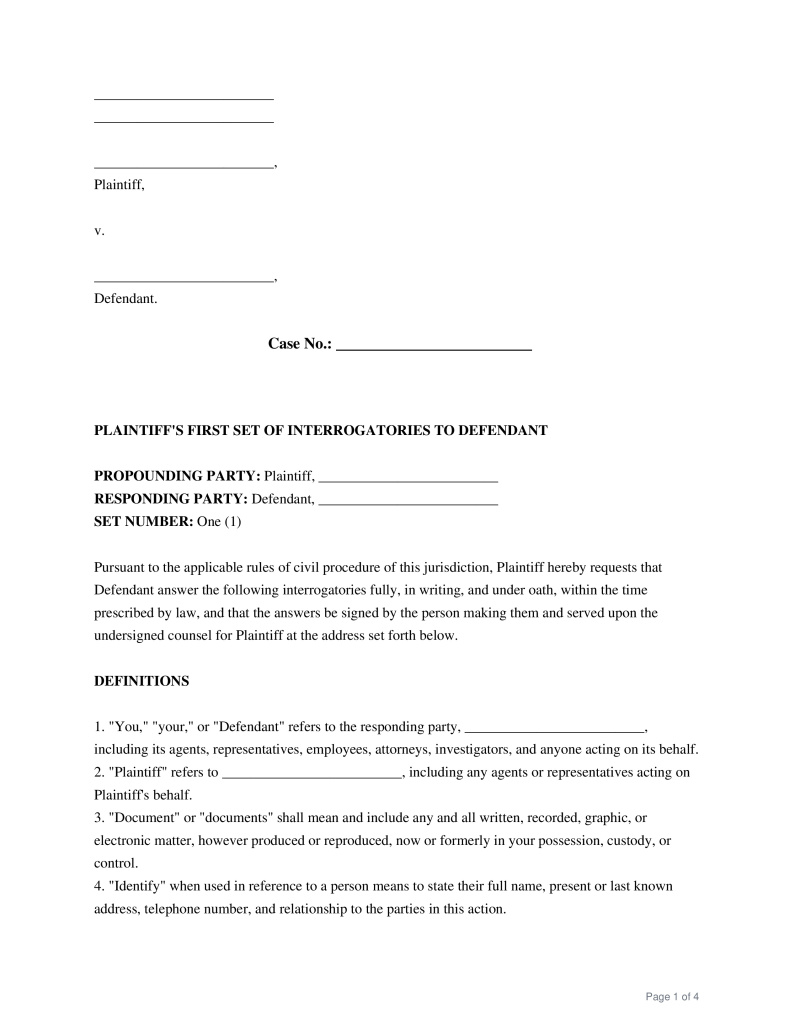
A Request for Interrogatories is a formal legal document utilized during the discovery phase of civil litigation that directs an opposing party to provide written answers to specific questions under oath.
Filing Party Role
Choose the role that matches the caption and case posture. This helps label the requesting party correctly.
Use the role appearing in the court caption or pleadings.
Table of Contents
What are Interrogatories?
Interrogatories are formal, written questions served by one party to another during the discovery phase of a civil lawsuit. Under civil procedure rules, the receiving party must provide written answers or objections under oath or penalty of perjury within a specified timeframe. Attorneys use a Request for Interrogatories to gather facts, narrow the scope of disputed issues, and secure admissions that can be used at trial. This discovery tool helps parties understand the opposing side's evidence and legal positions before court proceedings begin.
Purpose and Role in Civil Litigation
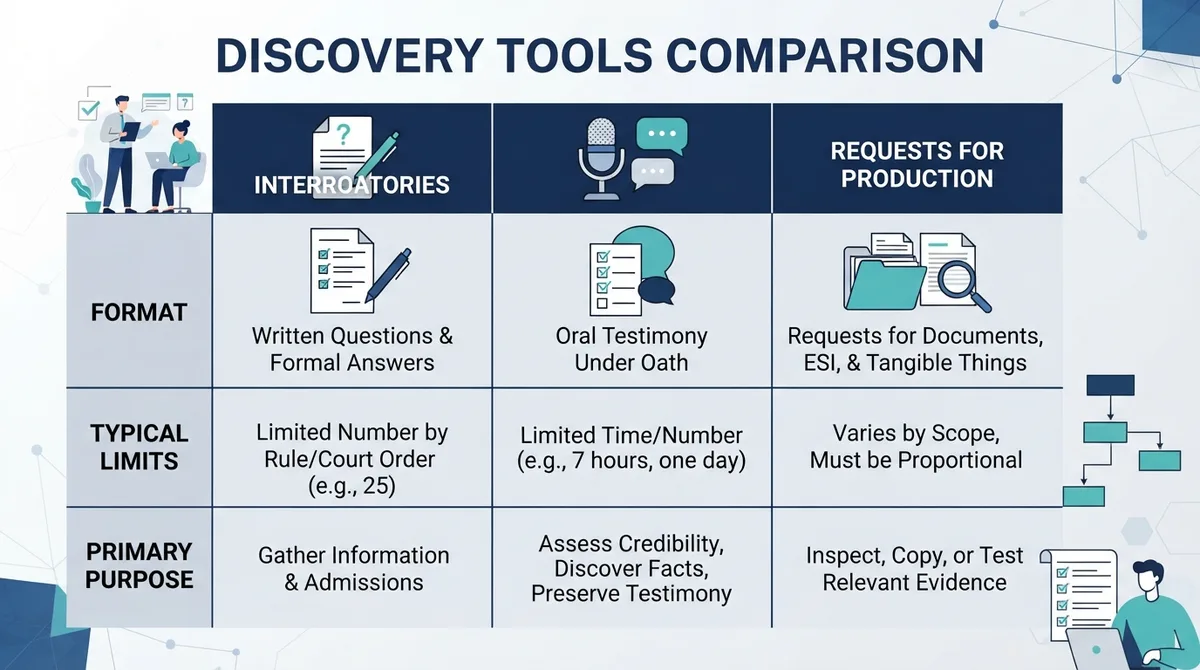
Discovery serves as the fact-finding phase of a lawsuit, allowing both sides to obtain information from each other. Interrogatories are designed to establish a baseline of facts, identify key witnesses, and locate physical evidence. Because the responses are provided under oath, they carry legal weight and can prevent parties from changing their stories later in the case. This process helps prevent surprises during trial and encourages settlement discussions by clarifying the strength of each party's position.
Parties utilize these written questions to achieve specific litigation goals:
- Fact Clarification - Establishing undisputed facts to streamline trial preparation and narrow the issues.
- Witness Identification - Identifying individuals with personal knowledge of the events surrounding the lawsuit.
- Document Location - Locating relevant physical or electronic records for subsequent production requests.
- Contentions and Claims - Clarifying the specific legal theories and factual bases of the opponent's claims.
Types of Interrogatories
Attorneys select different formats of written questions depending on the complexity of the case and local court requirements:
- Form Interrogatories - Standardized, pre-printed questions approved by state courts or local rules for common types of cases such as personal injury or breach of contract.
- Special Interrogatories - Customized, case-specific questions drafted by attorneys to target unique factual issues in a particular lawsuit.
- Contention Interrogatories - Questions asking a party to state all facts, witnesses, or documents supporting a specific allegation or defense in their pleadings.
Procedural Rules and Limits
Courts and administrative bodies enforce strict rules to prevent parties from abusing the discovery process. These rules dictate how questions must be formatted, the maximum number of questions allowed, and the deadlines for submitting responses. Failure to follow these rules can result in objections, waiver of rights, or judicial sanctions.
Key requirements under federal and state rules include:
- Numerical Limitations - The number of questions is typically restricted to 25 questions, including subparts, unless the parties agree or the court or commission orders otherwise (29 CFR § 2200.55).
- Filing Requirements - Interrogatories, objections, and answers are generally not filed with the court unless directed, but are instead maintained by counsel and made available to parties upon request (LR 33).
- Response Timelines - Receiving parties must serve answers and objections within a designated timeframe, such as 45 days after service of the interrogatories (Mass. R. Civ. P. 33).
- Verification Under Oath - Each question must be answered separately and fully in writing under the penalties of perjury or affirmation (Mass. R. Civ. P. 33; 29 CFR § 2200.55).
- Formulation Standards - Every individual question must state the requested information in concise language (LR 33).
Drafting and Responding to Interrogatories
Drafting effective questions requires precision to ensure the recipient cannot easily evade answering. Questions must be clear, direct, and limited in scope to avoid objections. When a party receives a Request for Interrogatories, they must conduct a reasonable investigation of their records and memory to provide complete answers.
A responding party has several options when addressing each written question:
- Full Answer - Providing a complete, factual response based on all information reasonably available to the party.
- Business Records Election - Offering to produce business records from which the answer can be derived if the burden of finding the answer is substantially the same for both parties.
- Specific Objections - Declining to answer based on legally recognized grounds, such as attorney-client privilege or the work-product doctrine.
Common Objections to Interrogatories
A party is not required to answer every question if a valid legal objection exists. Objections must be stated clearly, and the reasons for the objection must be provided in writing. If an objection is made, the requesting party can challenge it by filing a motion with the court.
Attorneys frequently raise specific objections to protect their clients' interests:
- Attorney-Client Privilege - Protecting confidential communications between a client and their legal counsel from disclosure.
- Overly Broad and Unduly Burdensome - Arguing that the request is too wide in scope or requires excessive effort and expense to answer relative to its value.
- Vague and Ambiguous - Asserting that the question is poorly phrased and cannot be understood with reasonable certainty.
- Not Reasonably Calculated to Lead to Admissible Evidence - Claiming that the requested information is irrelevant to the subject matter of the litigation.
Frequently Asked Questions
Sources
- LR 33 - Interrogatories - Provides local rules on interrogatories, including filing procedures and definitions.
- 2200.55 - Interrogatories - Details procedures for serving and answering interrogatories in OSHA proceedings.
- Civil Procedure Rule 33: Interrogatories to parties - Outlines the procedures for serving and answering interrogatories in Massachusetts civil cases.
Not the form you're looking for?
Try our legal document generator to create a custom document
Disclaimer: The templates available on this website are provided for general informational purposes only and do not constitute legal advice. They are not intended to be, and should not be interpreted as, compliant with any specific legal, regulatory, or privacy requirements. These templates are not a replacement for professional legal guidance and should not be relied upon for any particular matter or circumstance. Users are strongly encouraged to seek advice from a qualified attorney licensed in their jurisdiction before using, modifying, or relying on any template.
All templates are provided on an "as is," "with all faults," and "as available" basis. The provider disclaims any and all warranties of any kind, whether express, implied, statutory, or otherwise, including without limitation warranties of merchantability, fitness for a particular purpose, title, or non-infringement.
LegalTemplates.com makes no guarantees or representations regarding the accuracy, completeness, expected outcomes, or reliability of the materials contained in these templates or any materials referenced or linked from them.