Answer to Complaint
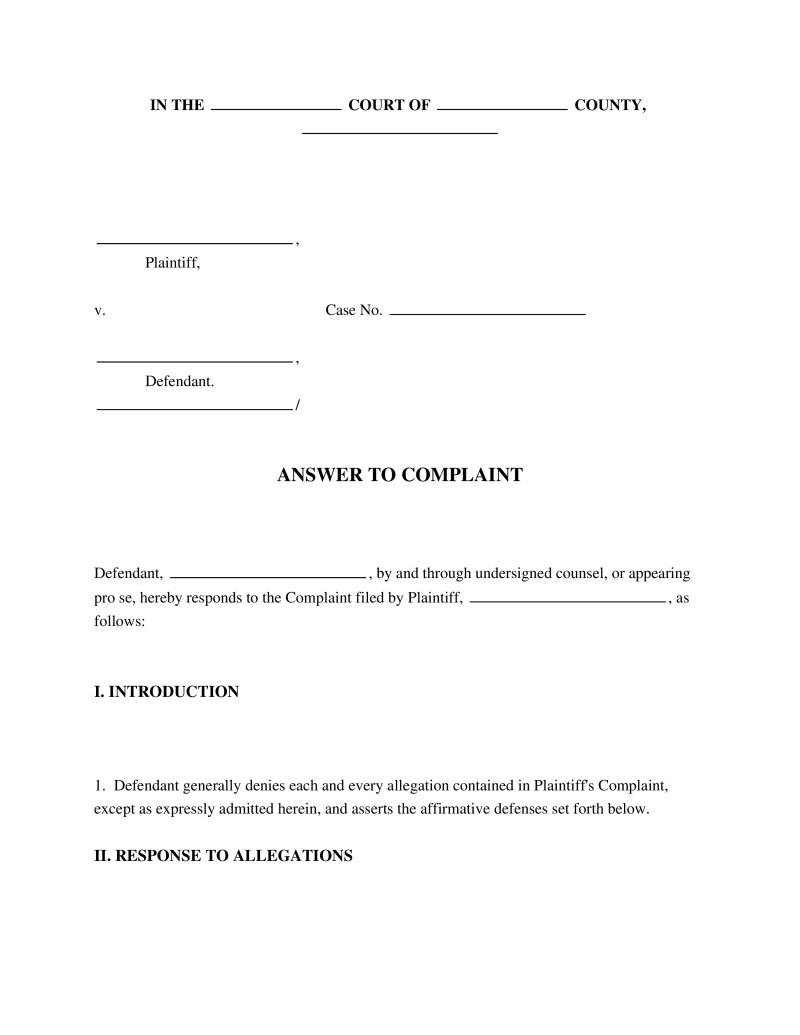
An Answer to Complaint is a formal legal pleading submitted by a defendant in response to a plaintiff's complaint, asserting defenses or counterclaims.
Filing Party Type
Select 'Business/Entity' if the defendant is a corporation, LLC, partnership, or other organization.
Enter the registered name of the business or entity as it appears in official records.
Select the entity type.
Enter the type if not listed above.
Table of Contents
What is an Answer to Complaint?
An Answer to Complaint is a formal legal document filed by a defendant in response to a plaintiff's complaint, which initiates a civil lawsuit. Its primary purpose is to inform the court and the plaintiff of the defendant's position regarding the allegations made in the complaint. Through this document, the defendant either admits, denies, or states that they lack sufficient information to admit or deny each specific allegation. The Answer also serves as the vehicle for the defendant to assert any affirmative defenses, counterclaims, or cross-claims they may have against the plaintiff or other parties, thereby shaping the scope of the litigation.
Legal Requirements and Validity
The validity and effectiveness of an Answer to Complaint hinge on strict adherence to procedural rules and substantive legal requirements. These requirements ensure fairness, clarity, and efficiency in the litigation process. Failure to meet these standards can result in severe consequences, including default judgment against the defendant.
Key requirements for a valid Answer to Complaint include:
- Timeliness of Filing - The Answer must be filed within a specified period after the defendant is served with the complaint. In federal court, under the Federal Rules of Civil Procedure, a defendant typically has 21 days to file an answer after being served, or 60 days if service is waived (Fed. R. Civ. P. 12(a)(1)). State rules often mirror or vary slightly from these timelines.
- Proper Captioning - The document must include a caption that identifies the court, the names of the parties, the case number, and the title of the document, consistent with the format of the original complaint.
- Numbered Paragraph Responses - Each allegation in the plaintiff's complaint must be addressed individually, typically by numbering the responses to correspond with the complaint's paragraphs. The defendant must explicitly admit, deny, or state a lack of sufficient knowledge to admit or deny each allegation (Fed. R. Civ. P. 8(b)).
- Affirmative Defenses - The Answer must clearly set forth any affirmative defenses the defendant intends to raise. These are defenses that, if proven, defeat the plaintiff's claim even if the plaintiff's allegations are true (Fed. R. Civ. P. 8(c)). Common examples include statute of limitations, res judicata, accord and satisfaction, or contributory negligence.
- Counterclaims and Cross-claims - If the defendant has a claim against the plaintiff (counterclaim) or against a co-defendant (cross-claim), these must be included in the Answer, following the same pleading standards as a complaint (Fed. R. Civ. P. 13).
- Signature and Verification - The Answer must be signed by the defendant or their attorney. In some jurisdictions or for specific types of cases, the Answer may also require verification under oath, attesting to the truthfulness of the statements made therein.
- Service on Opposing Parties - After filing with the court, a copy of the Answer must be properly served on the plaintiff and any other parties to the action, typically through mail or electronic means, followed by filing proof of service with the court.
How to Draft an Answer to Complaint
Drafting an Answer to Complaint is a critical step in civil litigation, requiring careful attention to detail and a thorough understanding of the legal claims and defenses involved. The process typically involves several distinct stages:
- Review the Complaint Thoroughly - Carefully read and analyze every paragraph of the plaintiff's complaint. Understand the factual allegations, the legal claims being made, and the relief sought. Identify any ambiguities or allegations that are unclear. Pay close attention to the specific dates, parties, and events mentioned.
- Determine Responses to Each Allegation - For each numbered paragraph in the complaint, formulate a specific response. You must choose one of three options: Admit (if the allegation is true), Deny (if the allegation is false), or state that you Lack Sufficient Knowledge to Admit or Deny (if you genuinely do not have enough information to form a belief about the truth of the allegation). Avoid general denials of the entire complaint; each allegation requires an individual response.
- Identify and Assert Affirmative Defenses - Research and identify all potential affirmative defenses that apply to the facts of your case and the plaintiff's claims. These are defenses that, if proven, defeat the plaintiff's case regardless of whether their factual allegations are true. Examples include statute of limitations, waiver, estoppel, failure to state a claim, or lack of personal jurisdiction. List each affirmative defense clearly and concisely, stating the legal basis for each.
- Include Counterclaims or Cross-Claims (if applicable) - If the defendant believes they have a valid claim against the plaintiff (a counterclaim) or against another defendant in the same lawsuit (a cross-claim), these must be included in the Answer. These claims should be pleaded with the same level of detail and specificity as required for an initial complaint, outlining the facts, legal basis, and relief sought for each claim.
- Draft a Demand for Relief - Conclude the Answer with a demand for relief. This typically includes a request that the court deny the plaintiff's requested relief, dismiss the complaint, and award the defendant their costs and attorney's fees incurred in defending the action. If counterclaims were asserted, also include a demand for the relief sought on those claims.
- Sign and Verify the Document - The Answer must be signed by the defendant or their attorney. In some jurisdictions, or for specific types of cases, the Answer may also need to be verified under oath, meaning the defendant signs a sworn statement affirming the truthfulness of the contents. Ensure all necessary signatures and notarizations, if any, are obtained before filing.
- File with the Court and Serve Opposing Parties - Electronically file or physically submit the original signed Answer with the appropriate court clerk within the deadline. Immediately after filing, ensure a copy of the filed Answer is properly served on the plaintiff and any other parties to the lawsuit, typically through certified mail or e-service, and file proof of service with the court.
Rights and Obligations of Parties Involved
The filing of an Answer to Complaint establishes the defendant's formal entry into the lawsuit, creating specific rights and obligations for both the defendant and the plaintiff. These rights and obligations are fundamental to the adversarial system and ensure a structured and fair legal process.
Defendant's Rights and Obligations:
- Right to Present a Defense - The defendant has a fundamental right to respond to the allegations, assert their version of events, and present legal arguments and evidence in their defense.
- Right to Discovery - Once an Answer is filed, the defendant has the right to engage in discovery, which includes requesting documents, interrogatories, and depositions from the plaintiff and other parties to gather information relevant to the case.
- Right to Due Process - The defendant is entitled to fair treatment throughout the legal process, including proper notice of proceedings, an opportunity to be heard, and impartial adjudication.
- Obligation to Respond Truthfully - The defendant is obligated to respond honestly to each allegation in the complaint, admitting what is true, denying what is false, and stating a lack of knowledge where appropriate. Misrepresentations can lead to sanctions.
- Obligation to Adhere to Court Rules and Deadlines - The defendant must comply with all applicable federal and state rules of civil procedure, as well as local court rules and deadlines for filing documents, responding to discovery, and appearing in court.
- Obligation to Avoid Frivolous Defenses - Under rules like Federal Rule of Civil Procedure 11, the defendant and their attorney have an obligation to ensure that any defenses or claims asserted in the Answer have a reasonable factual and legal basis.
Plaintiff's Rights and Obligations:
- Right to Receive a Timely Answer - The plaintiff has the right to receive a formal Answer from the defendant within the legally prescribed timeframe. Failure to provide a timely Answer can lead to a default judgment in the plaintiff's favor.
- Right to Discovery - Similar to the defendant, the plaintiff also has the right to conduct discovery to obtain information from the defendant relevant to their claims and the defendant's defenses.
- Obligation to Respond to Counterclaims - If the defendant includes counterclaims in their Answer, the plaintiff then becomes a defendant to those claims and has an obligation to file a responsive pleading, typically an Answer to Counterclaim, within a specified period.
- Obligation to Participate in Discovery - The plaintiff must cooperate with the defendant's discovery requests, providing relevant information and documents as required by the rules of civil procedure.
- Obligation to Avoid Frivolous Claims - The plaintiff, like the defendant, is bound by rules such as Federal Rule of Civil Procedure 11, which requires that their claims continue to have a factual and legal basis throughout the litigation.
Applicable Federal and State Laws
The process of drafting, filing, and litigating an Answer to Complaint is primarily governed by procedural laws at both the federal and state levels. These laws establish the framework within which civil cases proceed, ensuring consistency and fairness.
Federal Statutes
For cases filed in federal courts, the primary governing authority is the Federal Rules of Civil Procedure (FRCP):
- Federal Rules of Civil Procedure, Rule 8 (General Rules of Pleading) - Dictates the general requirements for pleadings, including the need for a short and plain statement of defenses and specific responses to each allegation in the complaint. It also covers affirmative defenses (Fed. R. Civ. P. 8).
- Federal Rules of Civil Procedure, Rule 12 (Defenses and Objections: When and How Presented; Motion for Judgment on the Pleadings; Consolidating Motions; Waiving Defenses; Pretrial Hearing) - Specifies the timeframes for filing an Answer and outlines various defenses that can be raised, either in the Answer or through a pre-answer motion (Fed. R. Civ. P. 12).
- Federal Rules of Civil Procedure, Rule 11 (Signing Pleadings, Motions, and Other Papers; Representations to the Court; Sanctions) - Requires attorneys and unrepresented parties to certify that their filings, including the Answer, are based on a reasonable inquiry, are well-grounded in fact, are warranted by existing law or a nonfrivolous argument for changing it, and are not filed for any improper purpose (Fed. R. Civ. P. 11).
- Federal Rules of Civil Procedure, Rule 13 (Counterclaim and Crossclaim) - Governs the inclusion of counterclaims (claims by the defendant against the plaintiff) and cross-claims (claims by one defendant against another) within the Answer (Fed. R. Civ. P. 13).
State Laws and Requirements
In state court systems, each state has its own set of civil procedure rules, often modeled after the Federal Rules of Civil Procedure but with specific variations. These state rules address the same fundamental aspects as the FRCP:
- State Rules of Civil Procedure - Every state, such as the California Code of Civil Procedure or the New York Civil Practice Law and Rules (CPLR), contains analogous rules to the FRCP regarding pleading requirements, deadlines for filing an Answer, affirmative defenses, and the inclusion of counterclaims and cross-claims (e.g., Cal. Civ. Proc. Code § 431.30; N.Y. C.P.L.R. 3011, 3018).
- Local Court Rules - Beyond state statutes, individual courts (e.g., county superior courts, district courts) often have their own local rules that dictate specific formatting, filing procedures, and other administrative requirements for pleadings, which must be followed.
- Statutes of Limitations - While not directly governing the Answer's content, state statutes of limitations are critical for identifying and asserting the affirmative defense that a plaintiff's claim was filed too late (e.g., Cal. Civ. Proc. Code § 335 et seq.).
Penalties for Non-Compliance
Failure to adhere to the legal requirements for an Answer to Complaint can result in significant penalties:
- Default Judgment - If a defendant fails to file an Answer within the prescribed timeframe, the court may enter a default against them, and subsequently a default judgment, granting the plaintiff the relief sought in the complaint without a trial (Fed. R. Civ. P. 55).
- Waiver of Defenses - Certain defenses, particularly those related to jurisdiction or service of process, may be waived if not raised in the initial Answer or a pre-answer motion (Fed. R. Civ. P. 12(h)).
- Sanctions under Rule 11 - If an Answer is found to contain frivolous claims or defenses, or is filed for an improper purpose, the court can impose sanctions on the attorney or the party, which may include monetary fines, attorney's fees, or other punitive measures (Fed. R. Civ. P. 11).
- Striking of Pleadings - A court may strike portions of an Answer, or the entire Answer, if it is deemed scandalous, impertinent, or fails to comply with pleading requirements (Fed. R. Civ. P. 12(f)).
Frequently Asked Questions
Not the form you're looking for?
Try our legal document generator to create a custom document
Disclaimer: The templates available on this website are provided for general informational purposes only and do not constitute legal advice. They are not intended to be, and should not be interpreted as, compliant with any specific legal, regulatory, or privacy requirements. These templates are not a replacement for professional legal guidance and should not be relied upon for any particular matter or circumstance. Users are strongly encouraged to seek advice from a qualified attorney licensed in their jurisdiction before using, modifying, or relying on any template.
All templates are provided on an "as is," "with all faults," and "as available" basis. The provider disclaims any and all warranties of any kind, whether express, implied, statutory, or otherwise, including without limitation warranties of merchantability, fitness for a particular purpose, title, or non-infringement.
LegalTemplates.com makes no guarantees or representations regarding the accuracy, completeness, expected outcomes, or reliability of the materials contained in these templates or any materials referenced or linked from them.