South Carolina Bill of Sale
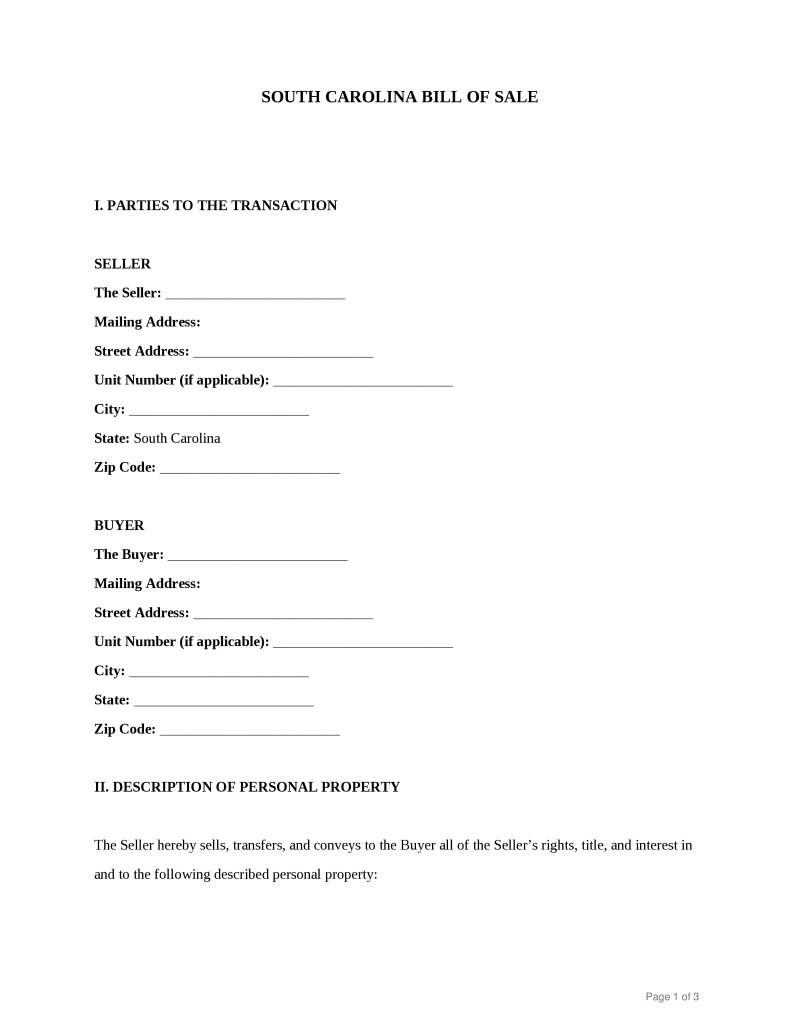
A South Carolina Bill of Sale is a formal legal document used to record the transfer of ownership of personal property from a seller to a buyer.
Asset Type
Choose the category that best describes the item. This helps include the right identifying details, such as VIN, hull number, serial number, or livestock identifiers.
Use this when the item does not fit one of the listed categories.
Table of Contents
What is a South Carolina Bill of Sale?
A South Carolina Bill of Sale is a formal legal document used to record the transfer of ownership of personal property from a seller to a buyer. This document serves as a receipt and proof of purchase, detailing the terms of the transaction, the purchase price, and the condition of the item being sold. Residents and businesses in South Carolina commonly use this form during private sales of motor vehicles, vessels, and other high-value personal assets. It establishes a clear paper trail that protects both parties from future disputes regarding ownership or liability.
Legal Framework and Statutory Requirements
South Carolina law regulates the transfer of personal property, particularly motor vehicles, to protect the interests of buyers and sellers. The South Carolina Department of Motor Vehicles provides official forms to facilitate these transactions and ensure compliance with state registration procedures. The state enforces specific rules regarding ownership documentation:
- Vehicle Title Requirement - Requires a valid certificate of title for selling or mortgaging motor vehicles within the state, subject to specific exceptions (S.C. Code Ann. § 56-19-210).
- Official Document Provision - Establishes that the South Carolina Department of Motor Vehicles provides authorized forms to document vehicle transactions and facilitate title transfers.
Types of South Carolina Bills of Sale
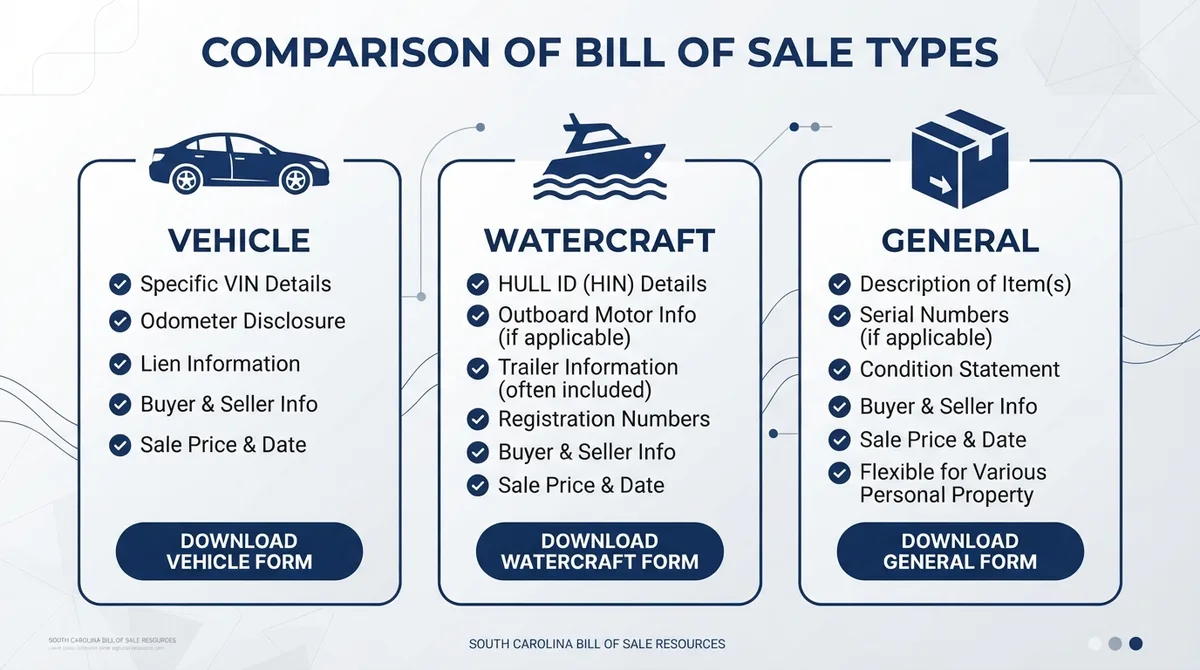
Transactions involving different classes of personal property require specific document variations:
- Vehicle Bill of Sale - Used to document the transfer of cars, trucks, motorcycles, and other motor vehicles before registering them with the South Carolina Department of Motor Vehicles.
- Watercraft Bill of Sale - Executed for the sale of boats, outboard motors, and personal watercraft, which must be registered with the South Carolina Department of Natural Resources.
- General Bill of Sale - Utilized for transactions involving generic personal property such as electronics, furniture, tools, or livestock where no state registration is required.
Essential Elements of the Document
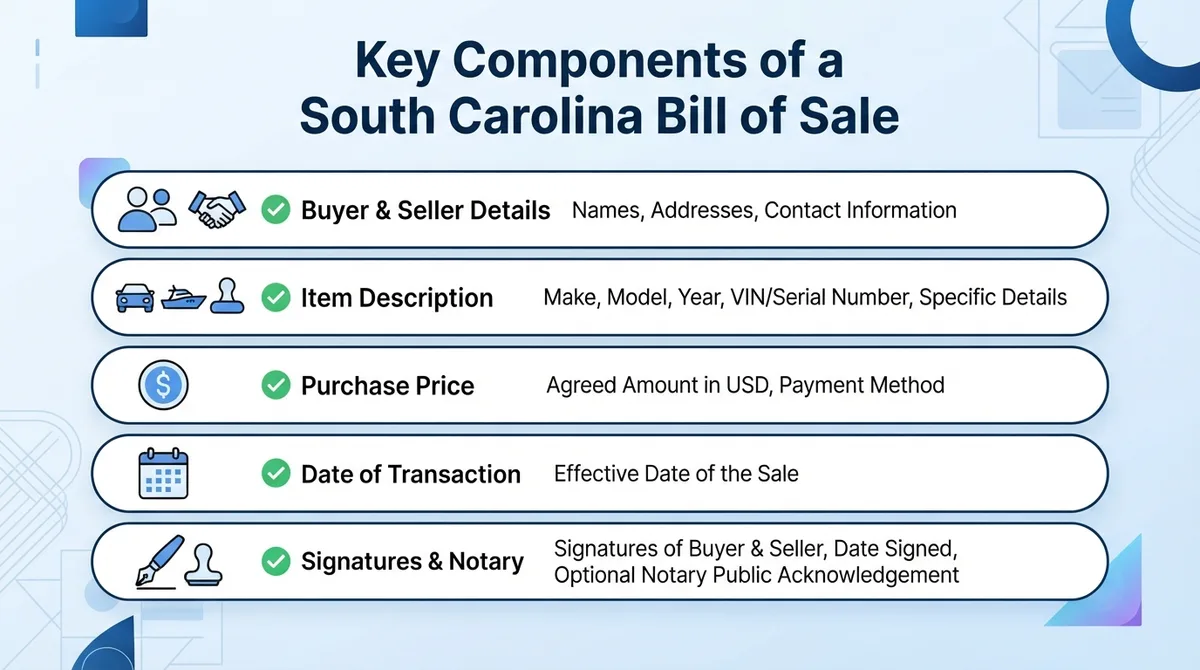
To ensure the validity and enforceability of a South Carolina Bill of Sale, specific details must be included in the written agreement:
- Party Information - Full legal names, physical addresses, and contact details of both the buyer and the seller.
- Item Description - Comprehensive details of the property, including make, model, year, color, serial number, or vehicle identification number.
- Transaction Date - The exact calendar day, month, and year when the sale is finalized and ownership transfers.
- Purchase Price - The agreed-upon monetary amount or a description of the trade-in terms if property is exchanged.
- Signatures - The physical or electronic signatures of both parties indicating mutual consent to the terms of the sale.
Vehicle Registration and Title Transfer Process
Buyers of motor vehicles in South Carolina must complete specific steps to register the vehicle and obtain a new title:
- Obtain the Title and Bill of Sale - Secure the properly assigned certificate of title from the seller along with the completed bill of sale.
- Secure Insurance - Obtain a valid auto insurance policy that meets the minimum liability coverage requirements of South Carolina.
- Submit Documents to SCDMV - Present the title, bill of sale, proof of insurance, and identification to a local South Carolina Department of Motor Vehicles office.
- Pay Taxes and Fees - Submit payment for the state infrastructure maintenance fee, registration fees, and title transfer fees.
Common Mistakes in Property Transfers
Parties executing a private sale often make errors that delay registration or invalidate the transaction:
- Omitted Vehicle Identification Numbers - Failing to record the exact seventeen-digit identification number, which prevents the state from verifying the vehicle history.
- Incorrect Purchase Price - Listing an inaccurate sales price to avoid state infrastructure maintenance fees, which constitutes tax fraud.
- Missing Seller Title - Attempting to complete a vehicle sale using only a bill of sale without the required certificate of title (S.C. Code Ann. § 56-19-210).
- Unreadable Signatures - Signing the document illegibly without printing names clearly underneath, making identity verification difficult for state agencies.
Proof of Ownership and Liability Protection
A bill of sale serves critical legal functions for both parties beyond facilitating registration with state agencies:
- Seller Liability Release - Protects the seller from liability for traffic violations, accidents, or towing fees incurred by the buyer after the transfer date.
- Buyer Proof of Purchase - Establishes the buyer as the rightful owner of the property, preventing claims of theft or unauthorized possession.
- Tax Documentation - Serves as official documentation for tax reporting, ensuring accurate reporting of capital gains or vehicle taxes.
- Warranty Status Clarification - Confirms whether the property is sold under warranty or in an as-is condition.
Frequently Asked Questions
Sources
- South Carolina Code of Laws - Title 56, Chapter 19: Protection of Titles to and Interests in Motor Vehicles - Statutory provisions related to the protection of titles to and interests in motor vehicles in South Carolina.
Bill of Sale in other states
Not the form you're looking for?
Try our legal document generator to create a custom document
Disclaimer: The templates available on this website are provided for general informational purposes only and do not constitute legal advice. They are not intended to be, and should not be interpreted as, compliant with any specific legal, regulatory, or privacy requirements. These templates are not a replacement for professional legal guidance and should not be relied upon for any particular matter or circumstance. Users are strongly encouraged to seek advice from a qualified attorney licensed in their jurisdiction before using, modifying, or relying on any template.
All templates are provided on an "as is," "with all faults," and "as available" basis. The provider disclaims any and all warranties of any kind, whether express, implied, statutory, or otherwise, including without limitation warranties of merchantability, fitness for a particular purpose, title, or non-infringement.
LegalTemplates.com makes no guarantees or representations regarding the accuracy, completeness, expected outcomes, or reliability of the materials contained in these templates or any materials referenced or linked from them.