Iowa Bill of Sale
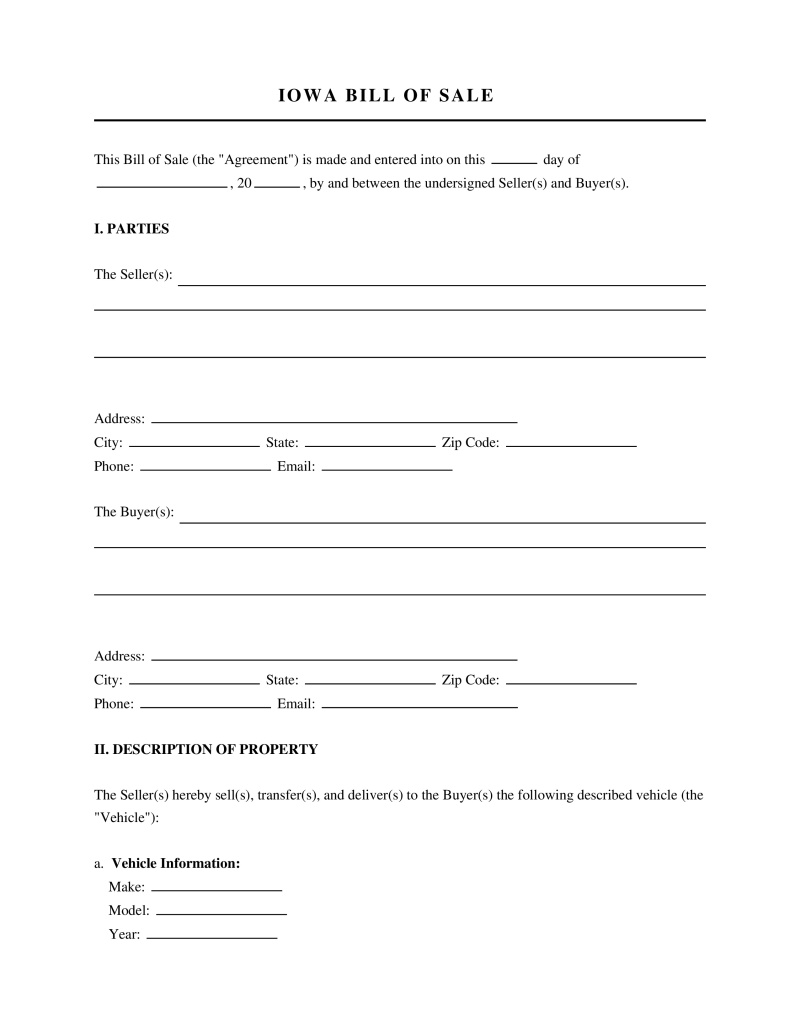
An Iowa Bill of Sale is a legal instrument that formally documents the transfer of ownership of personal property from a seller to a buyer within the state.
Asset Type
Choose the category that best describes the item. This helps include the right identifying details, such as VIN, hull number, serial number, or livestock identifiers.
Use this when the item does not fit one of the listed categories.
Table of Contents
What is an Iowa Bill of Sale?
An Iowa bill of sale is a legal document that records the transfer of ownership of personal property from a seller to a buyer within the state of Iowa. It serves as proof of purchase and sale, detailing the transaction's specifics, including the identity of both parties, a description of the item being sold, the purchase price, and the date of the transfer. This document is widely used for various types of personal property, such as vehicles, boats, firearms, and other valuable goods, providing essential documentation for both legal and administrative purposes.
Legal Requirements and Validity of an Iowa Bill of Sale
For an Iowa bill of sale to be legally valid and enforceable, it must accurately reflect the terms of the transaction and include several key pieces of information. While Iowa law does not mandate a specific form for all personal property sales, certain elements are crucial for establishing a clear record of ownership transfer. Adherence to these requirements helps prevent future disputes and ensures the document holds legal weight.
- Identification of Parties - The full legal names and addresses of both the seller (grantor) and the buyer (grantee) must be clearly stated. This ensures that the parties involved in the transaction are unambiguously identified.
- Description of Property - A detailed and unambiguous description of the personal property being sold is essential. For vehicles, this includes the make, model, year, Vehicle Identification Number (VIN), and odometer reading. For other items, specific identifiers like serial numbers, colors, or unique characteristics should be included to prevent confusion.
- Purchase Price and Terms - The agreed-upon purchase price must be clearly indicated. If the sale involves a gift, trade, or other non-monetary consideration, this should also be explicitly stated. Any specific payment terms, such as installment plans or conditions for payment, should be outlined.
- Date of Transaction - The exact date on which the sale and transfer of ownership occurred is a critical component for establishing the timeline of the transaction.
- Signatures of Parties - Both the seller and the buyer must sign and date the bill of sale. Their signatures signify their agreement to the terms and conditions outlined in the document and confirm the transfer of ownership.
- Witness or Notarization - While often not legally required for all personal property sales in Iowa, having the bill of sale witnessed or notarized can add an extra layer of legal validity and authenticity, particularly for high-value items or complex transactions.
How to Complete an Iowa Bill of Sale
Creating a comprehensive and legally sound Iowa bill of sale involves several straightforward steps, ensuring all necessary information is accurately recorded for the transaction. Following these guidelines will help both parties create a valid document.
- Gather Essential Information - Before beginning, collect all necessary details from both the buyer and the seller, including their full legal names, current addresses, and contact information. For the item being sold, gather its make, model, year, serial number (if applicable), and any other unique identifying features. For vehicles, the Vehicle Identification Number (VIN) and current odometer reading are crucial.
- Identify the Parties and Property - Clearly state the full legal names and addresses of both the seller and the buyer at the top of the document. Subsequently, provide a thorough and precise description of the personal property being transferred. This detailed description helps to prevent any ambiguity regarding the item being sold.
- Specify the Purchase Price and Date - Accurately record the total agreed-upon purchase price for the item. If the transaction involves a gift, trade, or other forms of consideration, clearly state this instead of a monetary value. The exact date of the transaction should also be entered to establish the official time of ownership transfer.
- Outline Terms and Conditions (Optional) - Include any specific terms or conditions relevant to the sale, such as whether the item is being sold "as-is" without warranties, or if there are any specific payment arrangements. For vehicles, it is common to include a statement about the odometer reading's accuracy. This section allows for customization based on the nature of the sale.
- Sign and Date the Document - Both the seller and the buyer must sign and print their names on the bill of sale. Their signatures confirm their agreement to the terms and acknowledge the transfer of ownership. The date of signing should also be included next to each signature.
- Provide Copies to All Parties - Once completed and signed, ensure that both the seller and the buyer receive original copies of the Iowa bill of sale. This ensures that each party has official documentation of the transaction for their records, which may be required for title transfers, tax purposes, or future reference.
Rights and Obligations of Parties in an Iowa Bill of Sale
A bill of sale formalizes the transfer of personal property, establishing specific rights and obligations for both the seller and the buyer. Understanding these responsibilities is crucial for a smooth transaction and for protecting the interests of both parties under Iowa law.
- Seller's Obligation to Transfer Clear Title - The seller is generally obligated to transfer legal ownership of the property to the buyer free from any undisclosed liens, encumbrances, or claims. This means the seller warrants that they are the rightful owner and have the authority to sell the item.
- Seller's Obligation for Disclosure - While many sales of used personal property are "as-is" in Iowa, sellers may still have an obligation to disclose known material defects that are not readily apparent to the buyer. Misrepresentation or fraud regarding the condition of the item can void the sale or lead to legal repercussions.
- Buyer's Obligation for Payment - The buyer is obligated to provide the agreed-upon consideration (usually monetary payment) to the seller as specified in the bill of sale. Failure to pay the full amount can result in the seller retaining ownership or pursuing legal action for breach of contract.
- Buyer's Right to Receive Property - Upon full payment, the buyer has the right to take possession of the purchased property. The seller is typically responsible for delivering the item or making it available for pickup as agreed.
- Buyer's Responsibility for Due Diligence - Buyers have a responsibility to inspect the property before purchase, especially in "as-is" sales. While sellers must disclose known defects, buyers should conduct their own examination to ensure the item meets their expectations.
Transfer of Ownership and Titling in Iowa
While an Iowa bill of sale serves as proof of a transaction, for certain types of personal property, particularly vehicles, a separate process is required to formally transfer the title and register the item with the state. This process ensures that the state's official records reflect the correct owner and facilitates compliance with applicable laws.
For motor vehicles, boats, and other titled property in Iowa, the bill of sale is typically a supporting document for the title transfer process. The County Treasurer's office handles vehicle titling and registration. The process generally involves:
- Endorsed Certificate of Title - The seller must sign and date the existing certificate of title, transferring it to the buyer. This endorsement includes the seller's signature, printed name, and the sale date, along with the odometer disclosure for vehicles.
- Application for New Title - The buyer must complete an Application for Certificate of Title and Registration (Iowa DOT Form 411007) and submit it to their County Treasurer's office. This application requires information from the bill of sale and the endorsed title.
- Payment of Fees and Taxes - Buyers are typically responsible for paying title transfer fees, registration fees, and any applicable sales tax (e.g., Iowa's 5% sales tax on vehicles) at the time of titling.
- Proof of Insurance - For motor vehicles, proof of financial responsibility (vehicle insurance) is required to register the vehicle in the buyer's name.
- Issuance of New Title and Registration - Once all requirements are met and fees are paid, the County Treasurer's office will issue a new certificate of title in the buyer's name and new registration plates or stickers.
Failure to properly transfer a title can lead to legal complications, including penalties, inability to register the vehicle, and issues with proving ownership.
Applicable Federal and State Laws
The creation and enforcement of an Iowa bill of sale are governed by both federal and state laws, which aim to ensure fair transactions, protect consumers, and prevent fraud. These laws provide the legal framework within which such transfers of personal property occur.
- Uniform Commercial Code (UCC) as adopted by Iowa - Governs commercial transactions, including the sale of goods. Article 2 of the UCC specifically addresses the sale of goods, covering aspects such as contract formation, warranties, and remedies for breach (Iowa Code Chapter 554, Article 2).
- Iowa Code Chapter 321 (Motor Vehicles and Law of the Road) - Contains extensive provisions regarding the titling, registration, and transfer of ownership of motor vehicles in Iowa. This chapter dictates the requirements for odometer statements, assignment of titles, and associated fees (Iowa Code § 321.1 et seq.).
- Iowa Consumer Fraud Act - Prohibits deceptive practices, misrepresentation, and unfair methods of competition in the sale of goods and services. Sellers who engage in fraudulent activities when selling personal property can face significant penalties, including fines and civil lawsuits (Iowa Code Chapter 714.16).
- Federal Odometer Act (Truth in Mileage Act) - Requires sellers of motor vehicles to provide an accurate odometer disclosure statement to the buyer at the time of sale. Tampering with an odometer is a federal offense, carrying severe penalties for violations (49 U.S.C. § 32701 et seq.).
- Federal Trade Commission (FTC) Used Car Rule - Mandates that dealerships prominently display a Buyer's Guide on all used cars offered for sale, disclosing warranty information and whether the vehicle is sold "as-is." While primarily for dealers, it reflects broader consumer protection principles (16 CFR Part 455).
Penalties for non-compliance with these laws can vary significantly depending on the nature and severity of the violation. For instance, odometer fraud can result in civil penalties of up to three times the actual damages or $10,000, whichever is greater, and potential criminal prosecution. Violations of the Iowa Consumer Fraud Act can lead to injunctions, restitution to consumers, and civil penalties of up to $40,000 per violation. Improper vehicle titling or registration can result in fines, late fees, and potential impoundment of the vehicle.
Frequently Asked Questions
Iowa Bill of Sale Sample
Bill of Sale in other states
Not the form you're looking for?
Try our legal document generator to create a custom document
Disclaimer: The templates available on this website are provided for general informational purposes only and do not constitute legal advice. They are not intended to be, and should not be interpreted as, compliant with any specific legal, regulatory, or privacy requirements. These templates are not a replacement for professional legal guidance and should not be relied upon for any particular matter or circumstance. Users are strongly encouraged to seek advice from a qualified attorney licensed in their jurisdiction before using, modifying, or relying on any template.
All templates are provided on an "as is," "with all faults," and "as available" basis. The provider disclaims any and all warranties of any kind, whether express, implied, statutory, or otherwise, including without limitation warranties of merchantability, fitness for a particular purpose, title, or non-infringement.
LegalTemplates.com makes no guarantees or representations regarding the accuracy, completeness, expected outcomes, or reliability of the materials contained in these templates or any materials referenced or linked from them.