Alabama Power of Attorney Form
An Alabama Power of Attorney Form is a legal instrument that enables an individual, known as the principal, to formally designate another person, the agent, to make decisions or act on their behalf.
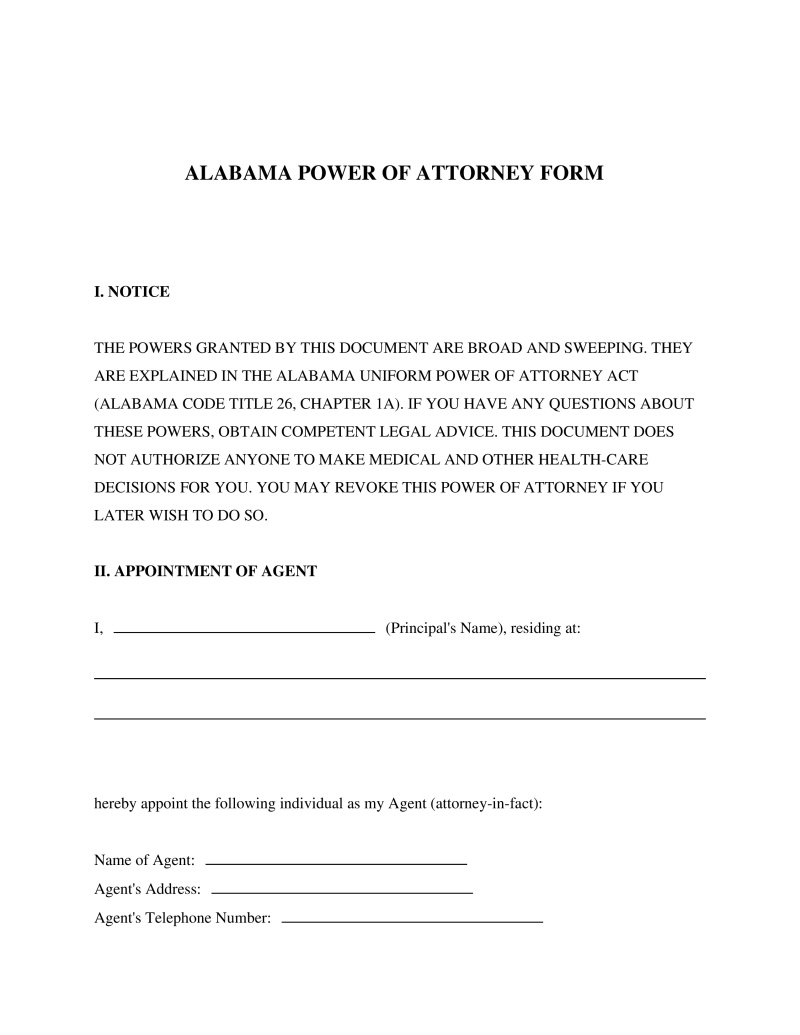
Authority Effective Timing
Many powers of attorney are effective immediately. A springing power of attorney becomes effective only after a stated event, commonly the Principal's incapacity, but some jurisdictions impose special requirements for proving that event.
Use this only if the authority should not begin immediately and should start on a calendar date.
Describe the triggering event clearly, such as written certification of incapacity by one or two licensed physicians.
For springing authority, third parties often need clear proof before accepting the Agent's authority.
Use precise language so banks, healthcare providers, or other institutions can verify when the authority has begun.
Table of Contents
What is an Alabama Power of Attorney Form?
An Alabama Power of Attorney form is a legal document that grants one individual, known as the agent or attorney-in-fact, the authority to act on behalf of another person, the principal, in specific legal, financial, or healthcare matters. This instrument allows the principal to delegate decision-making power, ensuring their affairs can be managed even if they become unavailable or incapacitated. The scope of authority granted can vary significantly, ranging from very broad powers to highly specific tasks, depending on the principal's needs and the type of power of attorney executed.
Types of Powers of Attorney in Alabama
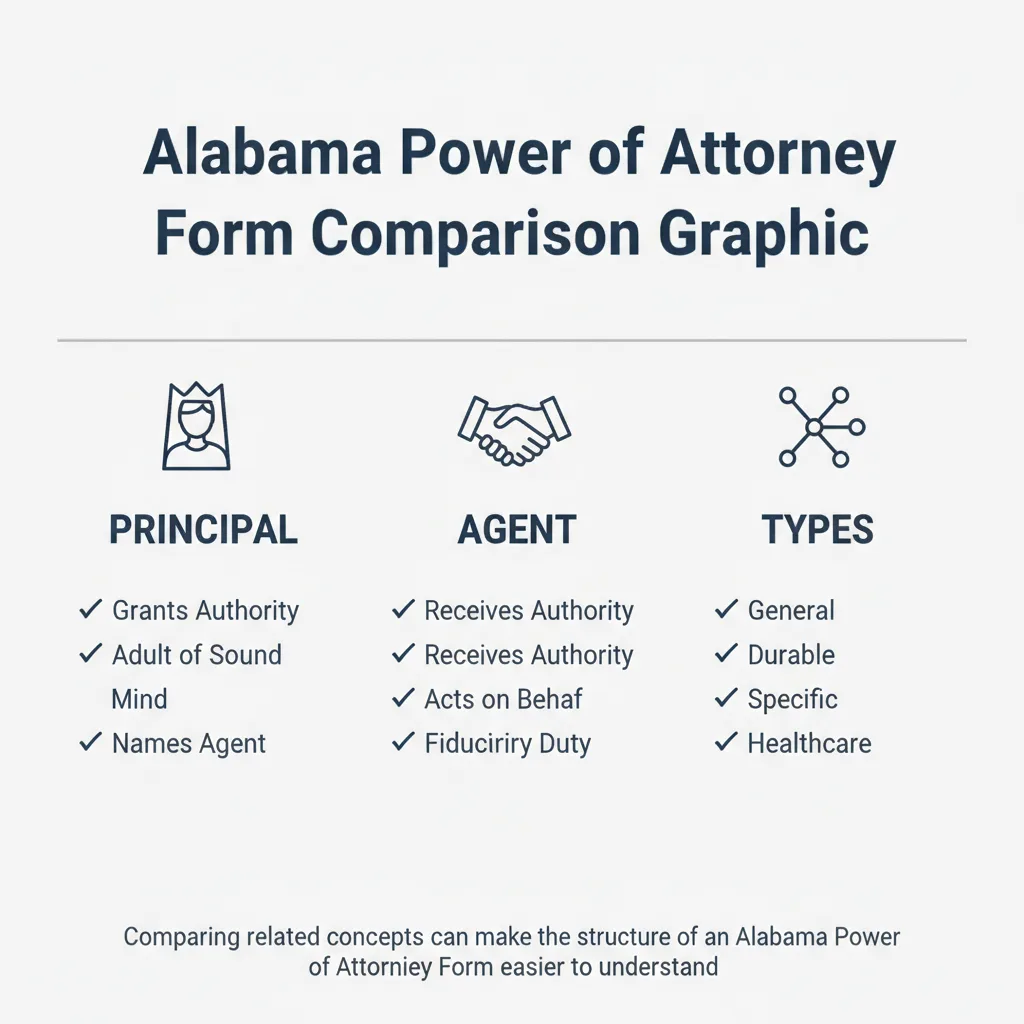
While the specific legal framework for powers of attorney in Alabama is primarily derived from common law principles and specific statutory provisions for certain applications, several general types are commonly recognized and utilized:
- General Power of Attorney - Grants the agent broad authority to act on the principal's behalf in all financial and legal matters. This type typically becomes invalid if the principal becomes incapacitated.
- Durable Power of Attorney - Remains effective even if the principal becomes incapacitated. This is a critical distinction for long-term planning and is often used for financial management.
- Special or Limited Power of Attorney - Grants the agent specific, narrow authority to act on the principal's behalf for a particular transaction or during a defined period. For example, it might authorize an agent to sell a specific property or handle a single banking transaction.
- Healthcare Power of Attorney (Advance Directive for Healthcare) - Appoints an agent to make medical decisions for the principal if they are unable to do so themselves. This document is often part of an broader advance directive that may also include living will provisions.
Parties to an Alabama Power of Attorney
A Power of Attorney involves two primary parties, each with distinct roles and responsibilities that are legally defined upon the document's execution. Understanding these roles is fundamental to the proper creation and application of the instrument.
- Principal - The individual granting authority. The principal must be of sound mind and legal age (typically 18 years old) at the time the power of attorney is signed, understanding the nature and consequences of the document.
- Agent (or Attorney-in-Fact) - The individual receiving the authority to act on behalf of the principal. The agent has a fiduciary duty to act in the principal's best interest, managing affairs diligently and honestly. The agent does not need to be an attorney, but should be a trustworthy individual capable of handling the delegated responsibilities.
Key Elements and Notarization Requirements
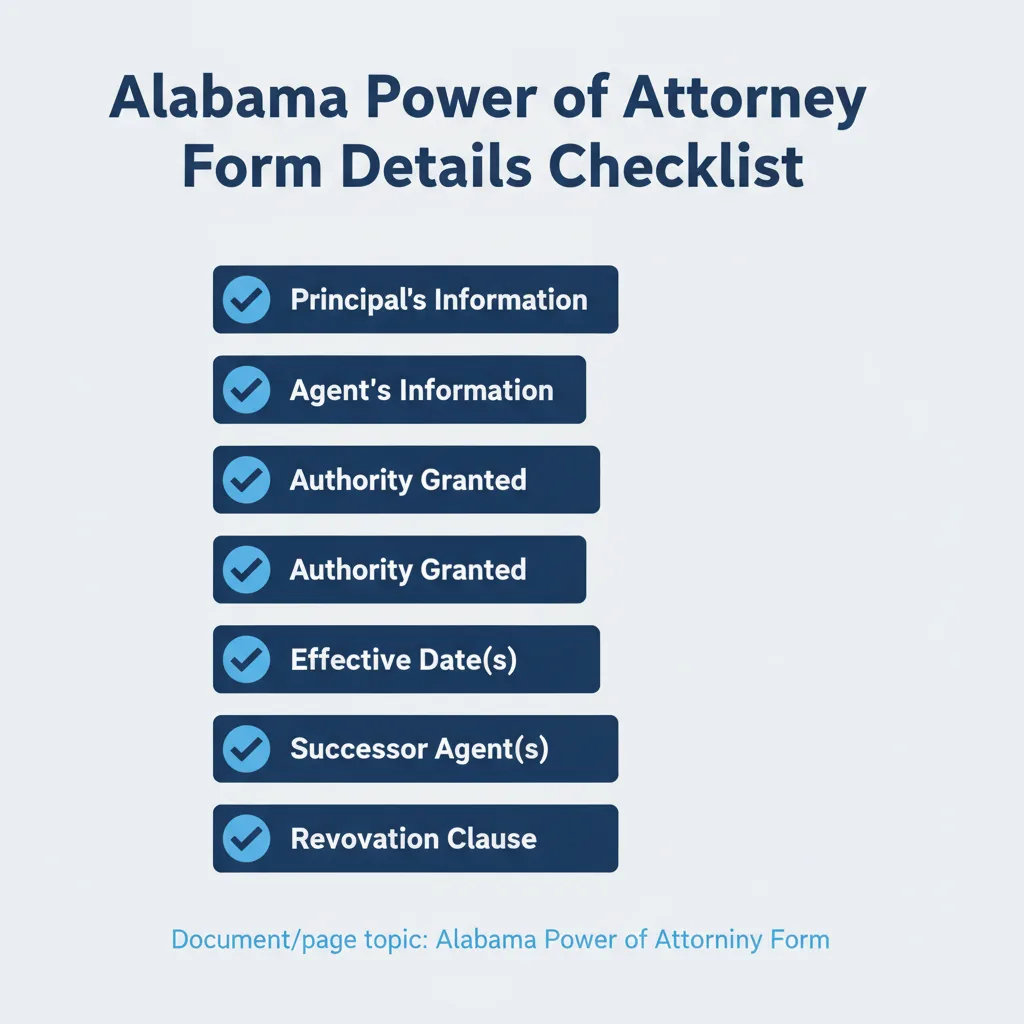
For an Alabama Power of Attorney form to be legally valid and effective, it must adhere to certain fundamental requirements. While specific forms may vary for particular purposes, general elements and signing procedures are consistent across most types of powers of attorney.
- Clear Identification of Parties - The document must explicitly name the principal and the agent, including their full legal names and addresses.
- Grant of Authority - The powers being granted to the agent must be clearly and unambiguously stated. This section defines the scope of the agent's ability to act, whether broad or limited.
- Effective Date and Durability Clause - The power of attorney should specify when it becomes effective. If it is intended to remain valid upon the principal's incapacitation, it must include specific language to establish its durability.
- Principal's Signature - The principal must sign the document voluntarily.
- Notarization - In Alabama, a Power of Attorney typically requires notarization to be legally enforceable. Notaries public in Alabama have the authority to take acknowledgments of instruments such as powers of attorney, verifying the principal's identity and ensuring the signature is authentic. This process adds a layer of legal validity and helps prevent fraud.
Specific Applications in Alabama
Various state agencies in Alabama provide or recognize specific Power of Attorney forms tailored for particular administrative purposes, streamlining the process for principals to delegate authority in specialized areas:
- Unemployment Compensation Matters - The Alabama Department of Labor offers a Power of Attorney form specifically for unemployment compensation matters. This allows an agent to represent a claimant in interactions with the Department regarding their unemployment benefits.
- Tax Tribunal Representation - The Alabama Tax Tribunal provides a Power of Attorney and Declaration of Representative Form 2848ATT. This form authorizes an agent to represent the principal before the Tax Tribunal for various tax-related proceedings and appeals.
- Vehicle-Related Transactions - The Alabama Department of Revenue's training manual includes information on Power of Attorney requirements for vehicle-related matters. This indicates that a Power of Attorney can be used to authorize an agent to handle tasks such as vehicle registration, titling, or sales on behalf of the principal.
Revocation and Termination of an Alabama Power of Attorney
An Alabama Power of Attorney is not necessarily permanent and can be terminated under various circumstances. Understanding how a power of attorney can be revoked or naturally expires is crucial for both principals and agents.
- Principal's Revocation - The principal can revoke a Power of Attorney at any time, provided they are of sound mind. Revocation should be done in writing, signed by the principal, and preferably notarized. It is also advisable to notify the agent and any third parties who have relied on the power of attorney about the revocation.
- Death of the Principal - A Power of Attorney automatically terminates upon the death of the principal, regardless of its durability clause.
- Incapacitation (for Non-Durable POAs) - If the Power of Attorney is not designated as durable, it terminates automatically if the principal becomes incapacitated.
- Specific Termination Date or Event - A Power of Attorney may specify a particular date or the occurrence of a certain event that will cause it to terminate.
- Agent's Inability or Unwillingness to Serve - If the appointed agent becomes incapacitated, resigns, or is unwilling to act, the Power of Attorney may terminate unless a successor agent is named in the document.
Frequently Asked Questions
Sources
- Alabama Department of Labor: Unemployment Compensation Power of Attorney Form - Provides a Power of Attorney form for unemployment compensation matters in Alabama.
- Alabama Department of Revenue: Power of Attorney and Declaration of Representative Form 2848ATT - Provides a Power of Attorney form for representation before the Alabama Tax Tribunal.
- Alabama Department of Revenue: Designated Agent Training Manual - Includes information on Power of Attorney requirements for vehicle-related matters in Alabama.
- Alabama Secretary of State: Notaries Public - Provides information on the role of notaries public in Alabama, including their authority to take acknowledgments of instruments such as powers of attorney.
Power of Attorney in other states
Not the form you're looking for?
Try our legal document generator to create a custom document
Disclaimer: The templates available on this website are provided for general informational purposes only and do not constitute legal advice. They are not intended to be, and should not be interpreted as, compliant with any specific legal, regulatory, or privacy requirements. These templates are not a replacement for professional legal guidance and should not be relied upon for any particular matter or circumstance. Users are strongly encouraged to seek advice from a qualified attorney licensed in their jurisdiction before using, modifying, or relying on any template.
All templates are provided on an "as is," "with all faults," and "as available" basis. The provider disclaims any and all warranties of any kind, whether express, implied, statutory, or otherwise, including without limitation warranties of merchantability, fitness for a particular purpose, title, or non-infringement.
LegalTemplates.com makes no guarantees or representations regarding the accuracy, completeness, expected outcomes, or reliability of the materials contained in these templates or any materials referenced or linked from them.