Motion to Compel
A Motion to Compel is a formal legal request submitted to a court asking a judge to order an opposing party to comply with discovery obligations or other procedural requirements.
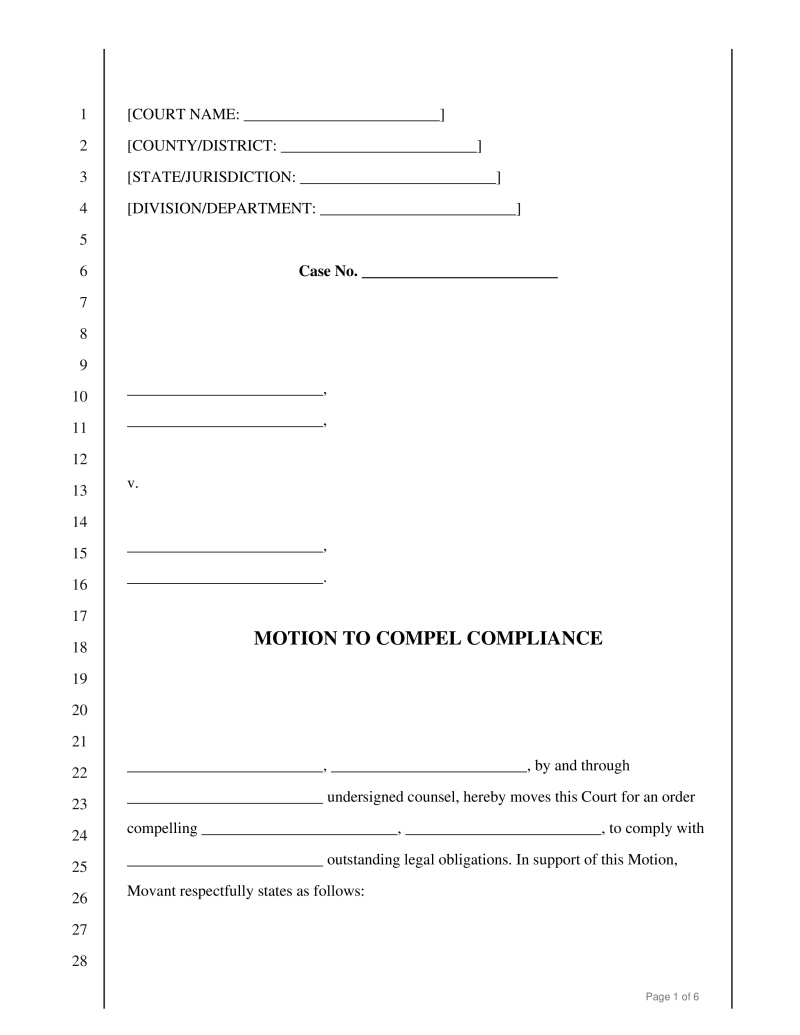
Primary Unmet Obligation
Choose the best fit. You can add more detail later. Motions to compel often involve discovery responses, document production, deposition conduct, subpoena compliance, or compliance with a prior order.
Use a short description of the obligation the non-complying person or entity has not met.
Table of Contents
What is a Motion to Compel?
A Motion to Compel is a formal legal request filed with a court asking a judge to order an opposing party, or sometimes a third party, to take a specific action. It is most frequently used during the pre-trial discovery phase of civil litigation when one party refuses to answer interrogatories, produce requested documents, or appear for a deposition. The moving party must demonstrate to the court that they have made a good-faith effort to resolve the dispute without court intervention before seeking judicial relief.
Common Scenarios for Filing a Motion to Compel
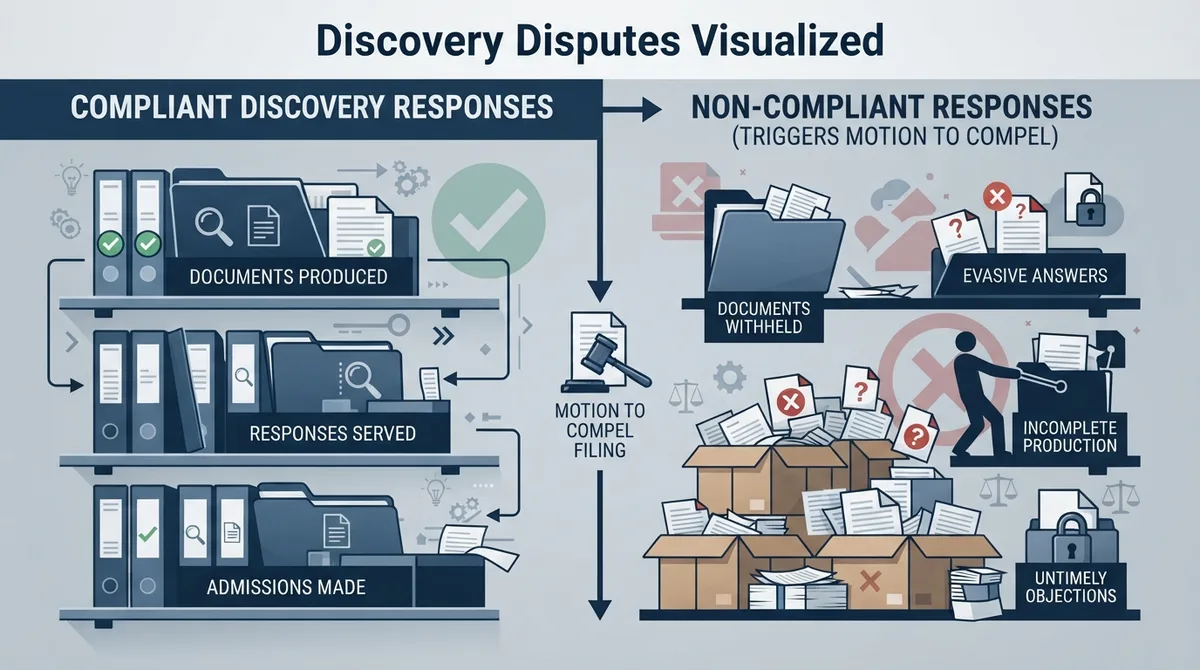
Parties in civil litigation utilize this motion to resolve various discovery disputes:
- Failure to Answer Interrogatories - One party fails to provide written answers to questions posed during discovery within the legally prescribed timeframe.
- Withholding Requested Documents - A party refuses to produce physical or electronic records, emails, financial statements, or other physical evidence relevant to the lawsuit.
- Refusal to Submit to Depositions - An individual fails to appear for a scheduled deposition or refuses to answer questions during a deposition without a valid legal privilege.
- Inadequate or Evasive Responses - A party provides incomplete, vague, or boilerplate objections to discovery requests rather than substantive answers.
- Refusal to Permit Property Inspection - An opposing party denies access to land, buildings, or physical equipment necessary for inspection or testing.
Types of Discovery Subject to Compulsion
Discovery mechanisms that can be enforced through a court order include:
- Interrogatories - Written questions that the receiving party must answer under oath within a specified timeframe.
- Requests for Production of Documents - Formal demands for physical or electronic evidence, including emails, medical records, contracts, and database exports.
- Requests for Admission - Written statements that the opposing party must either admit or deny to narrow the factual issues for trial.
- Depositions - Out-of-court oral testimony taken under oath, which is transcribed by a court reporter for potential use in trial.
- Physical and Mental Examinations - Court-ordered evaluations of a party whose physical or mental condition is a central issue in the case.
The Meet and Confer Requirement
Courts require parties to attempt to resolve discovery disputes independently before seeking judicial intervention. This process is known as the meet and confer requirement. The moving party must document these efforts in detail, usually by attaching a certification to the motion. If a party files a motion without first attempting to resolve the matter in good faith, the court may deny the motion outright or impose financial sanctions on the filing party.
Rules Governing Motions to Compel
Civil procedure rules at both the federal and state levels establish the framework for compelling discovery:
- Federal Rule of Civil Procedure 37 - Governs motions for an order compelling disclosure or discovery in federal courts (Fed. R. Civ. P. 37).
- Good Faith Certification Requirement - Mandates that a motion to compel must include a certification that the movant has in good faith conferred or attempted to confer with the opposing party (Fed. R. Civ. P. 37(a)(1)).
- Payment of Expenses and Fees - Requires the losing party to pay the prevailing party's reasonable expenses, including attorney fees, unless the nondisclosure was substantially justified (Fed. R. Civ. P. 37(a)(5)).
- Sanctions for Noncompliance - Authorizes courts to issue further sanctions, such as dismissing the action or entering a default judgment, if a party disobeys a court order to compel (Fed. R. Civ. P. 37(b)).
Court Rulings and Sanctions for Noncompliance
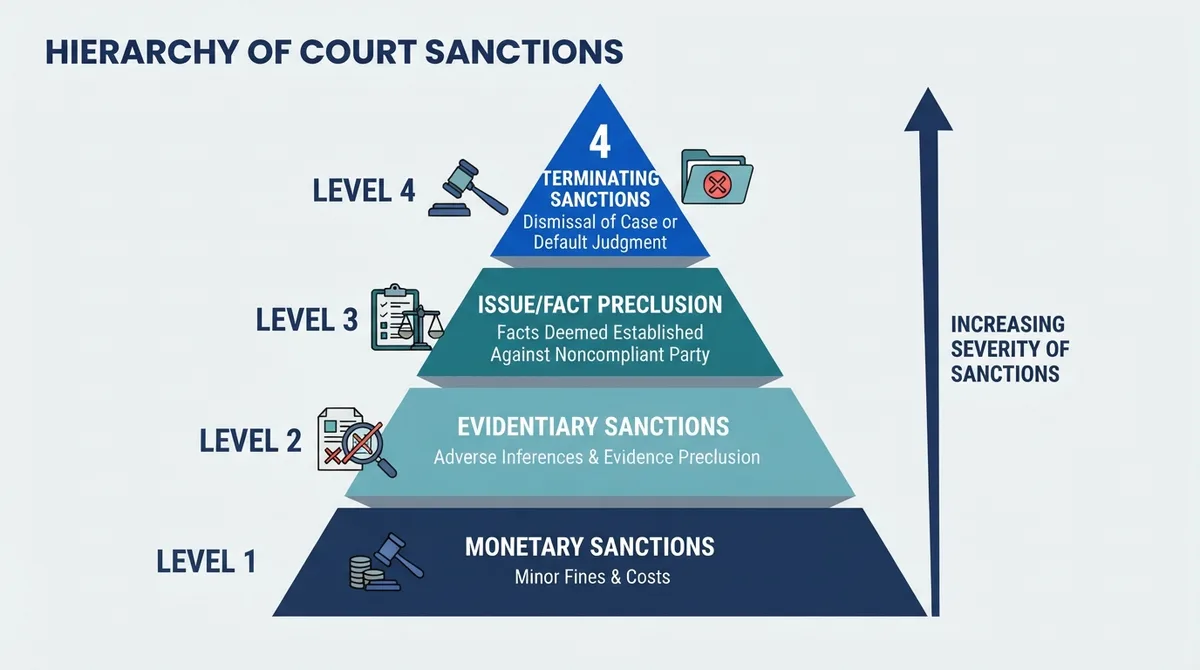
When a judge reviews a motion, they may grant the motion in whole or in part, deny the motion, or issue protective orders. If the court grants the motion, the non-compliant party must provide the requested discovery within a specified timeframe. Continued failure to comply with the court's order can lead to severe legal consequences:
- Monetary Sanctions - Ordering the non-compliant party or their attorney to pay the reasonable attorney fees and costs incurred in bringing the motion.
- Evidentiary Sanctions - Prohibiting the disobedient party from introducing certain evidence or supporting or opposing designated claims or defenses.
- Striking Pleadings - Striking portions of the non-compliant party's complaint or answer, which can severely damage their legal position.
- Contempt of Court - Treating the failure to obey the court order as contempt of court, which can result in fines or even imprisonment.
- Default Judgment or Dismissal - Dismissing the action in whole or in part, or rendering a default judgment against the disobedient party.
Frequently Asked Questions
Not the form you're looking for?
Try our legal document generator to create a custom document
Disclaimer: The templates available on this website are provided for general informational purposes only and do not constitute legal advice. They are not intended to be, and should not be interpreted as, compliant with any specific legal, regulatory, or privacy requirements. These templates are not a replacement for professional legal guidance and should not be relied upon for any particular matter or circumstance. Users are strongly encouraged to seek advice from a qualified attorney licensed in their jurisdiction before using, modifying, or relying on any template.
All templates are provided on an "as is," "with all faults," and "as available" basis. The provider disclaims any and all warranties of any kind, whether express, implied, statutory, or otherwise, including without limitation warranties of merchantability, fitness for a particular purpose, title, or non-infringement.
LegalTemplates.com makes no guarantees or representations regarding the accuracy, completeness, expected outcomes, or reliability of the materials contained in these templates or any materials referenced or linked from them.