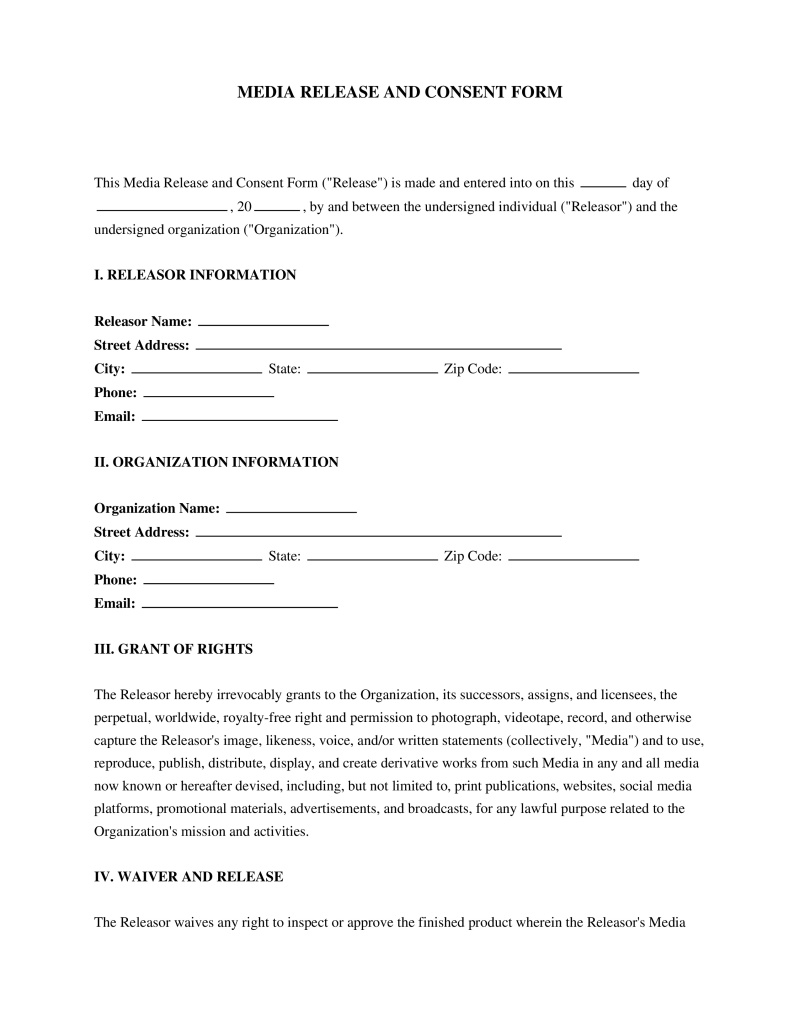
Media Release Template
A Media Release is a formal statement issued to the press, often including a grant of rights for publication or broadcast.
Media Types Granted
Select all types of media for which permission is granted.
Describe any additional media types covered by this release.
Table of Contents
What is a Media Release Template?
A media release template is a standardized document format used by organizations or individuals to disseminate newsworthy information to journalists, media outlets, and the public. Its primary purpose is to announce significant events, achievements, product launches, or other developments in a formal and concise manner, aiming to secure media coverage. This structured format ensures that all critical information is presented clearly and consistently, facilitating quick understanding and efficient reporting by media professionals. Companies, non-profit organizations, government agencies, and public relations firms are common users of these templates to manage their public communications.
Key Elements of a Media Release Template
A well-structured media release template includes several standard components designed to provide comprehensive information while adhering to journalistic conventions:
- FOR IMMEDIATE RELEASE - A standard header indicating that the information can be published immediately.
- Headline - A concise, attention-grabbing statement summarizing the most important news.
- Dateline - Specifies the city, state, and date from which the news originates (e.g., NEW YORK – June 1, 2023).
- Introduction (Lead Paragraph) - The first paragraph, often called the “lede,” which summarizes the core news story and answers the who, what, when, where, and why.
- Body Paragraphs - Detailed information expanding on the introduction, providing context, quotes from key individuals, and supporting facts or statistics.
- Boilerplate (About Us) - A brief, standard paragraph providing background information about the issuing organization.
- Media Contact Information - Name, title, phone number, and email address of the person media representatives can contact for further information or interviews.
- ### (End Mark) - A traditional journalistic symbol indicating the end of the press release.
- Call to Action (Optional) - Instructions for readers, such as visiting a website, attending an event, or downloading a resource.
- Visual Elements (Optional) - Information about accompanying images, videos, or other multimedia assets.
How to Draft a Media Release Template
Creating an effective media release involves a methodical approach to ensure clarity, impact, and adherence to journalistic standards. Following a structured process helps organizations communicate their message efficiently and maximize their chances of media pickup.
- Identify the Newsworthy Angle - Before drafting, determine what makes your announcement relevant and interesting to the public and media. Is it a significant achievement, a unique product, a community benefit, or a response to a current event? Clearly define the primary message and the key takeaway you want journalists to convey.
- Craft a Compelling Headline and Lead Paragraph - The headline must be concise, active, and informative, summarizing the entire story in 10-20 words. The lead paragraph (the first paragraph) should immediately answer the fundamental questions of who, what, when, where, and why, providing a complete summary of the news. This ensures that even if a journalist only reads the first few lines, they grasp the core message.
- Develop the Body with Supporting Details and Quotes - Expand on the lead paragraph by providing additional context, background information, and specific details that support your announcement. Integrate direct quotes from relevant spokespeople, such as CEOs, project leaders, or beneficiaries, to add credibility and a human element to the story. Ensure quotes are impactful and convey enthusiasm or strategic importance.
- Include a Standard Boilerplate and Media Contact - Conclude the release with a boilerplate paragraph that briefly describes your organization, its mission, and its values. This provides essential background for journalists unfamiliar with your entity. Following the boilerplate, provide clear contact information for media inquiries, including a name, title, email address, and phone number, to facilitate follow-up questions and interview requests.
- Review, Edit, and Distribute - Thoroughly proofread the entire media release for grammatical errors, typos, factual inaccuracies, and clarity. Ensure it adheres to brand guidelines and legal requirements. Once finalized, distribute the release through appropriate channels, which may include direct outreach to target journalists, newswire services, or posting it on your organization's website and social media platforms.
Legal Considerations and Rights
While a media release template itself is a communication tool, its content and distribution are subject to various legal frameworks concerning accuracy, privacy, and intellectual property. Organizations must ensure that all information disseminated is factual and does not infringe upon the rights of others. Misleading statements can lead to legal liabilities, particularly in regulated industries.
- Defamation and Libel Laws - Organizations must ensure that statements made in a media release are truthful and do not unjustly harm the reputation of individuals or other entities. False statements of fact that cause damage can lead to claims of defamation (libel if written), which are governed by state common law and statutes (e.g., California Civil Code § 45).
- Right to Privacy and Publicity - If a media release mentions individuals, particularly in a promotional context, explicit consent may be required. The right to privacy protects individuals from the unauthorized public disclosure of private facts, while the right to publicity protects against the unauthorized commercial use of a person's name, likeness, or identity (e.g., New York Civil Rights Law § 50).
- Copyright Law - Any images, videos, or substantial textual content (beyond fair use) included or referenced in a media release must either be original work, licensed, or explicitly permitted for use. Unauthorized use of copyrighted material can lead to infringement claims (17 U.S.C. § 101 et seq.).
- Contractual Obligations - If the media release pertains to a joint venture, partnership, or settlement, its content must align with the terms of any underlying contractual agreements. Breaching confidentiality clauses or misrepresenting contractual terms can result in legal action.
Frequently Asked Questions
Not the form you're looking for?
Try our legal document generator to create a custom document
Disclaimer: The templates available on this website are provided for general informational purposes only and do not constitute legal advice. They are not intended to be, and should not be interpreted as, compliant with any specific legal, regulatory, or privacy requirements. These templates are not a replacement for professional legal guidance and should not be relied upon for any particular matter or circumstance. Users are strongly encouraged to seek advice from a qualified attorney licensed in their jurisdiction before using, modifying, or relying on any template.
All templates are provided on an "as is," "with all faults," and "as available" basis. The provider disclaims any and all warranties of any kind, whether express, implied, statutory, or otherwise, including without limitation warranties of merchantability, fitness for a particular purpose, title, or non-infringement.
LegalTemplates.com makes no guarantees or representations regarding the accuracy, completeness, expected outcomes, or reliability of the materials contained in these templates or any materials referenced or linked from them.