Maryland Bill of Sale
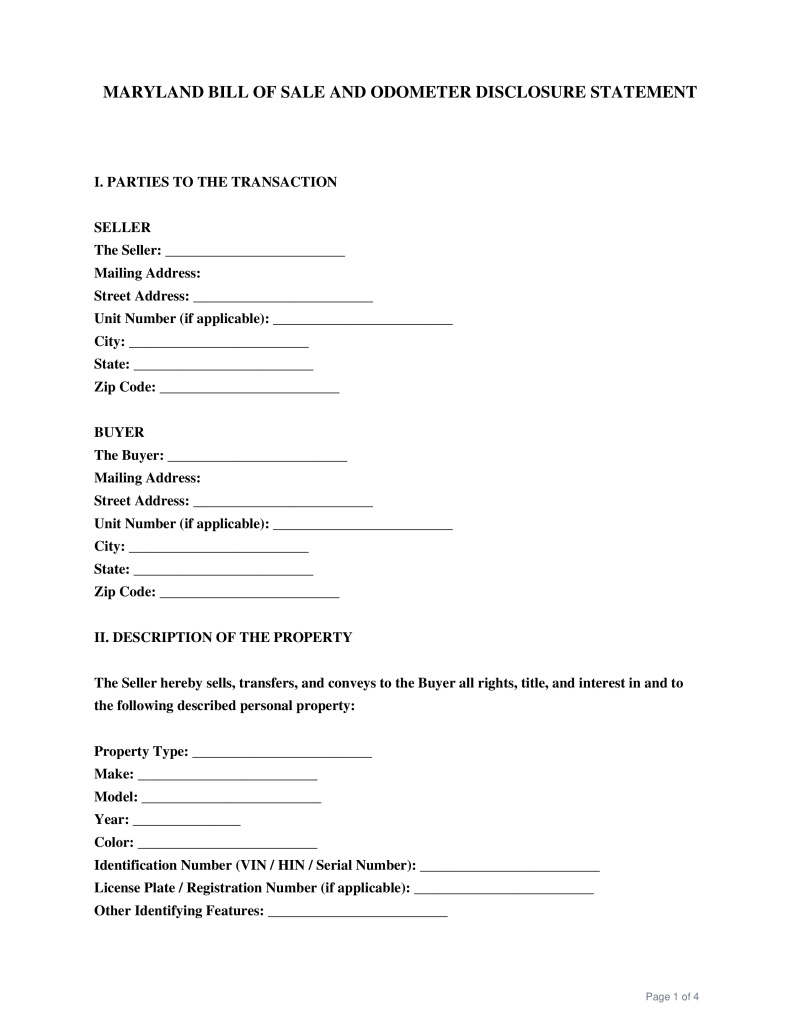
A Maryland Bill of Sale is a legal instrument that records the transfer of ownership of personal property, such as a vehicle or vessel, from a seller to a buyer within the state of Maryland.
Asset Type
Choose the category that best describes the item. This helps include the right identifying details, such as VIN, hull number, serial number, or livestock identifiers.
Use this when the item does not fit one of the listed categories.
Table of Contents
What is a Maryland Bill of Sale?
A Maryland Bill of Sale is a legal document that records the transfer of ownership of personal property, most commonly motor vehicles, from a seller to a buyer. This document serves as a receipt of the transaction, detailing the terms of the sale, the purchase price, and the identities of the parties involved. While it is primarily associated with motor vehicle transactions processed through the Maryland Department of Transportation Motor Vehicle Administration, it can also be drafted for other valuable personal items. Utilizing this form protects both parties by establishing a clear record of the transfer of ownership and liability.
Purpose and Legal Significance
Using a Maryland Bill of Sale provides essential legal protections for both the buyer and the seller during a private transaction. For the seller, the document serves as proof that they are no longer responsible for the item, which is particularly important for motor vehicles regarding future traffic violations, accidents, or liability claims. For the buyer, the document acts as proof of ownership, which is necessary when registering the property or obtaining a new title. The Maryland Department of Transportation Motor Vehicle Administration strongly recommends that private sellers provide a bill of sale to assist the buyer with the titling process and to safeguard both parties against future disputes.
Types of Maryland Bills of Sale
Different transactions require specific formats to ensure all necessary details are recorded for state agencies or personal records:
- Vehicle Bill of Sale (Form VR-181) - A specialized document provided by the Maryland Department of Transportation Motor Vehicle Administration used specifically for motor vehicle transactions to establish the official purchase price.
- General Bill of Sale - A versatile document used for the transfer of personal property such as electronics, furniture, or equipment where no state registration is required.
- Vessel Bill of Sale - A document used specifically for the transfer of boats and other watercraft, which may be required by the Maryland Department of Natural Resources for registration purposes.
Essential Elements of the Document
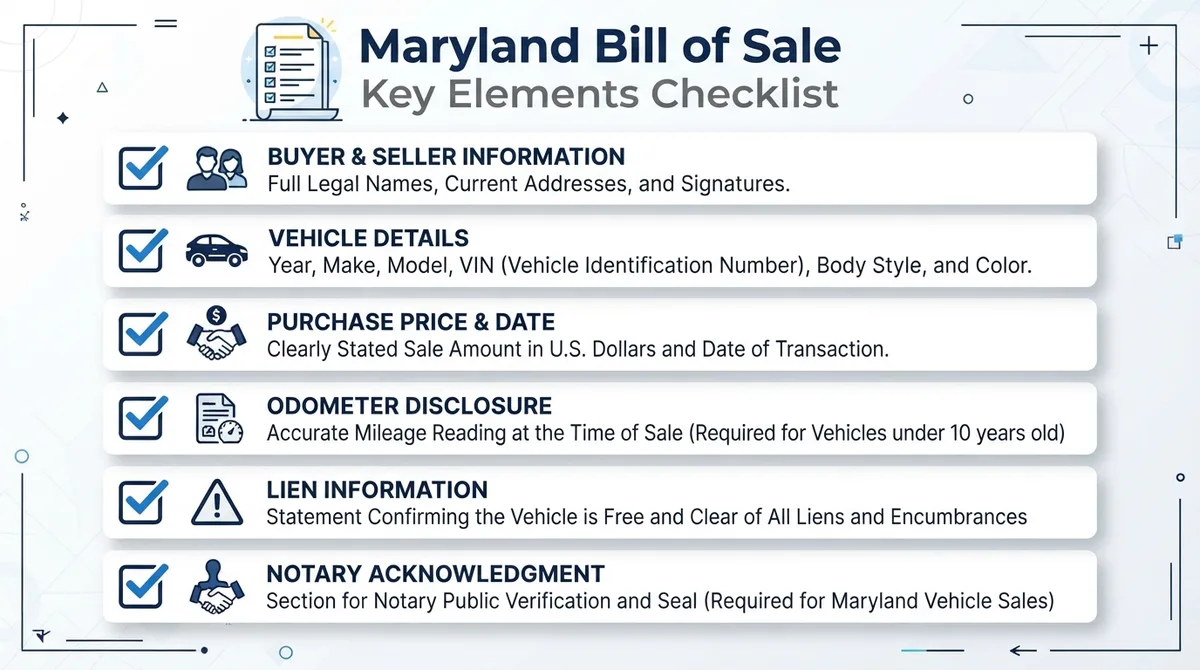
To ensure a Maryland Bill of Sale is legally useful and accepted by state agencies, it must contain specific pieces of information regarding the transaction:
- Party Identification - The full legal names, physical addresses, and signatures of both the buyer and the seller.
- Property Description - A detailed description of the item being sold, including make, model, year, and serial numbers or identification codes.
- Financial Details - The exact purchase price paid for the property, along with the date of the transaction and the payment method.
- Vehicle-Specific Information - For motor vehicles, the document must include the Vehicle Identification Number, the odometer reading at the time of sale, and the vehicle make, model, and body style.
Maryland MVA Form VR-181 Requirements
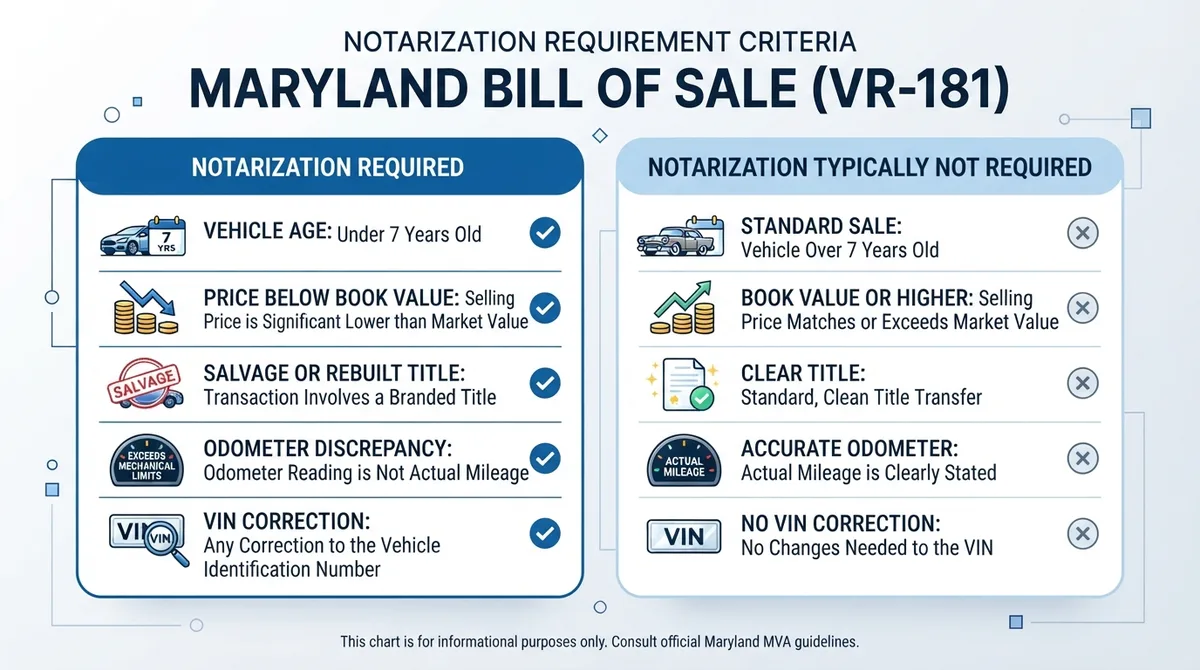
The Maryland Department of Transportation Motor Vehicle Administration provides an official Bill of Sale known as Form VR-181. This specific form has strict regulatory guidelines that must be followed for vehicle registration and titling:
- Notarization Requirement - Form VR-181 must be signed in the presence of a notary public if the vehicle is less than seven years old, the purchase price is at least 500 dollars below the book value, or the buyer wants to calculate excise tax based on the purchase price.
- Price Verification - The primary purpose of Form VR-181 is to establish the purchase price of the vehicle to calculate the state excise tax correctly.
- Incomplete Forms - The Motor Vehicle Administration will not accept altered, incomplete, or illegible forms, which can delay the titling process.
Guidelines for Completing a Vehicle Sale in Maryland
Private sellers and buyers must follow specific steps to ensure a legal and smooth transfer of vehicle ownership in the state of Maryland:
- Prepare the Title - The seller must sign and date the vehicle title on the transfer section, recording the odometer reading and the buyer's information.
- Complete the Bill of Sale - Both parties must fill out the Maryland Bill of Sale, ensuring all vehicle details, purchase price, and signatures are complete.
- Obtain Notarization - If the transaction meets the criteria for Form VR-181, the parties must sign the document in front of a licensed notary public.
- Remove License Plates - The seller must remove the license plates from the vehicle before handing it over to the buyer, returning them to the Motor Vehicle Administration or transferring them to another vehicle.
- Submit Registration Documents - The buyer must present the completed title, the bill of sale, proof of insurance, and safety inspection certificate to the Motor Vehicle Administration to complete registration.
Frequently Asked Questions
Sources
- Selling a Vehicle | MDOT Motor Vehicle Administration - Guidelines for private sellers on completing a vehicle sale in Maryland, including the use of a bill of sale.
- Buying a Vehicle | MDOT Motor Vehicle Administration - Information for buyers on completing a vehicle purchase in Maryland, emphasizing the importance of a bill of sale.
- Bill of Sale (Form VR-181) | MDOT Motor Vehicle Administration - Official Bill of Sale form (VR-181) provided by the MVA for vehicle transactions in Maryland.
Bill of Sale in other states
Not the form you're looking for?
Try our legal document generator to create a custom document
Disclaimer: The templates available on this website are provided for general informational purposes only and do not constitute legal advice. They are not intended to be, and should not be interpreted as, compliant with any specific legal, regulatory, or privacy requirements. These templates are not a replacement for professional legal guidance and should not be relied upon for any particular matter or circumstance. Users are strongly encouraged to seek advice from a qualified attorney licensed in their jurisdiction before using, modifying, or relying on any template.
All templates are provided on an "as is," "with all faults," and "as available" basis. The provider disclaims any and all warranties of any kind, whether express, implied, statutory, or otherwise, including without limitation warranties of merchantability, fitness for a particular purpose, title, or non-infringement.
LegalTemplates.com makes no guarantees or representations regarding the accuracy, completeness, expected outcomes, or reliability of the materials contained in these templates or any materials referenced or linked from them.