Illinois Bill of Sale
An Illinois Bill of Sale serves as proof that ownership of personal property has been transferred from a seller to a buyer in accordance with Illinois state requirements.
Asset Type
Choose the category that best describes the item. This helps include the right identifying details, such as VIN, hull number, serial number, or livestock identifiers.
Use this when the item does not fit one of the listed categories.
Table of Contents
What is an Illinois Bill of Sale?
An Illinois bill of sale serves as a legal document recording the transfer of ownership of personal property from a seller to a buyer within the state. This instrument functions primarily as a receipt, outlining the specific details of the transaction, including the purchase price, date of sale, and a comprehensive description of the item being transferred. Residents utilize this document for various exchanges, ranging from motor vehicles and watercraft to firearms and general personal effects, to establish proof of ownership and protect the seller from post-sale liability.
Legal Requirements
A bill of sale in Illinois becomes legally binding when it accurately reflects the agreement between the parties and adheres to state contract laws. While the document does not always require notarization to be valid between the buyer and seller, certain government agencies may require notarized signatures for specific transactions, such as title corrections. The document must contain accurate information to satisfy the requirements of the Illinois Secretary of State (SOS) during the registration process for titled property. A valid document typically prevents future legal disputes regarding ownership or the condition of the asset sold.
Required Elements of a Valid Illinois Bill of Sale
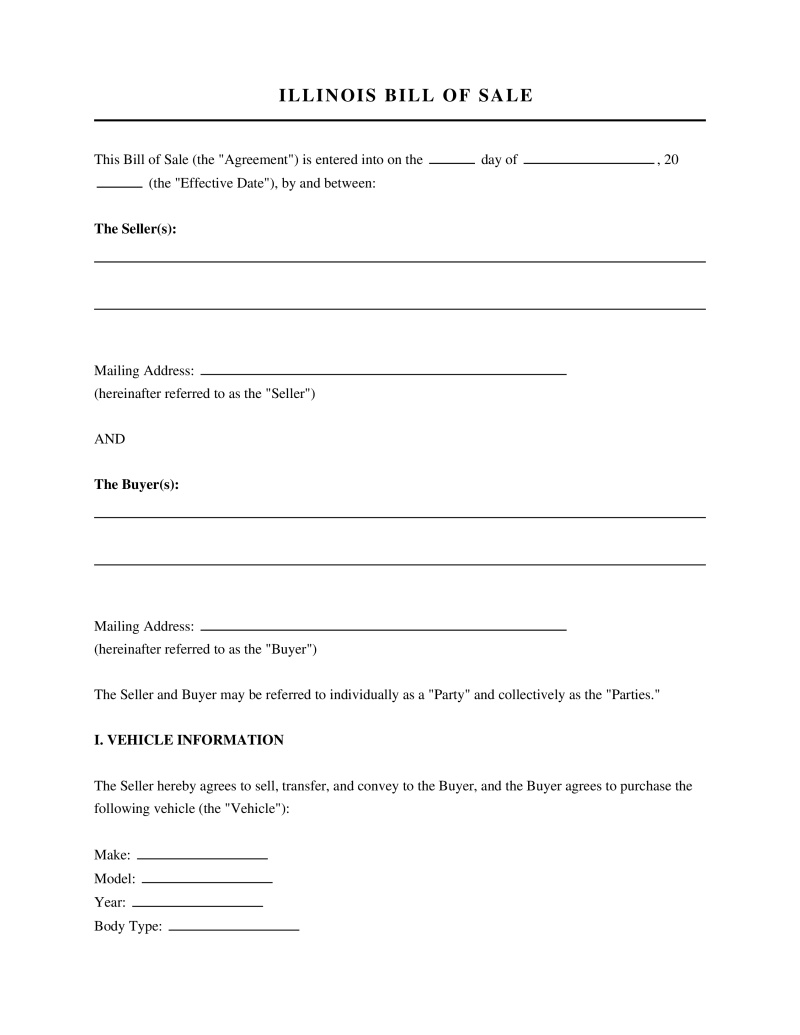
To ensure the document holds legal weight and satisfies state record-keeping requirements, specific information must appear in the final agreement:
- Parties' Information - Full legal names, physical addresses, and contact information for both the buyer and the seller.
- Property Description - Detailed identification of the item, including serial numbers, VIN (for vehicles), HIN (for boats), make, model, year, and color.
- Transaction Details - The agreed-upon purchase price, date of the transaction, and the method of payment.
- Odometer Disclosure - A statement verifying the accurate mileage reading for motor vehicles, required by federal and state law.
- Signatures - Dated signatures from both the buyer and the seller acknowledging the transfer of title and funds.
- Warranty Information - A clause specifying whether the item is sold "as-is" or if the seller provides specific warranties regarding the condition.
State Statutes and Regulations
Illinois law governs the sale of personal property through various statutes depending on the type of asset being transferred:
- Uniform Commercial Code (Sales) - Governs the general sale of goods and the enforcement of contracts between buyers and sellers (810 ILCS 5/2-101 et seq.).
- Illinois Vehicle Code - Mandates specific procedures for the transfer of vehicle titles and registration (625 ILCS 5/3-100 et seq.).
- Boat Registration and Safety Act - Outlines the requirements for transferring ownership of watercraft within the state (625 ILCS 45/3-1 et seq.).
- Firearm Owners Identification Card Act - Regulates the private sale of firearms, requiring verification of the buyer's FOID card and record retention (430 ILCS 65/3).
- Odometer Disclosure Requirements - Enforces the accurate reporting of mileage during the transfer of motor vehicles (625 ILCS 5/3-112.1).
- Private Party Vehicle Use Tax - Imposes tax obligations on the purchaser of a vehicle in a private transaction (35 ILCS 120/1 et seq.).
Vehicle Transfer and Tax Procedures
The transfer of a motor vehicle in Illinois involves specific steps beyond the simple exchange of keys. The Illinois Secretary of State requires the seller to sign over the Certificate of Title to the buyer. The bill of sale acts as a supplemental document to this process. It proves the purchase price, which is critical for calculating the appropriate taxes. Illinois imposes a Private Party Vehicle Use Tax on non-dealer transactions. The buyer must file specific tax forms based on the age and price of the vehicle. The bill of sale provides the necessary documentation to support the value declared on these tax returns.
Firearm Transfer Specifics
Illinois maintains strict regulations regarding the private transfer of firearms, which significantly impacts the content and retention of a bill of sale. Sellers must verify that the buyer possesses a valid Firearm Owners Identification (FOID) card through the Illinois State Police portal before completing the sale. The state mandates a waiting period before the buyer can take possession of the firearm. The bill of sale or transfer record must be retained by the seller for a statutory period. This document must include the specific details of the firearm and the transferee's FOID number to ensure compliance with state public safety laws.
How to Complete an Illinois Bill of Sale
Completing this document accurately ensures a smooth transfer of ownership and prevents administrative delays with state agencies.
- Negotiate Terms and Inspection - Inspect the property thoroughly and agree upon a final purchase price and the condition of the sale. This stage establishes whether the item includes any warranties or if the transaction occurs on an "as-is" basis.
- Draft the Document - Input the full legal names and addresses of both parties, along with a comprehensive description of the item. For vehicles, this includes the Vehicle Identification Number (VIN), make, model, and year; for other items, include serial numbers or unique identifiers.
- Record Odometer Reading - Verify the current mileage on the vehicle's dashboard and record this exact number on the document for vehicle sales. State and federal laws require this disclosure to prevent odometer fraud and ensure transparency.
- Execute the Agreement - Sign and date the document in the presence of the other party. While notarization remains optional for the bill of sale itself, having a notary witness the signatures adds a layer of authentication to the transaction.
- Finalize Transfer and Registration - Exchange the payment for the item and the completed document. The buyer must then take the bill of sale and the assigned title to the Illinois Secretary of State facility to apply for a new title and registration.
Frequently Asked Questions
Illinois Bill of Sale Sample
Bill of Sale in other states
Not the form you're looking for?
Try our legal document generator to create a custom document
Disclaimer: The templates available on this website are provided for general informational purposes only and do not constitute legal advice. They are not intended to be, and should not be interpreted as, compliant with any specific legal, regulatory, or privacy requirements. These templates are not a replacement for professional legal guidance and should not be relied upon for any particular matter or circumstance. Users are strongly encouraged to seek advice from a qualified attorney licensed in their jurisdiction before using, modifying, or relying on any template.
All templates are provided on an "as is," "with all faults," and "as available" basis. The provider disclaims any and all warranties of any kind, whether express, implied, statutory, or otherwise, including without limitation warranties of merchantability, fitness for a particular purpose, title, or non-infringement.
LegalTemplates.com makes no guarantees or representations regarding the accuracy, completeness, expected outcomes, or reliability of the materials contained in these templates or any materials referenced or linked from them.