California Power of Attorney Form
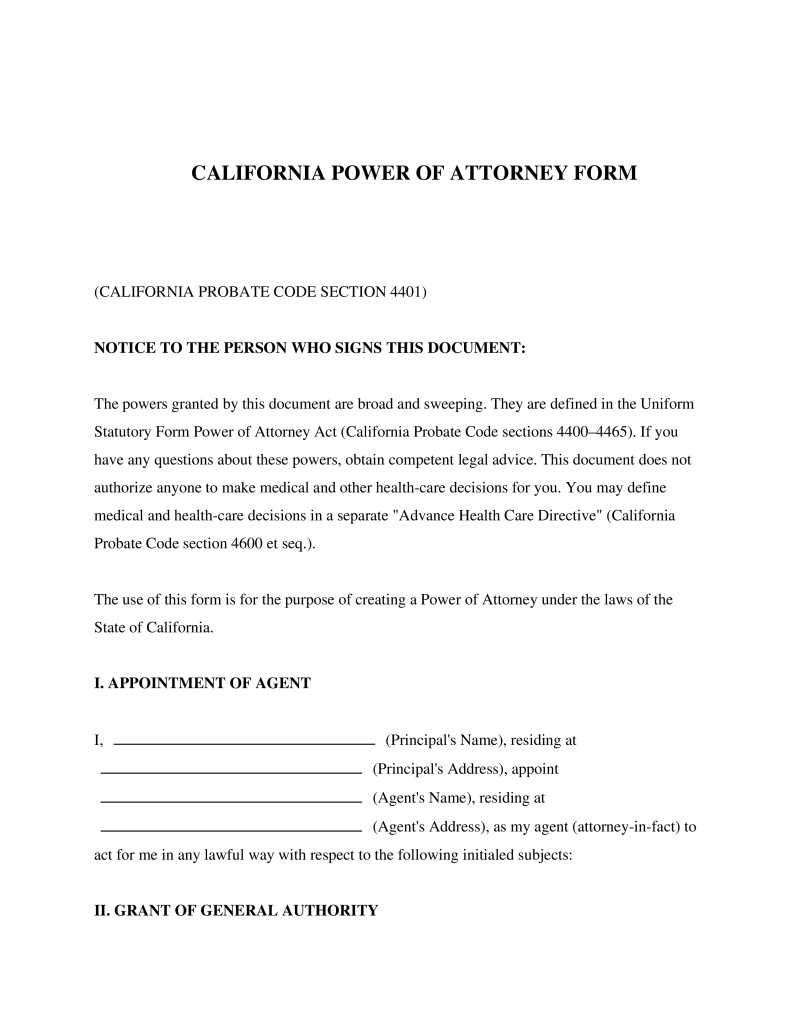
A California Power of Attorney Form is a legal instrument that delegates authority from one individual, known as the principal, to another, termed the agent or attorney-in-fact in the state of CA.
Authority Effective Timing
Many powers of attorney are effective immediately. A springing power of attorney becomes effective only after a stated event, commonly the Principal's incapacity, but some jurisdictions impose special requirements for proving that event.
Use this only if the authority should not begin immediately and should start on a calendar date.
Describe the triggering event clearly, such as written certification of incapacity by one or two licensed physicians.
For springing authority, third parties often need clear proof before accepting the Agent's authority.
Use precise language so banks, healthcare providers, or other institutions can verify when the authority has begun.
Table of Contents
What is a California Power of Attorney Form?
A California Power of Attorney form is a legal document that allows an individual, known as the principal, to grant authority to another person, referred to as the agent or attorney-in-fact, to make decisions and act on their behalf. The California Statutory Power of Attorney form, specifically, is a standardized document designed for this purpose, enabling the principal to delegate control over financial, real estate, tax, or other specified matters. This document is typically used for estate planning, incapacity planning, or convenience, ensuring that someone trusted can manage affairs when the principal is unable to do so.
Types of California Power of Attorney
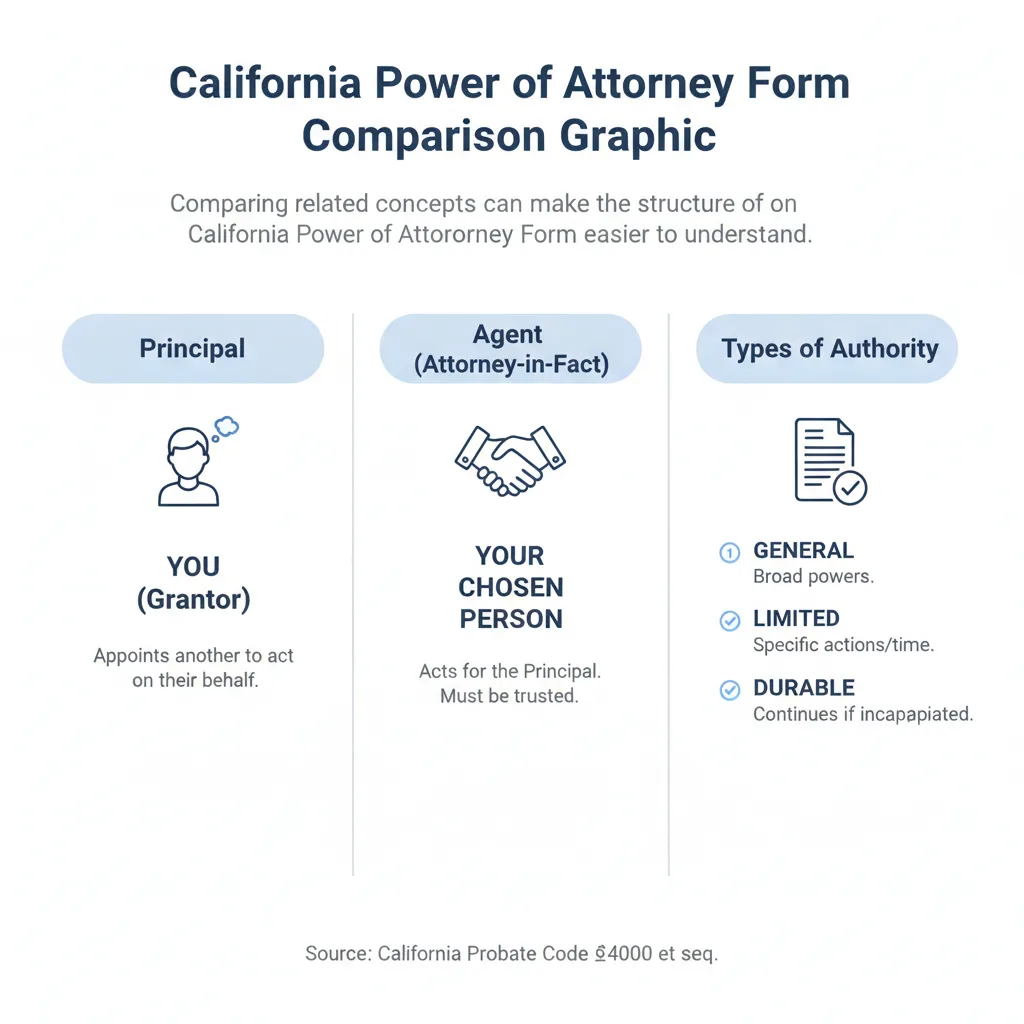
In California, a Power of Attorney can be structured in several ways, each defining the scope and duration of the agent's authority. The California Statutory Power of Attorney form can be adapted to serve various purposes, allowing the principal to choose the specific type of authority they wish to grant.
- General Power of Attorney - Grants broad authority to the agent to act on the principal's behalf in all financial and legal matters. This authority typically becomes effective immediately upon signing and terminates if the principal becomes incapacitated or dies.
- Durable Power of Attorney - Remains effective even if the principal becomes incapacitated. This is a critical feature for long-term planning, ensuring continuity of management during illness or disability. The California Statutory Power of Attorney form is durable unless explicitly stated otherwise.
- Limited (or Special) Power of Attorney - Grants the agent specific, narrow authority to act only in certain matters or for a defined period. For example, it might authorize an agent to sell a specific property or handle a single financial transaction.
- Springing Power of Attorney - Becomes effective only upon the occurrence of a specified event or condition, such as the principal's incapacitation. The document must clearly define the triggering event and how it will be determined.
Parties Involved in a Power of Attorney
A California Power of Attorney involves at least two primary parties, each with distinct roles and responsibilities. Understanding these roles is fundamental to creating and implementing the document effectively.
- Principal - This is the individual who creates the Power of Attorney and grants authority to another person. The principal must be of sound mind and legal age (18 years or older) when signing the document to ensure they understand its implications.
- Agent (or Attorney-in-Fact) - This is the individual designated by the principal to act on their behalf. The agent has a fiduciary duty to act in the principal's best interest, managing their affairs diligently and honestly, and must keep accurate records of all transactions made under the Power of Attorney.
Scope of Authority and Key Provisions
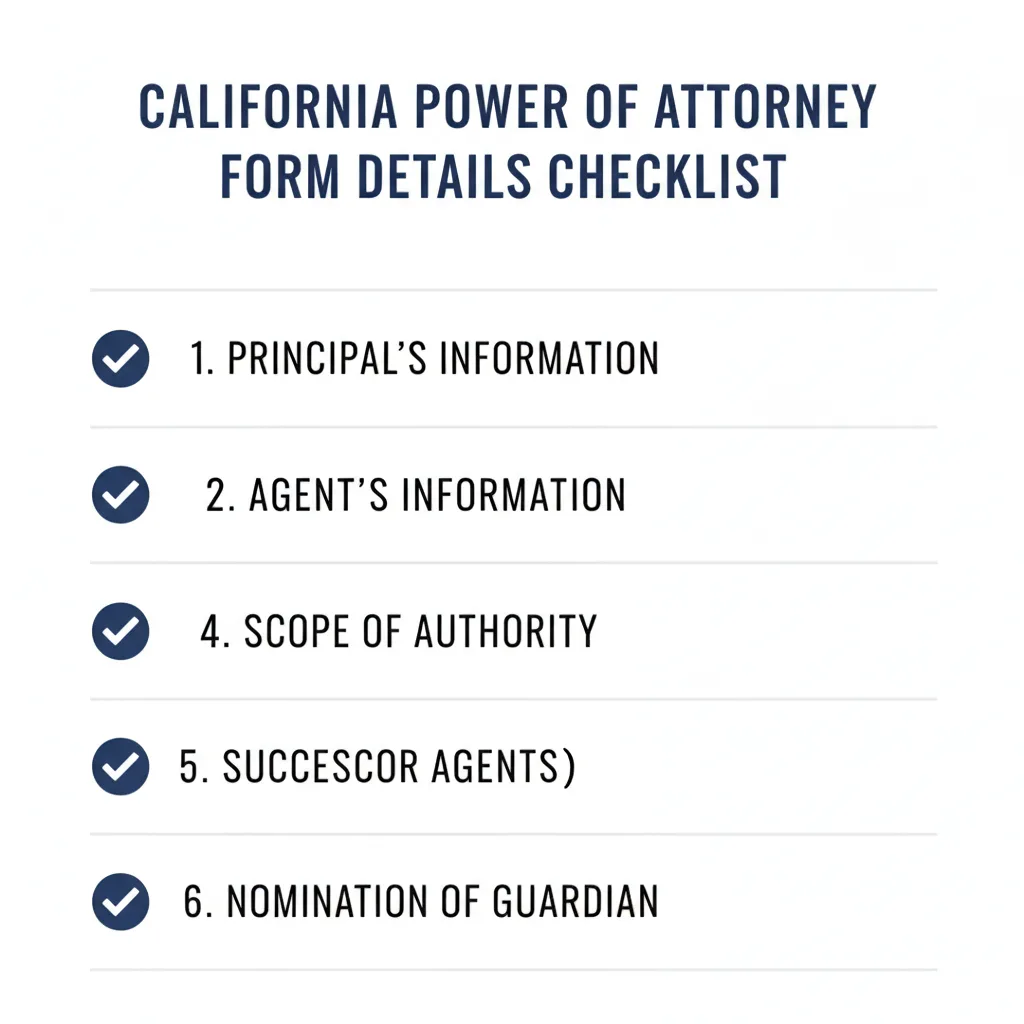
The California Statutory Power of Attorney form allows principals to delineate precisely which powers their agent can exercise. The principal can grant authority over a wide range of matters, or limit it to very specific actions. The duration of this control is also a critical element that must be specified within the document.
- Financial Matters - Authority to manage bank accounts, investments, and other financial assets.
- Real Estate Transactions - Power to buy, sell, lease, or mortgage real property.
- Tax Matters - Authority to file tax returns, pay taxes, and interact with tax authorities.
- Business Operations - Management of business interests, including making operational and financial decisions.
- Claims and Litigation - Authority to pursue or defend legal claims on the principal's behalf.
- Insurance and Annuities - Management of insurance policies and annuity contracts.
- Government Benefits - Ability to apply for and receive government benefits, such as Social Security or Medicare.
- Personal and Family Maintenance - Authority to provide for the principal's personal care, housing, and necessary expenses.
The principal must clearly specify the duration of the agent's authority. This can be for a specific period, until a certain event occurs, or indefinitely, particularly in the case of a durable power of attorney.
Execution Requirements for Validity
For a California Power of Attorney form to be legally valid and enforceable, it must meet specific execution requirements. These steps ensure that the principal genuinely intends to grant the specified powers and is not acting under duress or undue influence.
- Principal's Signature - The principal must sign the Power of Attorney document. They must be mentally competent at the time of signing.
- Notarization - The principal's signature must be acknowledged before a notary public. The notary public verifies the principal's identity and witnesses their signature.
- Witnesses (Optional but Recommended) - While not always legally required for financial powers of attorney in California, having two witnesses attest to the principal's signature can add an extra layer of protection against challenges to the document's validity.
Once properly executed, the Power of Attorney should be kept in a safe place, and copies may be provided to the agent, financial institutions, or other relevant parties who may need to rely on its authority.
Revocation and Termination of a Power of Attorney
A California Power of Attorney is not necessarily permanent and can be terminated or revoked under various circumstances. Understanding these conditions is important for both the principal and the agent.
- Revocation by Principal - The principal can revoke the Power of Attorney at any time, as long as they are mentally competent. This must be done in writing, typically through a document called a "Revocation of Power of Attorney," and should be delivered to the agent and any third parties who have relied on the original document.
- Death of the Principal - A Power of Attorney automatically terminates upon the death of the principal.
- Incapacitation of Agent - If the agent becomes incapacitated or dies, the Power of Attorney may terminate unless a successor agent was named in the document.
- Specific Termination Date or Event - If the Power of Attorney specifies a termination date or the occurrence of a particular event, it will end automatically when that date is reached or the event occurs.
- Court Order - A court can terminate a Power of Attorney if it finds that the agent is abusing their authority or that the principal was not competent when they signed the document.
Frequently Asked Questions
Sources
- Wills, estates, and advance care planning | California Courts | Self Help Guide - Provides information on the California Statutory Power of Attorney form, including its purpose and considerations for its use.
Power of Attorney in other states
Not the form you're looking for?
Try our legal document generator to create a custom document
Disclaimer: The templates available on this website are provided for general informational purposes only and do not constitute legal advice. They are not intended to be, and should not be interpreted as, compliant with any specific legal, regulatory, or privacy requirements. These templates are not a replacement for professional legal guidance and should not be relied upon for any particular matter or circumstance. Users are strongly encouraged to seek advice from a qualified attorney licensed in their jurisdiction before using, modifying, or relying on any template.
All templates are provided on an "as is," "with all faults," and "as available" basis. The provider disclaims any and all warranties of any kind, whether express, implied, statutory, or otherwise, including without limitation warranties of merchantability, fitness for a particular purpose, title, or non-infringement.
LegalTemplates.com makes no guarantees or representations regarding the accuracy, completeness, expected outcomes, or reliability of the materials contained in these templates or any materials referenced or linked from them.