Request for Production
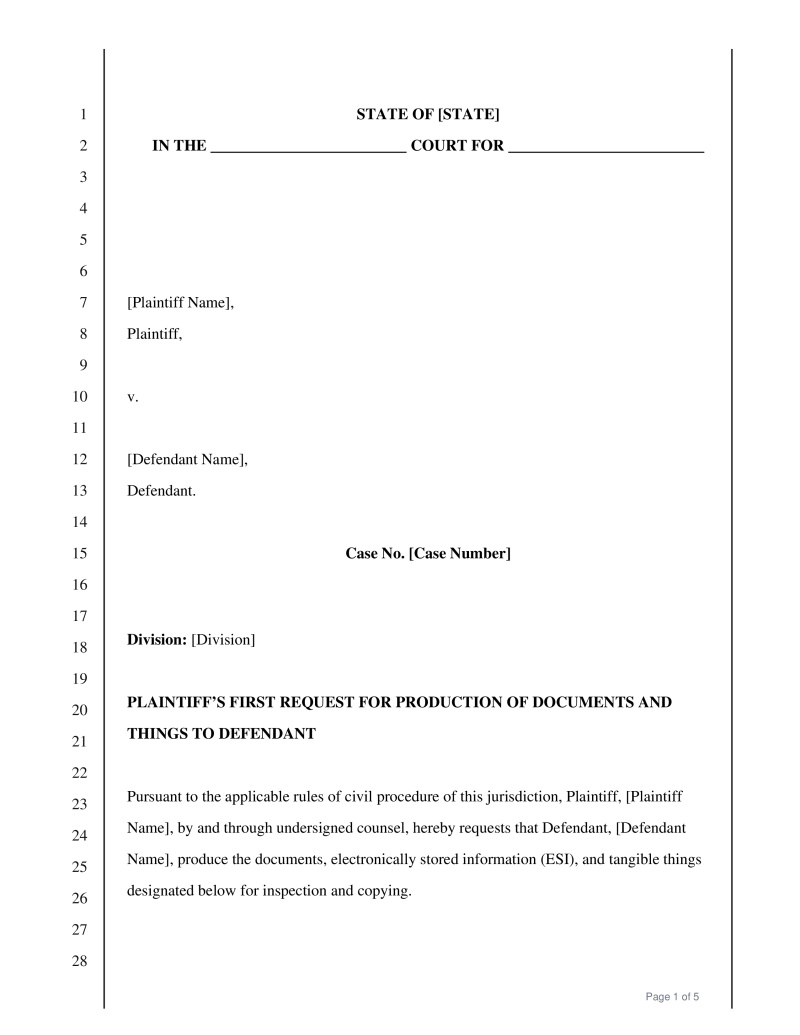
A Request for Production is a formal discovery device used in civil litigation that requires a party to preserve and produce specified documents, electronically stored information, or tangible things.
Serving Party Role
Choose the litigation role of the party sending the discovery requests. This helps format the caption and party labels correctly.
Use the role that appears in the case caption or pleadings.
Table of Contents
What is a Request for Production?
A Request for Production is a formal discovery device utilized in civil litigation to obtain physical evidence from another party to a lawsuit. Governed by rules of civil procedure, this written request directs the receiving party to provide specific documents, electronically stored information, or tangible items for inspection and copying. Litigants use this tool to uncover facts, evaluate the strength of the opposing party's claims, and prepare evidence for trial. The scope of the request is limited to nonprivileged matters that are relevant to any party's claim or defense.
Scope and Legal Framework
Under federal and state civil procedure rules, the scope of discovery is broad but bounded by relevance and proportionality. Parties use this mechanism to obtain a wide array of materials to build their legal arguments:
- Federal Rules of Civil Procedure Rule 34 - Governs the procedures for requesting the production of documents, electronically stored information, and tangible items in federal civil actions (Fed. R. Civ. P. 34).
- Relevance Standard - Permits discovery regarding any nonprivileged matter that is relevant to any party's claim or defense (Fed. R. Civ. P. 26(b)(1)).
- Proportionality Requirement - Mandates that discovery must be proportional to the needs of the case, considering the stakes, resources, and importance of the issues (Fed. R. Civ. P. 26(b)(1)).
Types of Materials Requested
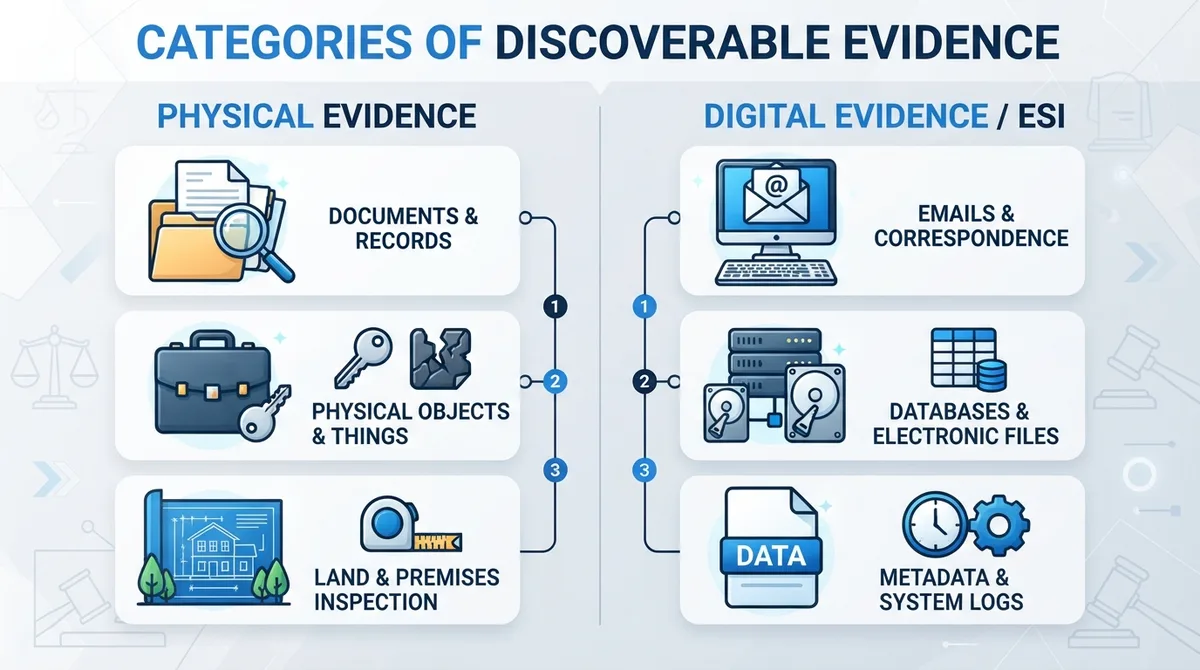
A civil litigant can request several categories of items to support their claims or defenses during the discovery phase of litigation:
- Paper Documents - Physical records, including contracts, correspondence, medical records, financial statements, and handwritten notes.
- Electronically Stored Information - Digital data such as emails, text messages, spreadsheets, databases, and metadata.
- Tangible Objects - Physical items of evidence, including defective products, machinery parts, or biological samples.
- Property Access - Requests to enter designated land or other property to inspect, measure, survey, photograph, or test the property or any designated object on it.
Requirements for Drafting a Request
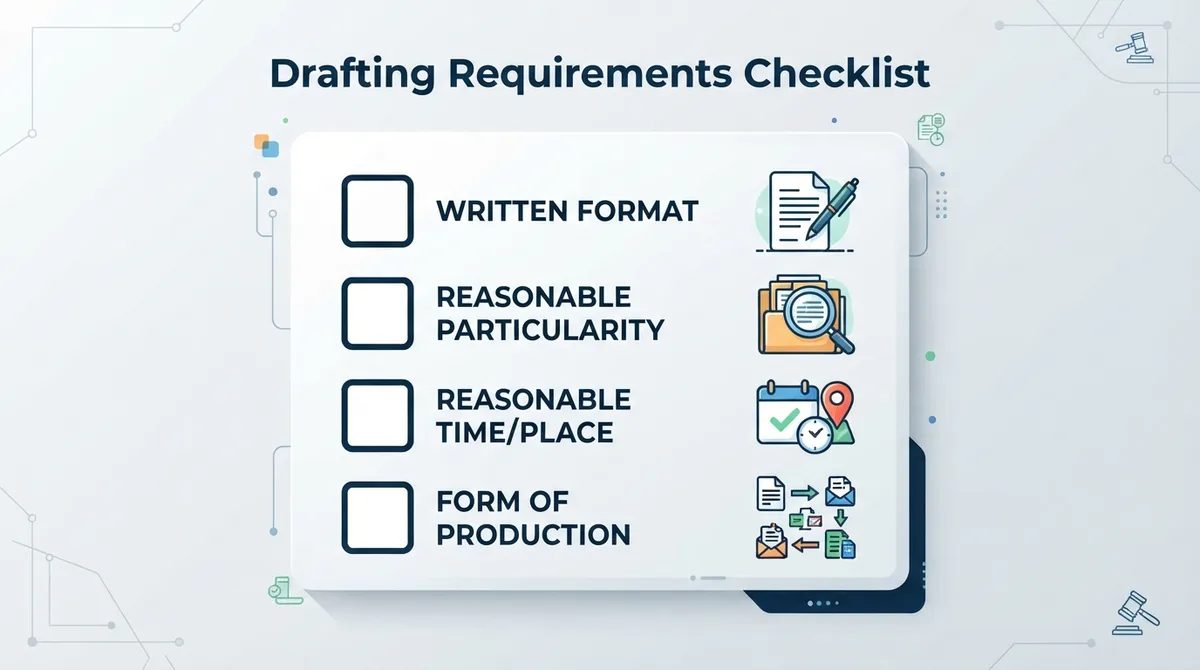
To ensure a Request for Production is legally enforceable, the drafting party must adhere to specific structural and procedural requirements:
- Written Format - All requests must be made in writing and served on the opposing party or their legal representative.
- Reasonable Particularity - The requesting party must describe each item or category of items to be inspected with reasonable detail.
- Reasonable Time and Place - The request must specify a reasonable time, place, and manner for the inspection and performing the related acts.
- Form of Production - The requesting party may specify the form or forms in which electronically stored information is to be produced.
Electronically Stored Information Guidelines
The expansion of digital communications has made electronically stored information a primary focus of modern discovery. Parties must follow precise guidelines when requesting and producing digital files:
- Native Format Production - Parties should produce electronically stored information in its native format or a format as close to native as practicable to preserve usability.
- Email Thread Preservation - Email productions must include metadata, sender and recipient information, timestamps, and any attachments associated with the messages.
- Database Extraction - Complex databases should be produced in queryable formats or delimited text files accompanied by data dictionaries.
- Metadata Integrity - Litigants must avoid altering metadata, such as creation dates and author identities, during the collection and transmission process.
Responding to a Request for Production
Upon receiving a Request for Production, the responding party has a legal obligation to respond within a designated timeframe. The response must address each individual request:
- Written Response Timeline - The responding party must serve a written response within 30 days after being served with the request (Fed. R. Civ. P. 34(b)(2)(A)).
- Statement of Consent or Objection - For each item or category, the response must state that inspection will be permitted or state the specific grounds for objecting to the request.
- Privilege Log - If documents are withheld based on attorney-client privilege or work-product protection, the responding party must provide a privilege log detailing the withheld items.
- Duty to Search - The responding party must conduct a diligent and reasonable search of all sources within their possession, custody, or control.
Frequently Asked Questions
Sources
- Standard Requests for Production of Documents - Provides a standard form for requests for production of documents in civil cases.
- DISCOVERY: REQUESTS FOR PRODUCTION OF DOCUMENTS (RULE 34) - Explains the process and requirements for serving requests for production of documents under Rule 34 of the Federal Rules of Civil Procedure.
- Requests for Production - Sample Instructions for Form of ESI - Provides sample instructions for producing electronically stored information (ESI) in response to requests for production.
Not the form you're looking for?
Try our legal document generator to create a custom document
Disclaimer: The templates available on this website are provided for general informational purposes only and do not constitute legal advice. They are not intended to be, and should not be interpreted as, compliant with any specific legal, regulatory, or privacy requirements. These templates are not a replacement for professional legal guidance and should not be relied upon for any particular matter or circumstance. Users are strongly encouraged to seek advice from a qualified attorney licensed in their jurisdiction before using, modifying, or relying on any template.
All templates are provided on an "as is," "with all faults," and "as available" basis. The provider disclaims any and all warranties of any kind, whether express, implied, statutory, or otherwise, including without limitation warranties of merchantability, fitness for a particular purpose, title, or non-infringement.
LegalTemplates.com makes no guarantees or representations regarding the accuracy, completeness, expected outcomes, or reliability of the materials contained in these templates or any materials referenced or linked from them.