Child Travel Consent Form
Create Child Travel Consent Form
Child Travel Consent Form
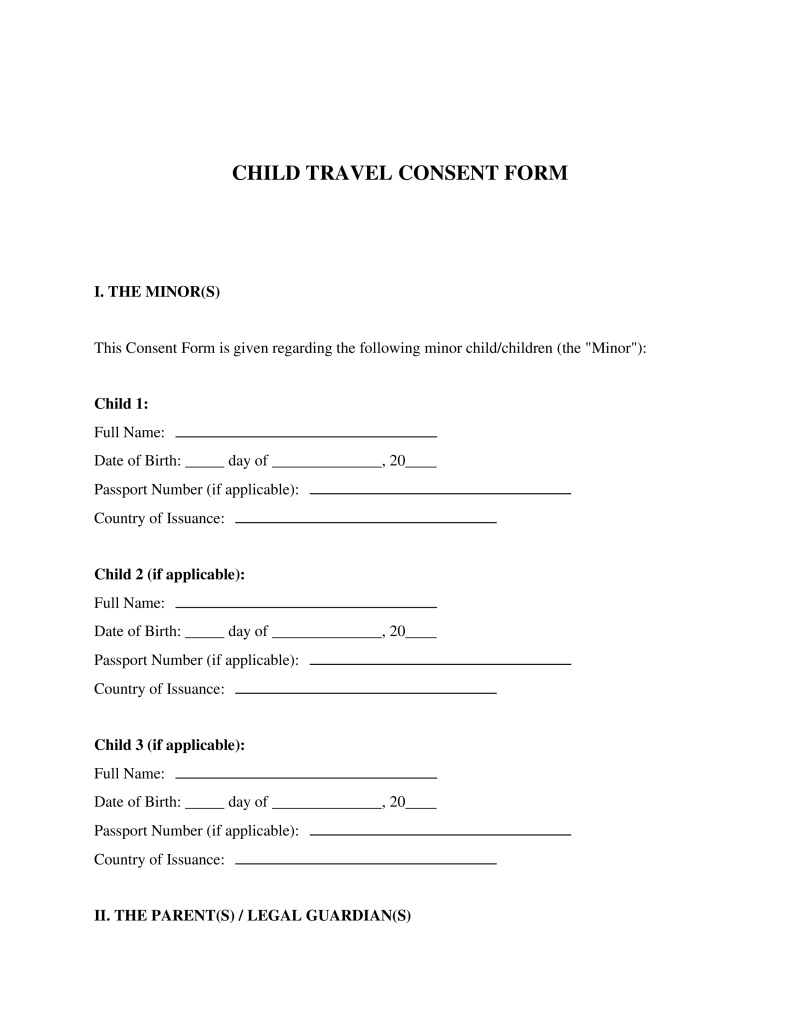
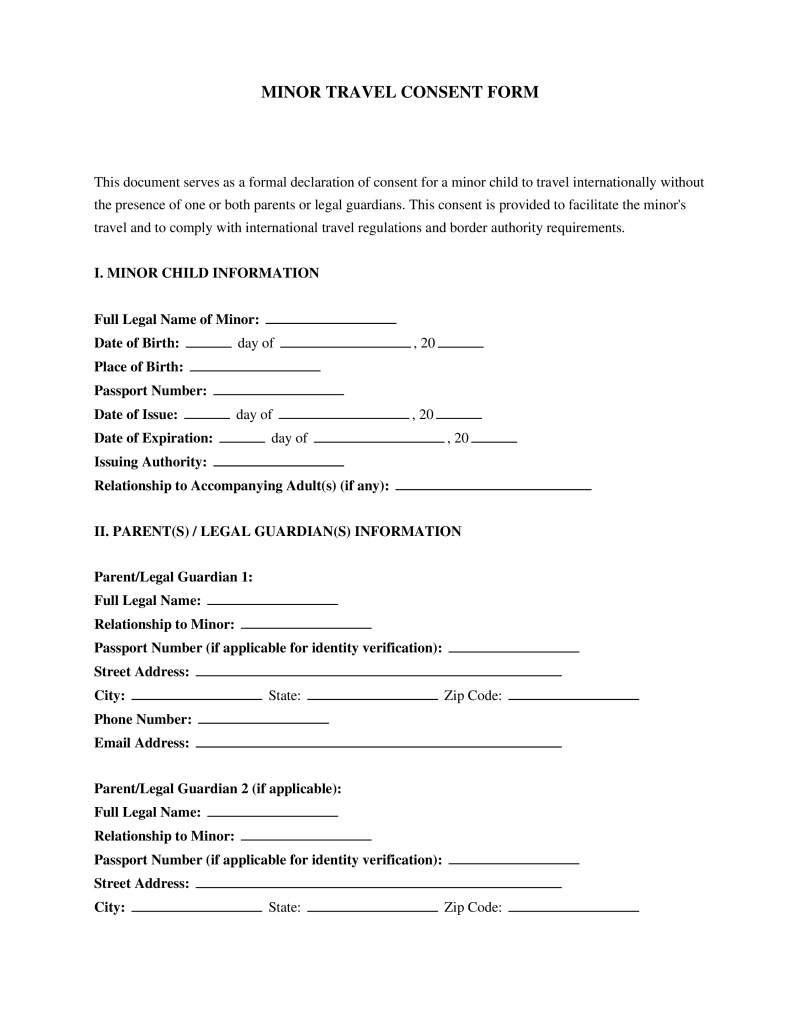
A Child Travel Consent Form is a legal document granting permission for a minor to travel, often required for international trips.
Answer the question(s) below to create your Child Travel Consent Form
Travel Arrangement
Choose the option that best describes the travel supervision arrangement. This helps tailor the consent language for airlines, border officials, schools, or trip supervisors.
Table of Contents
What is a Child Travel Consent Form?
A Child Travel Consent Form is a legal document used to grant permission for a minor child to travel without one or both of their parents or legal guardians. This form serves to confirm that the non-traveling parent or parents approve of the child's travel arrangements. Its primary purpose is to prevent international child abduction and to satisfy the entry requirements of various countries, ensuring the child's welfare and the legal integrity of their travel.
When is a Consent Form Recommended?
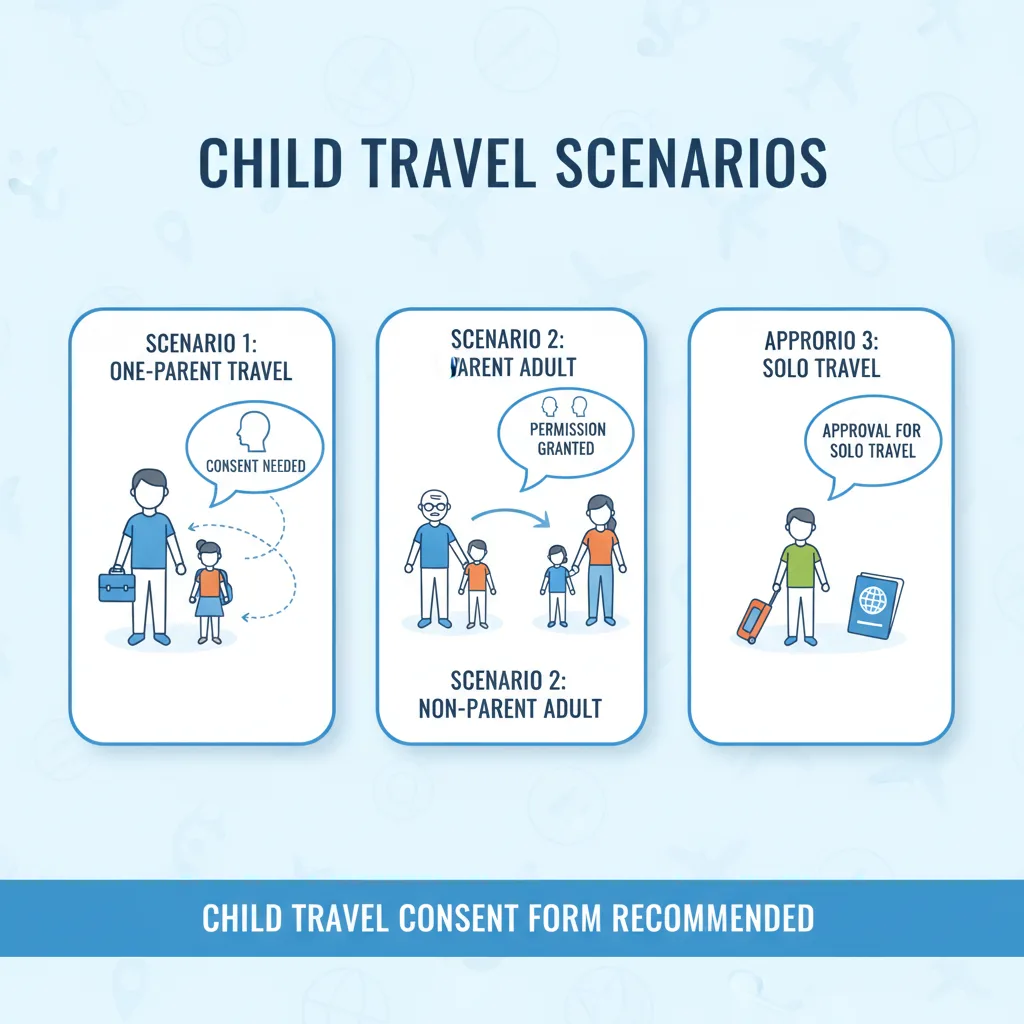
The need for a Child Travel Consent Form arises in several common scenarios, particularly when a minor is traveling internationally. Authorities, including U.S. Customs and Border Protection and the U.S. Department of State, strongly recommend or require this document to verify parental permission and prevent potential issues during travel.
- Travel with One Parent - If a child is traveling with only one parent or legal guardian, some countries require a signed and notarized letter from the other parent (U.S. Department of State). This is especially important if the parents are separated or divorced.
- Travel with a Non-Parent Adult - When a child travels alone or with an adult who is not a parent or legal guardian, such as a grandparent, teacher, or family friend, a notarized, written permission letter from the parents or legal guardians is often required by some countries (U.S. Department of State).
- Child Traveling Alone - For minors traveling without any accompanying adult, a consent form provides essential documentation of parental approval for the trip (USAGov).
- International Travel - Even when not explicitly required by a specific country, a consent form is generally advisable for any international travel involving a minor without both parents. U.S. Customs and Border Protection suggests a consent letter if an infant is not traveling with both parents, even for land or sea travel where a passport might not be required for U.S. and Canadian citizens (U.S. Customs and Border Protection).
Essential Information in the Form
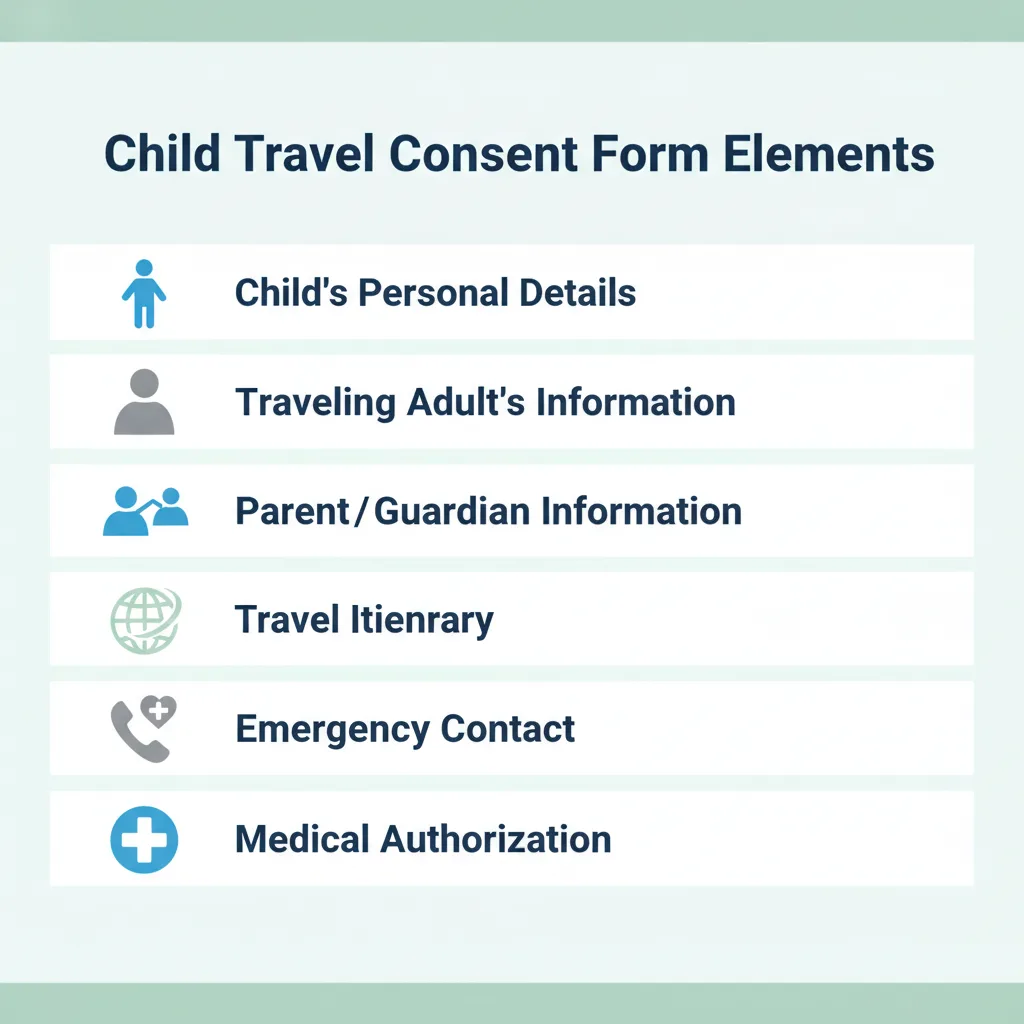
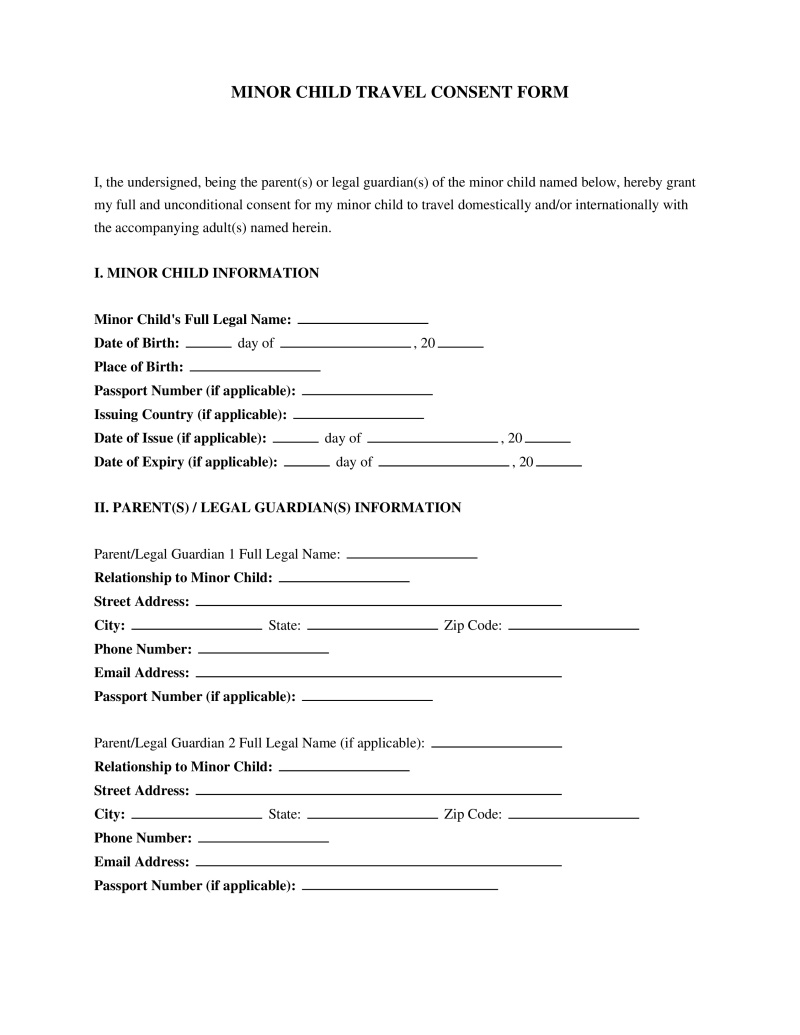
To be effective and comprehensive, a Child Travel Consent Form should contain specific details that clearly identify the child, the authorized travelers, and the nature of the trip. While no single federal template exists, sample forms, such as those provided by state governments, illustrate the typical information included.
- Child's Personal Details - Full name, date of birth, place of birth, and passport number (if applicable).
- Traveling Adult's Information - Full name, relationship to the child, passport number, and contact information.
- Parent(s) or Legal Guardian(s) Information - Full names, contact details, and signatures of the parent(s) or legal guardian(s) granting consent.
- Travel Itinerary - Specifics of the trip, including the destination country or countries, the dates of travel (departure and return), and the purpose of the trip (e.g., vacation, school trip, visiting relatives).
- Emergency Contact Information - Phone numbers and email addresses for both the traveling adult and the non-traveling parent(s) or guardian(s) for use in unforeseen circumstances.
- Medical Authorization (Optional but Recommended) - While not strictly a consent to travel, it is often prudent to include language authorizing the traveling adult to seek medical treatment for the child in an emergency, especially during international trips.
Notarization and Authenticity
The authenticity of a Child Travel Consent Form is significantly enhanced through notarization, a process that verifies the identities of the signatories and confirms their voluntary agreement. This step adds a layer of legal credibility, which is frequently preferred or required by border authorities and foreign governments.
- Verification of Signatures - A notary public witnesses the signing of the document by the parent(s) or legal guardian(s), ensuring that the signatures are genuine. This helps to prevent fraud or false claims of consent.
- Increased Acceptance - Both the U.S. Department of State and USAGov recommend that consent letters be notarized, particularly for international travel. Notarization makes the document more readily accepted by customs officials and airlines, reducing potential delays or complications.
- Language Preference - USAGov specifies that it is preferred for the letter of consent to be in English. If traveling to a non-English speaking country, it may be beneficial to have the document translated and certified.
International Travel Requirements
Traveling internationally with a minor often involves navigating specific documentation requirements that vary by destination country. Beyond general identification, a Child Travel Consent Form plays a critical role in ensuring smooth passage and compliance with international laws designed to protect children.
- Country-Specific Rules - Each country may have unique entry requirements for minors, especially concerning those not accompanied by both legal parents. It is essential to research the specific regulations of the destination country and any transit countries well in advance of travel.
- Proof of Relationship - In addition to a consent form, travelers may be required to present the child's birth certificate to prove the parental relationship. In cases of sole legal custody, documentation such as a court order may be necessary (U.S. Department of State).
- Passport and Visa Requirements - While a consent form addresses parental permission, it does not replace the fundamental requirement for a valid passport for international air travel. Depending on the destination, a visa may also be necessary for the child.
Legal and Practical Implications
The absence of a Child Travel Consent Form can lead to significant legal and practical challenges for both the child and the accompanying adult. Border control agencies are vigilant about child protection, and proper documentation is a key component of their security protocols.
Without a consent form, travelers may experience delays, questioning, or even denial of entry or exit. This is particularly true at international borders where officials are trained to identify potential cases of child abduction or trafficking. The document serves as critical evidence that all legal guardians have sanctioned the child's travel, thereby mitigating concerns about parental kidnapping. It provides peace of mind for the traveling adult and ensures that the child's journey proceeds without unnecessary legal complications, upholding international efforts to safeguard minors.
Frequently Asked Questions
Generally, all parents or legal guardians who are not accompanying the child on the trip must sign the consent form. This ensures that all parties with parental responsibility have approved the travel arrangements.
While typically not required for domestic travel within the United States, it is always advisable to check with the airline or transportation provider. Some may have their own policies, especially for unaccompanied minors.
If one parent is deceased, a death certificate should be carried. If one parent has sole legal custody, a copy of the court order granting sole custody should be provided instead of the other parent's consent letter (U.S. Department of State).
The validity period is typically specified within the form itself, usually covering the exact dates of the planned trip. For multiple trips, separate forms or a broadly dated form with clear parameters may be used, though specific trip details are generally preferred.
While USAGov states English is preferred, it is highly recommended to have the form translated into the official language of the destination country, and potentially notarized again, for international travel to non-English speaking nations.
Besides the consent form, a child will typically need a valid passport, any required visas for the destination country, and a birth certificate to prove parentage (U.S. Customs and Border Protection).
Sources
- International travel documents for children | USAGov - Provides information on travel documents required for children, including consent letters for international travel.
- Travel with Minors | U.S. Department of State - Offers guidance on traveling with minors, including requirements for notarized consent letters when one parent cannot accompany the child.
- Children- Travel Documents for infants | U.S. Customs and Border Protection - Details on travel documents for children, including the necessity of consent letters when not traveling with both parents.
- Parental Consent to Travel Form | Massachusetts Government - Provides a sample parental consent form for child travel, which can be adapted for use in other jurisdictions.
Related Documents
Forms commonly used with Child Travel Consent Form.
Not the form you're looking for?
Try our legal document generator to create a custom document
Disclaimer: The templates available on this website are provided for general informational purposes only and do not constitute legal advice. They are not intended to be, and should not be interpreted as, compliant with any specific legal, regulatory, or privacy requirements. These templates are not a replacement for professional legal guidance and should not be relied upon for any particular matter or circumstance. Users are strongly encouraged to seek advice from a qualified attorney licensed in their jurisdiction before using, modifying, or relying on any template.
All templates are provided on an "as is," "with all faults," and "as available" basis. The provider disclaims any and all warranties of any kind, whether express, implied, statutory, or otherwise, including without limitation warranties of merchantability, fitness for a particular purpose, title, or non-infringement.
LegalTemplates.com makes no guarantees or representations regarding the accuracy, completeness, expected outcomes, or reliability of the materials contained in these templates or any materials referenced or linked from them.