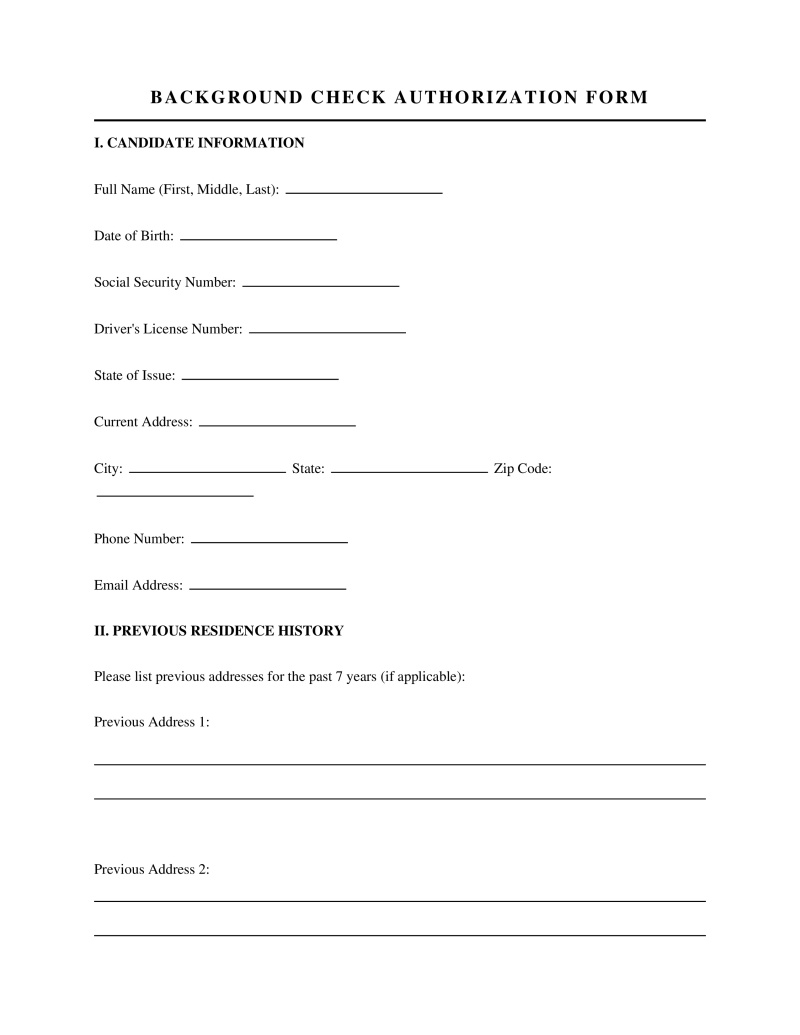
Background Check Authorization Form
A Background Check allows employers to obtain consent from individuals to conduct background checks for employment or other purposes, ensuring legal compliance.
Background Check Purpose
Select the main reason for the background check. This determines the scope and legal requirements.
Provide details if the purpose is not listed above.
Table of Contents
What is a Background Check Authorization Form?
A Background Check Authorization Form is a legal document that grants a designated party permission to investigate an individual's personal, criminal, financial, or professional history. Employers, landlords, and financial institutions utilize this document to verify the accuracy of information provided by applicants and to assess suitability for employment, housing, or credit. The Fair Credit Reporting Act (FCRA) mandates the execution of this form to ensure that the individual is fully aware of the screening process and has provided express written consent for the release of their private information.
Federal Statutes and Legal Framework
The collection and use of consumer reports are strictly regulated by federal laws designed to protect privacy and prevent discrimination. Primary federal statutes governing these forms include:
- Fair Credit Reporting Act - Establishes the national standards for consumer reporting agencies and the users of consumer reports, requiring written consent before a background check is conducted (15 U.S.C. § 1681b).
- Title VII of the Civil Rights Act - Prohibits employment discrimination based on race, color, religion, sex, or national origin, which guides how criminal records may be used in hiring decisions (42 U.S.C. § 2000e et seq.).
- Driver's Privacy Protection Act - Governs the disclosure of personal information gathered by state Departments of Motor Vehicles (18 U.S.C. § 2721 et seq.).
- Bankruptcy Code - Prohibits private employers from terminating or discriminating against an employee solely because the individual is or has been a debtor in bankruptcy (11 U.S.C. § 525).
Types of Background Check Authorizations
Different situations require specific variations of the authorization form depending on the scope of the investigation and the requesting entity.
- Employment Background Check Authorization - Grants employers permission to review criminal records, employment history, education verification, and credit reports for hiring purposes.
- Tenant Screening Authorization - Allows landlords or property managers to access credit reports, eviction history, and criminal background checks to assess rental applications.
- FBI Identity History Summary Request - Authorizes a fingerprint-based search of the FBI's national database, often required for government jobs, adoption, or visa applications.
- Gun Purchase Background Check (Form 4473) - Required for the purchase of a firearm to verify eligibility through the National Instant Criminal Background Check System (NICS).
- Volunteer Background Check Authorization - Used by non-profit organizations to screen volunteers, particularly those working with vulnerable populations like children or the elderly.
Essential Components of a Valid Form
To comply with the FCRA and ensure legal validity, the Background Check Authorization Form must contain specific elements and disclosures.
- Stand-Alone Disclosure - The disclosure stating that a consumer report may be obtained must be in a document consisting solely of the disclosure (15 U.S.C. § 1681b(b)(2)).
- Clear Authorization Language - The text must explicitly state that the individual grants permission for the background check to be conducted.
- Identification Information - The form requires the applicant's full legal name, date of birth, Social Security number, and current address to ensure accurate record matching.
- Summary of Rights - A copy of "A Summary of Your Rights Under the Fair Credit Reporting Act" usually accompanies the authorization.
- State-Specific Disclosures - Certain states require additional checkboxes or notifications regarding the applicant's right to receive a copy of the report.
State Laws and Restrictions
Many states have enacted legislation that restricts how and when background checks can be utilized, offering protections beyond federal standards.
- Ban the Box Laws - Prohibits employers from asking about criminal history on initial job applications to encourage fair hiring practices (varies by state and municipality).
- Salary History Bans - Prevents employers from requesting past salary information to reduce pay gaps (enacted in states like California, New York, and Massachusetts).
- Credit Check Restrictions - Limits the use of credit reports for employment decisions to specific roles involving financial responsibility (states such as Colorado and Connecticut).
- Seven-Year Rule - Restricts the reporting of adverse information, such as arrests not leading to conviction or civil suits, to the preceding seven years (California Civil Code § 1785.13).
Adverse Action Procedures
When an entity decides to deny employment, housing, or credit based on the results of a background check, specific legal protocols must be followed.
- Pre-Adverse Action Notice - The user must provide the applicant with a copy of the report and a summary of rights before taking final negative action.
- Waiting Period - A reasonable amount of time usually five business days must be provided to allow the applicant to dispute inaccurate information.
- Post-Adverse Action Notice - Final notification must be sent stating that the adverse action has been taken, including the contact information of the reporting agency.
How to Complete a Background Check Authorization Form
Proper completion of this document ensures the screening process proceeds without administrative delays.
Step 1: Review the Disclosure - Read the stand-alone document provided by the requesting party to understand the scope of the investigation.
Step 2: Provide Personal Data - Enter your full legal name, current address, date of birth, and Social Security number accurately to prevent identity mismatching.
Step 3: List Past Residences - Supply addresses for the past seven to ten years if requested, as criminal records are often filed by county.
Step 4: Select Copy Preference - Check the appropriate box if you reside in a state that guarantees the right to receive a free copy of the background report.
Step 5: Sign and Date - Affix your legal signature and the current date to validate the authorization.
Frequently Asked Questions
Not the form you're looking for?
Try our legal document generator to create a custom document
Disclaimer: The templates available on this website are provided for general informational purposes only and do not constitute legal advice. They are not intended to be, and should not be interpreted as, compliant with any specific legal, regulatory, or privacy requirements. These templates are not a replacement for professional legal guidance and should not be relied upon for any particular matter or circumstance. Users are strongly encouraged to seek advice from a qualified attorney licensed in their jurisdiction before using, modifying, or relying on any template.
All templates are provided on an "as is," "with all faults," and "as available" basis. The provider disclaims any and all warranties of any kind, whether express, implied, statutory, or otherwise, including without limitation warranties of merchantability, fitness for a particular purpose, title, or non-infringement.
LegalTemplates.com makes no guarantees or representations regarding the accuracy, completeness, expected outcomes, or reliability of the materials contained in these templates or any materials referenced or linked from them.