Promissory Note Between Family Members
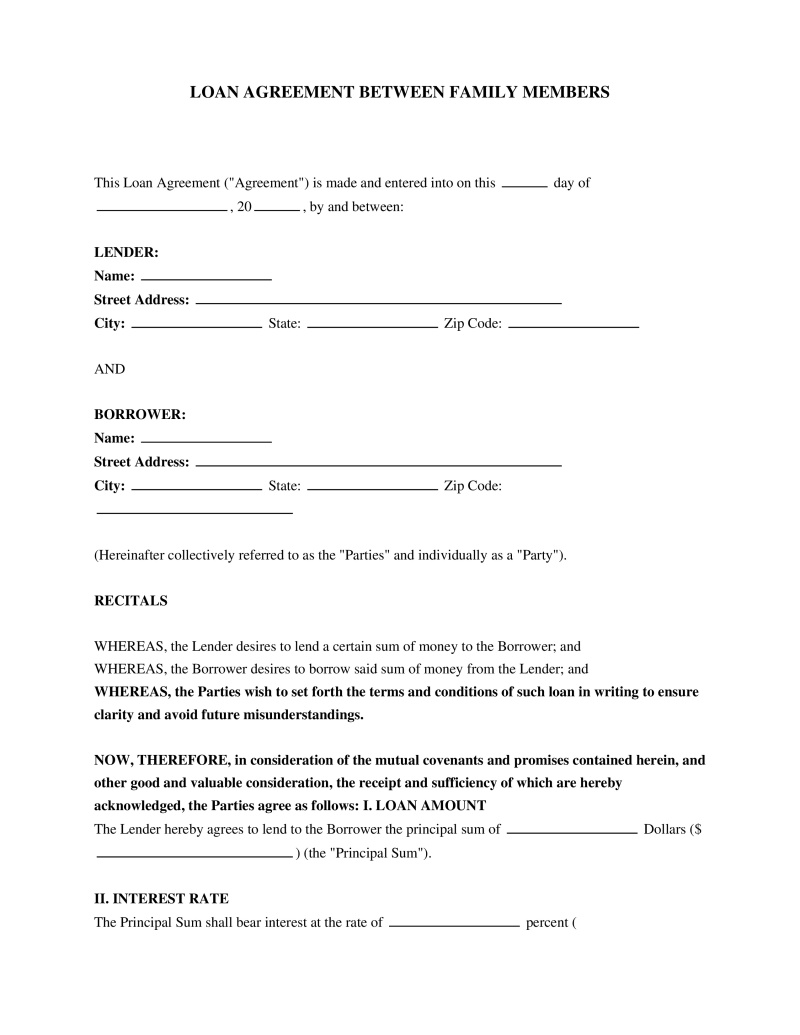
A Promissory Note Between Family Members is a legally binding written agreement that formalizes a loan made between relatives, stipulating the principal amount, interest rate, repayment schedule, and other conditions.
Loan Purpose
Select the main reason for the loan. This will be referenced in the promissory note.
Provide a brief description if you selected 'Other'.
Table of Contents
What is a Promissory Note Between Family Members?
A promissory note between family members is a legally binding written agreement outlining the terms of a loan made from one family member to another. This document formalizes a financial arrangement that might otherwise be treated informally, providing clarity and protection for both the lender and the borrower. It specifies the principal amount, interest rate, repayment schedule, and other critical conditions, ensuring that all parties understand their financial obligations and rights. Such notes are often used to facilitate home purchases, business ventures, educational expenses, or to consolidate debts within a family context, offering a structured approach to intra-family lending.
Legal Requirements and Validity
For a promissory note between family members to be legally valid and enforceable, it must adhere to certain fundamental legal requirements. These elements ensure that the agreement is clear, unambiguous, and capable of standing up to scrutiny if disputes arise. While some states may have specific minor variations, the core components are generally universal across jurisdictions:
- Identification of Parties - The full legal names and addresses of both the lender (payee) and the borrower (maker) must be clearly stated.
- Principal Amount - The exact sum of money being loaned must be specified in both numerical and written form to prevent discrepancies.
- Interest Rate - If interest is being charged, the annual interest rate must be clearly stated. This rate must comply with state usury laws, which set maximum allowable interest rates.
- Repayment Terms - The schedule for repayment, including the frequency (e.g., monthly, quarterly), the amount of each payment, and the final due date, must be detailed. This can include installment payments, a lump-sum payment, or payments contingent on specific events.
- Date of Execution - The specific date on which the promissory note is signed by all parties must be included.
- Signatures - Both the lender and the borrower must sign the document. While not always legally required for validity, having the signatures witnessed or notarized can add an extra layer of authenticity and prevent future claims of forgery.
- Governing Law - A clause indicating which state's laws will govern the interpretation and enforcement of the note is often included, typically the state where the loan is made or where the parties reside.
How to Draft a Promissory Note Between Family Members
Creating a formal promissory note between family members involves several key steps to ensure its legal enforceability and clarity. Following a structured process helps to avoid misunderstandings and provides a clear record of the loan agreement:
- Identify All Parties and Loan Details - Begin by clearly stating the full legal names and addresses of the lender (the family member providing the money) and the borrower (the family member receiving the money). Specify the exact principal amount of the loan, the date the loan is issued, and the purpose of the loan if desired, as this can provide context.
- Determine Interest Rate and Repayment Schedule - Decide whether interest will be charged on the loan and, if so, clearly state the annual interest rate. This rate must be reasonable and comply with state usury laws to avoid legal issues. Outline the repayment schedule, including the frequency of payments (e.g., monthly, quarterly, annual), the amount of each payment, and the total number of payments or the final maturity date of the loan.
- Include Default Terms and Collateral (If Applicable) - Define what constitutes a default on the loan, such as missed payments or failure to adhere to other terms. Specify the consequences of default, which could include accelerating the entire loan balance due immediately. If the loan is secured, clearly describe the collateral (e.g., a car, property) that the borrower is pledging as security for the loan, including its identification details.
- Add Prepayment and Modification Clauses - Consider including a clause that allows the borrower to prepay the loan without penalty, which can be beneficial for family relationships. Also, include a provision that any modifications or amendments to the note must be made in writing and signed by both parties to ensure future changes are documented and agreed upon.
- Review and Execute the Document - Once drafted, both the lender and borrower should thoroughly review the entire promissory note to ensure all terms are accurate, complete, and understood. After careful review, both parties must sign and date the document. While not always legally required, having the signatures witnessed by a neutral third party or notarized by a public notary can significantly strengthen the note's legal standing.
Rights and Obligations of Parties Involved
A promissory note between family members establishes specific rights and obligations for both the lender (payee) and the borrower (maker), similar to any other loan agreement. Understanding these roles is crucial for maintaining transparency and ensuring compliance with the terms of the note.
The lender, as the party providing the funds, has the right to receive timely payments according to the agreed-upon schedule. This includes the principal amount and any accrued interest. In the event of a default, the lender has the right to pursue legal remedies to recover the outstanding balance, potentially including the collateral if the note is secured. The lender is also obligated to accurately record payments received, provide statements if requested, and release any collateral once the loan is fully repaid. Furthermore, the lender must adhere to all terms of the note, such as not demanding payment before it is due or altering terms unilaterally.
The borrower, as the party receiving the funds, has the primary obligation to repay the loan in full, including any interest, precisely as outlined in the promissory note. This includes making payments on time and in the specified amounts. The borrower has the right to receive a clear accounting of the loan balance and payments made. If the note is secured, the borrower has the obligation to maintain the collateral in good condition and to ensure it remains available to the lender in case of default. The borrower also has the right to prepay the loan if the note allows for it, potentially saving on interest costs. Both parties are obligated to act in good faith and communicate any issues or potential difficulties regarding repayment promptly.
Applicable Federal and State Laws
Promissory notes between family members are subject to various federal and state laws that govern contracts, lending, and financial transactions. Adherence to these laws is essential for the note to be legally valid and enforceable. Failure to comply can result in the note being deemed unenforceable or subject to legal challenge.
Federal Laws and Considerations
While no single federal law specifically targets promissory notes between family members, several federal statutes and regulations may indirectly influence their creation and enforcement:
- Internal Revenue Service (IRS) Regulations - Loans between family members must comply with IRS rules, especially regarding imputed interest (26 U.S.C. § 7872). If a loan is made at a below-market interest rate, the IRS may impute interest, treating the forgone interest as a taxable gift from the lender to the borrower, which could have gift tax implications for the lender if it exceeds the annual gift tax exclusion.
- Uniform Commercial Code (UCC) - While primarily a state law, the UCC is a uniform act adopted by nearly all U.S. states. Article 3 of the UCC, which governs negotiable instruments, provides a framework for the legal characteristics of promissory notes, including requirements for their negotiability (U.C.C. § 3-104). Even if a family note is not intended to be negotiable, its principles often guide the drafting.
- Truth in Lending Act (TILA) - Although TILA (15 U.S.C. § 1601 et seq.) primarily applies to loans made by professional lenders and not typically to private, non-commercial loans between family members, its principles of clear disclosure regarding loan terms are good practice to follow for transparency.
State Laws and Requirements
State laws play a more direct and significant role in governing promissory notes, particularly concerning contract validity, interest rates, and enforcement:
- Contract Law - Each state has its own body of contract law that dictates the basic requirements for a valid and enforceable agreement, including offer, acceptance, consideration, and legal purpose. A promissory note, being a type of contract, must satisfy these state-specific requirements.
- Usury Laws - All states have usury laws that set the maximum allowable interest rate that can be charged on a loan (e.g., California Civil Code § 1916.1, New York General Obligations Law § 5-501). Charging an interest rate above the legal limit can render the interest portion of the note, or even the entire note, unenforceable, and may carry penalties for the lender.
- Statutes of Limitations - Each state specifies a time limit within which legal action must be taken to enforce a contract, including a promissory note (e.g., Texas Civil Practice and Remedies Code § 16.004). If the lender waits too long after a default, they may lose the right to sue for repayment.
- Real Estate and Secured Transactions Laws - If the promissory note is secured by real estate, state real estate laws regarding mortgages or deeds of trust will apply. If secured by personal property, state laws governing secured transactions (often based on UCC Article 9) will dictate the process for perfecting and enforcing the security interest.
Consequences of Non-Compliance
Failing to comply with the legal requirements for a promissory note between family members can lead to significant adverse consequences for both the lender and the borrower. These repercussions can range from rendering the note unenforceable to incurring unexpected tax liabilities or damaging familial relationships.
For the lender, a poorly drafted or non-compliant note might mean they lose the legal ability to recover the loaned funds. If the note lacks essential elements like a clear principal amount, repayment schedule, or proper signatures, a court may deem it an unenforceable agreement or even a gift rather than a loan. This can result in the lender being unable to pursue legal action in case of default, effectively losing their money. Furthermore, if the interest rate is below market rates and not properly accounted for, the IRS may impute interest, treating the forgone interest as a taxable gift, leading to potential gift tax implications for the lender.
For the borrower, non-compliance primarily arises from failing to meet the repayment obligations outlined in the note. Defaulting on a legally valid promissory note can lead to the lender pursuing legal action to recover the debt. This could result in a judgment against the borrower, which may impact their credit score, lead to wage garnishment, bank account levies, or the foreclosure of collateral if the loan was secured. Even if the note is between family members, a formal default can severely strain personal relationships, potentially causing irreparable damage beyond the financial implications. If the note is not properly documented, the borrower might also face challenges in proving repayments were made, leading to disputes over the outstanding balance.
Frequently Asked Questions
Not the form you're looking for?
Try our legal document generator to create a custom document
Disclaimer: The templates available on this website are provided for general informational purposes only and do not constitute legal advice. They are not intended to be, and should not be interpreted as, compliant with any specific legal, regulatory, or privacy requirements. These templates are not a replacement for professional legal guidance and should not be relied upon for any particular matter or circumstance. Users are strongly encouraged to seek advice from a qualified attorney licensed in their jurisdiction before using, modifying, or relying on any template.
All templates are provided on an "as is," "with all faults," and "as available" basis. The provider disclaims any and all warranties of any kind, whether express, implied, statutory, or otherwise, including without limitation warranties of merchantability, fitness for a particular purpose, title, or non-infringement.
LegalTemplates.com makes no guarantees or representations regarding the accuracy, completeness, expected outcomes, or reliability of the materials contained in these templates or any materials referenced or linked from them.