Civil Summons
Create Civil Summons
Civil Summons
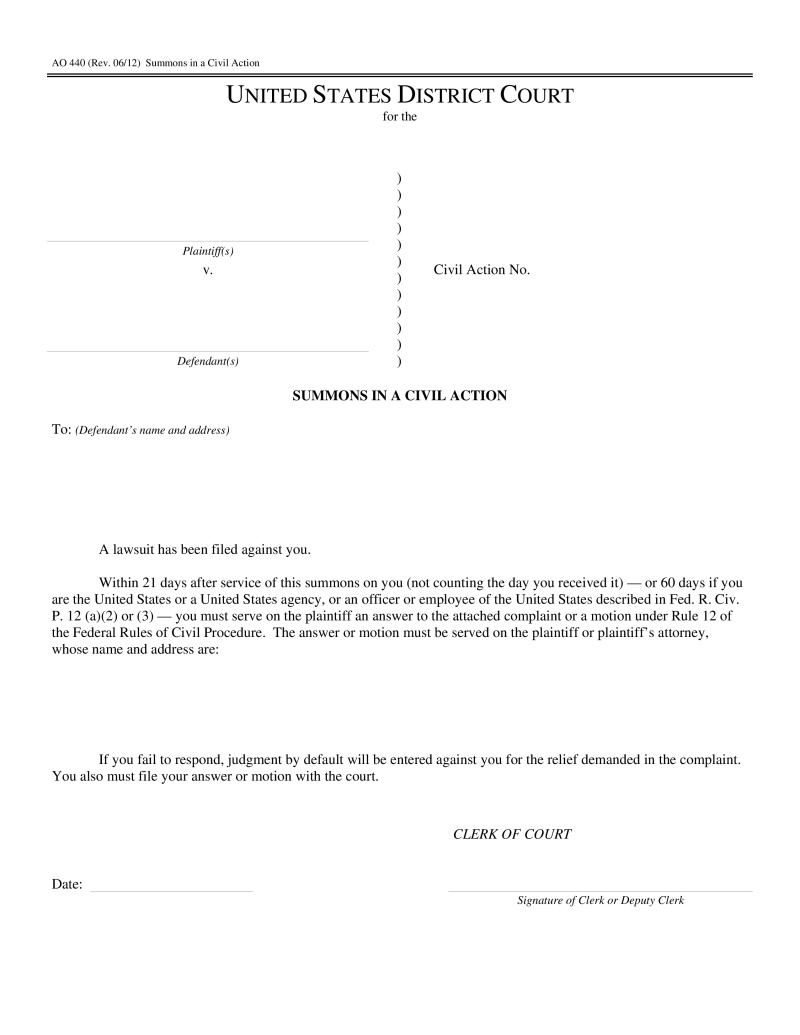
A Civil Summons is an official legal document issued by a court that notifies a defendant of a pending lawsuit against them and mandates their appearance or response within a specified period.
Answer the question(s) below to create your Civil Summons
Case Posture
Choose the filing posture that best matches the summons request. An alias or pluries summons is commonly used when a prior summons was not successfully served.
Table of Contents
What is a Civil Summons?
A Civil Summons is an official legal document issued by a court that formally notifies a defendant that a lawsuit has been filed against them. This document commands the defendant to file an answer or appear in court within a specified timeframe to respond to the plaintiff's complaint. In the United States federal court system, this notice is standardized as the Summons in a Civil Action, also known as Form AO 440. Service of this document is a fundamental requirement of constitutional due process, ensuring that no legal action proceeds without proper notice to the affected parties.
Purpose and Function of a Civil Summons
The primary function of a summons is to assert the court's jurisdiction over the defendant and the subject matter of the case. By delivering this formal notice, the court establishes its authority to make legal determinations that bind the parties involved. The document serves several critical operational purposes in civil litigation:
- Formal Notification - Informs the defendant that legal proceedings have officially commenced against them.
- Jurisdictional Establishment - Asserts the court's power over the defendant once proper service of process is completed.
- Response Deadline - Establishes a strict timeline within which the defendant must file a written response or risk default.
- Consequence Warning - Explains that failure to respond may result in a default judgment, granting the plaintiff the requested relief.
Key Elements of Form AO 440
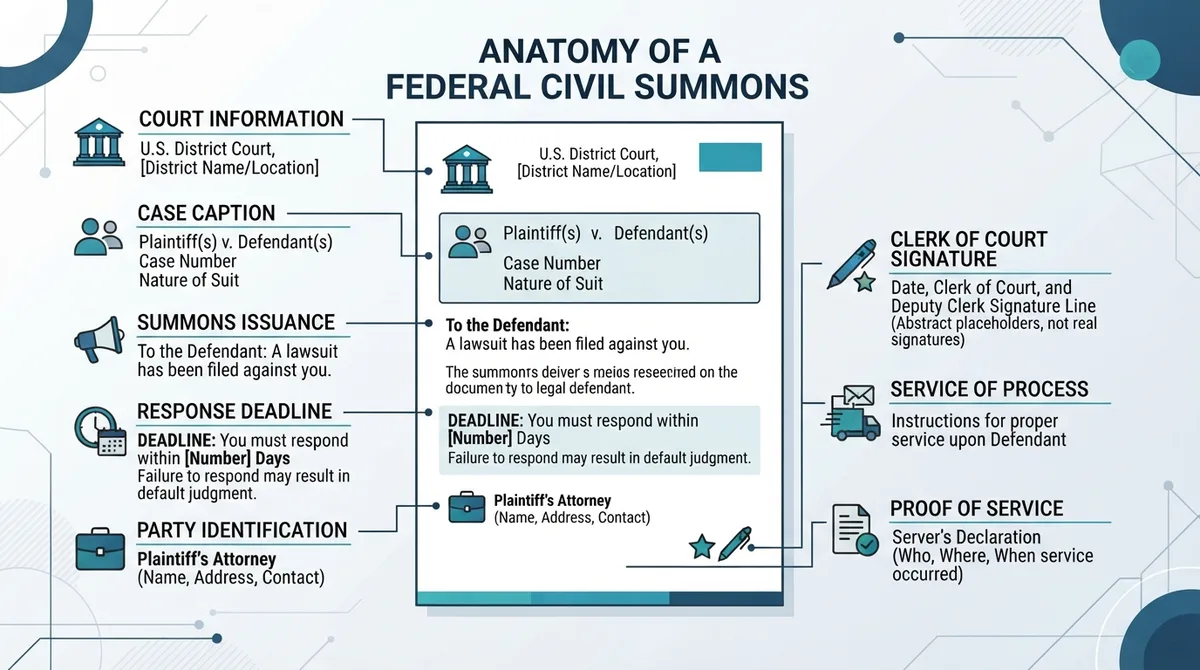
In federal practice, the standard Summons in a Civil Action (Form AO 440) contains specific fields that must be completed accurately to ensure validity. Errors in these elements can lead to motions to dismiss for insufficient process. The standard form includes the following essential details:
- Court Identity - Specifies the exact federal district court where the lawsuit is pending.
- Party Names - Lists the full names of both the plaintiff and the defendant.
- Plaintiff Attorney Information - Provides the name, address, and contact information of the plaintiff's legal counsel.
- Response Window - States the exact number of days the defendant has to submit an answer, typically 21 days under federal rules.
- Clerk Signature - Requires the signature of the clerk of court and the official seal of the court to be legally binding.
Types of Civil Summons
Different jurisdictions and legal scenarios utilize distinct variations of this legal notice to initiate actions:
- Standard Civil Summons - Directs a defendant to respond to a civil complaint within a specified period, typically used in general civil litigation (Form AO 440).
- Summons by Publication - Issued when a defendant cannot be located, allowing notice to be printed in an approved newspaper.
- Third-Party Summons - Brought by an existing defendant to bring a new third party into the ongoing lawsuit.
- Administrative Summons - Issued by government agencies rather than courts to compel testimony or document production.
Service of Process Rules
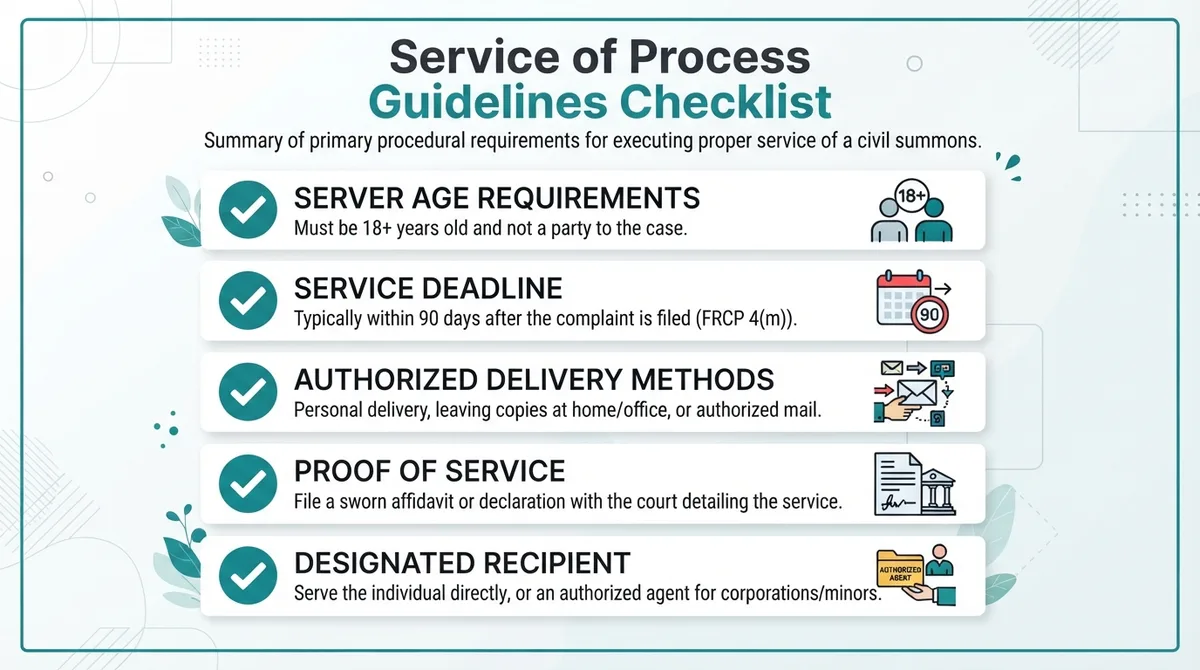
The delivery of a Civil Summons is governed by strict procedural rules to guarantee that the defendant receives actual notice of the lawsuit. In federal jurisdictions, these procedures are detailed in the rules of civil procedure:
- Federal Rule of Civil Procedure 4 - Outlines the methods, timelines, and requirements for serving a summons and complaint in federal civil actions (Fed. R. Civ. P. 4).
- Authorized Servers - Mandates that service must be performed by a person who is at least 18 years old and not a party to the lawsuit (Fed. R. Civ. P. 4(c)(2)).
- Time Limit for Service - Requires service of the summons and complaint to be completed within 90 days after the complaint is filed (Fed. R. Civ. P. 4(m)).
- Waiver of Service - Permits the plaintiff to request that the defendant waive formal service to reduce litigation costs (Fed. R. Civ. P. 4(d)).
Consequences of Non-Response
Ignoring a Civil Summons carries severe legal ramifications for the defendant. When a defendant fails to file a timely response, the litigation moves forward without their participation, leading to several procedural outcomes:
- Entry of Default - The court clerk formally records that the defendant has failed to plead or otherwise defend the action.
- Default Judgment - The court may enter a final judgment against the defendant, awarding the plaintiff the damages or relief requested in the complaint.
- Loss of Defenses - The defendant waives the right to present legal defenses, challenge evidence, or contest the allegations.
- Enforcement Actions - The resulting judgment can be enforced through wage garnishments, property liens, or bank account levies.
Frequently Asked Questions
A summons is the official court notice informing a defendant of a lawsuit and instructing them to respond. A complaint is the separate legal document filed by the plaintiff that outlines the factual allegations and legal claims against the defendant.
Under federal rules, a defendant generally has 21 days after being served to file an answer. If the defendant waives formal service, the response time is typically extended to 60 days from the date the waiver request was sent.
In federal court, a summons cannot generally be served by standard mail unless the defendant agrees to waive formal service. Some state courts allow service by certified mail under specific jurisdictional rules.
If a summons is served to the wrong individual, the service is legally defective and can be challenged. The defendant's attorney can file a motion to dismiss the action for insufficient service of process.
Any person who is at least 18 years old and is not a party to the lawsuit may serve a civil summons. This task is commonly handled by professional process servers or deputy U.S. marshals.
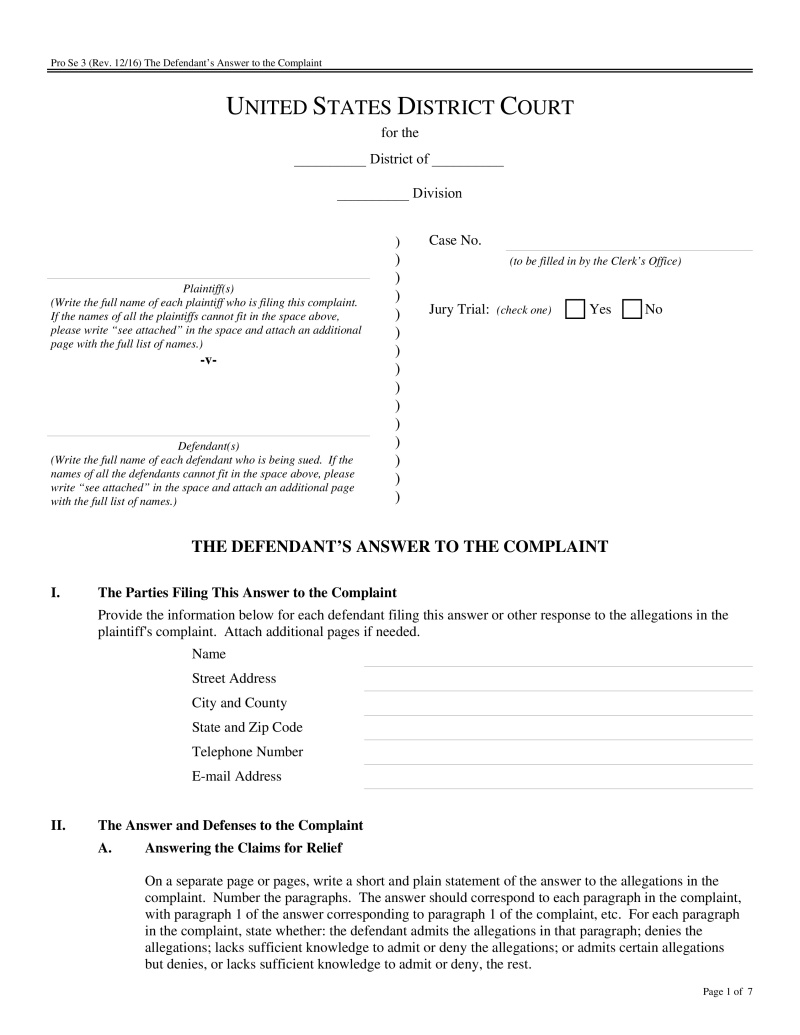
A civil summons notifies a defendant of a lawsuit and requires them to answer the complaint to defend themselves. A subpoena commands a witness to testify or produce documents in an ongoing case, regardless of whether they are a party.
Sources
- Civil Forms | United States Courts - Provides access to official civil forms, including the Summons in a Civil Action (AO 440).
- Summons in a Civil Action | United States Courts - Details the Summons in a Civil Action (AO 440) form, including its purpose and usage.
- Civil Forms | Southern District of Florida | United States District Court - Lists civil forms, including the Summons in a Civil Action (AO 440).
- Civil Summons & Waiver of Service Forms | Eastern District of Louisiana | United States District Court - Provides access to civil summons and waiver of service forms, including the Summons in a Civil Case (AO 440).
- Summons in a Civil Action | Southern District of Florida | United States District Court - Details the Summons in a Civil Action (AO 440) form, including its revision date and category.
Related Documents
Forms commonly used with Civil Summons.
Not the form you're looking for?
Try our legal document generator to create a custom document
Disclaimer: The templates available on this website are provided for general informational purposes only and do not constitute legal advice. They are not intended to be, and should not be interpreted as, compliant with any specific legal, regulatory, or privacy requirements. These templates are not a replacement for professional legal guidance and should not be relied upon for any particular matter or circumstance. Users are strongly encouraged to seek advice from a qualified attorney licensed in their jurisdiction before using, modifying, or relying on any template.
All templates are provided on an "as is," "with all faults," and "as available" basis. The provider disclaims any and all warranties of any kind, whether express, implied, statutory, or otherwise, including without limitation warranties of merchantability, fitness for a particular purpose, title, or non-infringement.
LegalTemplates.com makes no guarantees or representations regarding the accuracy, completeness, expected outcomes, or reliability of the materials contained in these templates or any materials referenced or linked from them.