Idaho Bill of Sale
An Idaho Bill of Sale is a legal document that records the transfer of ownership of personal property from a seller to a buyer within the state of Idaho.
Asset Type
Choose the category that best describes the item. This helps include the right identifying details, such as VIN, hull number, serial number, or livestock identifiers.
Use this when the item does not fit one of the listed categories.
Table of Contents
What is an Idaho Bill of Sale?
An Idaho bill of sale is a legal document that records the transfer of ownership of personal property from a seller to a buyer. This instrument serves as primary evidence that a transaction occurred, outlining critical details such as the purchase price, date of sale, and a comprehensive description of the item being transferred. Residents of Idaho utilize this form for various private transactions, including the sale of motor vehicles, vessels, livestock, and general personal property, to establish clear title and satisfy requirements set forth by the Idaho Transportation Department (ITD) or county assessors regarding sales tax and registration.
Legal Requirements
In Idaho, a bill of sale functions as a binding contract under state law. While verbal agreements may hold validity for certain small transactions, written documentation provides necessary protection for both parties. The state places specific emphasis on the accuracy of these documents when used for vehicle registration and tax assessment purposes. A valid bill of sale must contain specific information to be accepted by state agencies:
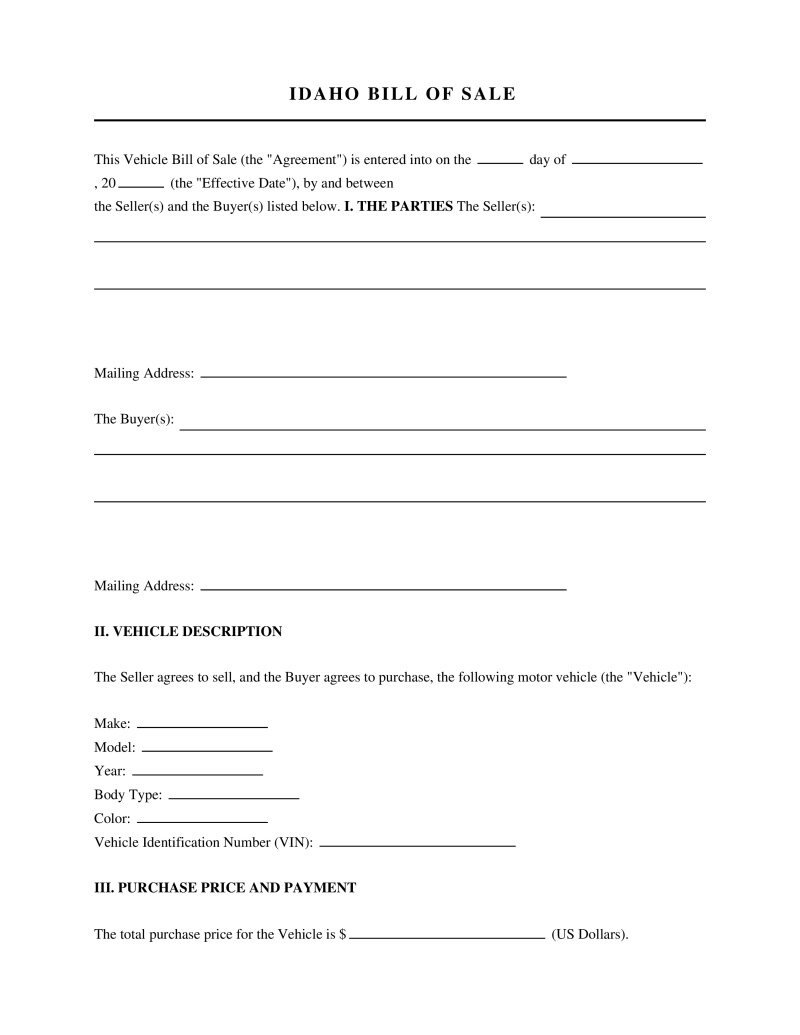
- Party Identification - The legal names and physical addresses of both the buyer and the seller must appear clearly on the document.
- Property Description - The item requires a detailed description, including serial numbers, Vehicle Identification Numbers (VIN), make, model, and year where applicable.
- Consideration - The document must state the exact purchase price or value of the trade exchanged for the property.
- Date of Transfer - The specific date when ownership and possession changed hands is required for liability and tax timelines.
- Signatures - Both parties must sign the document to attest to the accuracy of the information provided.
Idaho Motor Vehicle Transfer Regulations
The Idaho Transportation Department (ITD) maintains strict regulations regarding the transfer of motor vehicles. A bill of sale becomes essential when the vehicle title does not have a designated space for the purchase price or if the seller is not the person listed on the title. The state provides a specific form, ITD 3020, which serves as a Notice of Release of Liability and a Bill of Sale. This dual-purpose document protects the seller from liability for tickets, accidents, or crimes committed with the vehicle after the transfer date.
Idaho statutes regarding vehicle transfers involve several key components:
- Sales Tax Assessment - The purchase price listed on the bill of sale determines the amount of sales tax due at the time of registration (Idaho Code § 63-3612).
- Release of Liability - Sellers must file a release of liability within five days of the delivery of the vehicle to avoid ongoing responsibility (Idaho Code § 49-526).
- Title Transfer Deadline - Buyers generally have 30 days to title and register the vehicle before late fees accrue.
- Odometer Disclosure - Federal and state regulations mandate the disclosure of mileage for vehicles under 20 years old.
Seller and Buyer Obligations
The transfer of property in Idaho creates distinct responsibilities for each party involved in the transaction. Understanding these obligations ensures compliance with state laws and prevents future legal disputes regarding ownership or condition of the property.
Seller Responsibilities
The individual selling the property carries the burden of proving ownership and disclosing known defects depending on the terms of the sale. For vehicle sales, the seller must provide the buyer with the title. If the title is lost, the seller must obtain a duplicate before the sale can proceed. The seller is responsible for removing their license plates from the vehicle upon transfer, as plates in Idaho generally stay with the owner, not the vehicle.
Buyer Responsibilities
The purchaser assumes responsibility for the property immediately upon the execution of the bill of sale and delivery. For motor vehicles, the buyer must present the bill of sale to the county assessor or DMV to prove the purchase price. If the declared price falls significantly below the market value without a valid explanation, the state may assess tax based on the retail book value rather than the stated purchase price.
How to Complete an Idaho Bill of Sale
Executing a bill of sale in Idaho requires attention to detail to ensure the document is legally binding and acceptable for registration purposes. The following process outlines the necessary actions for a standard transfer of ownership.
- Negotiation and Terms - The parties agree upon the purchase price and the method of payment. This stage includes determining if the sale involves a warranty or if the property sells "as-is," meaning the buyer accepts the item in its current condition with all faults.
- Information Collection - The seller gathers necessary data from the property, such as the VIN for vehicles, Hull Identification Number (HIN) for boats, or serial numbers for firearms and electronics. Both parties exchange current contact information and verify identities to prevent fraud.
- Drafting the Document - The parties fill out the bill of sale form, ensuring all fields are legible. For vehicle sales, the seller must record the current odometer reading exactly as it appears on the dashboard, without including tenths of a mile.
- Execution and Signing - Both the buyer and seller sign and date the document. While Idaho does not mandate notarization for private vehicle sales, having the signatures notarized adds a layer of authentication, which is beneficial for high-value transactions or when the buyer resides out of state.
- Finalization and Filing - The buyer retains the original bill of sale for registration and titling application. The seller keeps a copy for their personal records and uses the information to file the Notice of Release of Liability with the Idaho Transportation Department.
State and Federal Statutes
Various laws govern the sale of personal property and the specific requirements for documentation in Idaho. These statutes ensure transparency in transactions and protect consumer rights.
- Uniform Commercial Code (Sales) - Governs contracts for the sale of goods, including warranties and the transfer of title (Idaho Code § 28-2-101 et seq.).
- Motor Vehicle Titling Act - Establishes the procedures and requirements for transferring vehicle titles and registration (Idaho Code § 49-501 et seq.).
- Sales Tax Act - Defines the imposition of sales tax on retail sales and the requirements for documenting the purchase price (Idaho Code § 63-3601 et seq.).
- Federal Odometer Act - Mandates the disclosure of mileage for motor vehicles to prevent odometer fraud (49 U.S.C. § 32705).
- Truth in Mileage Act - Requires sellers to certify the accuracy of the odometer reading at the time of transfer (49 CFR § 580.5).
Frequently Asked Questions
Idaho Bill of Sale Sample
Bill of Sale in other states
Not the form you're looking for?
Try our legal document generator to create a custom document
Disclaimer: The templates available on this website are provided for general informational purposes only and do not constitute legal advice. They are not intended to be, and should not be interpreted as, compliant with any specific legal, regulatory, or privacy requirements. These templates are not a replacement for professional legal guidance and should not be relied upon for any particular matter or circumstance. Users are strongly encouraged to seek advice from a qualified attorney licensed in their jurisdiction before using, modifying, or relying on any template.
All templates are provided on an "as is," "with all faults," and "as available" basis. The provider disclaims any and all warranties of any kind, whether express, implied, statutory, or otherwise, including without limitation warranties of merchantability, fitness for a particular purpose, title, or non-infringement.
LegalTemplates.com makes no guarantees or representations regarding the accuracy, completeness, expected outcomes, or reliability of the materials contained in these templates or any materials referenced or linked from them.