Indiana Bill of Sale
An Indiana Bill of Sale is a legal document used to record the transfer of ownership of personal property from a seller to a buyer within the state.
Asset Type
Choose the category that best describes the item. This helps include the right identifying details, such as VIN, hull number, serial number, or livestock identifiers.
Use this when the item does not fit one of the listed categories.
Table of Contents
What is an Indiana Bill of Sale?
An Indiana bill of sale serves as a legal document recording the transfer of ownership of personal property from a seller to a buyer. This written agreement outlines the specific terms of the transaction, including the purchase price, a detailed description of the item, and the identities of the parties involved. Residents and businesses utilize this form to establish proof of purchase for various assets, such as motor vehicles, watercraft, firearms, and livestock, which is often necessary for tax reporting and registration purposes with the state.
Legal Requirements and Validity
A bill of sale in Indiana becomes legally binding when it meets specific criteria established by state contract law and the Uniform Commercial Code. The document functions as a contract of sale and a receipt. While oral agreements for the sale of goods may be valid in certain contexts, written documentation provides superior evidence in the event of a dispute. For transactions involving motor vehicles or watercraft, the Indiana Bureau of Motor Vehicles (BMV) often requires this document to verify the purchase price for taxation and titling.
To ensure the document holds up under legal scrutiny, it must contain specific elements:
- Identification of Parties - The full legal names and physical addresses of both the seller (transferor) and the buyer (transferee).
- Property Description - A comprehensive description of the item, including serial numbers, Vehicle Identification Numbers (VIN), make, model, year, and color.
- Consideration - The specific monetary amount paid or the value of items traded in exchange for the property.
- Date of Sale - The actual date when the transfer of ownership and payment occurred.
- Signatures - The handwritten or electronic signatures of the seller and, in many cases, the buyer to indicate mutual assent.
Indiana Vehicle Registration and Titling
The most common application of a bill of sale in Indiana involves the private sale of motor vehicles. When a vehicle changes hands between private parties, the buyer must obtain a new certificate of title and registration from the BMV. The bill of sale acts as a critical supporting document during this process. It establishes the transaction date, which starts the clock for the statutory period within which the buyer must apply for a title. Failure to apply for a title within the designated timeframe can result in administrative penalties and late fees.
Specific regulations govern the use of a bill of sale for BMV purposes:
- Proof of Purchase Price - The BMV uses the bill of sale to determine the sales tax due if the purchase price is not listed on the title or if the listed price appears significantly lower than the fair market value.
- State Form 44237 - The Indiana BMV provides a specific form, the Bill of Sale (State Form 44237), which creates a standardized format for vehicle transactions, though a generic form containing the same information is often accepted.
- Odometer Disclosure - Federal and state laws mandate that the seller discloses the accurate mileage of the vehicle at the time of transfer for vehicles under a certain age.
- Title Application Deadline - Residents must apply for a certificate of title within 45 days of purchasing the vehicle (Ind. Code § 9-17-2-1).
Warranties and "As-Is" Clauses
Transactions involving used personal property in Indiana generally fall under the regulations of the Uniform Commercial Code regarding warranties. Unless explicitly disclaimed, the sale of goods may carry an implied warranty of merchantability, suggesting the item is fit for its intended purpose. Sellers often wish to avoid ongoing liability for the condition of the item after the transaction concludes. To achieve this, the bill of sale typically includes specific language regarding the condition of the property.
Sellers protect themselves through specific contractual clauses:
- As-Is Provision - A statement declaring that the buyer accepts the item in its current condition with all faults, effectively disclaiming implied warranties.
- Inspection Acknowledgment - A clause confirming that the buyer had the opportunity to inspect the property and is satisfied with its condition before purchase.
- Warranty of Title - A guarantee from the seller that they possess the legal authority to sell the item and that it is free from liens or encumbrances.
How to Complete an Indiana Bill of Sale
Executing a valid bill of sale requires attention to detail to ensuring accurate record-keeping and smooth processing with state agencies. The following process outlines the necessary actions for a standard transaction.
- Negotiation and Information Gathering - Agree upon the final purchase price and terms of the sale with the other party. Collect necessary identification details from the other party and locate all identifying numbers on the property, such as the VIN for a car or Hull Identification Number (HIN) for a boat.
- Drafting the Document - Fill out the bill of sale form with the collected information, ensuring no fields are left blank. Include the "As-Is" language if the sale comes without warranties and verify that the vehicle description matches the current title or registration exactly.
- Odometer Disclosure Execution - Verify the current odometer reading on the vehicle dashboard if the item is a motor vehicle. Record this exact mileage on the bill of sale and the title assignment section, ensuring the buyer is aware of the reading and any known discrepancies.
- Signing and Exchange - Arrange for both parties to sign the document in the presence of each other. While notarization is not strictly required for all private sales in Indiana, having a notary public witness the signatures adds a layer of verification that prevents future disputes regarding the authenticity of the signatures.
- Finalizing the Transfer - Provide the buyer with the original bill of sale and the signed-over certificate of title. The seller should retain a copy of the signed bill of sale for their personal records as proof that they no longer own the potentially liable property.
Relevant Laws and Statutes
Various federal and state laws govern the execution and validity of sales documentation in Indiana. These statutes establish the framework for property rights, consumer protection, and taxation.
- Indiana Uniform Commercial Code - Governs the sale of goods, including contract formation, warranties, and remedies for breach of contract (Ind. Code § 26-1-2).
- Certificate of Title Requirements - Mandates that a person who purchases a vehicle must apply for a certificate of title within 45 days of the purchase date (Ind. Code § 9-17-2-1).
- Odometer Disclosure Requirements - Requires the disclosure of mileage upon the transfer of ownership for motor vehicles to prevent fraud (49 U.S.C. Chapter 327).
- Sales Tax on Motor Vehicles - Establishes the requirement for collecting sales tax on vehicle transactions, often calculated based on the bill of sale price (Ind. Code § 6-2.5-2).
- Watercraft Titling and Registration - Outlines the requirements for titling and registering boats in Indiana, including the use of a bill of sale for proof of ownership (Ind. Code § 9-31-2).
Frequently Asked Questions
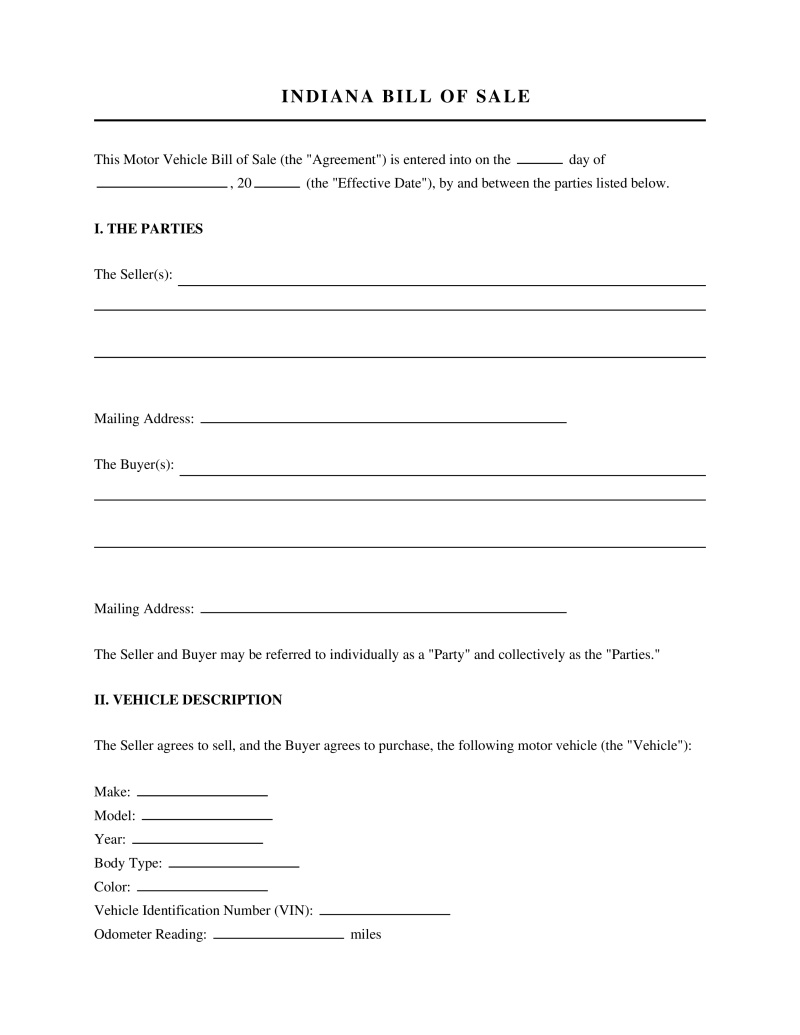
Indiana Bill of Sale Sample
Bill of Sale in other states
Not the form you're looking for?
Try our legal document generator to create a custom document
Disclaimer: The templates available on this website are provided for general informational purposes only and do not constitute legal advice. They are not intended to be, and should not be interpreted as, compliant with any specific legal, regulatory, or privacy requirements. These templates are not a replacement for professional legal guidance and should not be relied upon for any particular matter or circumstance. Users are strongly encouraged to seek advice from a qualified attorney licensed in their jurisdiction before using, modifying, or relying on any template.
All templates are provided on an "as is," "with all faults," and "as available" basis. The provider disclaims any and all warranties of any kind, whether express, implied, statutory, or otherwise, including without limitation warranties of merchantability, fitness for a particular purpose, title, or non-infringement.
LegalTemplates.com makes no guarantees or representations regarding the accuracy, completeness, expected outcomes, or reliability of the materials contained in these templates or any materials referenced or linked from them.