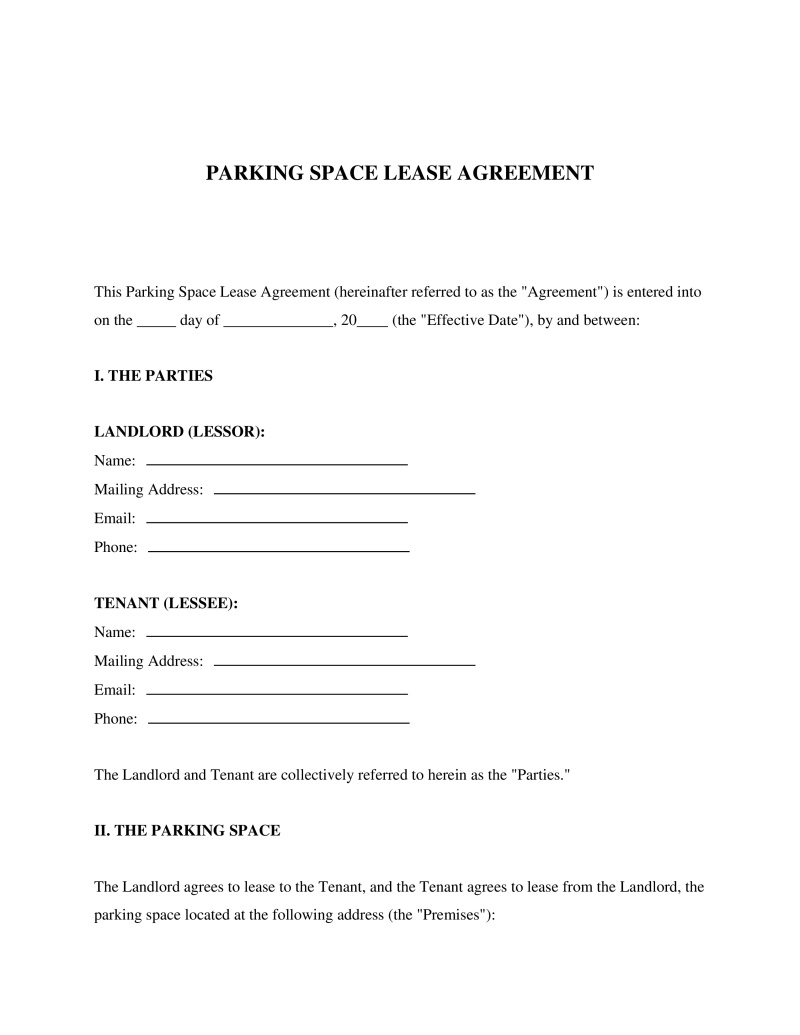
Parking Space Lease Agreement
A Parking Space Lease Agreement is a formal legal instrument delineating the specific terms and conditions governing the rental of a designated parking area between a property owner and a lessee.
Parking Space Type
Select the type of parking space you are leasing from the options provided. This information helps clarify your parking rights and responsibilities, which can affect your lease agreement. If you choose "Other," briefly describe the space type in the comments section.
Provide details if you selected 'Other'.
Table of Contents
What is a Parking Space Lease Agreement?
A Parking Space Lease Agreement is a legally binding contract that outlines the terms and conditions under which an owner of a parking space (the lessor) grants another party (the lessee) the right to use that space for a specified period. This document defines the responsibilities and expectations of both parties, ensuring clarity regarding rent, duration, rules of use, and other pertinent details. It is commonly utilized by individuals, businesses, and property management companies to formalize the rental of parking facilities, whether standalone or associated with residential or commercial properties.
Legal Requirements and Validity
For a Parking Space Lease Agreement to be legally valid and enforceable, it must meet several fundamental contractual requirements. These elements ensure that both parties understand their commitments and that the agreement can withstand legal scrutiny. A valid agreement typically includes:
- Offer and Acceptance - One party must propose specific terms for the lease, and the other party must unequivocally agree to those terms.
- Consideration - There must be an exchange of value between the parties, typically the payment of rent by the lessee in exchange for the right to use the parking space provided by the lessor.
- Competent Parties - Both the lessor and lessee must be of legal age and possess the mental capacity to enter into a contract.
- Legal Purpose - The purpose of the agreement must be lawful and not violate any existing statutes or public policy.
- Mutual Assent - Both parties must agree to the same terms and conditions, demonstrating a "meeting of the minds."
- Written Form (for certain durations) - While some short-term parking agreements may be verbal, many jurisdictions require leases for periods exceeding one year to be in writing to be enforceable, pursuant to the Statute of Frauds.
Rights and Obligations of Parties Involved
A Parking Space Lease Agreement clearly delineates the rights and obligations of both the lessor (owner) and the lessee (renter) to prevent disputes and ensure a smooth arrangement. Understanding these roles is crucial for compliance and effective management of the parking space.
Lessor's Rights and Obligations
The lessor, as the owner of the parking space, holds certain rights and responsibilities:
- Right to Receive Rent - The lessor is entitled to receive timely payment of the agreed-upon rent for the use of the parking space.
- Right to Enforce Rules - The lessor has the right to establish and enforce reasonable rules regarding the use of the parking space, such as vehicle type restrictions or permitted hours.
- Obligation to Provide Access - The lessor must ensure the lessee has uninterrupted and safe access to the designated parking space throughout the lease term.
- Obligation to Maintain Space (if applicable) - Depending on the agreement, the lessor may be responsible for the general maintenance and upkeep of the parking area, including snow removal, lighting, or security.
- Right to Terminate Lease - The lessor can terminate the lease in accordance with the agreement's terms, such as for non-payment of rent or violation of rules, often requiring proper notice.
Lessee's Rights and Obligations
The lessee, as the renter of the parking space, also has specific rights and responsibilities:
- Right to Exclusive Use - The lessee has the right to use the designated parking space exclusively for the duration of the lease, free from interference by others.
- Right to Quiet Enjoyment - The lessee is entitled to use the parking space without undue disturbance from the lessor or other parties.
- Obligation to Pay Rent - The lessee must pay the agreed-upon rent on time, as specified in the Parking Space Lease Agreement.
- Obligation to Adhere to Rules - The lessee must comply with all reasonable rules and regulations set forth by the lessor regarding the use of the parking space.
- Obligation to Maintain Space Condition - The lessee is generally responsible for keeping the parking space clean and free from debris, and for not causing damage beyond normal wear and tear.
- Obligation to Vacate - Upon termination of the lease, the lessee must promptly vacate the parking space and return any access devices, such as parking passes or remote controls.
Key Provisions in a Parking Space Lease Agreement
A comprehensive Parking Space Lease Agreement typically includes several key provisions to ensure clarity and protect the interests of both the lessor and the lessee. These elements address critical aspects of the rental arrangement:
- Identification of Parties - Full legal names and contact information for both the lessor and the lessee.
- Description of Parking Space - A precise identification of the parking space, including its number, location, and any distinguishing features.
- Lease Term - The start and end dates of the lease, specifying whether it is a fixed-term, month-to-month, or other arrangement.
- Rent Amount and Payment Terms - The exact amount of rent, due date, acceptable payment methods, and any late fees or grace periods.
- Security Deposit Details - The amount of any security deposit, conditions for its return, and any allowable deductions.
- Rules and Regulations - Specific rules governing the use of the parking space, such as vehicle restrictions, towing policies, or prohibited activities.
- Maintenance Responsibilities - Clarification of who is responsible for the upkeep, cleaning, and any necessary repairs of the parking space or common areas.
- Termination Clause - Conditions under which either party can terminate the agreement, including required notice periods.
- Governing Law - The jurisdiction whose laws will govern the interpretation and enforcement of the agreement.
- Signatures and Date - The dated signatures of all parties involved, indicating their acceptance of the terms.
How to Complete a Parking Space Lease Agreement
Completing a Parking Space Lease Agreement involves several methodical steps to ensure all necessary information is included and the document is legally sound. Careful attention to detail at each stage helps to prevent future misunderstandings or disputes.
- Gather Essential Information - Begin by collecting all pertinent details for both the lessor and the lessee, including full legal names, current addresses, and contact information. Accurately identify the specific parking space by its number, location, or any unique identifiers. Determine the desired lease term, whether it's a fixed period or a month-to-month arrangement, and establish the monthly rent amount, due date, and acceptable payment methods.
- Draft the Agreement's Core Terms - Using a standard template or legal counsel, input the gathered information into the Parking Space Lease Agreement. Clearly state the lease commencement and termination dates, the exact rental fee, and any provisions for late payments or security deposits. Detail any specific rules for using the parking space, such as restrictions on vehicle types, towing policies, or maintenance responsibilities.
- Review and Negotiate Terms - Once the initial draft is complete, both parties should thoroughly review the entire document. This is the opportunity to clarify any ambiguous clauses, propose modifications, or negotiate terms that may not be mutually agreeable. Ensure that all parties fully understand their rights and obligations before proceeding.
- Include Necessary Addenda and Disclosures - Depending on the location or specific circumstances, additional forms or disclosures may be required. For instance, if the parking space is part of a larger residential property, disclosures related to lead-based paint for older buildings might be relevant, even if indirectly. Attach any community rules, maps, or other supplementary documents referenced in the main agreement.
- Sign and Distribute Copies - After all terms are finalized and agreed upon, both the lessor and the lessee must sign and date the Parking Space Lease Agreement. It is advisable to have the signatures notarized, although not always legally required, to add an extra layer of authenticity. Provide each party with a fully executed copy of the agreement for their records.
Legal Framework: Federal and State Laws
The legal framework governing Parking Space Lease Agreements primarily stems from state contract and property laws, though certain federal statutes may have indirect relevance, especially when the parking is associated with residential housing.
Federal Statutes
While there are no federal laws specifically regulating parking space leases, general federal anti-discrimination laws can apply if the parking space is offered in conjunction with a housing unit:
- Fair Housing Act - Prohibits discrimination in the sale, rental, and financing of housing based on race, color, national origin, religion, sex, familial status, or disability. If a parking space is part of a housing offering, discriminatory practices in its rental would fall under this act (42 U.S.C. § 3601 et seq.).
- Americans with Disabilities Act (ADA) - Requires public accommodations and commercial facilities to be accessible to people with disabilities. While primarily for public access, parking facilities associated with commercial properties or multi-family housing may have ADA-related requirements for accessible parking spaces (42 U.S.C. § 12181 et seq.).
State Laws and Requirements
State laws are the primary legal authority for Parking Space Lease Agreements, addressing various aspects of contract and property law:
- Statute of Frauds - Mandates that certain types of contracts, including leases for real property exceeding a specific duration (often one year), must be in writing to be enforceable (varies by state statute).
- Contract Law Principles - State common law and statutory contract principles govern the formation, interpretation, and enforcement of all lease agreements, including those for parking spaces.
- Landlord-Tenant Acts (Indirectly) - While most state landlord-tenant acts specifically address residential dwelling units, some provisions or general principles regarding leases, security deposits, or eviction procedures may be referenced by analogy for parking spaces, particularly if they are part of a larger residential lease (e.g., Uniform Residential Landlord and Tenant Act adopted in various forms by many states).
- Security Deposit Regulations - Many states have specific laws governing security deposits, including limits on the amount, requirements for holding the deposit, and timelines for its return. These regulations may apply to deposits taken for parking spaces (varies by state statute).
- Notice Requirements - State laws often dictate the amount of notice required for lease termination, rent increases, or other significant changes to a lease agreement, which can extend to parking leases.
Penalties for Non-Compliance
Non-compliance with the terms of a Parking Space Lease Agreement or applicable laws can result in various penalties and legal consequences for both parties. For the lessee, failure to pay rent can lead to late fees, potential towing of the vehicle, and ultimately, eviction from the parking space. Violation of parking rules might also incur fines or termination of the lease. For the lessor, non-compliance with legal requirements, such as failing to provide agreed-upon access or unlawfully withholding a security deposit, could result in legal action by the lessee, potentially leading to financial penalties, damages, or legal costs. Courts may order specific performance of the contract, award monetary damages for losses incurred, or, in severe cases, impose statutory penalties for violations of consumer protection or landlord-tenant laws.
Frequently Asked Questions
Already have a Lease Agreement?
Get it reviewed free — checked against your state's laws in about a minute.
Not the form you're looking for?
Try our legal document generator to create a custom document
Disclaimer: The templates available on this website are provided for general informational purposes only and do not constitute legal advice. They are not intended to be, and should not be interpreted as, compliant with any specific legal, regulatory, or privacy requirements. These templates are not a replacement for professional legal guidance and should not be relied upon for any particular matter or circumstance. Users are strongly encouraged to seek advice from a qualified attorney licensed in their jurisdiction before using, modifying, or relying on any template.
All templates are provided on an "as is," "with all faults," and "as available" basis. The provider disclaims any and all warranties of any kind, whether express, implied, statutory, or otherwise, including without limitation warranties of merchantability, fitness for a particular purpose, title, or non-infringement.
LegalTemplates.com makes no guarantees or representations regarding the accuracy, completeness, expected outcomes, or reliability of the materials contained in these templates or any materials referenced or linked from them.