Letter of Instruction
A Letter of Instruction is a non-binding document that provides detailed guidance and specific directions regarding personal, financial, or practical matters.
Instruction Priority
Choose the level of urgency so the letter can clearly communicate whether immediate handling, routine processing, or future action is expected.
Table of Contents
What is a Letter of Instruction?
A Letter of Instruction (LOI) is a non-legally binding document that provides detailed personal, financial, and practical information to an executor, trustee, agent under a power of attorney, or other designated individual. Its primary purpose is to offer guidance and facilitate the management of an individual's affairs during periods of incapacity or after their death. While not possessing the legal authority of a will or trust, a Letter of Instruction serves as a comprehensive roadmap for fiduciaries, ensuring that an individual's wishes and practical arrangements are understood and carried out efficiently.
Purpose and Scope
The scope of a Letter of Instruction is broad, encompassing various aspects of an individual's personal and financial life that may not be suitable or legally appropriate for inclusion in formal estate planning documents. It acts as a repository for practical information that aids fiduciaries in navigating complex personal and financial landscapes. The document is designed to reduce the burden on those responsible for managing affairs, providing clear directives and saving considerable time and potential frustration during what can be a challenging period.
Common information included in a Letter of Instruction:
- Financial Account Details - Bank accounts, investment portfolios, retirement plans, insurance policies, and credit card accounts, including account numbers, contact information, and login credentials.
- Digital Assets - Passwords and access information for email accounts, social media profiles, online banking, cloud storage, and other digital platforms.
- Personal Property Inventory - A list of valuable possessions, their locations, and any specific wishes for their distribution or care, particularly items not explicitly mentioned in a will.
- Key Contacts - Names and contact information for attorneys, financial advisors, accountants, insurance agents, doctors, and other important professionals or family members.
- Funeral and Burial Wishes - Specific preferences regarding funeral arrangements, cremation or burial, memorial services, and any pre-paid arrangements.
- Location of Important Documents - Information about where to find legal documents such as wills, trusts, deeds, birth certificates, marriage licenses, and safe deposit box keys.
- Household Management - Details about utility providers, home maintenance services, pet care instructions, and any ongoing bills or subscriptions.
Legal Standing and Enforceability
A Letter of Instruction is distinct from legally enforceable documents like a will, trust, or power of attorney. It does not transfer property, appoint fiduciaries, or make legally binding decisions. Instead, its authority derives from the willingness of the designated fiduciaries to follow its guidance. While an LOI cannot legally compel an executor or agent to act in a certain way, it serves as a powerful expression of an individual's desires and provides invaluable practical assistance.
The non-binding nature means that if an instruction within an LOI conflicts with a legally executed will or trust, the formal legal document will always take precedence. For instance, if an LOI suggests a specific distribution of assets that contradicts a will, the will's provisions must be followed. Despite this, the practical utility of an LOI is immense, as it often contains critical details that streamline the administration process, such as passwords or locations of hidden assets, which are not typically included in formal legal instruments.
How to Complete a Letter of Instruction
Creating a comprehensive Letter of Instruction involves a systematic approach to ensure all vital information is captured and organized effectively for your designated fiduciaries.
- Gather Essential Personal and Financial Information - Compile a thorough inventory of all your assets, liabilities, and personal details. This includes bank account numbers, investment firm contacts, insurance policy details, real estate documents, outstanding debts, and any regular bills. Ensure you have current contact information for all relevant institutions and individuals.
- Document Digital Assets and Access Credentials - List all online accounts, including email, social media, financial platforms, and cloud storage services. Provide usernames and passwords, or clear instructions on how to access these accounts, recognizing that some terms of service may restrict sharing. Consider using a secure password manager to store this sensitive information.
- Outline Personal Wishes and Preferences - Detail your preferences for funeral arrangements, memorial services, and disposition of remains (burial or cremation). Include any specific wishes for charitable donations in your name, care for pets, or distribution of sentimental items not covered in your will. This section helps ensure your personal values and desires are honored.
- Identify Key Professionals and Contacts - Create a list of all important contacts, including your attorney, financial advisor, accountant, insurance agent, and doctor, along with their contact information. Also, include contact details for close family members and friends who should be notified in case of an emergency or death. This ensures your fiduciaries can quickly reach necessary parties.
- Specify Location of Important Documents - Clearly state where your original will, trust documents, birth certificate, marriage certificate, deeds, titles, and any safe deposit box keys are stored. Providing exact locations prevents fiduciaries from having to search extensively for critical paperwork.
- Review and Update Regularly - A Letter of Instruction is a dynamic document that should be reviewed and updated at least annually, or whenever significant life events occur. Changes in financial accounts, digital assets, personal relationships, or wishes necessitate revisions to ensure the document remains accurate and relevant.
Integration with Estate Planning Documents
A Letter of Instruction functions as a critical complement to, rather than a replacement for, formal estate planning documents. While a will legally dictates the distribution of assets and appoints an executor, and a durable power of attorney grants authority for financial and healthcare decisions during incapacity, the LOI fills in the practical gaps. It provides the granular details and operational instructions that these legal documents typically omit, thereby enabling the appointed fiduciaries to execute their duties more effectively and efficiently.
For example, a will might name an executor, but the LOI would tell that executor where to find the will, how to access bank accounts, and even what specific sentiment is attached to a particular heirloom. Similarly, a power of attorney grants an agent the legal right to manage finances, but the LOI provides the actual login credentials, account numbers, and specific instructions for bill payments. This synergistic relationship ensures that both the legal framework and the practical implementation of an individual's wishes are thoroughly addressed.
Applicable Federal and State Considerations
While a Letter of Instruction itself is not a legally binding document, the information it contains and the actions it guides can be subject to various federal and state laws. Fiduciaries relying on an LOI must still adhere to legal requirements governing their roles.
Federal Statutes
Several federal laws may indirectly influence the content and use of information within an LOI:
- Health Insurance Portability and Accountability Act (HIPAA) - Governs the privacy and security of protected health information. If an LOI contains health-related instructions or references, fiduciaries may still require a separate, legally compliant HIPAA authorization to access medical records (45 CFR § 164.508).
- Electronic Communications Privacy Act (ECPA) - Generally prohibits unauthorized access to stored electronic communications. While an LOI might provide passwords, actual legal access to digital communications and accounts may be governed by specific terms of service or state versions of RUFADAA (18 U.S.C. § 2510 et seq.).
State Laws and Requirements
State laws play a significant role in defining the duties of fiduciaries and the legality of accessing certain types of information:
- Revised Uniform Fiduciary Access to Digital Assets Act (RUFADAA) - Adopted in various forms by most states, this model act provides a legal framework for fiduciaries to access, manage, and distribute digital assets and electronic communications. An LOI can complement RUFADAA by providing explicit consent and specific instructions, but the legal authority stems from the state statute and specific provisions in a will or trust (e.g., Cal. Prob. Code § 870 et seq., N.Y. EPTL § 13-A-1.1 et seq.).
- Uniform Probate Code (UPC) - Adopted by many states, the UPC outlines the duties and responsibilities of executors and personal representatives. While an LOI provides guidance, the executor's legal obligations are derived from the UPC and other state probate laws, including duties of loyalty, impartiality, and prudent administration (e.g., Uniform Probate Code § 3-703).
- Fiduciary Duties - State common law and statutes define the fiduciary duties of executors, agents under powers of attorney, and trustees. These duties typically include acting in good faith, with loyalty, prudence, and in the best interests of the beneficiaries. While an LOI provides instructions, a fiduciary's actions must always align with these legally mandated duties.
Penalties for Non-Compliance or Misconduct
Fiduciaries who misuse information provided in an LOI or fail to fulfill their legally binding duties can face significant penalties:
- Breach of Fiduciary Duty - Executors, agents, or trustees who neglect their responsibilities or act contrary to the legal documents (will, trust, power of attorney) can be sued by beneficiaries. Penalties may include removal from their role, personal liability for financial losses, or disgorgement of fees.
- Civil and Criminal Liability - Depending on the nature of the misconduct, such as fraud, embezzlement, or unauthorized access to protected information, a fiduciary could face civil lawsuits for damages or even criminal charges.
- Accountability in Probate Court - Executors and trustees are accountable to the probate court. Mismanagement of assets or failure to follow legal directives can lead to court-ordered remedies, including requiring the fiduciary to compensate the estate for losses.
Frequently Asked Questions
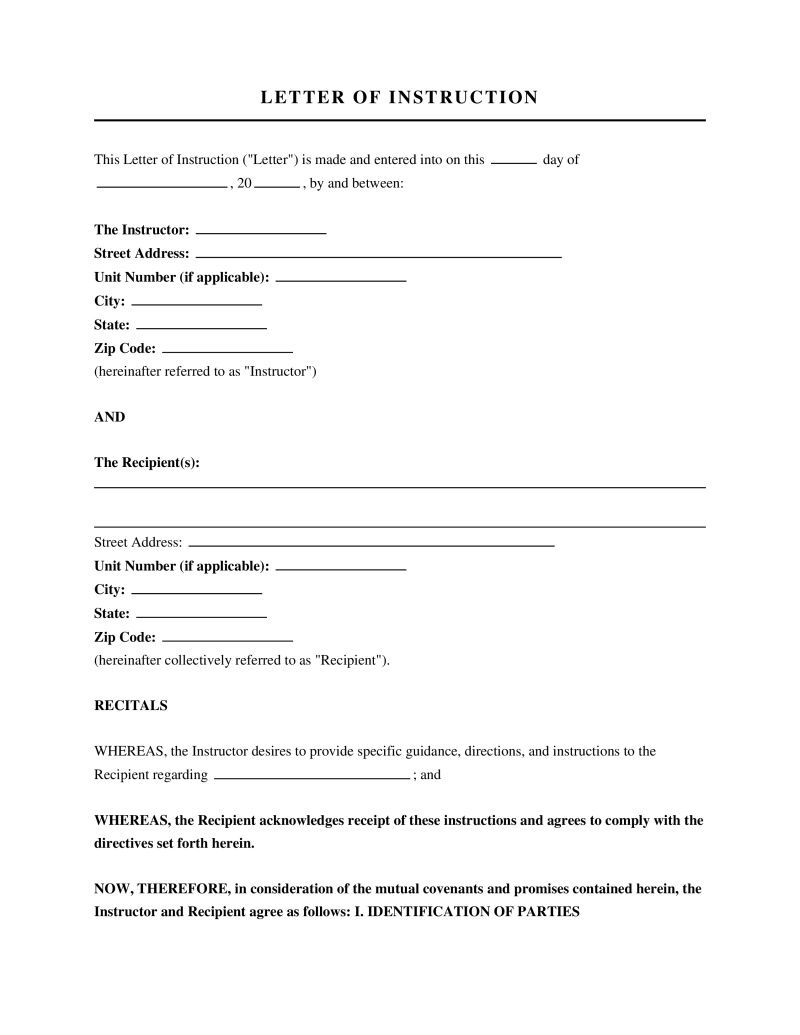
Letter of Instruction Sample
Not the form you're looking for?
Try our legal document generator to create a custom document
Disclaimer: The templates available on this website are provided for general informational purposes only and do not constitute legal advice. They are not intended to be, and should not be interpreted as, compliant with any specific legal, regulatory, or privacy requirements. These templates are not a replacement for professional legal guidance and should not be relied upon for any particular matter or circumstance. Users are strongly encouraged to seek advice from a qualified attorney licensed in their jurisdiction before using, modifying, or relying on any template.
All templates are provided on an "as is," "with all faults," and "as available" basis. The provider disclaims any and all warranties of any kind, whether express, implied, statutory, or otherwise, including without limitation warranties of merchantability, fitness for a particular purpose, title, or non-infringement.
LegalTemplates.com makes no guarantees or representations regarding the accuracy, completeness, expected outcomes, or reliability of the materials contained in these templates or any materials referenced or linked from them.