Trailer Bill of Sale
A Trailer Bill of Sale is a legal document that records the sale of ownership of a trailer.
Trailer Type
Select the category that best matches the trailer. This helps tailor the description and registration details.
Use the common name or registration category for the trailer.
Table of Contents
What is a Trailer Bill of Sale?
A trailer bill of sale is a legal document that records the transfer of ownership of a non-motorized trailer from a seller to a buyer. This essential document serves as proof of purchase, detailing the transaction's specifics, including the trailer's description, the agreed-upon price, and the identities of both parties involved. Its primary purpose is to establish a clear chain of ownership, which is crucial for the buyer to register the trailer, obtain a new title, and pay any applicable sales taxes with state motor vehicle departments. Both private individuals and commercial entities utilize a trailer bill of sale to formalize the sale of various types of trailers, such as utility trailers, boat trailers, travel trailers, or equipment trailers.
Required Elements of a Valid Trailer Bill of Sale
For a trailer bill of sale to be legally sound and effectively facilitate the transfer of ownership, it must contain several key pieces of information:
- Buyer's Full Legal Name and Address - Complete identification of the individual or entity acquiring the trailer.
- Seller's Full Legal Name and Address - Complete identification of the individual or entity relinquishing ownership of the trailer.
- Date of Sale - The specific calendar date on which the transaction occurred.
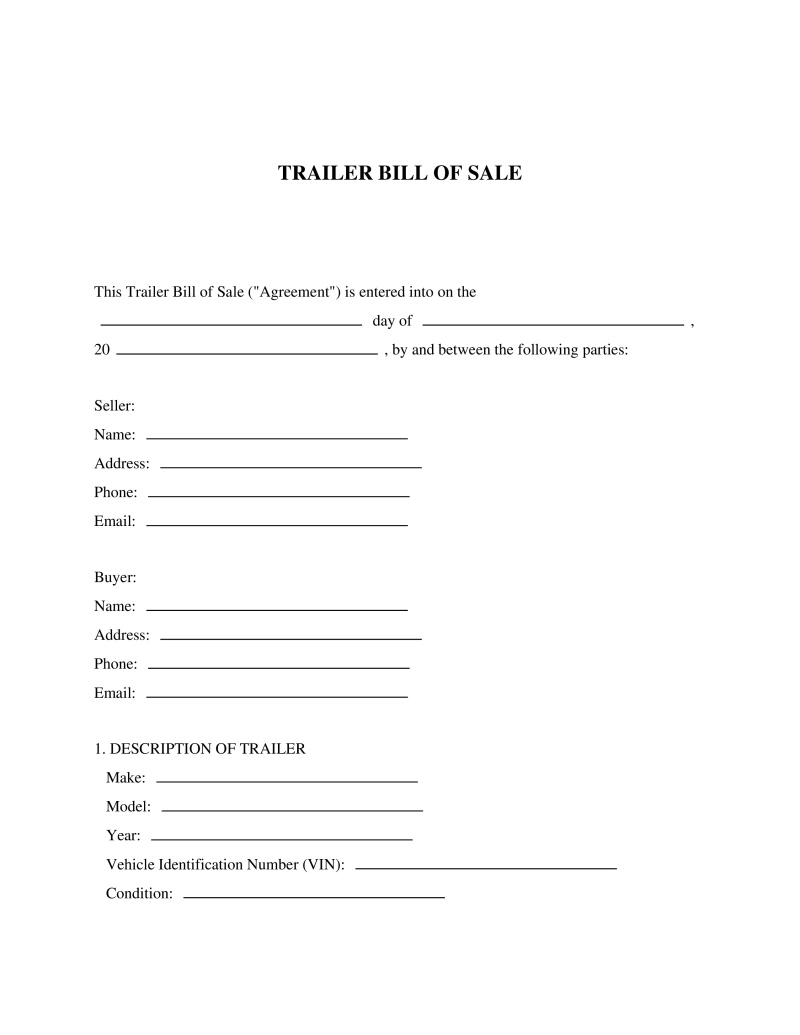
- Detailed Trailer Description - Comprehensive information about the trailer including its Vehicle Identification Number (VIN) or serial number, make, model, year of manufacture, type of trailer (e.g., utility, boat, travel), approximate weight, and any unique identifying features.
- Purchase Price - The exact monetary amount agreed upon for the sale of the trailer.
- Payment Method - Specification of how the payment was rendered (e.g., cash, check, money order).
- Signatures of Buyer and Seller - The legal signatures of both parties involved, indicating their agreement to the terms of the sale.
- "As-Is" Clause (if applicable) - A statement indicating that the buyer is purchasing the trailer in its current condition, without any warranties from the seller regarding its future performance or state.
- Notary Acknowledgment (if required by state law) - The signature and seal of a notary public, confirming the identities of the signers and the authenticity of their signatures.
How to Complete a Trailer Bill of Sale
Completing a trailer bill of sale involves several critical steps to ensure the document is accurate, legally enforceable, and properly records the transfer of ownership. Following a structured process helps both buyers and sellers protect their interests and comply with state regulations.
- Gather Essential Information - Before drafting the document, collect all necessary details for both the buyer and seller, including full legal names, current addresses, and contact information. Obtain the trailer's complete identification data, such as the Vehicle Identification Number (VIN) or serial number, make, model, year, and type. Verify the VIN matches the trailer's physical stamping and any existing title documents.
- Determine Sale Price and Terms - Clearly establish the final agreed-upon purchase price for the trailer. Document the method of payment, such as cash, certified check, or bank transfer. If any specific conditions or contingencies are part of the sale, like an "as-is" clause or a payment schedule, ensure these are explicitly stated within the document.
- Draft the Document Accurately - Utilize a standardized trailer bill of sale form, often available from state Department of Motor Vehicles (DMV) websites, or create one that includes all required elements. Carefully input all gathered information into the appropriate fields, double-checking for any typographical errors or omissions. Ensure the trailer's description is thorough enough to uniquely identify it.
- Review and Verify All Details - Before signing, both the buyer and seller must thoroughly read the entire trailer bill of sale. Confirm the accuracy of all names, addresses, the trailer's description, and the purchase price. Any discrepancies should be corrected and initialed by both parties before proceeding to the signing stage. This review prevents future disputes arising from inaccuracies.
- Execute Signatures and Notarization - Both the buyer and seller must affix their legal signatures to the document. In many states, or for added legal assurance, the signatures may need to be notarized. If notarization is required or desired, all parties must sign the document in the presence of a notary public. Each party should retain an original signed copy of the bill of sale for their records.
- Facilitate Title Transfer and Registration - The seller should sign over the existing trailer title to the buyer, if applicable, providing the bill of sale as supplementary proof of ownership. The buyer then takes the signed title and the trailer bill of sale to their local DMV or equivalent state agency to apply for a new title, register the trailer, and obtain new license plates. This step is critical for legal ownership and road use.
Rights and Obligations of Parties Involved
The sale of a trailer involves specific rights and obligations for both the buyer and the seller, which are often reinforced by the trailer bill of sale and state laws. Understanding these responsibilities helps ensure a smooth and legally compliant transaction.
The seller typically assumes certain duties and retains specific rights:
- Right to Receive Payment - The seller has the right to receive the full agreed-upon purchase price for the trailer, as stipulated in the bill of sale.
- Obligation to Provide Clear Title - The seller is generally obligated to provide the buyer with a clear and transferable title, free of any undisclosed liens or encumbrances. If a lien exists, the seller must ensure its release before or at the time of sale.
- Obligation to Accurately Describe Trailer Condition - The seller must truthfully represent the trailer's condition, especially if the sale is not explicitly "as-is." Any known defects or issues should be disclosed to the buyer.
- Obligation to Sign Documents - The seller must sign the bill of sale and the existing title document to legally transfer ownership.
- Obligation to Remove License Plates - In many jurisdictions, the seller is responsible for removing their old license plates from the trailer.
- Obligation to Report Sale - Some states require the seller to report the sale of the trailer to the Department of Motor Vehicles within a specified timeframe to avoid liability for future incidents involving the trailer.
Conversely, the buyer also has distinct rights and obligations:
- Right to Receive Trailer and Title - The buyer has the right to receive the trailer in the condition agreed upon and to receive a clear, transferable title document from the seller.
- Obligation to Pay Purchase Price - The buyer is obligated to pay the full agreed-upon purchase price to the seller according to the terms specified in the bill of sale.
- Obligation to Inspect Trailer - It is the buyer's responsibility to inspect the trailer thoroughly before completing the purchase to ascertain its condition and ensure it meets their expectations.
- Obligation to Register and Title Trailer - The buyer must register the trailer and apply for a new title in their name with the appropriate state motor vehicle authority within the legally mandated period.
- Obligation to Pay Sales Tax - The buyer is responsible for paying any applicable state and local sales taxes on the purchase price of the trailer.
- Obligation to Obtain Insurance - Depending on the trailer type and state laws, the buyer may be required to obtain insurance coverage for the trailer before operating it on public roads.
Applicable Legal Frameworks and Laws
The transfer of ownership of a trailer, formalized by a trailer bill of sale, is governed by a combination of model laws and specific state statutes. These legal frameworks ensure fairness, clarity, and enforceability in such transactions.
Uniform Commercial Code (UCC)
While not a federal law, the Uniform Commercial Code is a set of standardized laws regulating commercial transactions that has been adopted, with some variations, by all 50 U.S. states, the District of Columbia, and U.S. territories. It provides a comprehensive framework for sales and secured transactions:
- UCC Article 2, Sales - Governs the sale of goods, which includes trailers. This article outlines rules for contract formation, warranties (express and implied), risk of loss, and remedies for breach of contract (UCC § 2-101 et seq.).
- UCC Article 9, Secured Transactions - Becomes relevant if the purchase of the trailer involves financing where the trailer itself serves as collateral for a loan. This article details how security interests are created, perfected, and enforced (UCC § 9-101 et seq.).
State Laws and Regulations
Each state has specific laws that directly impact the sale, titling, and registration of trailers. These statutes often supplement or modify the general provisions of the UCC:
- State Motor Vehicle Codes - These comprehensive statutes define trailers, establish requirements for titling, registration, and license plates, and detail the process for transferring ownership, often specifying the role of a bill of sale (e.g., California Vehicle Code § 4000 et seq., Texas Transportation Code § 501.001 et seq.).
- Sales Tax Statutes - States impose sales or use tax on the purchase of tangible personal property, including trailers. These laws specify the tax rate, who is responsible for collection and remittance, and exemptions (e.g., New York Tax Law § 1101 et seq.).
- Notary Public Laws - Many states have laws that dictate when a document, such as a bill of sale, must be notarized to be legally valid or to be accepted by state agencies for title transfer. These laws also regulate the duties and powers of notaries public (e.g., Florida Statutes Chapter 117).
- Consumer Protection and Fraud Statutes - General state laws prohibiting deceptive trade practices, misrepresentation, and fraud in commercial transactions can apply to trailer sales, offering recourse to buyers who have been misled about a trailer's condition or history (e.g., Uniform Deceptive Trade Practices Act, adopted by many states).
Consequences of Non-Compliance
Failure to properly execute a trailer bill of sale or comply with associated state laws can lead to significant legal and financial repercussions for both the buyer and the seller:
- Difficulty in Title and Registration - Without a properly completed bill of sale, the buyer may face significant challenges or outright refusal when attempting to transfer the trailer's title and register it with the state DMV.
- Legal Disputes Over Ownership - An invalid or incomplete bill of sale can lead to disputes over legal ownership, particularly if the trailer is later sold to another party or if there are conflicting claims.
- Fines and Penalties - Both parties may incur fines for late registration, failure to pay sales tax, or other violations of state motor vehicle laws.
- Liability Issues - If the seller fails to properly transfer ownership, they might remain legally liable for accidents, parking violations, or other issues involving the trailer even after they have sold it.
- Inability to Obtain Insurance - Buyers may struggle to obtain insurance for a trailer without proper proof of ownership and registration, leaving them financially vulnerable in case of damage or theft.
- Invalidation of Sale - In severe cases of fraud or significant non-compliance, a court could potentially invalidate the entire sale, requiring the return of the trailer and purchase price.
Frequently Asked Questions
Trailer Bill of Sale Sample
Not the form you're looking for?
Try our legal document generator to create a custom document
Disclaimer: The templates available on this website are provided for general informational purposes only and do not constitute legal advice. They are not intended to be, and should not be interpreted as, compliant with any specific legal, regulatory, or privacy requirements. These templates are not a replacement for professional legal guidance and should not be relied upon for any particular matter or circumstance. Users are strongly encouraged to seek advice from a qualified attorney licensed in their jurisdiction before using, modifying, or relying on any template.
All templates are provided on an "as is," "with all faults," and "as available" basis. The provider disclaims any and all warranties of any kind, whether express, implied, statutory, or otherwise, including without limitation warranties of merchantability, fitness for a particular purpose, title, or non-infringement.
LegalTemplates.com makes no guarantees or representations regarding the accuracy, completeness, expected outcomes, or reliability of the materials contained in these templates or any materials referenced or linked from them.