RV Bill of Sale Template
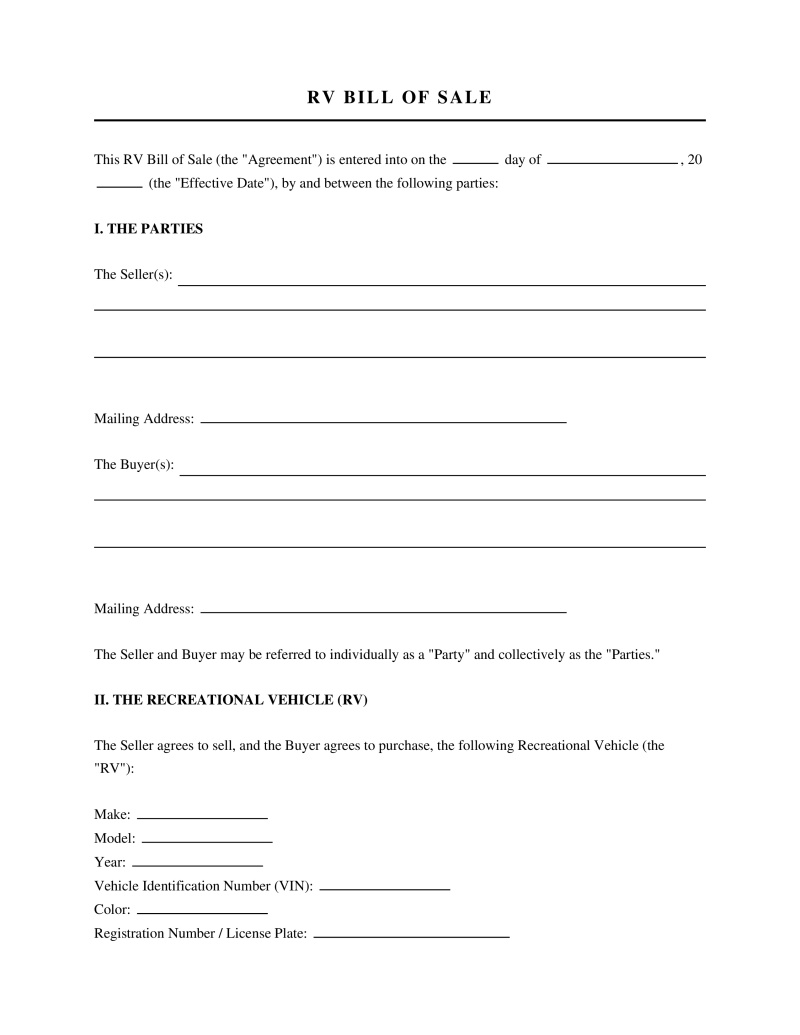
An RV Bill of Sale is a legal document that records the sale and transfer of ownership of a recreational vehicle from seller to buyer.
Is Sale By Dealer
Select 'Yes' if the Seller is a business or dealership. Select 'No' if the Seller is a private individual.
Enter the Seller's state-issued dealer license number.
Select the state where the dealer is licensed.
Table of Contents
What is a RV Bill of Sale Template?
An RV Bill of Sale Template is a legal instrument used to document the transfer of ownership of a recreational vehicle from a seller to a buyer. This written record serves as the primary receipt for the transaction, detailing the specific terms of the sale including the purchase price, vehicle identification number (VIN), and the condition of the camper or motorhome. State motor vehicle departments often require this document to process the registration and titling of the vehicle in the new owner's name. It functions simultaneously as proof of ownership for the buyer and a release of liability for the seller once the transaction concludes.
Required Elements of a Valid RV Bill of Sale
A comprehensive bill of sale must contain specific data points to be considered legally binding and acceptable by local tax collectors or DMV offices. Missing information can lead to delays in registration or legal disputes regarding ownership.
- Parties Involved - Full legal names, physical addresses, and contact information for both the buyer and the seller.
- Vehicle Description - The make, model, year, body style, and unique Vehicle Identification Number (VIN) of the recreational vehicle.
- Purchase Price - The agreed-upon monetary amount paid for the vehicle, often written in both words and numbers to prevent alteration.
- Date of Sale - The specific calendar date when the transaction occurred and ownership officially transferred.
- Odometer Reading - The current mileage displayed on the vehicle's odometer at the time of transfer.
- Signatures - Hand-written or electronic signatures of all parties involved, occasionally requiring notarization depending on state statutes.
Federal and State Legal Considerations
The sale of motor vehicles, including RVs, falls under various federal and state regulations designed to protect consumers and ensure accurate record-keeping. These laws govern how transfers must be documented and reported.
- Federal Odometer Act - Mandates the disclosure of mileage for vehicles under a certain age to prevent odometer fraud (49 U.S.C. § 32705).
- Uniform Commercial Code Article 2 - Governs contracts for the sale of goods, including requirements for written contracts for sales over $500 (UCC § 2-201).
- State Notarization Requirements - Specific states mandate that a notary public witness the signing of the bill of sale for it to be valid for titling (State Statutes Vary).
- Implied Warranty of Merchantability - Automatically guarantees that a vehicle sold by a merchant is fit for its ordinary purpose unless effectively disclaimed (UCC § 2-314).
- Lemon Laws - State-specific statutes that may provide recourse for buyers of defective vehicles, though protections for used RVs vary significantly (Magnuson-Moss Warranty Act).
Registration and Titling Process
Following the execution of the RV Bill of Sale, the new owner must take specific actions to legally register the vehicle. Departments of Motor Vehicles (DMV) or equivalent state agencies enforce strict timelines and documentation standards.
- Proof of Ownership - The signed bill of sale and the previous title signed over by the seller serve as primary evidence of the transfer.
- Tax Payments - Sales tax is typically calculated based on the purchase price listed on the bill of sale and collected at the time of registration.
- Insurance Requirements - Proof of valid insurance coverage is generally required before the state will issue new license plates or tags.
- Inspection Certificates - Some states require safety or emissions inspections before a used vehicle can be registered to a new owner.
Frequently Asked Questions
RV Bill of Sale Sample
Not the form you're looking for?
Try our legal document generator to create a custom document
Disclaimer: The templates available on this website are provided for general informational purposes only and do not constitute legal advice. They are not intended to be, and should not be interpreted as, compliant with any specific legal, regulatory, or privacy requirements. These templates are not a replacement for professional legal guidance and should not be relied upon for any particular matter or circumstance. Users are strongly encouraged to seek advice from a qualified attorney licensed in their jurisdiction before using, modifying, or relying on any template.
All templates are provided on an "as is," "with all faults," and "as available" basis. The provider disclaims any and all warranties of any kind, whether express, implied, statutory, or otherwise, including without limitation warranties of merchantability, fitness for a particular purpose, title, or non-infringement.
LegalTemplates.com makes no guarantees or representations regarding the accuracy, completeness, expected outcomes, or reliability of the materials contained in these templates or any materials referenced or linked from them.