Affidavit of Indigency
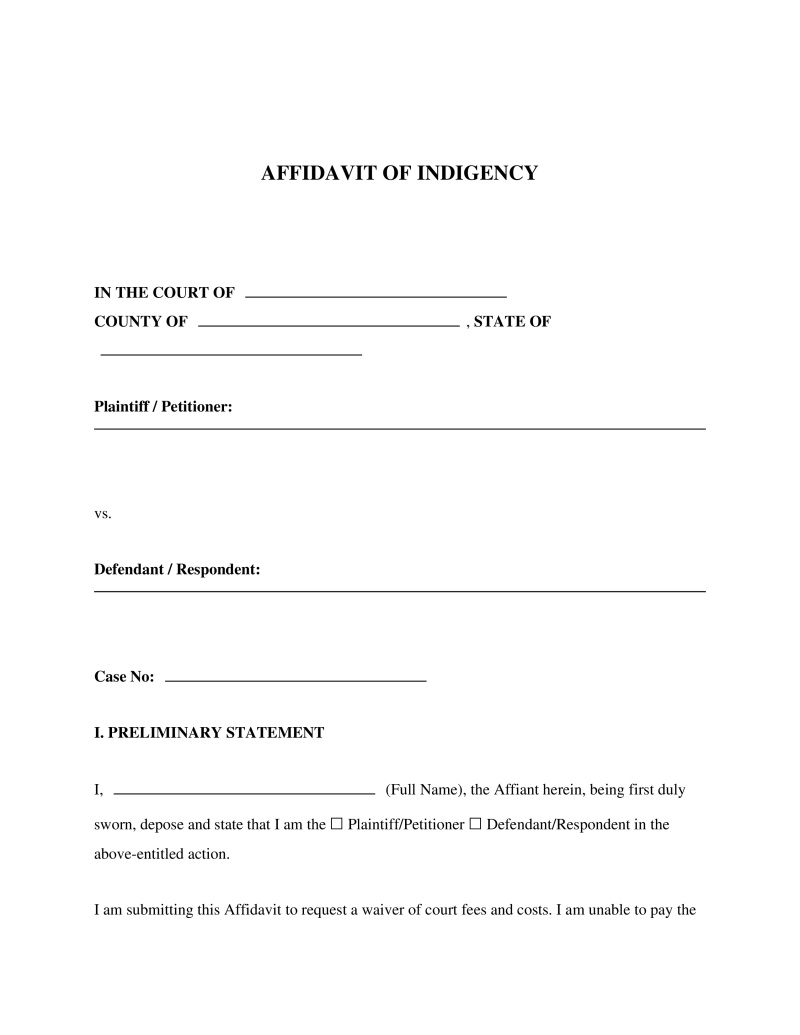
An Affidavit of Indigency is a sworn statement used to declare the financial inability of an individual to afford legal fees.
Applicant Type
Select 'Self' if you are the applicant. Select 'On behalf of another' if you are a guardian, parent, or legal representative.
Table of Contents
What is an Affidavit of Indigency?
An Affidavit of Indigency is a sworn legal document used by individuals to declare under oath their inability to afford the costs associated with legal proceedings. Its primary purpose is to request a waiver of court fees, filing fees, service costs, or other expenses that would otherwise prevent a litigant from accessing the judicial system. This document is typically submitted to a court or administrative body by individuals seeking to pursue or defend a case without financial hardship, thereby ensuring that economic status does not impede access to justice. It is a critical tool for low-income individuals to assert their legal rights or address legal obligations.
Legal Requirements and Validity
For an Affidavit of Indigency to be legally valid and effective, it must adhere to specific formal and substantive requirements, which can vary slightly depending on the jurisdiction. The document serves as a formal declaration of an individual's financial status, and thus, accuracy and completeness are paramount. Courts scrutinize these affidavits to prevent abuse of the system while upholding the principle of equal access to justice for all.
Key requirements for a valid Affidavit of Indigency include:
- Sworn Statement - The affidavit must be a sworn statement, meaning the declarant attests to the truthfulness of the information under penalty of perjury.
- Notarization - In most jurisdictions, the affidavit must be signed in the presence of a notary public or other authorized official who can administer oaths. This verifies the identity of the signatory and the authenticity of the signature.
- Comprehensive Financial Disclosure - The document must provide a detailed and accurate account of the applicant's financial situation, including all sources of income, assets, liabilities, and monthly expenses.
- Signature and Date - The applicant's full legal signature and the date of signing are essential for the document's validity.
- Jurisdictional Forms - Many courts provide specific forms for an Affidavit of Indigency, which applicants must use to ensure all necessary information is included and presented in the required format.
Failure to meet these requirements, or providing false or misleading information, can result in the denial of the fee waiver, imposition of court fees, and potentially lead to criminal charges for perjury or contempt of court.
How to Complete an Affidavit of Indigency
Completing an Affidavit of Indigency requires careful attention to detail and a thorough understanding of one's financial situation to ensure accuracy and compliance with court requirements.
- Obtain the Correct Form - Begin by acquiring the specific Affidavit of Indigency form from the court where your case is or will be filed. Most courts provide these forms on their websites or at the clerk's office. Using the correct form for your jurisdiction is crucial, as requirements can vary.
- Gather Financial Documentation - Collect all relevant financial records before you start filling out the form. This includes pay stubs, bank statements, tax returns, unemployment benefits statements, social security statements, disability income proofs, utility bills, rent or mortgage statements, and any documentation related to debts like credit card statements or loan agreements.
- Detail Income Sources - Accurately list all sources of income for yourself and any dependents living with you, specifying the amount and frequency. This includes employment wages, government benefits (e.g., Social Security, unemployment, food stamps), child support, alimony, pension payments, and any other regular financial inflows. Be precise about gross and net income.
- List Assets and Property - Disclose all assets you own, including cash, money in bank accounts, real estate, vehicles, significant personal property, investments, and any other valuable possessions. Provide estimated market values for these items. Ensure you do not omit any assets, as this could be seen as an attempt to mislead the court.
- Itemize Expenses and Debts - Provide a comprehensive list of your monthly expenses, such as rent or mortgage payments, utility bills, food costs, transportation, medical expenses, childcare, and insurance premiums. Also, list all outstanding debts, including credit card balances, student loans, medical bills, and other loan obligations, specifying the creditor and amount owed.
- Review and Sign Under Oath - Carefully review all the information entered to ensure it is accurate, complete, and truthful. Any misrepresentation can have serious legal consequences. Once satisfied, sign the affidavit in the presence of a notary public or other authorized official, as required by your court. The notary will then attest to your signature and administer the oath.
- File the Affidavit - After the affidavit is signed and notarized, file it with the clerk of the court where your legal matter is pending or will be initiated. Ensure you keep a copy for your records. The court will then review your financial information to determine whether you qualify for a fee waiver or other assistance.
Rights and Obligations of Parties Involved
The process involving an Affidavit of Indigency establishes specific rights and obligations for both the individual seeking assistance and the judicial system reviewing the request.
The applicant, as the party filing the affidavit, possesses several key rights and obligations:
- Right to Seek Fee Waiver - Individuals have the right to request a waiver of court fees and costs if they genuinely cannot afford them, ensuring access to justice regardless of economic status.
- Right to Confidentiality - While financial information is disclosed, applicants generally have a right to expect that this sensitive data will be handled confidentially by the court.
- Obligation to Provide Truthful Information - The applicant is legally obligated to provide accurate, complete, and truthful financial information in the affidavit. Any misrepresentation can lead to severe penalties, including perjury charges.
- Obligation to Update Information - If there is a significant change in the applicant's financial circumstances after filing the affidavit, there may be an obligation to inform the court.
The court, or the administrative body responsible for reviewing the affidavit, also has distinct rights and obligations:
- Obligation to Review Applications Fairly - The court is obligated to review all Affidavits of Indigency impartially and make a determination based on established legal criteria.
- Right to Request Additional Information - The court has the right to request further documentation or clarification from the applicant to verify the information provided in the affidavit.
- Power to Grant or Deny Waiver - The court holds the authority to either grant the requested fee waiver, grant a partial waiver, or deny the request based on its assessment of the applicant's financial situation.
- Obligation to Uphold Access to Justice - Courts have a broader obligation to ensure that financial barriers do not unduly impede an individual's ability to seek redress or defend themselves within the legal system.
Applicable Federal and State Laws
The legal framework surrounding an Affidavit of Indigency is shaped by both federal and state statutes, designed to ensure access to justice while preventing abuse of the system. While specific terminology and procedures may vary, the underlying principle of assisting indigent litigants remains consistent.
Federal Statutes
At the federal level, the ability for individuals to proceed without prepayment of fees is primarily governed by:
- Proceedings in Forma Pauperis - This statute allows federal courts to authorize the commencement, prosecution, or defense of any suit, action or proceeding, civil or criminal, or appeal therein, without prepayment of fees and costs or security therefor, by a person who submits an affidavit that they are unable to pay such costs (28 U.S.C. § 1915).
- Appointment of Counsel in Civil Cases - While there is no automatic right to appointed counsel in most civil cases, federal courts may, under certain circumstances, request an attorney to represent any person unable to afford counsel (28 U.S.C. § 1915(e)(1)).
State Laws and Requirements
Each state has its own set of statutes and court rules governing the use and acceptance of an Affidavit of Indigency, often referred to by various names such as "Petition to Proceed In Forma Pauperis" or "Request for Fee Waiver." These state-specific regulations typically address:
- Eligibility Criteria - States define specific income thresholds, asset limits, and other financial criteria that an applicant must meet to qualify for indigency status (e.g., California Rules of Court, Rule 3.50 et seq.; New York Civil Practice Law and Rules § 1101).
- Required Forms and Content - Many states mandate the use of standardized forms for affidavits of indigency, specifying the exact financial information that must be disclosed (e.g., Texas Rules of Civil Procedure, Rule 145).
- Review Process and Determination - State laws outline the procedures for court clerks or judges to review affidavits, including the possibility of hearings or requests for additional documentation to verify financial status.
- Penalties for False Statements - State statutes uniformly impose severe penalties for making false statements on an Affidavit of Indigency. These penalties can include criminal charges for perjury, fines, imprisonment, and the requirement to pay all waived court fees retroactively (e.g., Florida Statute § 837.06 for false official statements).
- Scope of Waiver - State laws specify what types of fees and costs can be waived, which may include filing fees, service of process fees, jury fees, and transcript costs.
It is imperative for individuals to consult the specific statutes and court rules of the jurisdiction in which they intend to file, as requirements and available assistance can differ significantly.
Frequently Asked Questions
Affidavit of Indigency Example
Not the form you're looking for?
Try our legal document generator to create a custom document
Disclaimer: The templates available on this website are provided for general informational purposes only and do not constitute legal advice. They are not intended to be, and should not be interpreted as, compliant with any specific legal, regulatory, or privacy requirements. These templates are not a replacement for professional legal guidance and should not be relied upon for any particular matter or circumstance. Users are strongly encouraged to seek advice from a qualified attorney licensed in their jurisdiction before using, modifying, or relying on any template.
All templates are provided on an "as is," "with all faults," and "as available" basis. The provider disclaims any and all warranties of any kind, whether express, implied, statutory, or otherwise, including without limitation warranties of merchantability, fitness for a particular purpose, title, or non-infringement.
LegalTemplates.com makes no guarantees or representations regarding the accuracy, completeness, expected outcomes, or reliability of the materials contained in these templates or any materials referenced or linked from them.