Revocable Trust
A Revocable Trust is a legal document that allows an individual to manage and distribute assets during their lifetime and after death, with the option to modify or terminate the agreement at any time.
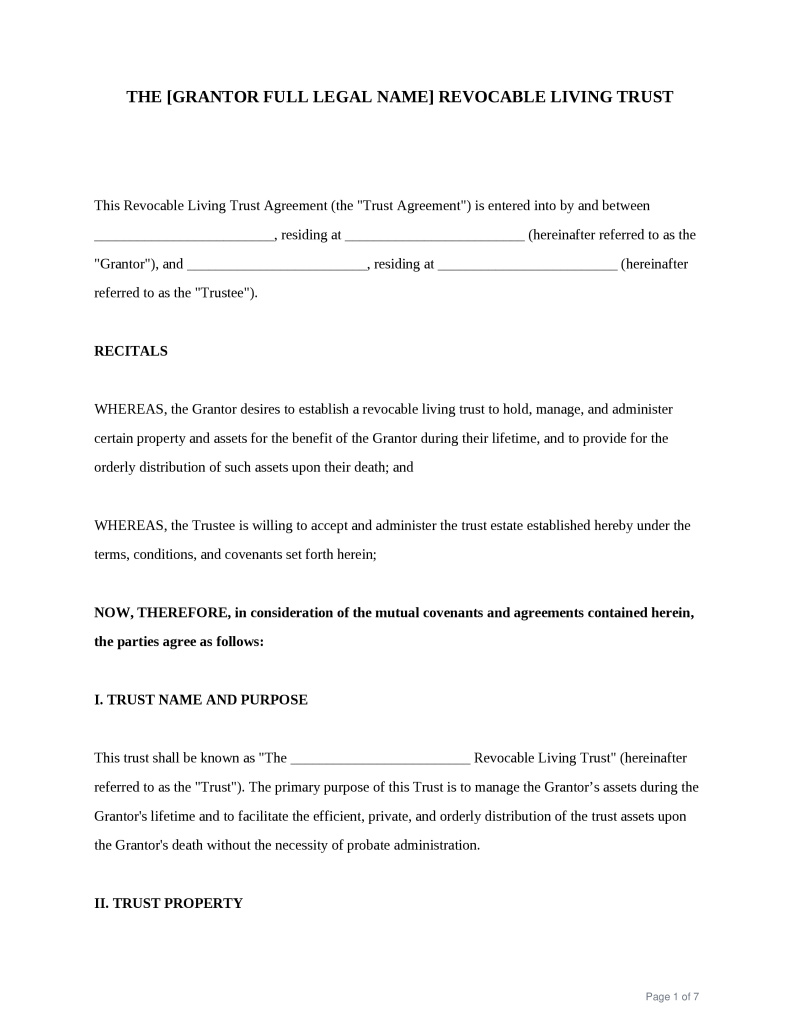
Trust Type
A single-grantor trust is created by one person. A joint trust is commonly used by married couples and may include special instructions for what happens after the first spouse dies.
Table of Contents
What is a Revocable Trust?
A revocable trust is a legal arrangement where a grantor transfers assets into a trust managed by a trustee for the benefit of designated beneficiaries. This estate planning tool allows the grantor to amend, alter, or completely revoke the trust agreement at any point during their lifetime. It is widely used to manage assets during the grantor's life, provide for management if the grantor becomes incapacitated, and distribute property after death without passing through the probate court process.
Key Parties and Structure
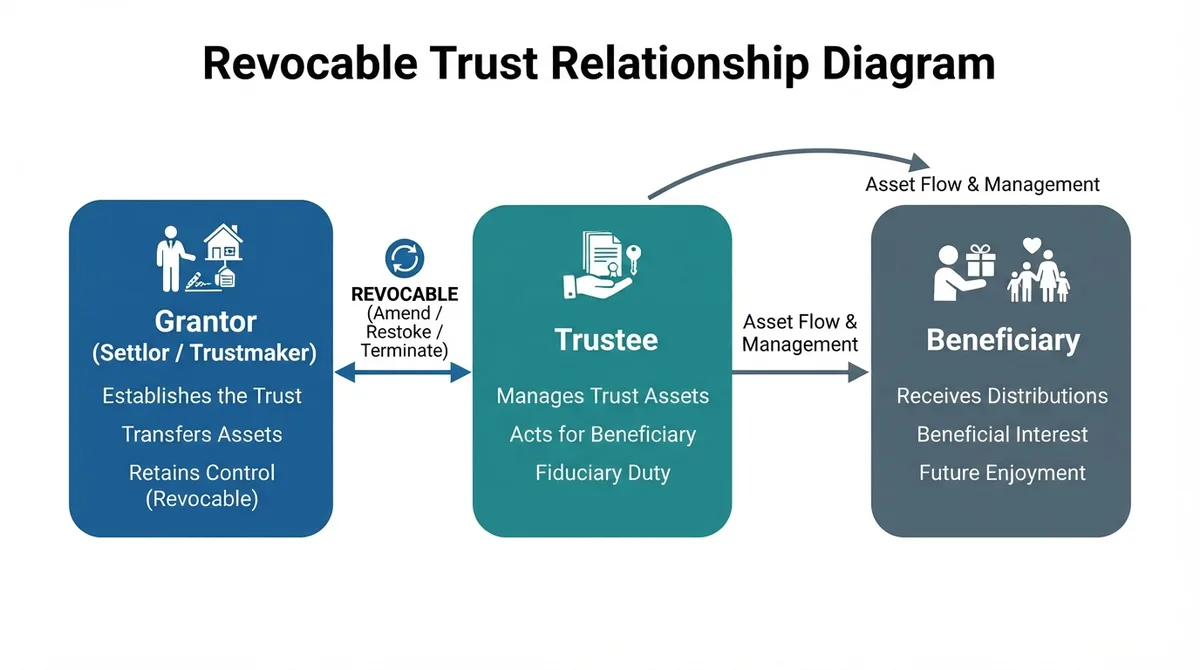
A revocable trust functions through the interaction of three primary roles, which often overlap during the initial phase of the trust's existence. The structure relies on specific roles to manage and distribute the trust property:
- The Grantor - The individual who creates the trust, transfers assets into it, and retains the power to amend or terminate the trust at any time.
- The Trustee - The individual or institution responsible for managing the trust assets according to the terms of the trust agreement, a role often held by the grantor during their lifetime.
- The Successor Trustee - The person or entity designated to take over management of the trust if the original trustee becomes incapacitated or dies.
- The Beneficiary - The individuals or organizations entitled to receive income or principal from the trust, with the grantor typically serving as the primary beneficiary during their lifetime.
Types of Revocable Trusts
While the core structure remains consistent, individuals select different configurations based on their marital status and planning goals:
- Individual Revocable Trust - A trust established by a single person who retains complete control over the trust assets and can revoke or amend the terms at any time.
- Joint Revocable Trust - A trust created by two individuals, typically spouses, who combine their assets into a single trust while maintaining joint control during their lifetimes.
Taxation and Regulatory Framework
The Internal Revenue Service maintains specific rules regarding the tax treatment of revocable trusts:
- Grantor Trust Status - All revocable trusts are classified as grantor trusts for federal tax purposes, meaning the grantor retains control over the income and assets (IRS Abusive Trust Tax Evasion Schemes Q&A).
- Tax Reporting Requirements - Income generated by trust assets must be reported directly on the grantor's individual income tax return, typically using the grantor's Social Security number.
- Section 645 Election - Allows the trustee of a qualified revocable trust and the executor of an estate to treat the trust as part of the estate for income tax purposes (26 U.S.C. § 645).
- IRS Form 8855 Filing - The official form used to make the Section 645 election, which must be filed by the due date of the estate's first income tax return and becomes irrevocable once made (IRS Form 8855 Instructions).
Funding and Administration
Creating a revocable trust requires active steps to ensure the legal entity actually holds the intended assets. Unfunded trusts do not achieve the primary goals of estate planning. The process of establishing and maintaining the trust involves several critical phases:
- Drafting the Agreement - Outlining the distribution terms, naming the successor trustees, and defining the powers of the trustee.
- Executing the Document - Signing the trust agreement in accordance with state-specific execution requirements, which frequently include notarization.
- Funding the Trust - Re-titling real estate, bank accounts, brokerage accounts, and other personal property into the name of the trust.
- Managing Trust Assets - Operating the trust during the grantor's lifetime, which involves paying taxes and managing investments under the grantor's personal tax identification number.
Comparison with Wills
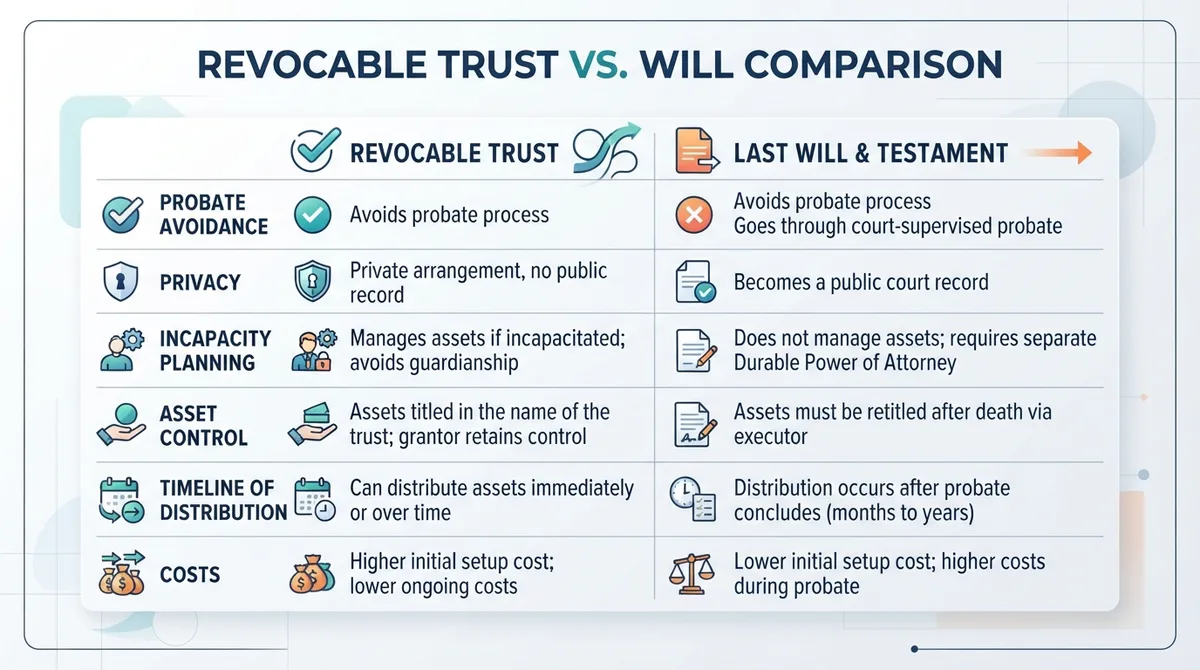
A revocable trust and a last will and testament are both foundational estate planning tools, but they operate through different legal mechanisms. The primary distinctions center on asset transfer, privacy, and administration:
- Probate Avoidance - Trust assets pass directly to beneficiaries without court involvement, whereas assets controlled by a will must pass through the public probate court process.
- Privacy Levels - Trust agreements remain private documents, while a will becomes a matter of public record once filed with the probate court.
- Incapacity Planning - A revocable trust provides a mechanism for a successor trustee to manage assets immediately if the grantor becomes incapacitated, a function that a will cannot perform.
- Post-Death Control - Trusts allow for complex, ongoing distribution schedules over many years, while wills typically distribute property in outright gifts shortly after probate concludes.
Frequently Asked Questions
Free Revocable Trust Sample
Sources
- Abusive trust tax evasion schemes - Questions and answers - Provides definitions and explanations of revocable trusts, including their characteristics and tax implications.
- About Form 8855, Election to Treat a Qualified Revocable Trust as Part of an Estate - Details the process for electing to treat a qualified revocable trust as part of an estate for tax purposes, including filing requirements and deadlines.
Not the form you're looking for?
Try our legal document generator to create a custom document
Disclaimer: The templates available on this website are provided for general informational purposes only and do not constitute legal advice. They are not intended to be, and should not be interpreted as, compliant with any specific legal, regulatory, or privacy requirements. These templates are not a replacement for professional legal guidance and should not be relied upon for any particular matter or circumstance. Users are strongly encouraged to seek advice from a qualified attorney licensed in their jurisdiction before using, modifying, or relying on any template.
All templates are provided on an "as is," "with all faults," and "as available" basis. The provider disclaims any and all warranties of any kind, whether express, implied, statutory, or otherwise, including without limitation warranties of merchantability, fitness for a particular purpose, title, or non-infringement.
LegalTemplates.com makes no guarantees or representations regarding the accuracy, completeness, expected outcomes, or reliability of the materials contained in these templates or any materials referenced or linked from them.