Irrevocable Trust
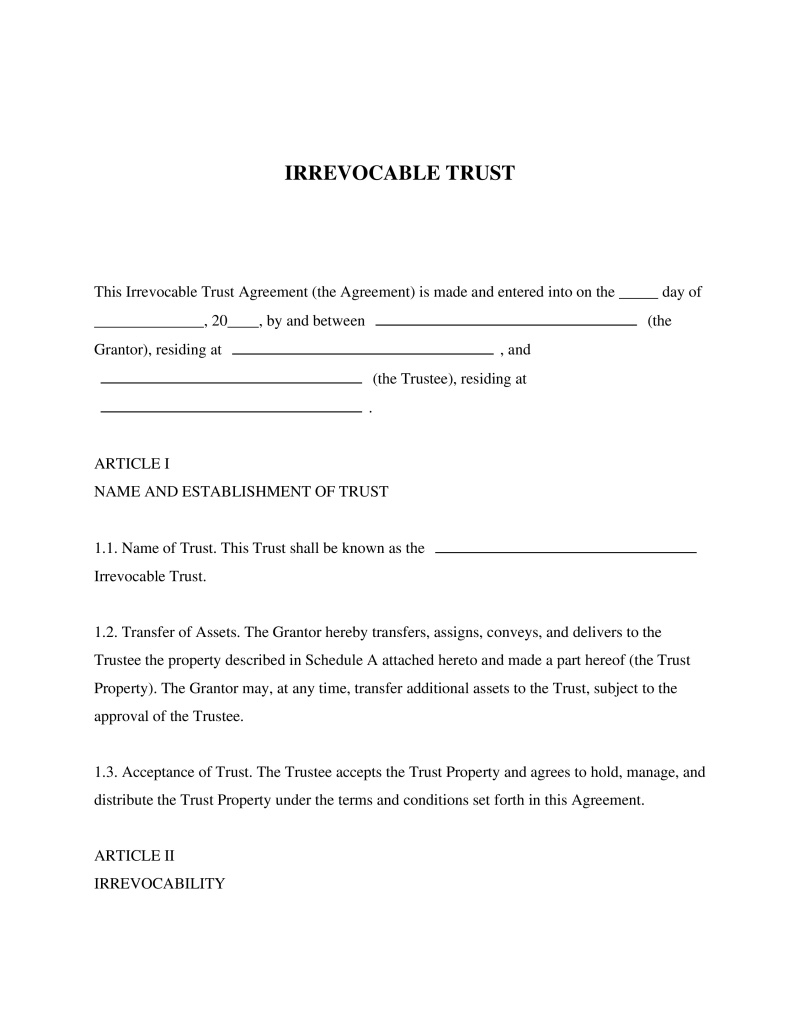
An Irrevocable Trust is a legal arrangement in which the grantor permanently transfers ownership of assets to a trustee, relinquishing the right to alter, amend, or terminate the agreement.
Primary Trust Objective
This helps tailor tax, asset-protection, Medicaid, special-needs, and distribution provisions without changing the irrevocable nature of the trust.
Use this if the trust has a specialized purpose not listed above.
Table of Contents
What is an Irrevocable Trust?
An irrevocable trust is a distinct legal arrangement in which the creator, known as the grantor, permanently transfers ownership of assets to a designated trustee to manage for the benefit of one or more beneficiaries. By its express terms, this type of trust cannot be modified, amended, or revoked once it is established, meaning the grantor relinquishes control over the transferred property. Individuals and families utilize these structures primarily for asset protection, estate tax minimization, and charitable giving strategies.
Legal Framework and Revocability
The legal status of a trust depends heavily on the language of the governing document and the jurisdiction in which it is created. State statutes and the specific terms of the trust instrument dictate whether an arrangement is legally classified as revocable or irrevocable.
State laws establish specific baselines for trust interpretation:
- Presumption of Revocability - Most states consider a trust to be revocable if the trust instrument remains silent on the matter of revocability.
- Irrevocability Clause - Explicit language must be included in the trust agreement to establish that the grantor cannot amend, terminate, or regain control of the assets.
- State Law Governance - Local trust codes govern the administration, fiduciary duties, and potential judicial modification procedures of the trust entity.
Types of Irrevocable Trusts
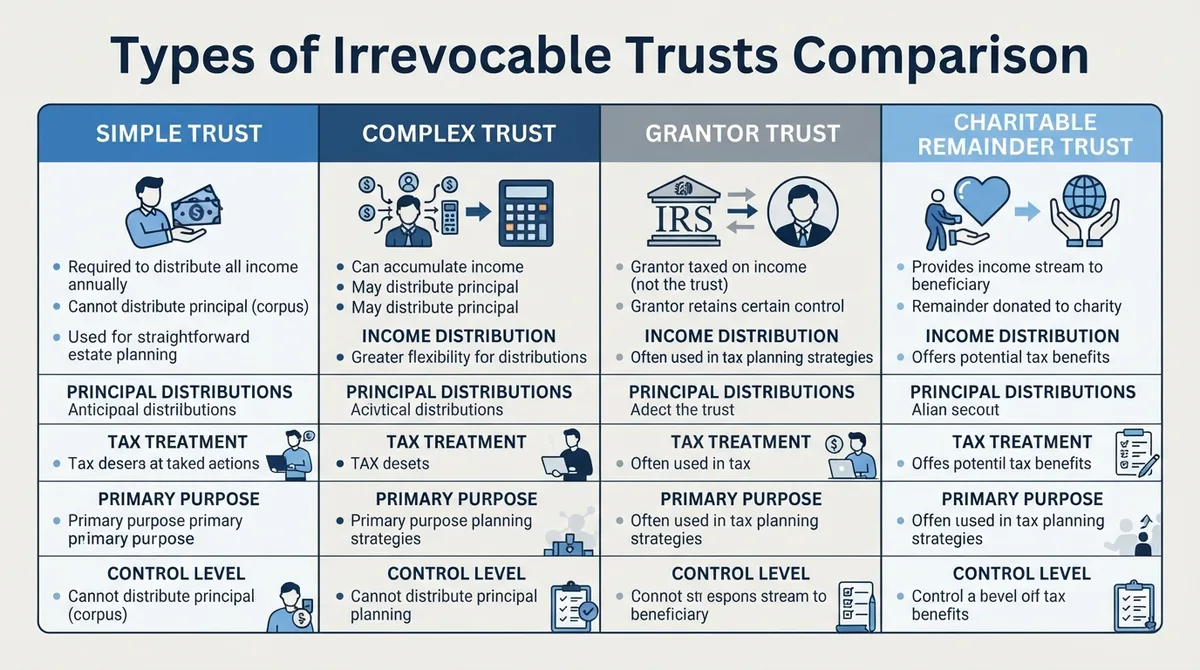
Various structures exist to meet specific financial, estate planning, and philanthropic goals:
- Charitable Remainder Trust - A trust that allows donors to transfer assets to a charitable organization while receiving an income stream for life or a specified term of years.
- Grantor Trust - A trust where the grantor retains certain powers, causing the trust income to be taxed directly to the grantor rather than the trust entity.
- Simple Trust - A trust required by its terms to distribute all of its annual income currently, making no distributions of trust principal or charitable contributions during the year.
- Complex Trust - A trust that is not a simple trust, meaning it can accumulate income, distribute principal, or make distributions to charitable organizations.
Tax Classification and Reporting Requirements
The Internal Revenue Service classifies irrevocable trusts into distinct categories for tax purposes, necessitating specific compliance measures. Once established, the trust operates as a separate taxpayer, requiring its own administrative identifiers and tax filings.
Federal tax compliance dictates the following requirements:
- Employer Identification Number Assignment - Governs the procedures for assigning tax identifiers to trusts (Internal Revenue Manual Part 21.7.13).
- U.S. Income Tax Return for Trusts and Estates - Mandates the filing of Form 1041 to report trust income (26 U.S.C. § 6012).
- Charitable Remainder Trust Rules - Establishes the regulatory framework and distribution requirements for charitable trusts (26 U.S.C. § 664).
- Distributions Reporting - Trustees must report distributions to beneficiaries, who may be responsible for paying income tax on the distributed amounts.
Roles and Responsibilities of Key Parties
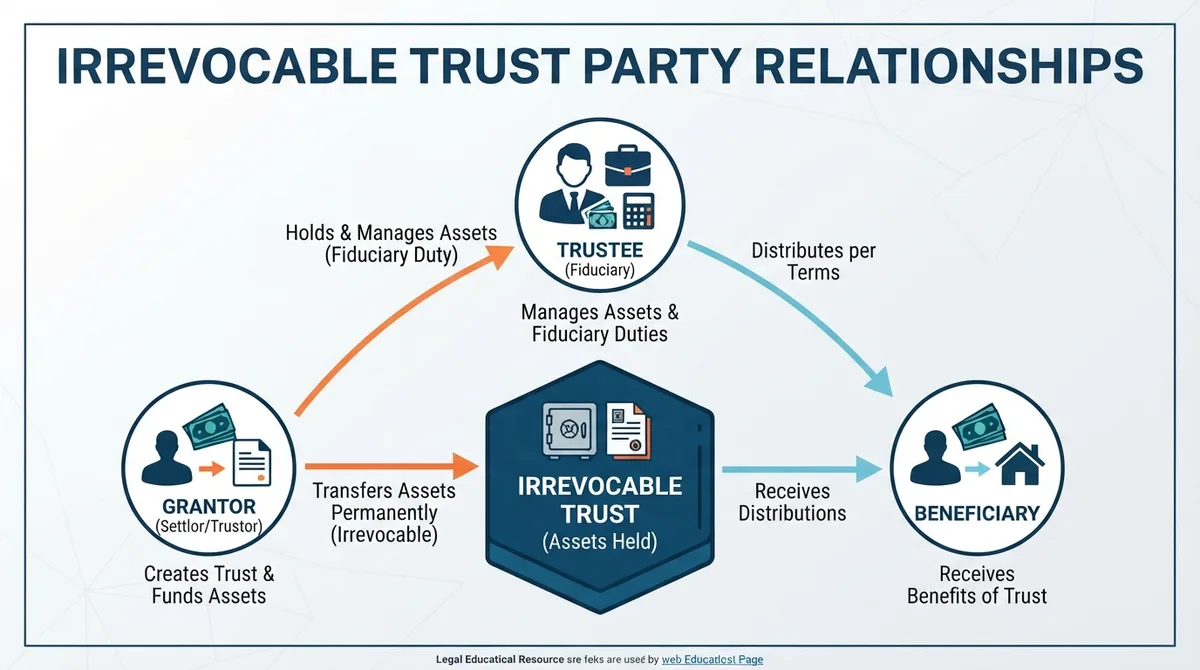
An irrevocable trust functions through the interaction of three primary parties, each bound by distinct legal parameters. The separation of these roles is critical to maintaining the tax and asset protection benefits of the structure.
The key parties are defined by their legal relationships to the trust:
- The Grantor - The individual who creates the trust and permanently transfers assets into it, relinquishing all legal control and ownership of the property.
- The Trustee - The fiduciary responsible for managing the trust assets, making distributions, filing tax returns, and executing the terms of the trust agreement.
- The Beneficiary - The individual or entity designated to receive income, principal, or other benefits from the trust assets according to the trust terms.
Frequently Asked Questions
Sources
- Charitable Remainder Trusts - Provides detailed information on charitable remainder trusts, a type of irrevocable trust, including their structure, benefits, and tax implications.
- Abusive Trust Tax Evasion Schemes - Questions and Answers - Clarifies the IRS's stance on abusive trust arrangements, including those involving irrevocable trusts, and outlines the criteria for legitimate trust structures.
- Assigning Employer Identification Numbers (EINs) - Outlines the IRS procedures for assigning Employer Identification Numbers (EINs) to trusts, including irrevocable trusts, and the responsibilities of trustees in this process.
Not the form you're looking for?
Try our legal document generator to create a custom document
Disclaimer: The templates available on this website are provided for general informational purposes only and do not constitute legal advice. They are not intended to be, and should not be interpreted as, compliant with any specific legal, regulatory, or privacy requirements. These templates are not a replacement for professional legal guidance and should not be relied upon for any particular matter or circumstance. Users are strongly encouraged to seek advice from a qualified attorney licensed in their jurisdiction before using, modifying, or relying on any template.
All templates are provided on an "as is," "with all faults," and "as available" basis. The provider disclaims any and all warranties of any kind, whether express, implied, statutory, or otherwise, including without limitation warranties of merchantability, fitness for a particular purpose, title, or non-infringement.
LegalTemplates.com makes no guarantees or representations regarding the accuracy, completeness, expected outcomes, or reliability of the materials contained in these templates or any materials referenced or linked from them.