Small Estate Affidavit
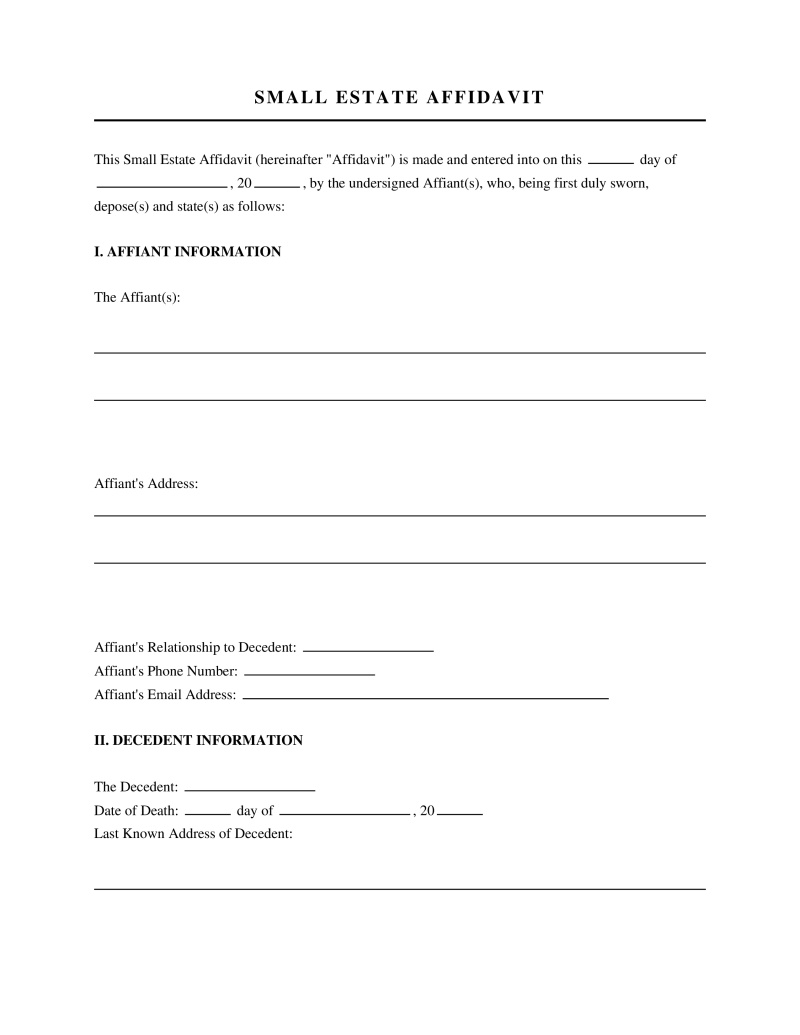
A Small Estate Affidavit is a legal document that allows heirs to collect property from the estate of a deceased individual without undergoing probate.
Affiant Relationship
Select your legal relationship to the deceased person (e.g., spouse, child, parent, sibling, other heir, or creditor).
Provide details if your relationship is not listed.
Table of Contents
What is a Small Estate Affidavit?
A Small Estate Affidavit is a legal document that allows heirs to collect property from the estate of a deceased individual without undergoing a formal probate process. This streamlined procedure is typically available for estates that fall below a certain monetary threshold and do not contain complex assets, such as real estate in some jurisdictions. Its primary purpose is to simplify the transfer of assets like bank accounts, vehicles, or personal belongings to rightful beneficiaries, reducing the time and expense associated with traditional probate court proceedings. This affidavit is commonly utilized by family members or other designated heirs to efficiently access and distribute the decedent's modest estate.
Legal Basis and Eligibility Requirements
The availability and specific requirements for using a Small Estate Affidavit are determined by state law, as probate is primarily a state matter. This mechanism serves as an exception to the general rule that a personal representative must be appointed by a court to manage a deceased person's estate. The underlying principle is to provide a less burdensome administrative option for estates that are not substantial enough to warrant the full judicial oversight of formal probate.
Eligibility for using a small estate affidavit is contingent upon several factors, which vary significantly from one state to another. These criteria are designed to ensure that the simplified process is applied only to estates that are genuinely small and straightforward, minimizing potential disputes or complexities. Understanding these state-specific nuances is crucial before attempting to use this legal instrument.
Common eligibility requirements across various jurisdictions include:
- Estate Value Limit - The total value of the deceased person's assets subject to probate must not exceed a specific dollar amount, which can range from a few thousand dollars to over a hundred thousand dollars, depending on the state (e.g., California Probate Code § 13100, Texas Estates Code § 205.001).
- Exclusion of Real Estate - Many states explicitly prohibit the use of a small estate affidavit if the decedent owned real estate, or they may allow it only under very limited circumstances, such as when the real estate is solely homestead property and passes to specific heirs.
- Waiting Period - A mandatory waiting period, typically ranging from 30 to 60 days, must pass since the decedent's death before the affidavit can be filed or presented to asset holders. This period allows time for any potential creditors or other interested parties to come forward.
- No Formal Probate Proceedings - No petition for the appointment of a personal representative or other formal probate proceeding can have been initiated or be pending in any court. The affidavit is an alternative to, not a supplement for, formal probate.
- Identification of Heirs - The affidavit must clearly identify all legal heirs and their relationship to the decedent, along with their respective entitlements to the estate assets.
- Absence of Disputes - The process generally assumes there are no significant disputes among heirs or creditors regarding the distribution of assets. If a dispute arises, formal probate may become necessary.
How to Complete a Small Estate Affidavit Form
Completing a Small Estate Affidavit form accurately is essential for its acceptance by financial institutions and other entities holding the decedent's assets. The process generally involves several key steps, each requiring careful attention to detail and adherence to state-specific instructions.
- Determine Eligibility and Obtain the Correct Form - Confirm that the decedent's estate meets all state-specific requirements for a small estate affidavit, including the maximum asset value and the types of assets included. Research the specific form provided by the relevant state or local court system, as these forms are often highly standardized and mandatory. Ensure all necessary criteria are met before proceeding.
- Gather Necessary Information and Documents - Collect all pertinent information about the deceased, including their full legal name, date of death, last known address, and Social Security number. Compile a comprehensive list of all assets intended to be transferred via the affidavit, such as bank account numbers, vehicle identification numbers, and descriptions of personal property. Obtain certified copies of the death certificate.
- Complete the Affidavit Form Accurately - Fill out the affidavit form completely and truthfully. This typically involves listing all heirs, their relationships to the decedent, and their share of the estate. Provide a detailed inventory of the estate's assets, including their estimated values, and confirm that the total value does not exceed the state's small estate limit. Some forms may require an affirmation that there are no known unpaid debts or that all debts will be paid from the estate.
- Sign and Notarize the Affidavit - The affiant(s) (the person or persons making the sworn statement) must sign the affidavit in the presence of a notary public. The notary will verify the identity of the signer(s) and witness their signature, then affix their seal. Some states may require multiple affiants, especially if there are multiple heirs with equal standing.
- File the Affidavit (if required) and Distribute to Asset Holders - While some states require filing the affidavit with the probate court, others only require presenting it directly to the institutions holding the assets. Once properly signed and notarized, the affidavit is presented to banks, credit unions, vehicle departments, or other entities to request the transfer of the deceased's assets to the designated heirs. Keep copies of the signed affidavit for your records and for each institution.
Rights and Obligations of Affiants
The individual or individuals who sign a Small Estate Affidavit, known as affiants, assume significant legal responsibilities and obligations. By executing the affidavit, they are making a sworn statement under penalty of perjury, affirming the truthfulness and accuracy of the information provided within the document. This carries legal weight and can have serious consequences if misrepresentations are made.
Key rights and obligations of affiants include:
- Truthful Representation - Affiants are obligated to provide accurate and complete information regarding the decedent's assets, debts, and heirs. Any intentional misstatement or omission can constitute perjury or fraud.
- Duty to Distribute Assets Properly - Upon receiving the decedent's assets, affiants have a fiduciary duty to distribute them according to state intestacy laws or the decedent's will, if one exists and is referenced in the affidavit. This means ensuring all rightful heirs receive their proper share.
- Payment of Debts - Depending on state law, affiants may be obligated to use the estate's assets to pay the decedent's legitimate debts before distributing remaining funds to heirs. Failure to do so could lead to personal liability.
- Indemnification - By presenting the affidavit, affiants typically agree to indemnify and hold harmless the institutions releasing assets. This means if a claim later arises that the assets were improperly distributed, the affiant may be personally responsible for returning the assets or their value.
- Access to Assets - Affiants have the right to demand and receive the specified assets from financial institutions, motor vehicle departments, or other third parties once the valid affidavit is presented. These institutions are generally protected from liability once they comply with a properly executed affidavit.
- Personal Liability for Misconduct - If an affiant fraudulently obtains assets, misrepresents facts, or mismanages the distribution, they can be held personally liable to creditors or other rightful heirs for damages.
Applicable Laws and Penalties
The legal framework surrounding Small Estate Affidavits is predominantly state-specific, given that probate and estate administration fall under state jurisdiction. However, certain federal laws may indirectly impact the process, particularly concerning specific types of assets or information.
Federal Statutes
While no single federal law directly governs the creation or use of Small Estate Affidavits, certain federal regulations can be relevant:
- Health Insurance Portability and Accountability Act (HIPAA) - Governs the privacy and security of protected health information (PHI) (45 CFR § 164.508). While not directly about asset transfer, heirs may need to access medical records to understand final expenses or insurance claims, requiring proper authorization or proof of legal standing, which a small estate affidavit might support for limited purposes.
- Employee Retirement Income Security Act (ERISA) - Regulates private sector employee benefit plans (29 U.S.C. § 1001 et seq.). For retirement accounts like 401(k)s, ERISA often dictates that benefits pass directly to designated beneficiaries, bypassing probate and thus often a small estate affidavit. However, if no beneficiary is named, or the estate is the beneficiary, state probate laws, including small estate procedures, may apply.
- Federal Deposit Insurance Act - Provides insurance for deposits in member banks (12 U.S.C. § 1811 et seq.). While not dictating transfer methods, it ensures that funds in bank accounts are protected, and banks must adhere to state probate laws for proper release of funds to estates.
State Laws and Requirements
State statutes are the primary source of law for Small Estate Affidavits. These laws vary widely but generally address:
- Small Estate Affidavit Statute - Each state has specific statutes outlining the conditions, procedures, and forms required for small estate affidavits, including the maximum value of the estate, types of assets covered, and any mandatory waiting periods (e.g., California Probate Code § 13100 et seq., New York SCPA § 1301 et seq., Florida Statute § 735.301).
- Intestacy Laws - These laws dictate how a decedent's property is distributed if they die without a valid will (e.g., Uniform Probate Code Article II, Part 1, adopted in various forms by many states). Affiants must adhere to these rules when distributing assets via a small estate affidavit.
- Probate Code Provisions - State probate codes establish the general framework for estate administration, with small estate affidavits being an exception or simplified procedure within that larger framework.
- Real Property Restrictions - Many state statutes explicitly state whether real estate can be transferred via a small estate affidavit, often prohibiting it or allowing it only under very limited circumstances for homestead property.
Penalties for Non-Compliance
Strict adherence to the legal requirements for small estate affidavits is crucial, as non-compliance can lead to significant penalties and liabilities for the affiant:
- Perjury Charges - Signing a small estate affidavit typically involves swearing under penalty of perjury that the information provided is true and accurate. Intentional false statements can lead to criminal charges for perjury, which may include fines and imprisonment.
- Fraudulent Misrepresentation - If an affiant knowingly provides false information to obtain assets, they could face civil lawsuits for fraud from rightful heirs or creditors, potentially leading to orders to return assets and pay damages.
- Personal Liability to Creditors - If an affiant distributes assets to heirs without satisfying the decedent's legitimate debts, they may become personally liable to those creditors for the amount owed, up to the value of the assets received.
- Personal Liability to Heirs - An affiant who improperly distributes assets, either by giving them to the wrong person or taking more than their rightful share, can be sued by other legal heirs to recover their portion of the estate.
- Revocation of Transfer - Assets transferred through a fraudulent or improperly executed small estate affidavit may be subject to recovery by a court or by other interested parties, requiring the affiant to return the property or its value.
Frequently Asked Questions
Small Estate Affidavit Example
Not the form you're looking for?
Try our legal document generator to create a custom document
Disclaimer: The templates available on this website are provided for general informational purposes only and do not constitute legal advice. They are not intended to be, and should not be interpreted as, compliant with any specific legal, regulatory, or privacy requirements. These templates are not a replacement for professional legal guidance and should not be relied upon for any particular matter or circumstance. Users are strongly encouraged to seek advice from a qualified attorney licensed in their jurisdiction before using, modifying, or relying on any template.
All templates are provided on an "as is," "with all faults," and "as available" basis. The provider disclaims any and all warranties of any kind, whether express, implied, statutory, or otherwise, including without limitation warranties of merchantability, fitness for a particular purpose, title, or non-infringement.
LegalTemplates.com makes no guarantees or representations regarding the accuracy, completeness, expected outcomes, or reliability of the materials contained in these templates or any materials referenced or linked from them.