International Minor Travel Authorization Letter
An International Minor Travel Authorization Letter is a legal instrument providing consent for a minor to travel internationally without the accompaniment of one or both parents or legal guardians.
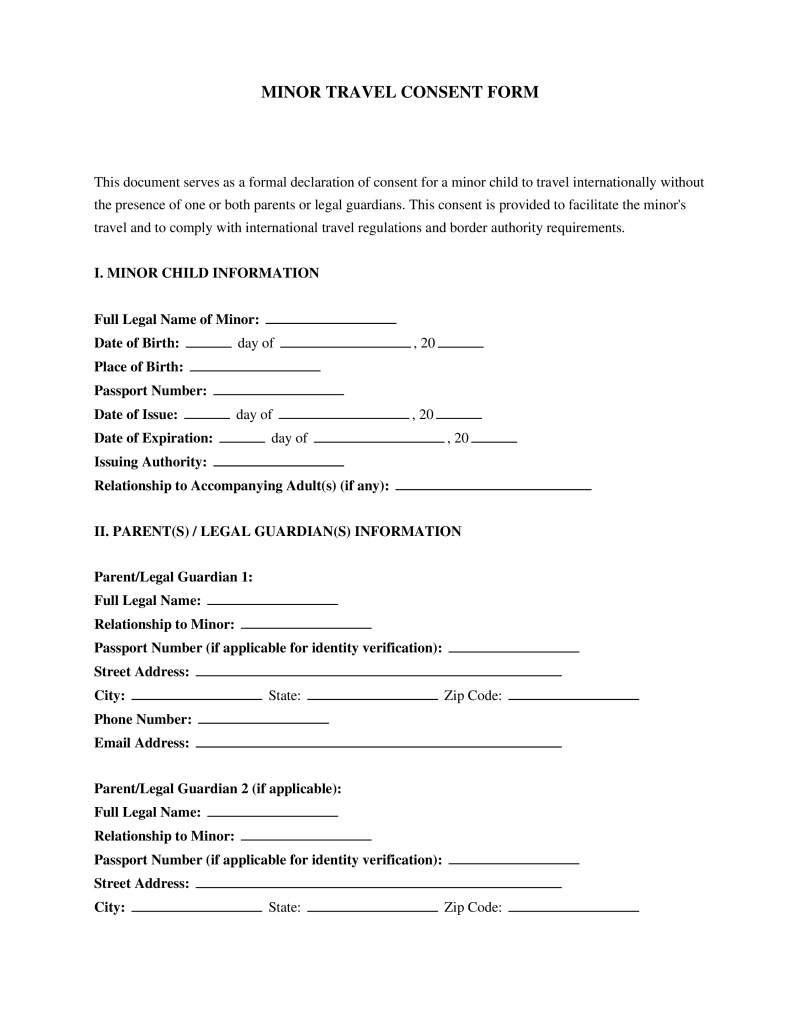
Authorization Scope
Select whether one or both parents/legal guardians are authorizing the minor's international travel.
Required by many authorities when only one parent or guardian is authorizing travel.
Provide details if you selected 'Other'.
Table of Contents
What is a International Minor Travel Authorization Letter?
An International Minor Travel Authorization Letter is a formal document granting permission for a child under the age of majority to travel internationally without one or both legal parents or guardians. Its primary purpose is to prevent international child abduction, ensure the minor's safety, and facilitate smooth passage through immigration and border control checkpoints in various countries. This letter is typically used when a minor travels with only one parent, a grandparent, another relative, a family friend, or as part of a school trip or organized group.
Legal Requirements and Validity
The legal requirements and validity of an International Minor Travel Authorization Letter can vary significantly depending on the countries involved in the travel itinerary, including the country of origin, transit countries, and the destination country. Border authorities globally are increasingly vigilant about child trafficking and abduction, leading to stricter enforcement of documentation requirements for minors traveling abroad. Key considerations for the letter's validity often include:
- Authenticity of Signatures - The signatures of all non-traveling parents or legal guardians must be genuine and verifiable.
- Notarization - Many countries and airlines require the letter to be notarized by a public notary. This process authenticates the signatures and confirms the identities of the signers, adding a layer of legal credibility to the document.
- Specificity of Content - The letter must clearly outline the minor's travel details, the identity of the accompanying adult (if any), the dates of travel, and the specific destination(s). Ambiguous or incomplete information may lead to delays or denial of travel.
- Language - While an English version is often acceptable, some destination countries may require the letter to be translated into their official language, sometimes with a certified translation.
- Duration of Validity - The letter is typically valid only for the specific trip and dates mentioned within the document. For multiple trips, separate letters may be required, or a broadly worded letter with a defined expiration date might be accepted, depending on the authorities.
Rights and Obligations of Parties Involved
The creation and use of an International Minor Travel Authorization Letter involve distinct rights and obligations for all parties concerned, designed to safeguard the minor's welfare and ensure legal compliance.
- Rights and Obligations of Non-Traveling Parents/Guardians - Non-traveling parents or legal guardians have the right to determine if and under what conditions their minor child travels internationally. They are obligated to provide accurate and truthful information in the authorization letter and to ensure that the travel arrangements align with any existing custody agreements or court orders. Their primary obligation is to protect the child's best interests and prevent unauthorized travel.
- Rights and Obligations of the Traveling Adult - The adult accompanying the minor, whether a parent, guardian, or other designated individual, assumes significant responsibility. This individual is obligated to adhere to the travel conditions specified in the authorization letter and to prioritize the minor's safety and well-being throughout the journey. They have the right to act in loco parentis for the duration of the trip, which may include making emergency medical decisions if explicitly authorized in the letter or by law.
- Rights and Obligations of the Minor - While minors typically do not have legal agency in creating such a document, they have the right to safe passage and protection from harm or abduction. Depending on their age and maturity, they may have the right to be informed about their travel arrangements and to express preferences, though the ultimate decision-making authority rests with their legal guardians.
- Rights and Obligations of Border Authorities - Immigration and customs officials at borders have the right and obligation to scrutinize travel documents for minors to prevent international child abduction and ensure compliance with national and international laws. They may question the minor and the accompanying adult, request additional documentation, or deny entry or exit if they suspect foul play or if documentation is insufficient. Their role is critical in enforcing child protection measures.
Required Elements of a Valid International Minor Travel Authorization Letter
For an International Minor Travel Authorization Letter to be considered valid and effective by border authorities, it typically must contain several key pieces of information. The absence of any of these elements can lead to delays or denial of travel.
- Minor's Full Legal Name and Date of Birth - Essential for identifying the child.
- Minor's Passport Number and Issuing Country - Links the letter directly to the child's primary travel document.
- Full Legal Name and Date of Birth of Traveling Adult - Identifies the person accompanying the minor.
- Traveling Adult's Passport Number and Issuing Country - Links the letter to the accompanying adult's primary travel document.
- Full Legal Names, Dates of Birth, and Contact Information of Non-Traveling Parents/Guardians - Provides verification of parental consent and emergency contact details.
- Specific Dates of Travel (Departure and Return) - Defines the authorized period of travel.
- Specific Destination(s) and Purpose of Travel - Clearly states where the minor is going and why.
- Emergency Contact Information for Non-Traveling Parents/Guardians - Critical for situations requiring immediate parental communication.
- Signatures of All Non-Traveling Parents/Guardians - Demonstrates explicit consent from all required parties.
- Notarization Seal and Signature - Provides legal authentication of the signatures, a common requirement by many authorities.
- Statement Granting Emergency Medical Treatment Authority (Optional but Recommended) - Authorizes the traveling adult to seek medical care for the minor if necessary.
How to Complete a International Minor Travel Authorization Letter
Completing an International Minor Travel Authorization Letter requires careful attention to detail to ensure it meets all necessary legal and practical requirements for international travel.
- Gather All Necessary Information - Compile all pertinent details for the minor, the accompanying adult, and the non-traveling parent(s) or guardian(s). This includes full legal names as they appear on passports, dates of birth, passport numbers, and contact information. Ensure all information is accurate and matches official identification documents to avoid discrepancies.
- Draft the Letter's Content - Clearly state the purpose of the letter: to authorize international travel for the minor. Include the minor's full name, date of birth, and passport details. Specify the full name, date of birth, and passport details of the adult accompanying the minor. Detail the exact travel dates (departure and return) and the specific destination(s). Include comprehensive contact information for the non-traveling parent(s) or guardian(s), including phone numbers and email addresses, for emergency purposes.
- Include Essential Provisions - Beyond basic travel details, consider including a clause that grants the traveling adult permission to seek emergency medical treatment for the minor if required. This provision can be crucial in unforeseen health situations abroad. Ensure the letter explicitly states that the non-traveling parent(s) or guardian(s) consent to all aspects of the described travel.
- Sign and Date the Document - All non-traveling parents or legal guardians must sign the letter in the presence of a notary public. Each signature should be accompanied by the printed name of the signer and the date the document was signed. This step is critical for legal validation and typically precedes notarization.
- Notarize the Authorization Letter - Locate a public notary to witness the signing of the letter by the non-traveling parent(s) or guardian(s). The notary will verify the identities of the signers and affix their official seal and signature, confirming the authenticity of the signatures. This notarization is often a mandatory requirement for international travel authorization letters.
- Prepare Supporting Documentation - Attach copies of the minor's birth certificate, passports for the minor and the traveling adult, and any relevant custody agreements or court orders that pertain to the minor's travel. These documents provide additional verification and can be requested by border officials to substantiate the authorization letter.
Legal Framework
The legal framework surrounding an International Minor Travel Authorization Letter is complex, drawing from federal laws, international conventions, and state statutes. These laws aim to protect minors from abduction and ensure proper consent for international travel.
- International Parental Kidnapping Crime Act (IPKCA) - This federal statute criminalizes the removal of a child from the United States or the retention of a child outside the United States with the intent to obstruct the lawful exercise of parental rights (18 U.S.C. § 1204). The authorization letter serves as a defense against potential charges under this act.
- Passport Issuance Regulations - The U.S. Department of State requires the consent of both parents or legal guardians for the issuance of a U.S. passport to a minor under the age of 16 (22 CFR § 51.28). This regulation underscores the importance of parental consent for international travel.
- Customs and Border Protection (CBP) Guidelines - While not a federal statute, U.S. Customs and Border Protection strongly recommends that minors traveling without both parents carry a notarized consent letter. These guidelines are enforced at U.S. ports of entry and exit to prevent child abduction.
- Hague Convention on the Civil Aspects of International Child Abduction - This international treaty, adopted by numerous countries, provides a legal mechanism for the swift return of children who have been wrongfully removed from their country of habitual residence or retained abroad in breach of custody rights. The authorization letter helps demonstrate that travel is not wrongful under the Convention.
- State Child Custody Orders - State family courts issue custody orders that often include specific provisions regarding a minor's international travel. These provisions may require explicit written consent, notification, or even court permission before a child can travel outside the country (e.g., California Family Code § 3048). Violating such orders can lead to severe penalties.
- State Notary Public Laws - Each state has statutes governing the powers and duties of notaries public, including the procedures for authenticating documents. Compliance with these state laws ensures the proper notarization of the travel authorization letter, which is crucial for its legal acceptance internationally (e.g., Uniform Law on Notarial Acts, adopted in various forms by many states).
Non-compliance with the requirements for an International Minor Travel Authorization Letter can result in significant penalties. These may include the minor being denied entry or exit at a border, leading to travel disruption and financial losses. More severely, unauthorized international travel of a minor can lead to criminal charges under the International Parental Kidnapping Crime Act, state parental kidnapping laws, or contempt of court charges for violating existing custody orders. Such legal actions can result in imprisonment, substantial fines, and long-term impacts on parental rights and relationships.
Frequently Asked Questions
Not the form you're looking for?
Try our legal document generator to create a custom document
Disclaimer: The templates available on this website are provided for general informational purposes only and do not constitute legal advice. They are not intended to be, and should not be interpreted as, compliant with any specific legal, regulatory, or privacy requirements. These templates are not a replacement for professional legal guidance and should not be relied upon for any particular matter or circumstance. Users are strongly encouraged to seek advice from a qualified attorney licensed in their jurisdiction before using, modifying, or relying on any template.
All templates are provided on an "as is," "with all faults," and "as available" basis. The provider disclaims any and all warranties of any kind, whether express, implied, statutory, or otherwise, including without limitation warranties of merchantability, fitness for a particular purpose, title, or non-infringement.
LegalTemplates.com makes no guarantees or representations regarding the accuracy, completeness, expected outcomes, or reliability of the materials contained in these templates or any materials referenced or linked from them.