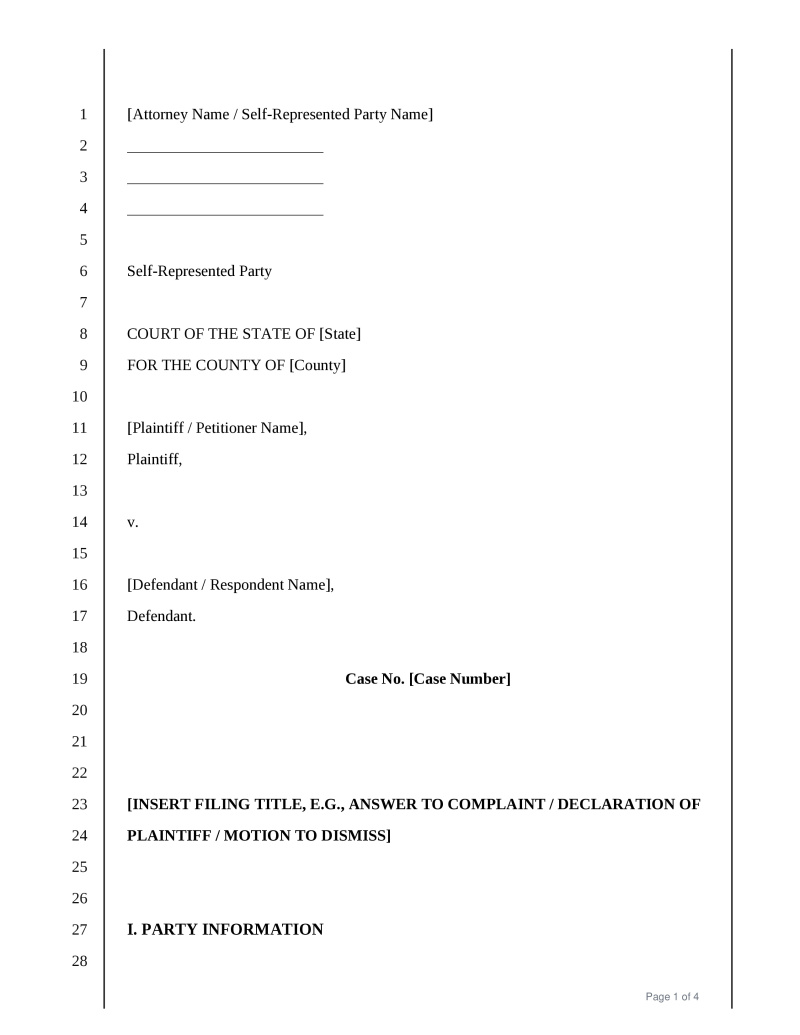
28 Lined Pleading Paper
A 28-lined pleading paper is a standardized legal document format characterized by numbered vertical lines along the left margin, used in United States courts for presenting formal written arguments and motions.
Case Posture
Choose "Existing case" if a case, cause, index, or docket number has already been assigned by the court.
Enter the number exactly as it appears on prior court papers, including prefixes, suffixes, or department codes.
Some courts require related cases, consolidated cases, or family law companion cases to be identified.
Table of Contents
What is a 28 Lined Pleading Paper?
28 Lined Pleading Paper is a specialized format of legal paper characterized by numbered lines along the left margin, running from 1 to 28, and vertical ruled lines on both sides of the page. Attorneys and self-represented litigants use this standardized paper to draft formal documents, known as pleadings, for submission to state and federal courts. The structured layout ensures that all legal filings maintain a uniform appearance, allowing judges and opposing parties to easily reference specific lines during oral arguments and written responses.
Origin and Purpose of Lined Pleading Paper
Historically, court documents were handwritten or typed on blank paper, which often led to inconsistencies in length, spacing, and readability. To standardize court filings and simplify the citation of specific passages, courts began requiring numbered lines. The number 28 became the standard in many jurisdictions, particularly in western states, because it fits standard letter-sized paper measuring 8.5 by 11 inches when double-spaced with standard margins.
Standardizing the format prevents parties from manipulating font sizes, line spacing, or margins to exceed page-limit rules set by the courts. The vertical lines, often referred to as rules, create a distinct column for the numbers on the left and a boundary for the text on the right. This layout ensures that every page filed in a lawsuit has the same capacity for text, creating a level playing field for all litigants.
Layout and Formatting Specifications
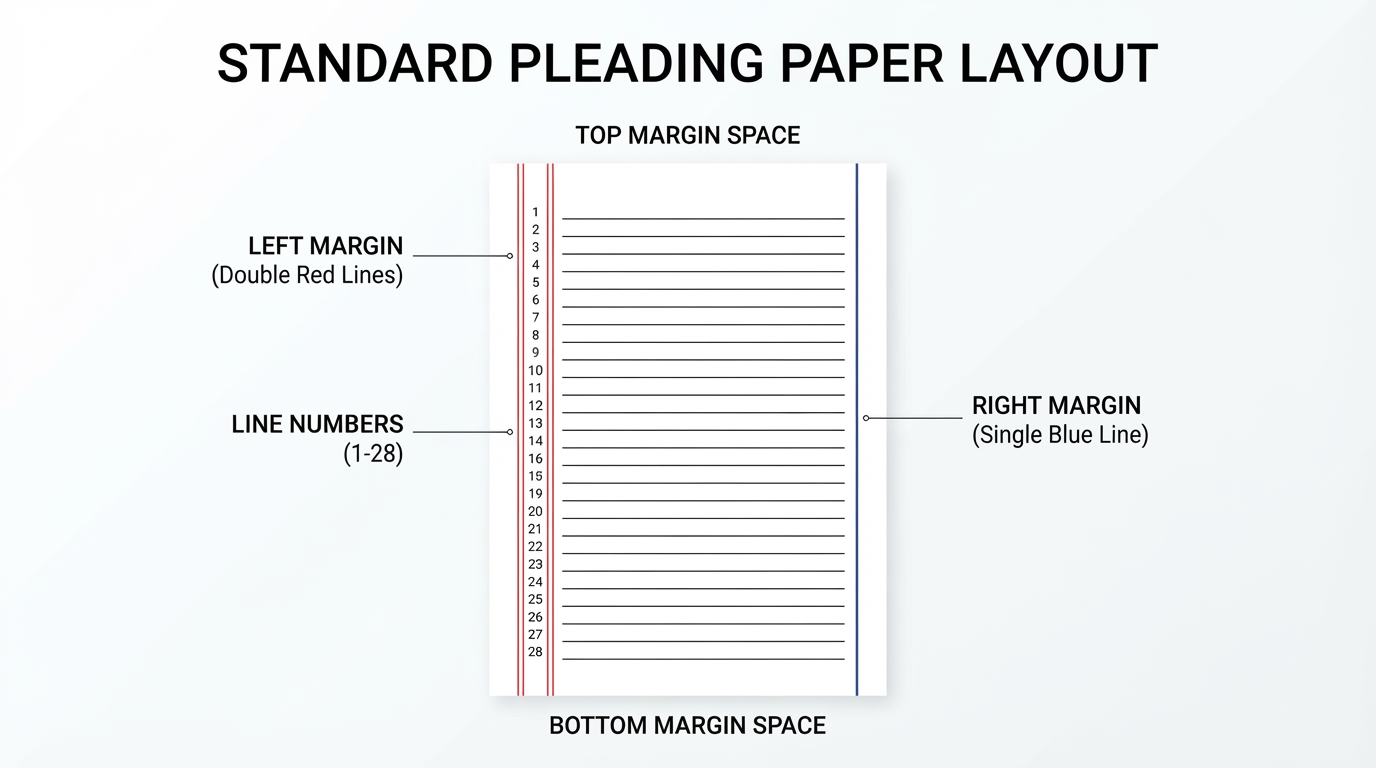
The physical layout of 28 Lined Pleading Paper must conform to strict typographical rules to be accepted by court clerks. Standard formatting specifications include:
- Line Numbering - Numbers from 1 to 28 must be aligned vertically on the left side of the page, positioned between the double vertical rules and the left edge of the paper.
- Vertical Rules - A double vertical line is placed on the left side, typically 1.5 inches from the edge, and a single vertical line is placed on the right side, 0.5 inches from the edge.
- Line Spacing - Text must be double-spaced to align perfectly with the numbered lines 1 through 28.
- Font Requirements - Courts generally mandate standard, easily readable fonts such as Times New Roman or Courier in 12-point size.
- Margin Dimensions - The top margin is typically set to 1 inch, while the bottom margin is designed to accommodate page numbering and footers.
Standard Components of a Legal Pleading
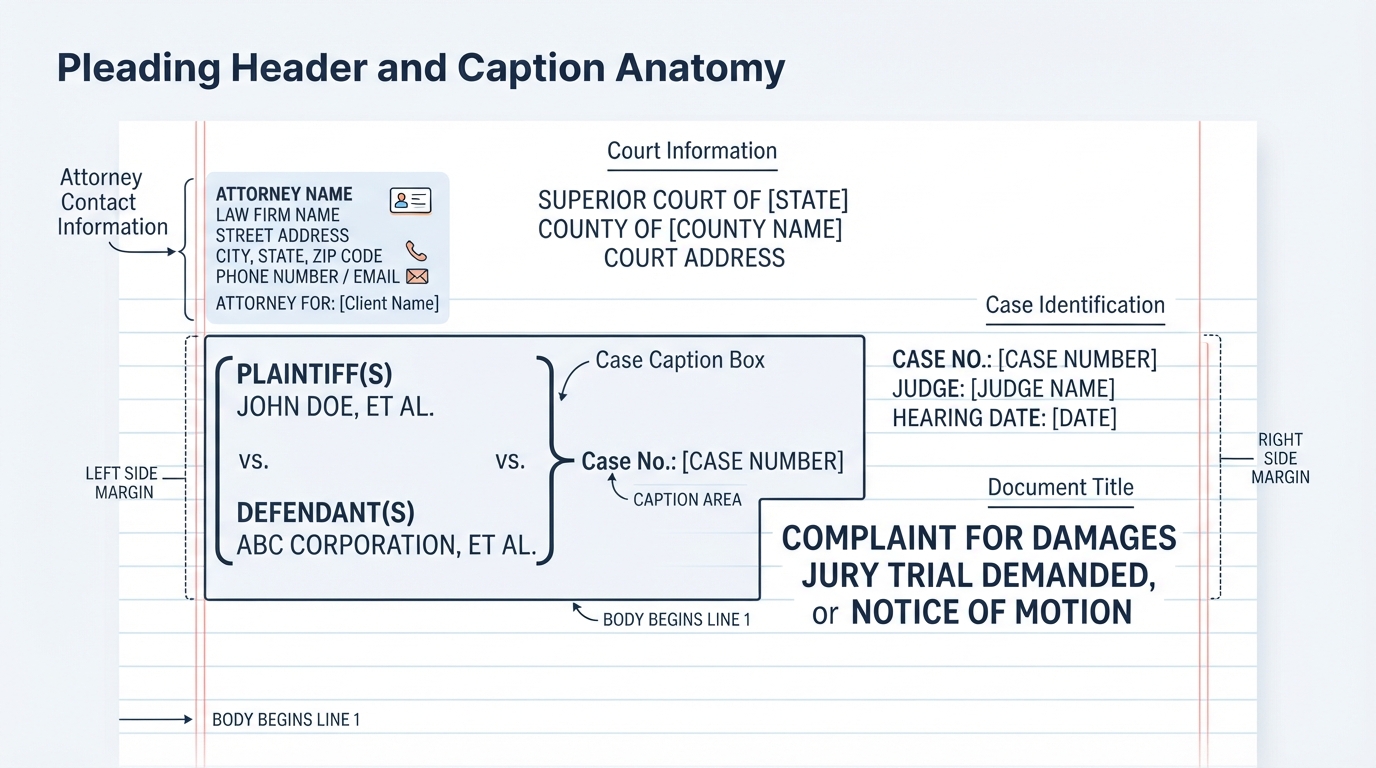
When drafting a document on 28 Lined Pleading Paper, specific information must appear in designated areas of the first page. The layout dictates where each element of the initial court filing is placed:
- Contact Information Block - The name, address, telephone number, email, and state bar number of the attorney or self-represented litigant must appear starting on line 1 in the upper-left corner.
- Court Title - The name of the court in which the action is pending is centered on the page, usually around line 8.
- Case Caption Box - A boxed area containing the names of the parties, such as the plaintiff and defendant, positioned below the court title.
- Case Details - The case number, assigned department, judge's name, and the specific chapter of the proceeding must be aligned to the right of the caption box.
- Document Title - A clear statement of what the document is, such as a complaint, answer, or stipulation, placed below the case details.
- Body Text - The factual and legal arguments, starting below the title, organized in numbered paragraphs aligned with lines 1 through 28.
Rules and Jurisdictional Variations
Different jurisdictions enforce distinct rules regarding the necessity and formatting of pleading paper:
- Northern District of California Bankruptcy Rules - Standardizes formatting by providing sample forms with 28 lines for stipulations and other pleadings (U.S. Bankruptcy Court for the Northern District of California).
- California Rules of Court Formatting Standards - Mandates specific line spacing, font sizes, and margin requirements for all papers filed in California state courts (Cal. Rules of Court, Rule 2.100 et seq.).
Types of Pleading Documents
Litigants use 28 Lined Pleading Paper to prepare a wide variety of formal court submissions:
- Complaint - The initial document filed by a plaintiff that outlines the legal claims and factual allegations against a defendant.
- Answer - The formal written response by a defendant addressing each allegation made in the plaintiff's complaint.
- Motion - A formal request made to a judge asking for a specific ruling or order during the course of a lawsuit.
- Stipulation - An agreement between opposing parties to resolve a specific procedural issue, such as extending a deadline.
- Declaration - A written statement of facts signed under penalty of perjury used to support or oppose a motion.
Frequently Asked Questions
Sources
- Pleading form with 28 lines - Provides a sample pleading form with 28 lines, illustrating the standard format for pleadings in this jurisdiction.
- Pleading form with 28 lines - Offers another example of a pleading form with 28 lines, demonstrating the required format for pleadings in this court.
Not the form you're looking for?
Try our legal document generator to create a custom document
Disclaimer: The templates available on this website are provided for general informational purposes only and do not constitute legal advice. They are not intended to be, and should not be interpreted as, compliant with any specific legal, regulatory, or privacy requirements. These templates are not a replacement for professional legal guidance and should not be relied upon for any particular matter or circumstance. Users are strongly encouraged to seek advice from a qualified attorney licensed in their jurisdiction before using, modifying, or relying on any template.
All templates are provided on an "as is," "with all faults," and "as available" basis. The provider disclaims any and all warranties of any kind, whether express, implied, statutory, or otherwise, including without limitation warranties of merchantability, fitness for a particular purpose, title, or non-infringement.
LegalTemplates.com makes no guarantees or representations regarding the accuracy, completeness, expected outcomes, or reliability of the materials contained in these templates or any materials referenced or linked from them.