Notice of Hearing
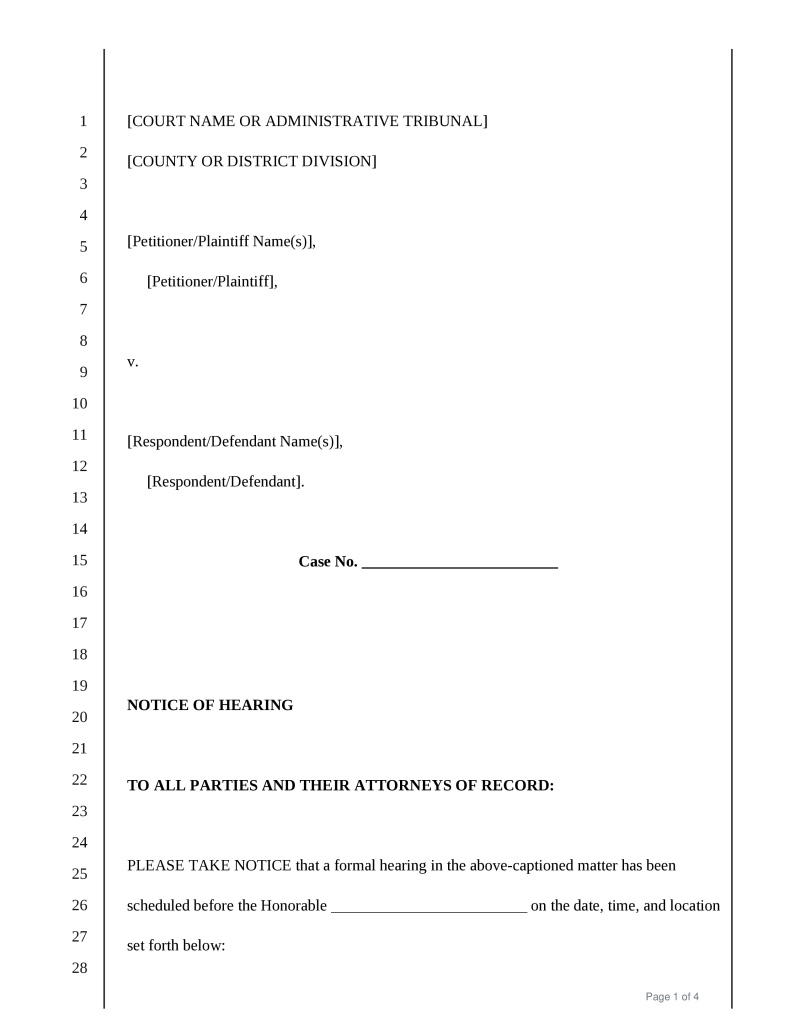
A Notice of Hearing is a formal legal document that notifies parties of the date, time, and location of an upcoming judicial or administrative proceeding.
Case Assignment Status
Most Notices of Hearing are filed in an existing matter. If this notice will accompany a new filing and no number has been issued yet, select No.
Enter the number exactly as it appears on the court or agency docket.
Table of Contents
What is a Notice of Hearing?
A Notice of Hearing is a formal legal document that notifies parties involved in a lawsuit, bankruptcy proceeding, or administrative action of the date, time, and location of an upcoming court appearance. This document ensures that all interested parties receive adequate notice of legal proceedings, satisfying constitutional due process requirements. It is commonly prepared and filed by the party initiating a motion, though courts and administrative agencies also issue them directly. The document provides a clear record that proper notice was given, allowing the court to proceed with the scheduled hearing.
Purpose and Legal Function
The primary purpose of a Notice of Hearing is to satisfy the constitutional requirement of due process by providing reasonable notice and an opportunity to be heard. Court systems and administrative agencies cannot legally make rulings that affect a party's rights or obligations without verifying that the party was properly informed of the proceedings. It serves as an official summons to appear before a judicial officer or administrative judge to present arguments, submit evidence, or object to a pending motion. The filing party must serve this notice to all other parties in the case within the specific timelines prescribed by local court rules.
Failing to provide proper notice can lead to severe legal consequences for the moving party. If a court discovers that a party did not receive a Notice of Hearing, any orders or judgments entered during that hearing may be declared void. This requirement protects individuals from surprise rulings and ensures a fair, transparent legal process. The court record must show a completed certificate of service before the judge will proceed with the scheduled docket items.
Types of Notice of Hearing
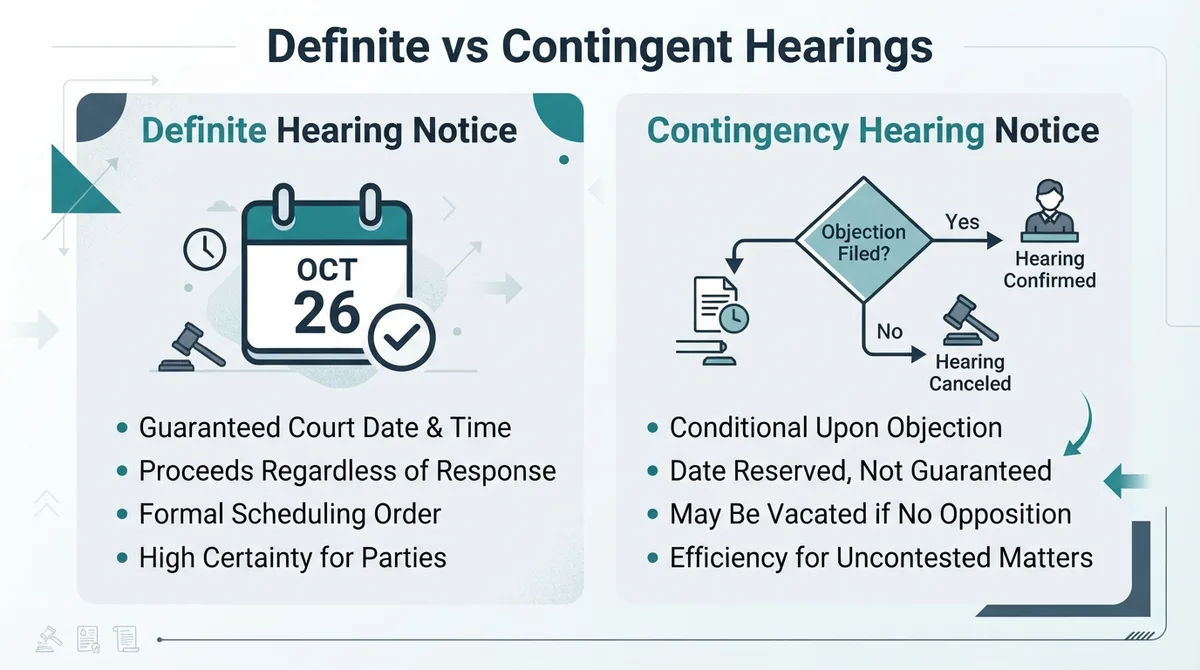
Courts and administrative bodies utilize different variations of this document depending on the nature of the proceedings:
- Definite Hearing Notice - Specifies a fixed date, time, and location for a court appearance that will occur regardless of prior responses.
- Contingency Hearing Notice - Schedules a hearing that will take place if and only if an objection or response is filed by a designated deadline.
- Immigration Court Notice - Issued by administrative bodies to schedule removal hearings or other immigration proceedings for noncitizens.
- Bankruptcy Motion Notice - Filed by creditors, debtors, or trustees to schedule hearings on specific motions within a bankruptcy case.
Required Elements and Information
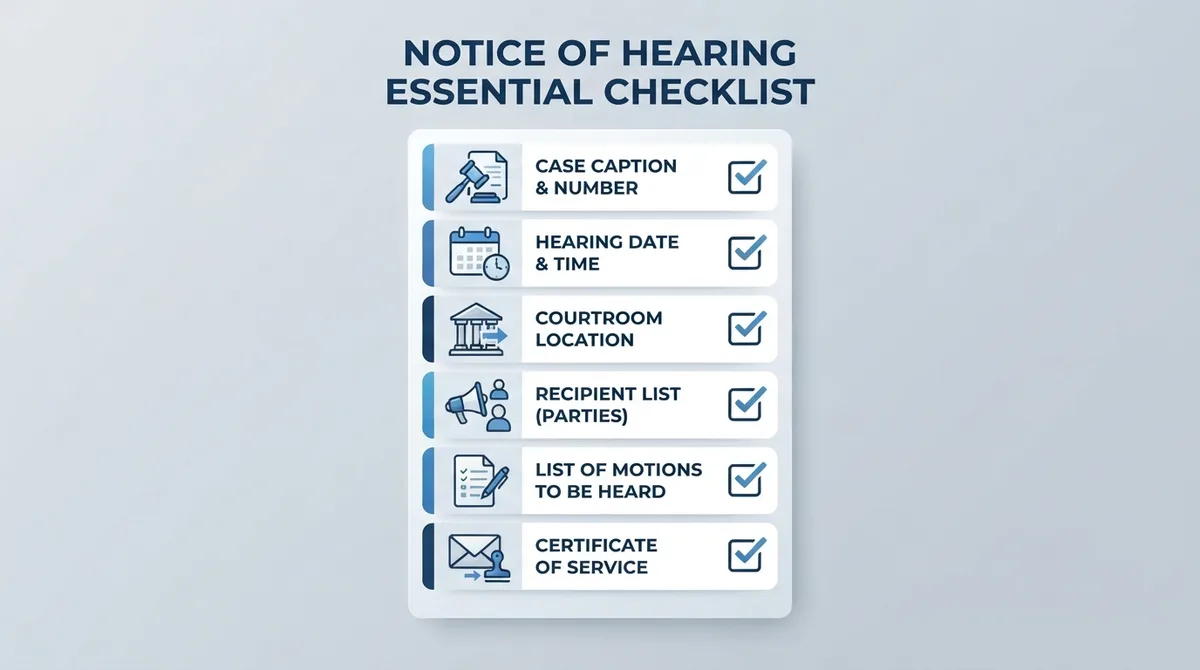
To be legally valid, a Notice of Hearing must contain specific details that allow the recipient to understand when, where, and why the proceeding is occurring:
- Case Caption - Identifies the court name, the names of the parties involved, and the assigned case or docket number.
- Hearing Details - Specifies the exact date, time, physical courtroom address, or virtual meeting link for remote hearings.
- Subject Matter - Outlines the specific motion, petition, or legal issue that the court will address during the proceeding.
- Response Deadlines - Clarifies the date by which opposing parties must file written objections or responses to the motion.
- Certificate of Service - Confirms the date and method used to deliver the document to all required parties in the case.
Filing and Service Procedures
The process for filing and serving a Notice of Hearing involves several precise steps to ensure legal compliance:
- Select a Date - Obtain an available hearing date from the court clerk or the judge's scheduling calendar.
- Prepare the Document - Complete the official local form or draft a custom notice containing all required case details.
- File with the Court - Submit the completed document to the court clerk, often through an electronic filing system.
- Serve the Parties - Deliver copies of the notice to all other parties or their legal counsel using approved service methods.
- File Proof of Service - Submit a signed certificate of service to the court to prove that all parties received the notice.
Legal Framework and Regulations
Various federal rules and agency guidelines dictate how notices are prepared, served, and timed:
- Federal Rules of Bankruptcy Procedure Service Requirements - Governs the timing and service of notices for motions in bankruptcy proceedings (FRBP 9006(d)).
- Immigration Court Practice Manual Notice Standards - Establishes requirements for scheduling and notifying parties of immigration hearings (8 CFR § 1003.18).
- Federal Rules of Civil Procedure Motion Timelines - Sets the default timeframes for serving written motions and notices of hearings in civil cases (FRCP 6(c)).
Frequently Asked Questions
Sources
- Notice of Hearing | District of Minnesota | United States District Court - Provides a downloadable 'Notice of Hearing' form for motions and related filings in the District of Minnesota.
- Notice of Hearing | Central District of California | United States Bankruptcy Court - Details the process for setting a hearing and providing notice, including selecting the Bankruptcy/Adversary menu and attaching the document.
- Notice of Hearing | Northern District of Georgia | United States Bankruptcy Court - Describes the filing process for a 'Notice of Hearing' related to a motion, referencing Local Form - Notice of Hearing and FRBP 9006(d).
- Notice of Hearing - Definite Hearing | Western District of Louisiana | United States Bankruptcy Court - Provides a downloadable 'Notice of Hearing - Definite Hearing' form, including PDF and Word/Text versions.
- Notice of Hearing - IF and ONLY IF | Western District of Louisiana | United States Bankruptcy Court - Offers a 'Notice of Hearing - If and Only If' form, available in PDF and Word/Text formats.
- Notice of Hearing | Executive Office for Immigration Review - Provides information on the 'Notice of Hearing' form used in immigration proceedings, available in multiple languages.
Not the form you're looking for?
Try our legal document generator to create a custom document
Disclaimer: The templates available on this website are provided for general informational purposes only and do not constitute legal advice. They are not intended to be, and should not be interpreted as, compliant with any specific legal, regulatory, or privacy requirements. These templates are not a replacement for professional legal guidance and should not be relied upon for any particular matter or circumstance. Users are strongly encouraged to seek advice from a qualified attorney licensed in their jurisdiction before using, modifying, or relying on any template.
All templates are provided on an "as is," "with all faults," and "as available" basis. The provider disclaims any and all warranties of any kind, whether express, implied, statutory, or otherwise, including without limitation warranties of merchantability, fitness for a particular purpose, title, or non-infringement.
LegalTemplates.com makes no guarantees or representations regarding the accuracy, completeness, expected outcomes, or reliability of the materials contained in these templates or any materials referenced or linked from them.