Certificate of Service
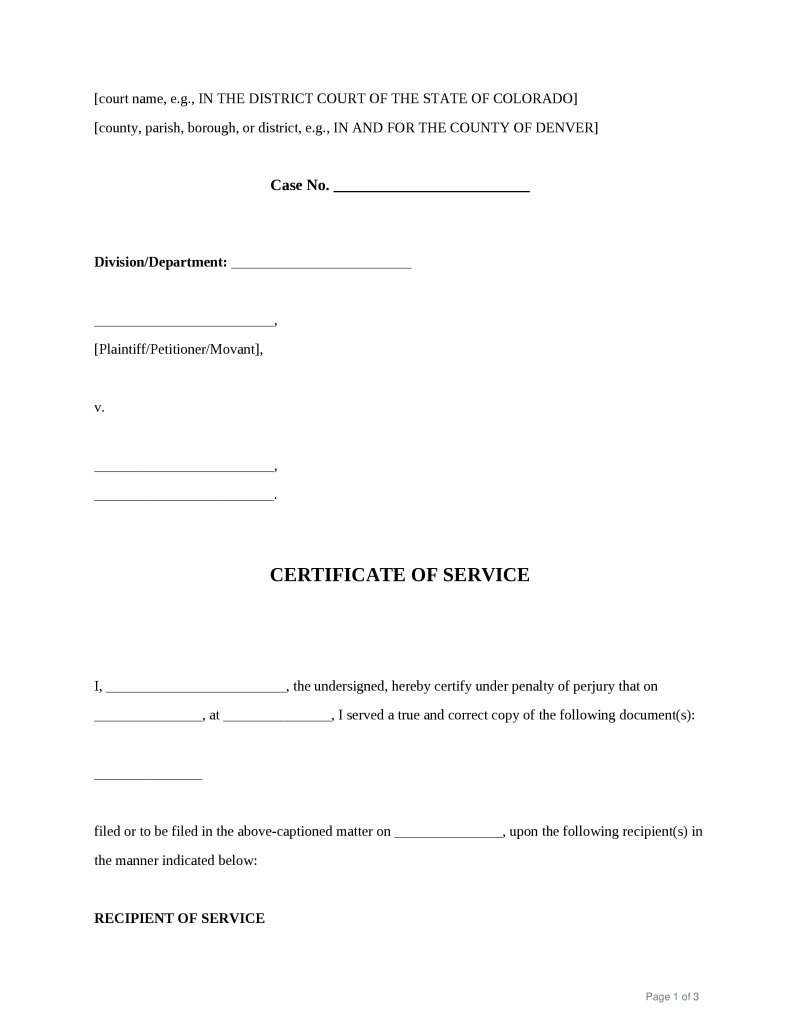
A Certificate of Service is a formal legal document that certifies a specific party has been officially served with legal papers in accordance with civil procedure rules.
Case Posture
Select whether a case number has already been assigned. Existing cases usually require the docket, cause, or case number in the caption.
Table of Contents
What is a Certificate of Service?
A Certificate of Service is a formal legal document filed with a court to certify that a copy of a specific filing has been delivered to all parties involved in a legal proceeding. This document serves as official proof to the court that the serving party has fulfilled their legal obligation to notify opposing counsel or unrepresented parties of new filings, motions, or pleadings. It plays a critical role in maintaining transparency and upholding the constitutional right to due process by ensuring that no legal actions are taken without the knowledge of all active participants in a case. Filing this certification is a mandatory procedural step in both state and federal litigation.
Purpose and Legal Significance
The primary function of this document is to guarantee that all parties to a lawsuit remain fully informed of every development and submission. In the American legal system, the principle of due process requires that each party has a fair opportunity to respond to any motion, brief, or other document submitted to the court. Filing this certification prevents ex parte communications, which are unilateral discussions or submissions to the judge without the other party's knowledge. It establishes a verifiable paper trail that protects the filing party from claims that the opposing side was left unaware of court actions.
Key Components of the Document
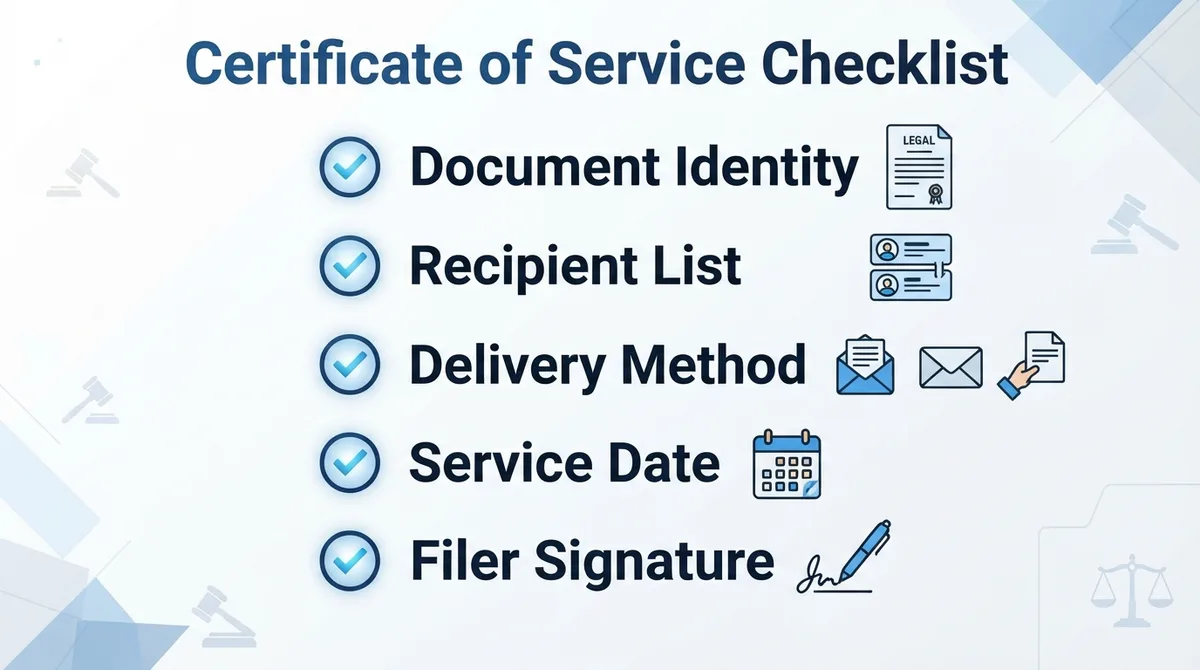
While specific formats vary by jurisdiction, standard court rules dictate that certain essential details must be present on the form to satisfy legal requirements:
- Identity of the Document - The exact title of the pleading, motion, or brief that was served to the other parties.
- Names of Recipients - The full names and addresses of all attorneys of record, law firms, or self-represented litigants who received the filing.
- Method of Delivery - The specific means used to transport the document, such as electronic filing, postal mail, hand delivery, or overnight courier.
- Date of Service - The precise day, month, and year the document was sent or delivered to the recipients.
- Signature of the Server - The handwritten or electronic signature of the attorney or self-represented party certifying the truth of the statement.
Types of Service Methods
Courts permit several distinct methods for delivering legal documents to opposing parties, each requiring specific notation on the certification form:
- Electronic Service - Delivery through the court's electronic filing system or via authorized email, which instantly transmits documents to registered users.
- First-Class Mail - Delivery using the United States Postal Service to the last known address of the recipient, which is generally deemed complete upon mailing.
- Personal Service - Direct, physical delivery of the paperwork to the individual or their authorized representative by hand.
- Overnight Courier - Delivery utilizing a commercial carrier service for next-day arrival, often requiring a signature upon receipt.
- Facsimile Service - Delivery via fax transmission, which is typically permitted only with the prior written consent of the receiving party.
Court-Specific Variations and Rules
Different federal and state jurisdictions maintain unique forms and procedural rules for submitting these certifications, reflecting local court requirements:
- Southern District of New York - Provides a specific fillable form tailored for pro se litigants to ensure self-represented individuals meet procedural standards.
- Middle District of Alabama - Offers standardized forms accessible to both licensed attorneys and self-represented individuals to certify delivery.
- District of Maryland - Utilizes a unified form applicable across civil, criminal, and self-represented litigation categories.
- Northern District of Mississippi - Mandates the use of Form 2e to satisfy local certification requirements in district litigation.
- Northern District of Georgia Bankruptcy Court - Enforces distinct filing requirements and specialized forms specifically adapted for bankruptcy proceedings.
Consequences of Non-Compliance
Failure to file a proper certification or serving documents late can result in severe procedural setbacks for a litigant. Courts may refuse to consider the underlying motion or pleading, treating it as if it were never filed. Judges have the authority to strike non-compliant documents from the record, which can cause parties to miss critical deadlines. In some instances, a lack of proof of service can lead to the dismissal of an entire action or the entry of a default judgment against a non-compliant party. Litigants must ensure meticulous compliance with local rules to avoid these legal penalties.
Frequently Asked Questions
Sources
- Certificate of Service | United States District Court for the Middle District of Alabama - Provides a Certificate of Service form for attorneys and self-represented individuals.
- Certificate of Service | United States District Court for the Southern District of New York - Provides a fillable Certificate of Service form for pro se litigants.
- Form 2e: Certificate of Service | United States District Court for the Northern District of Mississippi - Provides Form 2e: Certificate of Service for use in the Northern District of Mississippi.
- Certificate of Service | United States District Court for the District of Maryland - Provides a Certificate of Service form for civil, criminal, and self-represented litigants.
- Certificate of Service | United States Bankruptcy Court for the Northern District of Georgia - Provides a Certificate of Service form and filing requirements for bankruptcy cases.
Not the form you're looking for?
Try our legal document generator to create a custom document
Disclaimer: The templates available on this website are provided for general informational purposes only and do not constitute legal advice. They are not intended to be, and should not be interpreted as, compliant with any specific legal, regulatory, or privacy requirements. These templates are not a replacement for professional legal guidance and should not be relied upon for any particular matter or circumstance. Users are strongly encouraged to seek advice from a qualified attorney licensed in their jurisdiction before using, modifying, or relying on any template.
All templates are provided on an "as is," "with all faults," and "as available" basis. The provider disclaims any and all warranties of any kind, whether express, implied, statutory, or otherwise, including without limitation warranties of merchantability, fitness for a particular purpose, title, or non-infringement.
LegalTemplates.com makes no guarantees or representations regarding the accuracy, completeness, expected outcomes, or reliability of the materials contained in these templates or any materials referenced or linked from them.