Single Net Lease
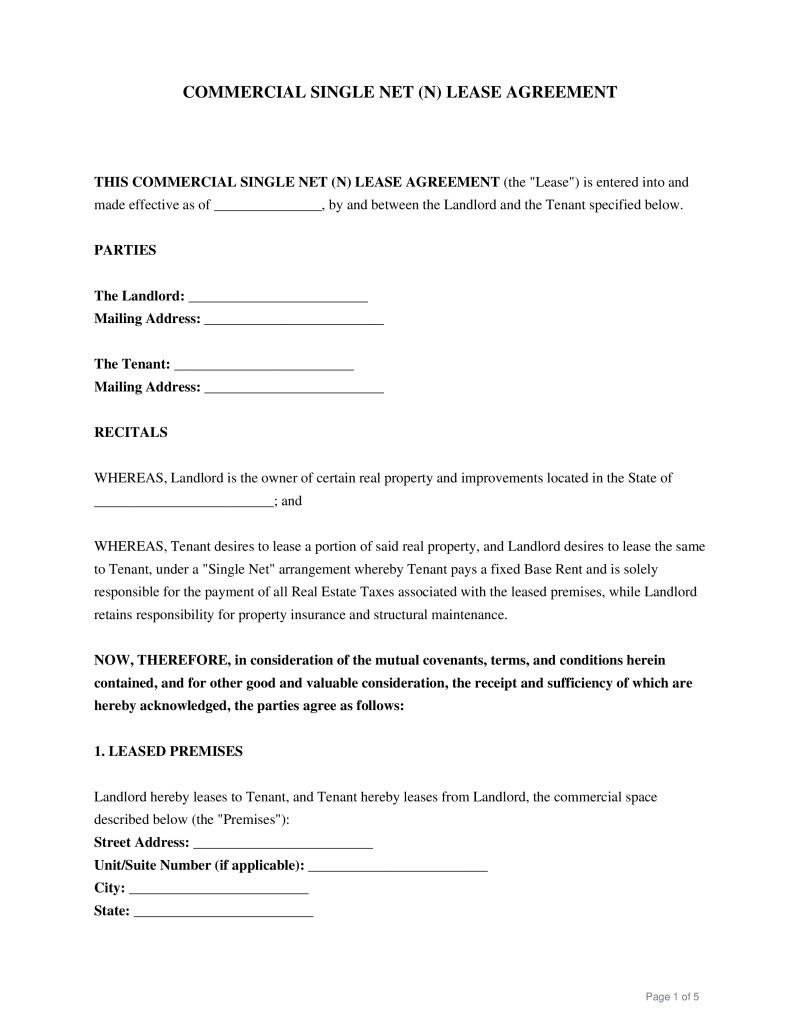
A Single Net Lease is a commercial real estate agreement in which the tenant pays base rent alongside one major property expense, typically property taxes, while the landlord remains responsible for all other operating costs.
Commercial Property Category
Select the category that best describes the leased space. This helps tailor use, access, signage, and operational provisions.
Use a short description that can be included in the lease.
Table of Contents
What is a Single Net Lease?
A Single Net Lease is a commercial real estate lease agreement where the tenant pays the base rent plus one specific category of property expenses. In this arrangement, the tenant assumes responsibility for the property taxes associated with the leased premises. The landlord remains responsible for all other operating expenses, including building insurance, maintenance, and structural repairs. This type of agreement is less common than other net lease variations but serves as a foundational structure in commercial property management.
Core Characteristics of a Single Net Lease
In commercial real estate, lease structures are categorized by how operating expenses are shared between the landlord and the tenant. A Single Net Lease, often abbreviated as an N lease, represents the simplest form of a net lease. The tenant pays a lower base rent compared to a standard gross lease because they take on the financial risk of property tax fluctuations. The landlord handles the administrative aspects of paying the tax authority, billing the tenant for reimbursement, or requiring the tenant to pay the tax authority directly.
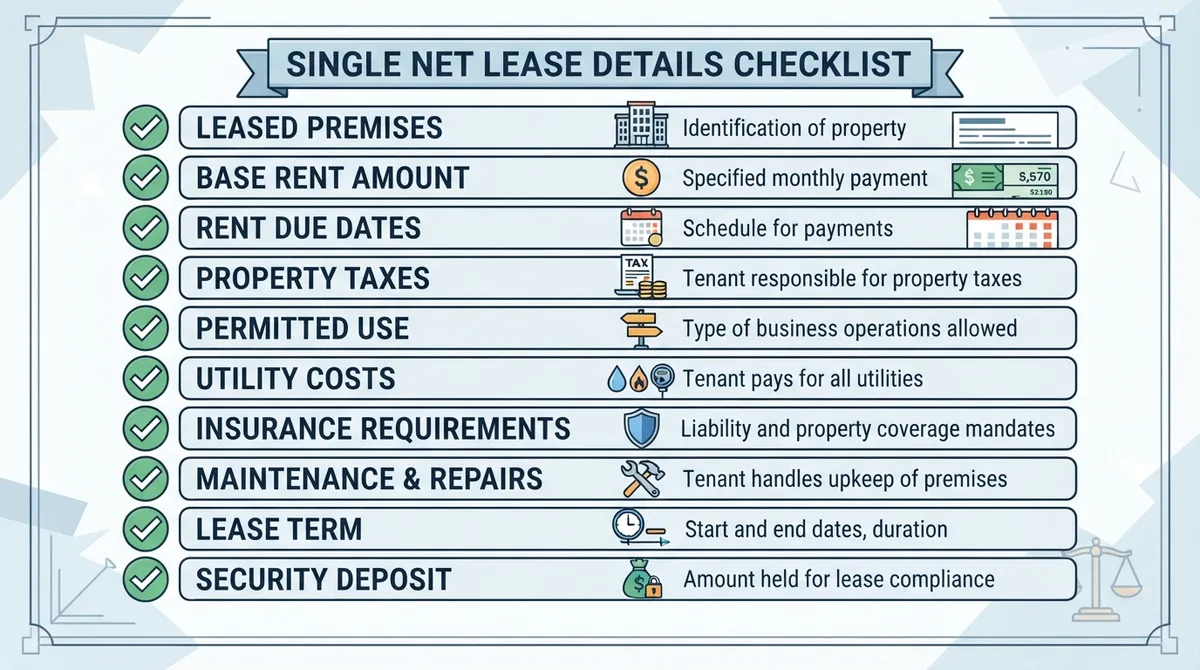
Commercial lease agreements define the financial obligations of each party:
- Base Rent - The fixed monthly or annual amount paid to the landlord for the use of the physical space.
- Property Taxes - The specific operating expense transferred to the tenant under this agreement.
- Landlord Retained Costs - The remaining operational expenses, such as insurance and maintenance, which do not transfer to the tenant.
Types of Net Leases
Commercial real estate utilizes several net lease structures depending on the distribution of property expenses:
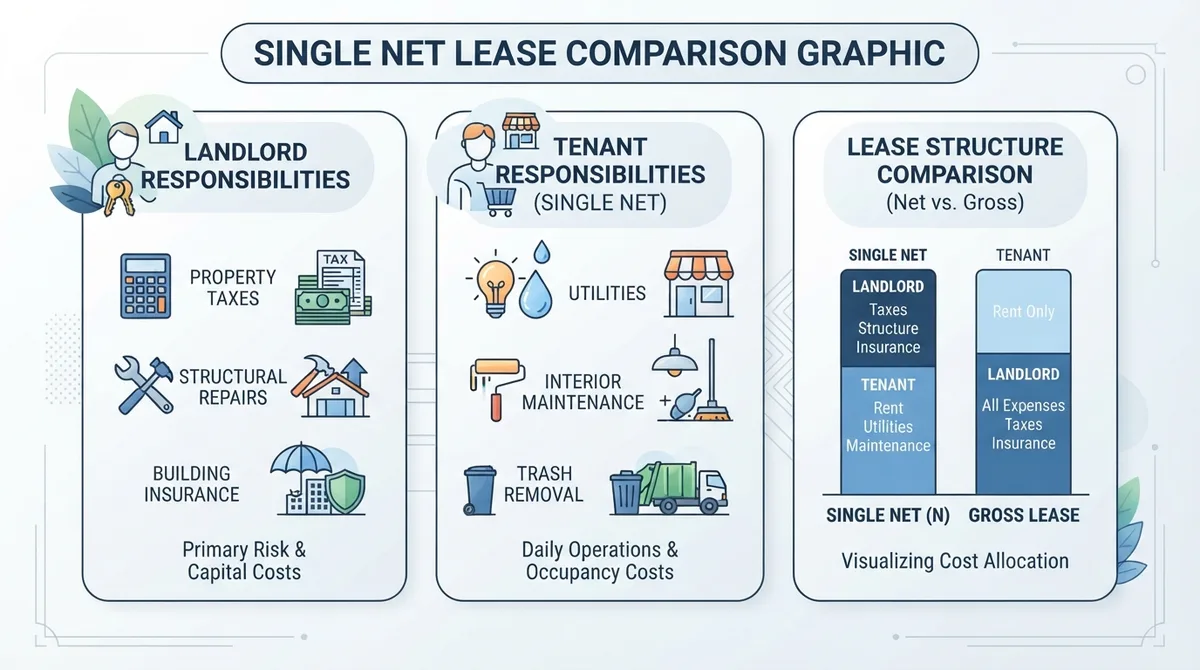
- Single Net Lease - A lease agreement where the tenant pays base rent and property taxes, while the landlord covers insurance and maintenance.
- Double Net Lease - A lease agreement where the tenant pays base rent, property taxes, and property insurance premiums, while the landlord retains maintenance duties.
- Triple Net Lease - A lease agreement where the tenant pays base rent, property taxes, property insurance, and all maintenance and repair costs.
Allocation of Expenses and Responsibilities
The division of costs in a Single Net Lease requires clear contractual language to prevent disputes. The lease document must specify how taxes are calculated, especially in multi-tenant buildings where taxes are prorated based on square footage.
The division of operational costs typically follows a standard distribution:
- Property Tax Obligations - The tenant pays the real estate taxes directly to the municipality or reimburses the landlord.
- Building Insurance - The landlord maintains and pays for the property casualty and liability insurance policies.
- Common Area Maintenance - The landlord manages and funds the upkeep of shared spaces, parking lots, and landscaping.
- Structural Repairs - The landlord retains sole responsibility for the foundation, roof, and exterior walls of the building.
Practical Considerations and Risk Allocation
Operating under this lease structure introduces specific financial variables for both parties. Landlords must monitor the tenant to ensure that property tax payments are made on time to avoid municipal liens on the property. Tenants must prepare for potential tax reassessments, which can significantly increase their monthly outlay without warning.
The lease agreement must outline clear protocols for managing these financial risks:
- Tax Disputes - The contract should specify whether the tenant has the right to challenge property tax assessments with local authorities.
- Payment Methods - The agreement defines whether the tenant pays the municipality directly or reimburses the landlord upon receipt of the tax bill.
- Default Terms - Failure to pay property taxes is treated as a lease default, allowing the landlord to initiate eviction proceedings.
- Proration at Term Limits - Tax obligations must be prorated for the partial years at the beginning and the end of the lease term.
Comparison of Commercial Lease Structures
Commercial real estate transactions utilize different lease types to allocate operating expenses. Understanding these distinctions helps parties evaluate the true cost of occupancy.
The primary commercial lease structures vary by the number of expenses transferred to the tenant:
- Gross Lease - The tenant pays a single flat rent amount, and the landlord covers all taxes, insurance, and maintenance costs.
- Single Net Lease - The tenant pays rent plus property taxes, while the landlord covers all other operational costs.
- Double Net Lease - The tenant pays rent, property taxes, and insurance premiums, while the landlord maintains the structure.
- Triple Net Lease - The tenant pays rent, taxes, insurance, and all maintenance and repair costs, minimizing landlord operational involvement.
Federal Regulatory Definitions
Several federal regulations address the definition of net leases:
- Net Lease Maintenance Exclusions - Establishes that a net lease is a transaction where the savings association is not obligated to provide servicing, repair, or maintenance of the leased property (12 CFR § 160.41).
Sources
- Definition of Net Lease in 12 CFR § 160.41 - Provides a definition of 'net lease' under federal regulations.
Not the form you're looking for?
Try our legal document generator to create a custom document
Disclaimer: The templates available on this website are provided for general informational purposes only and do not constitute legal advice. They are not intended to be, and should not be interpreted as, compliant with any specific legal, regulatory, or privacy requirements. These templates are not a replacement for professional legal guidance and should not be relied upon for any particular matter or circumstance. Users are strongly encouraged to seek advice from a qualified attorney licensed in their jurisdiction before using, modifying, or relying on any template.
All templates are provided on an "as is," "with all faults," and "as available" basis. The provider disclaims any and all warranties of any kind, whether express, implied, statutory, or otherwise, including without limitation warranties of merchantability, fitness for a particular purpose, title, or non-infringement.
LegalTemplates.com makes no guarantees or representations regarding the accuracy, completeness, expected outcomes, or reliability of the materials contained in these templates or any materials referenced or linked from them.