Double Net Lease
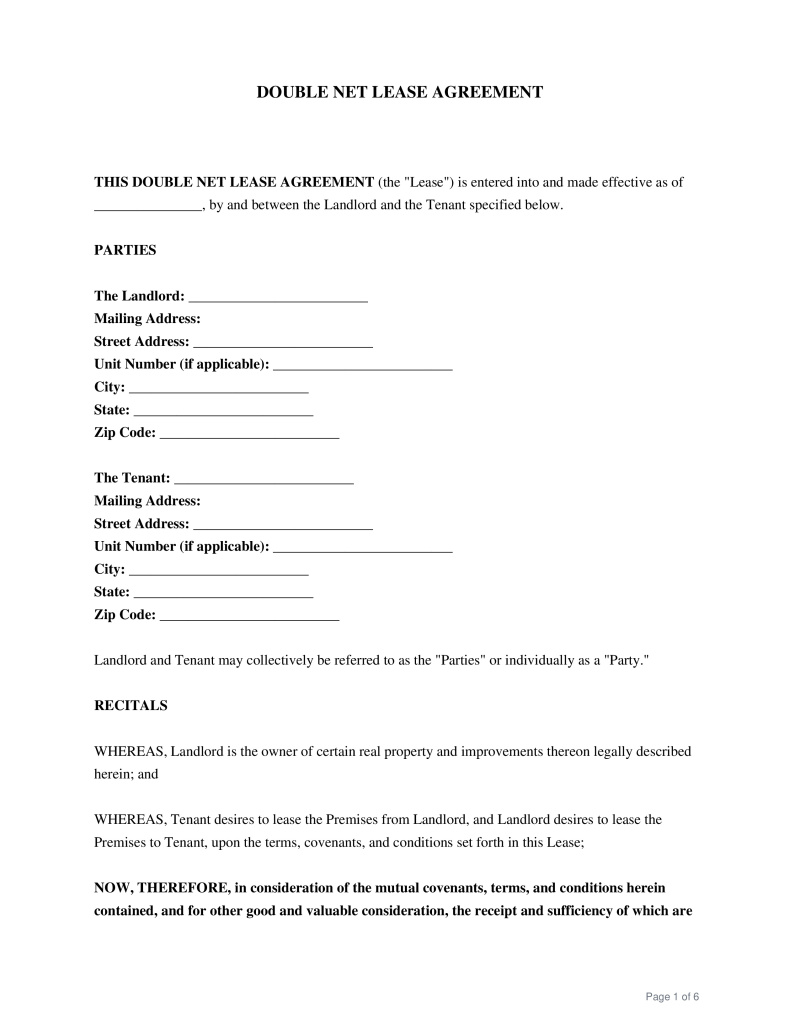
A Double Net Lease is a commercial real estate rental agreement under which the tenant assumes responsibility for both property taxes and building insurance premiums in addition to the base rent.
Commercial Property Type
Select the category that best describes the leased premises. This helps tailor use, maintenance, access, and operational provisions.
Use this if the property does not fit one of the listed categories.
Table of Contents
What is a Double Net Lease?
A Double Net Lease, commonly referred to as an NN lease, is a commercial real estate lease agreement where the tenant is responsible for paying the base rent along with two major categories of property expenses. Under this arrangement, the tenant assumes the financial obligation for both property taxes and insurance premiums associated with the leased space. Landlords typically retain responsibility for structural repairs, maintenance of common areas, and utility systems. This lease structure is widely utilized in commercial properties, including retail centers, office buildings, and industrial facilities, to distribute operating costs between property owners and tenants.
Types of Net Lease Agreements
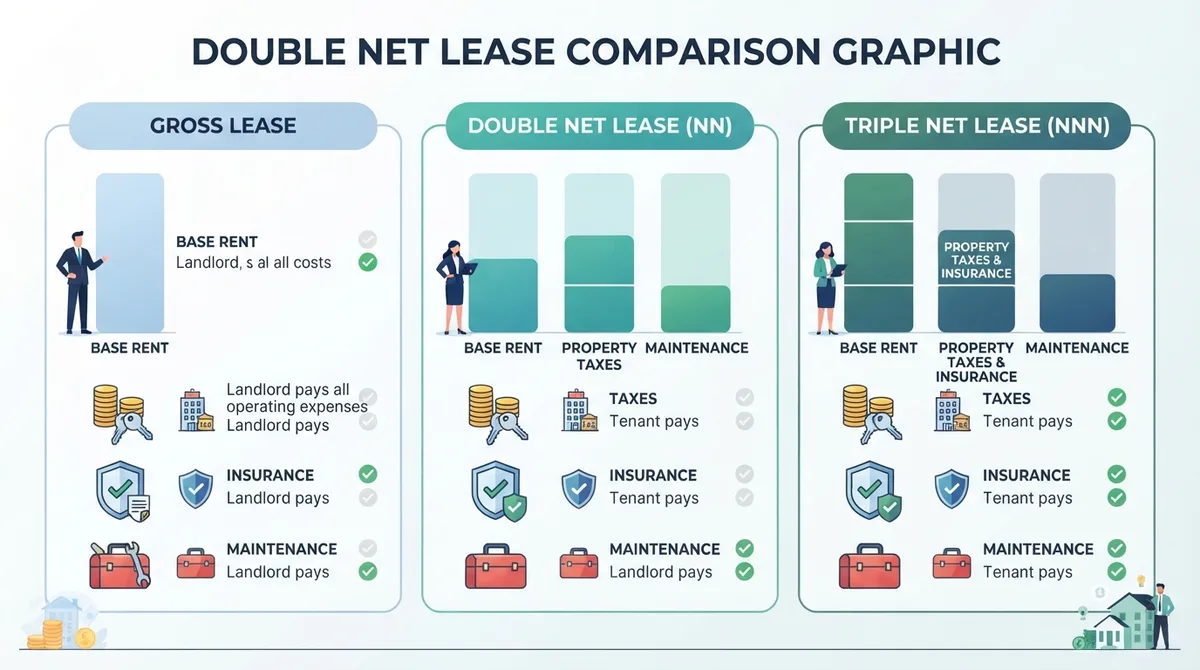
Commercial real estate transactions utilize different net lease structures to allocate financial responsibilities between landlords and tenants:
- Single Net Lease - A lease agreement where the tenant pays base rent and the property taxes, while the landlord covers insurance, maintenance, and structural repairs.
- Double Net Lease - A lease agreement where the tenant pays base rent, property taxes, and property insurance premiums, while the landlord remains responsible for structural maintenance and common area expenses.
- Triple Net Lease - A lease agreement where the tenant pays base rent plus property taxes, insurance premiums, and all maintenance and repair costs for the property.
Allocation of Expenses and Responsibilities
The division of financial obligations under a Double Net Lease requires clear delineation within the written agreement. Parties must specify how payments are calculated, processed, and verified throughout the lease term. The arrangement typically divides expenses according to the following categories:
- Base Rent - The fixed monthly or annual fee paid to the landlord for the physical occupancy of the commercial space.
- Property Taxes - The local government assessments levied on the real estate, which the tenant pays directly to the municipality or reimburses to the landlord.
- Insurance Premiums - The cost of property and casualty insurance coverage for the building, paid by the tenant to protect against physical damage or liability.
- Structural Maintenance - The responsibility of the landlord, covering foundation repairs, roof replacement, exterior walls, and primary structural integrity.
- Common Area Maintenance - Expenses associated with shared spaces, such as parking lots, lobbies, and landscaping, which are usually managed and paid for by the landlord.
Practical Applications in Commercial Real Estate
Double Net Lease agreements are frequently employed in multi-tenant commercial buildings where administrative expenses can be easily segregated. Property owners utilize this structure to stabilize their cash flow by shifting fluctuating tax and insurance costs to the tenants. This arrangement is also relevant in specific development contexts, such as the installation of renewable energy systems on leased buildings.
According to federal guidance on promoting solar energy, the lease structure directly impacts the feasibility of installing solar photovoltaic systems on leased buildings:
- Solar PV Installations - Landlords and tenants must negotiate how energy savings and system maintenance costs are distributed, particularly when the tenant pays taxes and insurance but the landlord owns the physical roof structure.
- Tax Incentives - Ownership of the solar infrastructure determines which party can claim federal tax credits, requiring careful alignment with the existing lease terms.
- Insurance Adjustments - Adding solar equipment often modifies the property insurance premiums, which directly affects the tenant's financial obligations under the lease.
Essential Elements of the Lease Agreement
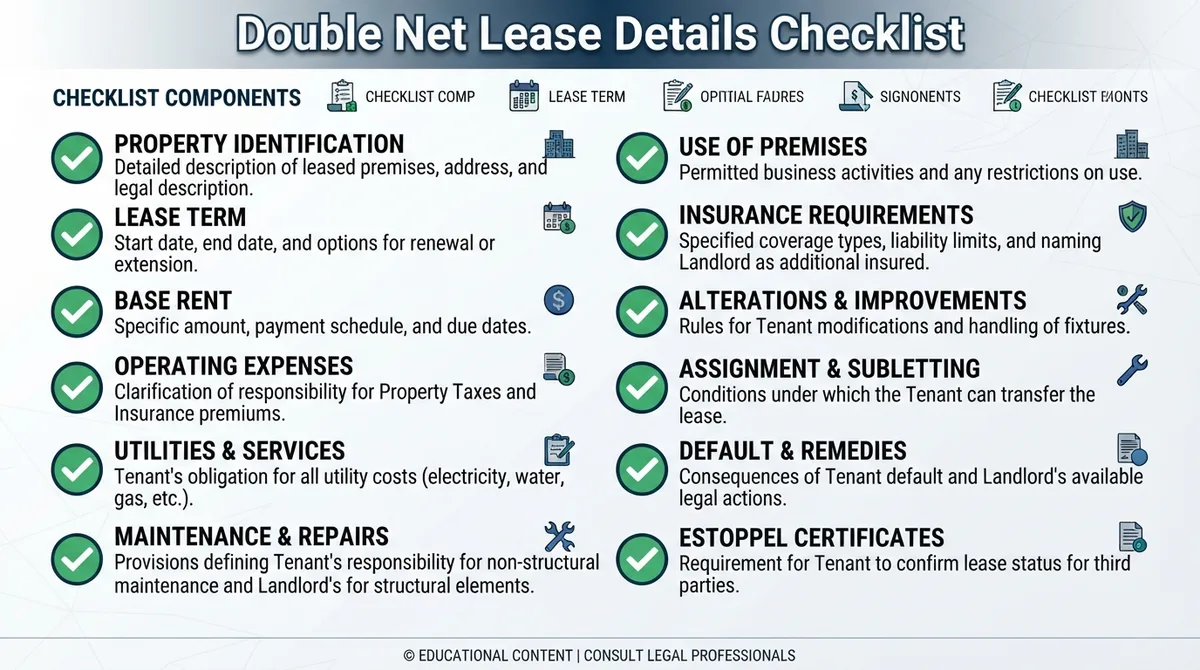
To ensure legal enforceability and prevent disputes, a Double Net Lease agreement must contain precise clauses detailing the rights and duties of each party:
- Proportionate Share Calculation - The method used to determine a tenant's share of taxes and insurance in multi-tenant properties, typically based on the square footage occupied.
- Payment Schedule - The timeline for tax and insurance payments, indicating whether the tenant pays the service providers directly or reimburses the landlord upon receiving invoices.
- Audit Rights - Provisions allowing the tenant to review the landlord's property tax assessments and insurance policies to verify the accuracy of the billed amounts.
- Default Provisions - Legal remedies available to the landlord if the tenant fails to pay taxes or insurance premiums, which may include eviction or financial penalties.
Sources
- Promoting Solar PV on Leased Buildings Guide - Provides a definition of 'Double Net Lease' in the context of solar photovoltaic installations on leased buildings.
Not the form you're looking for?
Try our legal document generator to create a custom document
Disclaimer: The templates available on this website are provided for general informational purposes only and do not constitute legal advice. They are not intended to be, and should not be interpreted as, compliant with any specific legal, regulatory, or privacy requirements. These templates are not a replacement for professional legal guidance and should not be relied upon for any particular matter or circumstance. Users are strongly encouraged to seek advice from a qualified attorney licensed in their jurisdiction before using, modifying, or relying on any template.
All templates are provided on an "as is," "with all faults," and "as available" basis. The provider disclaims any and all warranties of any kind, whether express, implied, statutory, or otherwise, including without limitation warranties of merchantability, fitness for a particular purpose, title, or non-infringement.
LegalTemplates.com makes no guarantees or representations regarding the accuracy, completeness, expected outcomes, or reliability of the materials contained in these templates or any materials referenced or linked from them.