Triple Net Lease (NNN)
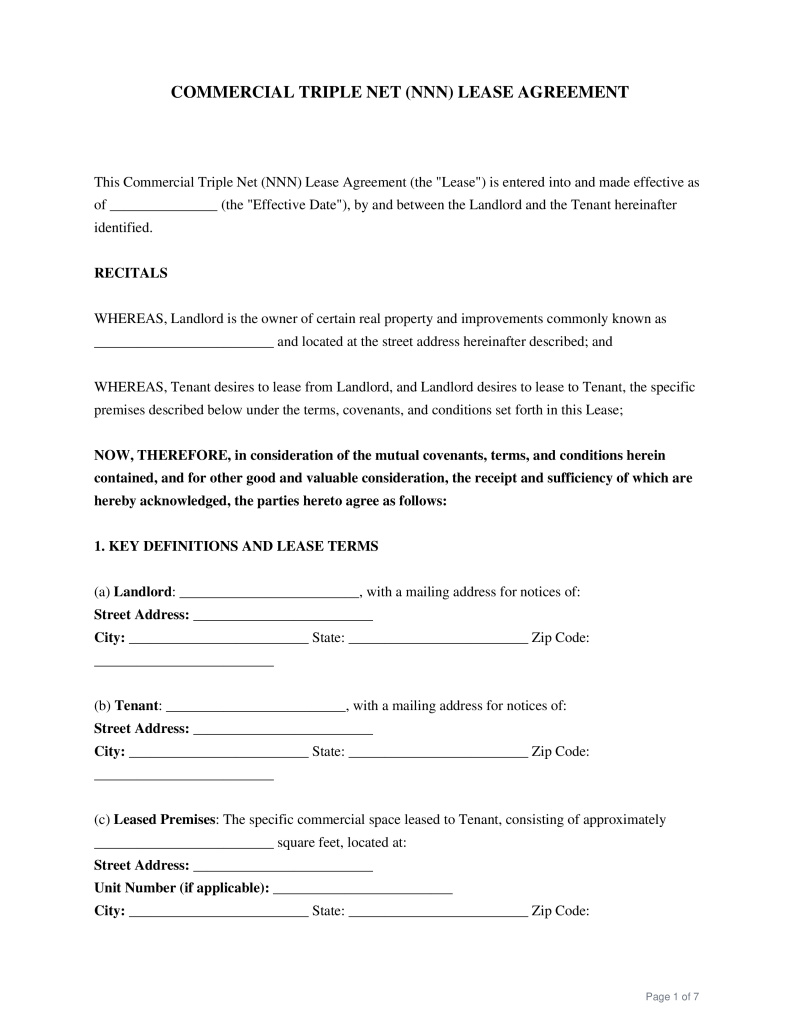
A triple net lease is a commercial real estate lease agreement wherein the tenant assumes responsibility for all operational expenses, including property taxes, insurance, and maintenance, in addition to base rent.
Commercial Property Category
Select the closest property category. This helps tailor use, maintenance, operating expense, and access provisions.
Use this field if the listed categories do not accurately describe the premises.
Table of Contents
What is a Triple Net Lease?
A triple net lease is a commercial real estate lease agreement where the lessee agrees to pay all operating expenses associated with the property in addition to the base rent. This contractual arrangement transfers the financial burden of ongoing property costs from the lessor to the lessee, who assumes responsibility for expenses normally associated with property ownership. These obligations typically include property taxes, insurance, utilities, and maintenance costs. Commercial landlords frequently utilize this lease structure for long-term tenancies involving retail, industrial, or office properties.
Core Mechanics and Structure
In a triple net lease, the base rent is typically lower than in a standard gross lease because the tenant absorbs the variable costs of operating the building. The landlord receives a predictable, passive stream of income, while the tenant gains greater operational control over the physical space. This arrangement aligns the interests of both parties regarding property upkeep, as the tenant directly benefits from efficient maintenance and utility management. The specific terms of expense distribution are heavily negotiated and detailed within the lease agreement to prevent disputes regarding capital expenditures versus routine maintenance.
Institutional investors favor this lease structure due to its bond-like characteristics, offering stable yields with minimal landlord management intervention. Tenants often prefer it because they can manage the property to their own standards and potentially lower their total costs through efficient operations. The lease agreements are usually long-term, often extending ten to fifteen years, with built-in rent escalations to account for inflation over the duration of the occupancy.
Types of Net Commercial Leases
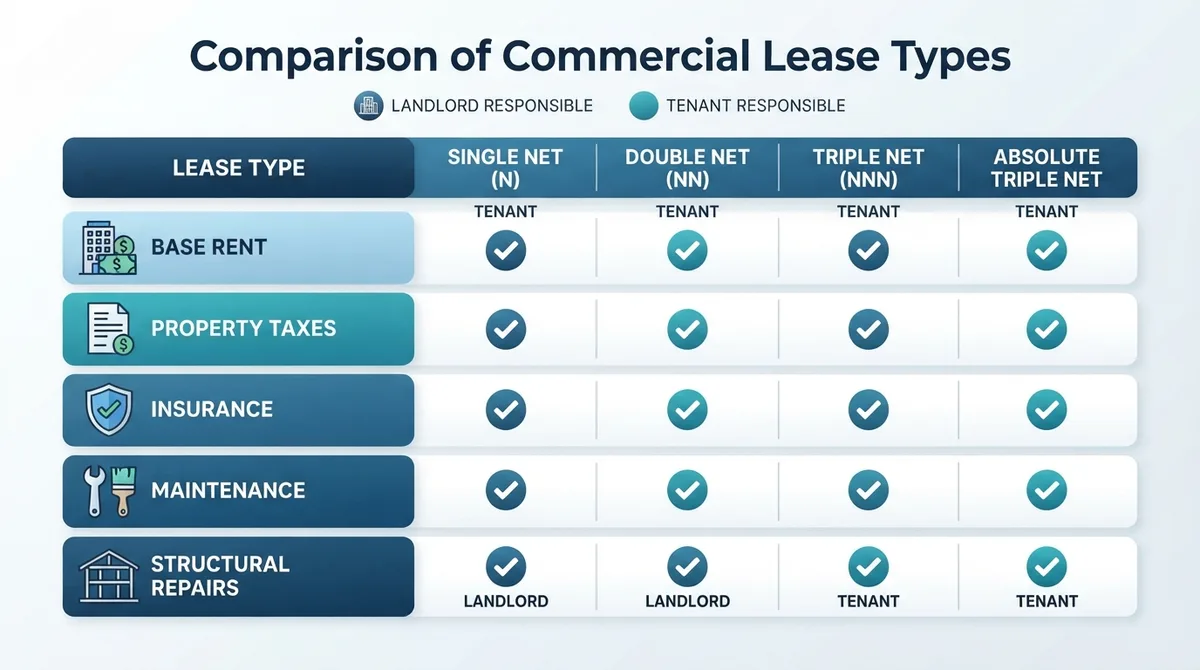
Commercial real estate transactions utilize several variations of net leases depending on how operating expenses are allocated between the landlord and tenant:
- Single Net Lease - A lease agreement where the tenant pays the base rent plus their pro-rata share of the property taxes, while the landlord covers insurance and maintenance.
- Double Net Lease - A lease agreement where the tenant pays the base rent, property taxes, and property insurance premiums, leaving the landlord responsible for structural maintenance.
- Triple Net Lease - A lease agreement where the tenant pays the base rent plus all property taxes, insurance, and maintenance costs, leaving the landlord with minimal financial obligations.
- Absolute Triple Net Lease - A lease agreement where the tenant carries absolute responsibility for all building costs, including major structural repairs, roof replacement, and rebuilding after catastrophic damage.
Federal Regulations and Tax Treatment
The federal government and regulatory agencies maintain specific guidelines regarding the classification and treatment of triple net leases:
- IRS Active Conduct Rule - Establishes that merely entering into a triple-net lease with respect to real property owned by a taxpayer does not constitute the active conduct of a trade or business by such taxpayer (Treasury § 1.1400Z2(d)-1).
- SEC Financial Disclosure Rules - Governs how companies must disclose acquired and disposed businesses, noting that triple net leases require the lessee to pay costs normally associated with ownership such as property taxes, insurance, utilities, and maintenance costs (85 FR 54002).
- Federal Lease Agreements - Demonstrates the application of triple net terms in government contracts, such as the lease of property to the American National Red Cross where the tenant pays all taxes, insurance, and operating costs, with a nominal base rent (Public Law 100-637).
Key Allocation of Expenses
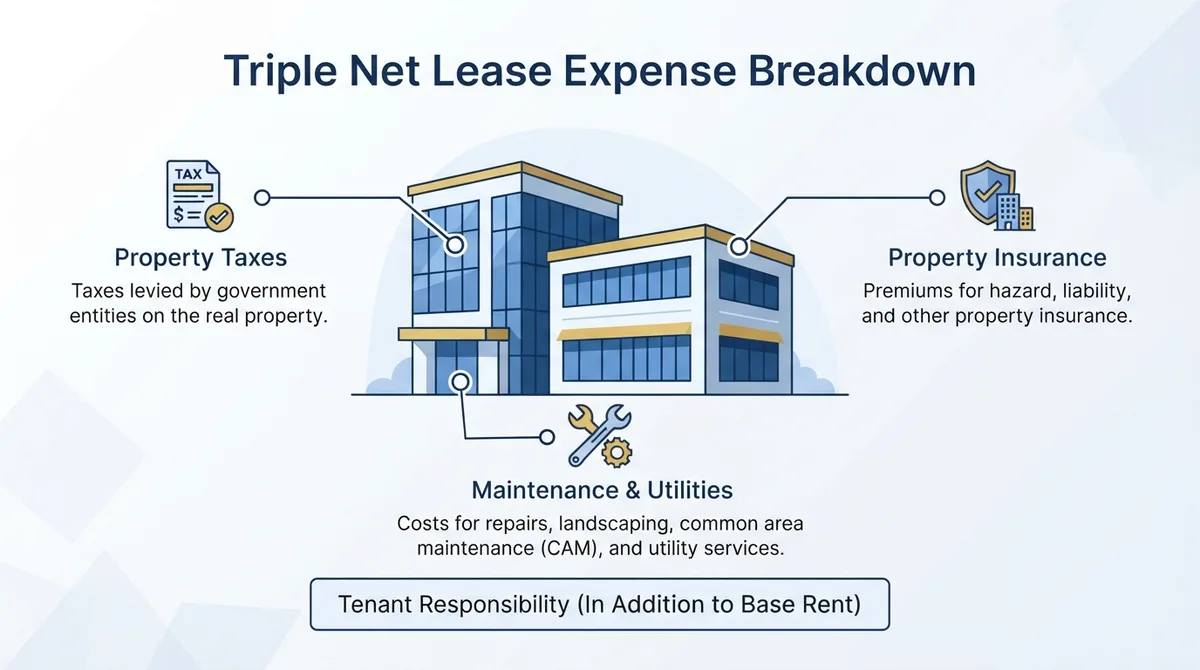
A standard commercial agreement clearly delineates which expenses fall under the responsibility of the lessee:
- Property Taxes - The lessee pays all local real estate and property taxes levied against the leased premises during the lease term.
- Property Insurance - The lessee covers all premiums for property damage, liability, and casualty insurance policies associated with the building.
- Maintenance and Repairs - The lessee handles routine maintenance, common area upkeep, and minor repairs to keep the property in good operating condition.
- Utilities and Operating Costs - The lessee manages and pays for all utility services, waste management, and daily operational expenditures directly.
Practical Considerations and Risk Factors
While a triple net lease offers stable income for landlords, it introduces specific risks for tenants who must manage fluctuating operating costs. Unexpected spikes in property tax assessments or insurance premiums directly impact the tenant's bottom line. Disputes often arise regarding the distinction between routine maintenance, which is the tenant's responsibility, and major structural replacements, which typically remain the landlord's obligation unless an absolute net lease is signed. Parties must conduct thorough due diligence, including property inspections and historical expense reviews, before finalizing the lease terms to ensure the financial projections are realistic.
Another critical element is the reconciliation of Common Area Maintenance charges. In multi-tenant properties, tenants pay a pro-rata share of shared space expenses, which are estimated at the beginning of the year and reconciled annually. Accurate bookkeeping and transparent accounting practices are essential to prevent legal disputes over these shared operational expenditures during the lease term.
Frequently Asked Questions
Sources
- Amendments to Financial Disclosures About Acquired and Disposed Businesses - Discusses triple net leases in the context of financial disclosures for acquired and disposed businesses.
- Internal Revenue Service, Treasury § 1.1400Z2(d)-1 - Clarifies that merely entering into a triple-net lease does not constitute the active conduct of a trade or business by the taxpayer.
- PUBLIC LAW 100-637—NOV. 8, 1988 - Details a lease agreement with the American National Red Cross, specifying a triple net lease arrangement.
Not the form you're looking for?
Try our legal document generator to create a custom document
Disclaimer: The templates available on this website are provided for general informational purposes only and do not constitute legal advice. They are not intended to be, and should not be interpreted as, compliant with any specific legal, regulatory, or privacy requirements. These templates are not a replacement for professional legal guidance and should not be relied upon for any particular matter or circumstance. Users are strongly encouraged to seek advice from a qualified attorney licensed in their jurisdiction before using, modifying, or relying on any template.
All templates are provided on an "as is," "with all faults," and "as available" basis. The provider disclaims any and all warranties of any kind, whether express, implied, statutory, or otherwise, including without limitation warranties of merchantability, fitness for a particular purpose, title, or non-infringement.
LegalTemplates.com makes no guarantees or representations regarding the accuracy, completeness, expected outcomes, or reliability of the materials contained in these templates or any materials referenced or linked from them.