Abstract Of Judgment
An Abstract of Judgment is a formal legal document certifying a court's final decision, which, when recorded, creates an involuntary public lien against the real property of a judgment debtor.
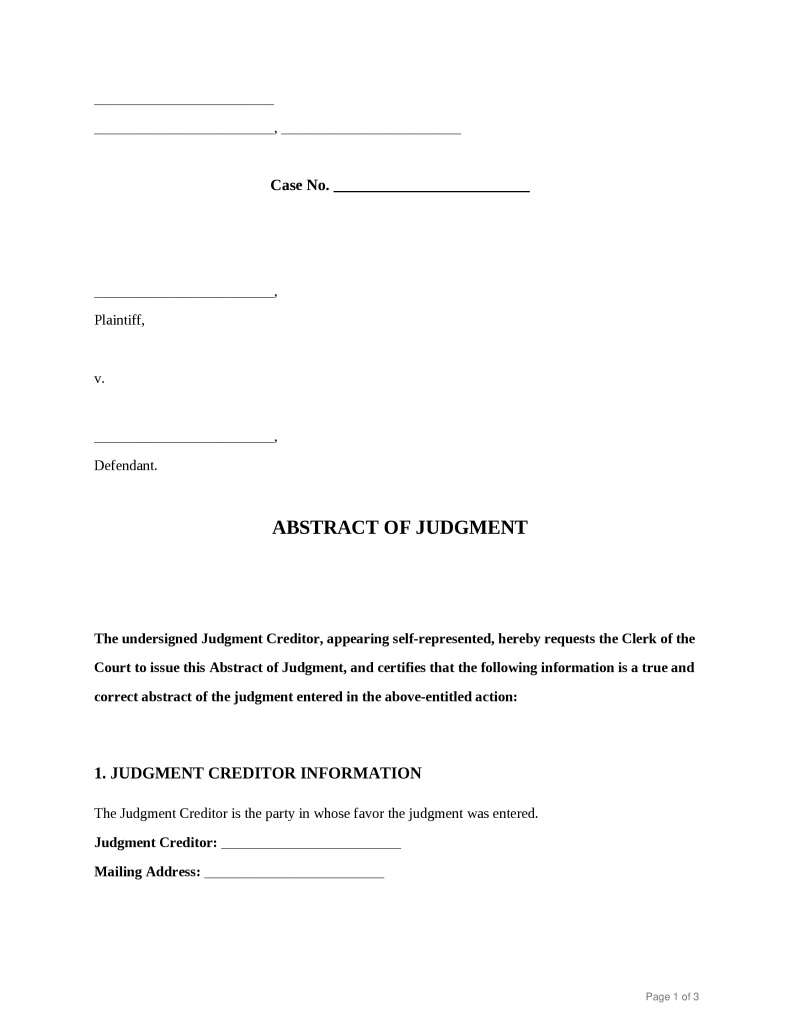
Judgment Entered Status
An abstract of judgment is usually prepared after a final money judgment, default judgment, renewed judgment, or other enforceable money order has been entered.
Table of Contents
What is a Abstract Of Judgment?
An abstract of judgment is a formal legal document that summarizes the essential components of a court's final judgment. Its primary purpose is to create a public record of the debt, which can then be recorded with a county recorder or registrar of deeds to establish a lien against the real property of the judgment debtor. Creditors utilize this document as a powerful collection tool, ensuring that the debtor cannot sell or refinance their property without first satisfying the outstanding judgment.
Purpose and Legal Function
The primary objective of this document is to secure the payment of a monetary judgment awarded by a court. By summarizing the court's decision, the document acts as a portable certificate of debt that can be registered in counties where the debtor owns or may acquire real estate.
The document performs several distinct legal functions:
- Lien Creation - Establishes an involuntary lien against any real property owned by the debtor in the county of recording.
- Asset Encumbrance - Prevents the debtor from transferring clear title to buyers or securing new loans against the property.
- Public Notice - Serves as constructive notice to third parties, including title companies and prospective buyers, of the existing debt.
- Priority Establishment - Secures the creditor's place in line relative to other subsequent creditors who may file claims against the same property.
Essential Elements of the Document
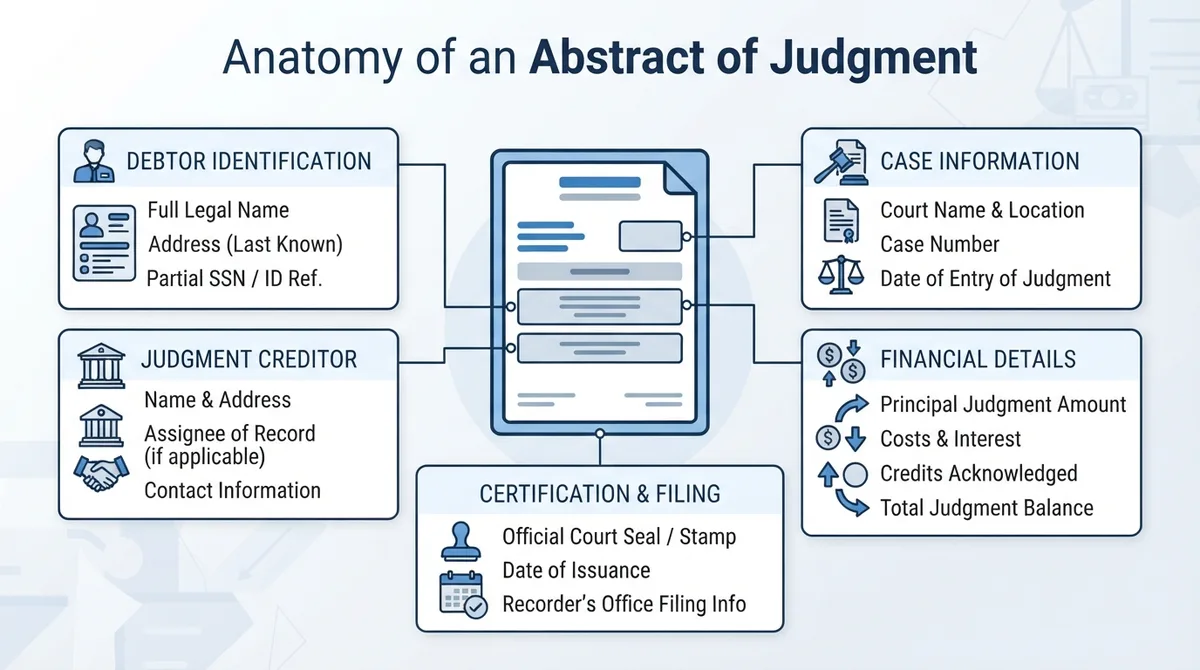
To be legally effective and accepted for recording, the document must contain specific, accurate details regarding the original court action. Errors in these details can invalidate the lien or delay its recording.
Most jurisdictions require the following information to be clearly stated:
- Debtor Identification - Full legal name, last known address, and social security or taxpayer identification numbers when authorized by law.
- Creditor Details - Full name and address of the judgment creditor who is entitled to receive the payment.
- Court Information - Name of the issuing court, the specific case number, and the date the judgment was entered.
- Financial Summary - Original amount of the judgment, any accrued interest, court costs awarded, and any payments credited toward the balance.
- Official Attestation - Signature and seal of the court clerk verifying that the abstract is an accurate reflection of the court records.
Federal Court Procedures and Variations
Federal courts provide specific forms and pathways for parties seeking to obtain and file these documents. The requirements for procuring and submitting the form depend on the specific district court or bankruptcy court where the judgment was rendered.
Examples of federal court rules and provisions include:
- Southern District of New York - Requires the submission of a specific form, payment of a filing fee, and electronic filing through the Electronic Case Filing system.
- District of Connecticut - Maintained as a standardized local form available through the district court clerk for judgment certification.
- Central District of California Bankruptcy Court - Offers a specialized bankruptcy form to secure judgments issued by bankruptcy judges.
- Southern District of Illinois - Provides a dedicated form for judgment creditors to obtain clerk certification of district court judgments.
- Southern District of California Bankruptcy Court - Standardizes the application and issuance process through a designated bankruptcy court form.
Recording and Enforcement Process
Obtaining the document from the court clerk is only the initial step in the collection process. The creditor must take active steps to enforce the lien in the appropriate jurisdictions.
The general enforcement process involves several key steps:
- Obtain the Form - Request the document from the clerk of the court that issued the original judgment, ensuring all case details are accurate.
- Pay the Fee - Submit the required administrative fee to the court clerk for preparing and certifying the document.
- Record the Document - File the certified copy with the county recorder or registrar of deeds in every county where the debtor is believed to own real property.
- Monitor the Lien - Track the expiration date of the lien, as state laws limit the duration of judgment liens and require timely renewals.
Types of Judgment Documents
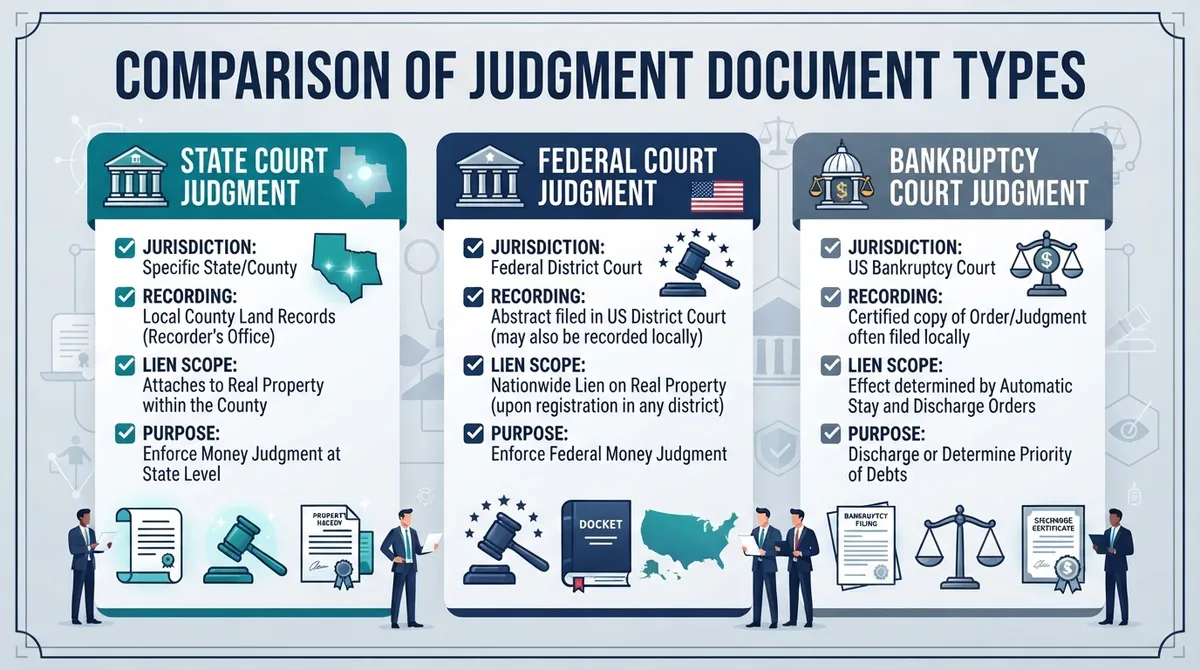
Different jurisdictions and court levels utilize distinct variations of judgment summaries depending on the nature of the case and the target property.
Common types of these documents include:
- State Court Abstract of Judgment - Summarizes judgments from state-level trial courts for recording in local county land records.
- Federal Court Abstract of Judgment - Certifies judgments originating from federal district courts, often requiring electronic filing and unique federal fees.
- Bankruptcy Court Abstract of Judgment - Issues from federal bankruptcy courts to secure non-dischargeable debts or adversary proceeding awards.
- Foreign Abstract of Judgment - Represents a judgment from another state or country that has been domesticated in the local jurisdiction.
Governing Rules and Regulations
Federal and state rules dictate the issuance and recording of these documents to protect the rights of both creditors and debtors:
- Federal Registration of Judgments - Permits a judgment registered in one district to be registered in any other district by filing a certified copy (28 U.S.C. § 1963).
- Federal Judgment Lien Creation - Aligns the creation, duration, and termination of federal court judgment liens with the laws of the state where the property is located (28 U.S.C. § 1962).
- Electronic Case Filing Requirements - Mandates the electronic submission of judgment documents through the district court database (SDNY Local Civil Rule 5.1).
Frequently Asked Questions
Sources
- Abstract of Judgment | U.S District Court - Provides the Abstract of Judgment form and filing instructions for the Southern District of New York.
- Abstract of Judgment | District of Connecticut | United States District Court - Provides the Abstract of Judgment form for the District of Connecticut.
- Abstract of Judgment | Central District of California | United States Bankruptcy Court - Provides the Abstract of Judgment form for the Central District of California.
- Abstract of Judgment | Southern District of Illinois | United States District Court - Provides the Abstract of Judgment form for the Southern District of Illinois.
- Abstract of Judgment | Southern District of California | United States Bankruptcy Court - Provides the Abstract of Judgment form for the Southern District of California.
Not the form you're looking for?
Try our legal document generator to create a custom document
Disclaimer: The templates available on this website are provided for general informational purposes only and do not constitute legal advice. They are not intended to be, and should not be interpreted as, compliant with any specific legal, regulatory, or privacy requirements. These templates are not a replacement for professional legal guidance and should not be relied upon for any particular matter or circumstance. Users are strongly encouraged to seek advice from a qualified attorney licensed in their jurisdiction before using, modifying, or relying on any template.
All templates are provided on an "as is," "with all faults," and "as available" basis. The provider disclaims any and all warranties of any kind, whether express, implied, statutory, or otherwise, including without limitation warranties of merchantability, fitness for a particular purpose, title, or non-infringement.
LegalTemplates.com makes no guarantees or representations regarding the accuracy, completeness, expected outcomes, or reliability of the materials contained in these templates or any materials referenced or linked from them.