Judgment
Create Judgment
Judgment
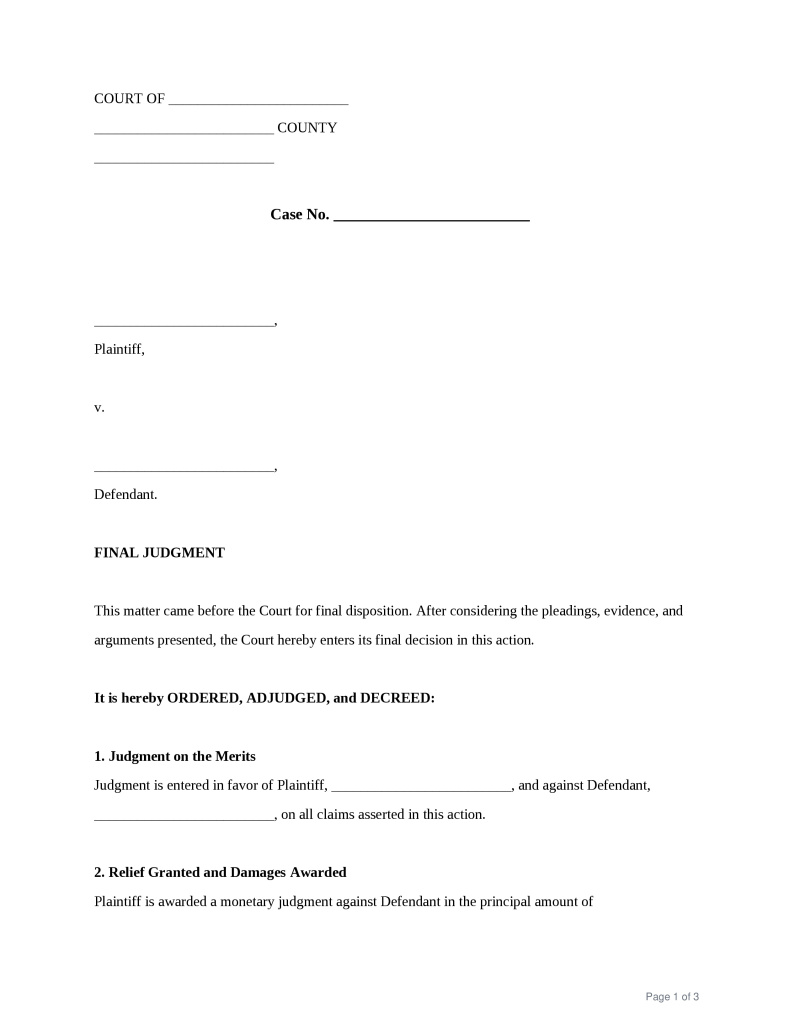
A judgment is a formal decision or determination made by a court of law or other tribunal that resolves a legal dispute by defining the rights and obligations of the parties involved.
Answer the question(s) below to create your Judgment
Judgment Basis
Choose the procedural event or ruling that led to the court's final decision.
Use the wording the court should understand for the judgment's procedural basis.
Table of Contents
What is a Judgment?
A judgment is the formal decision issued by a court of law at the conclusion of a legal proceeding. This document resolves the dispute between the parties, establishes their respective rights and obligations, and represents the official determination of the judge or jury. Litigants, attorneys, and court administrators use judgments to finalize cases, initiate enforcement actions, or file appeals.
Types of Judgments
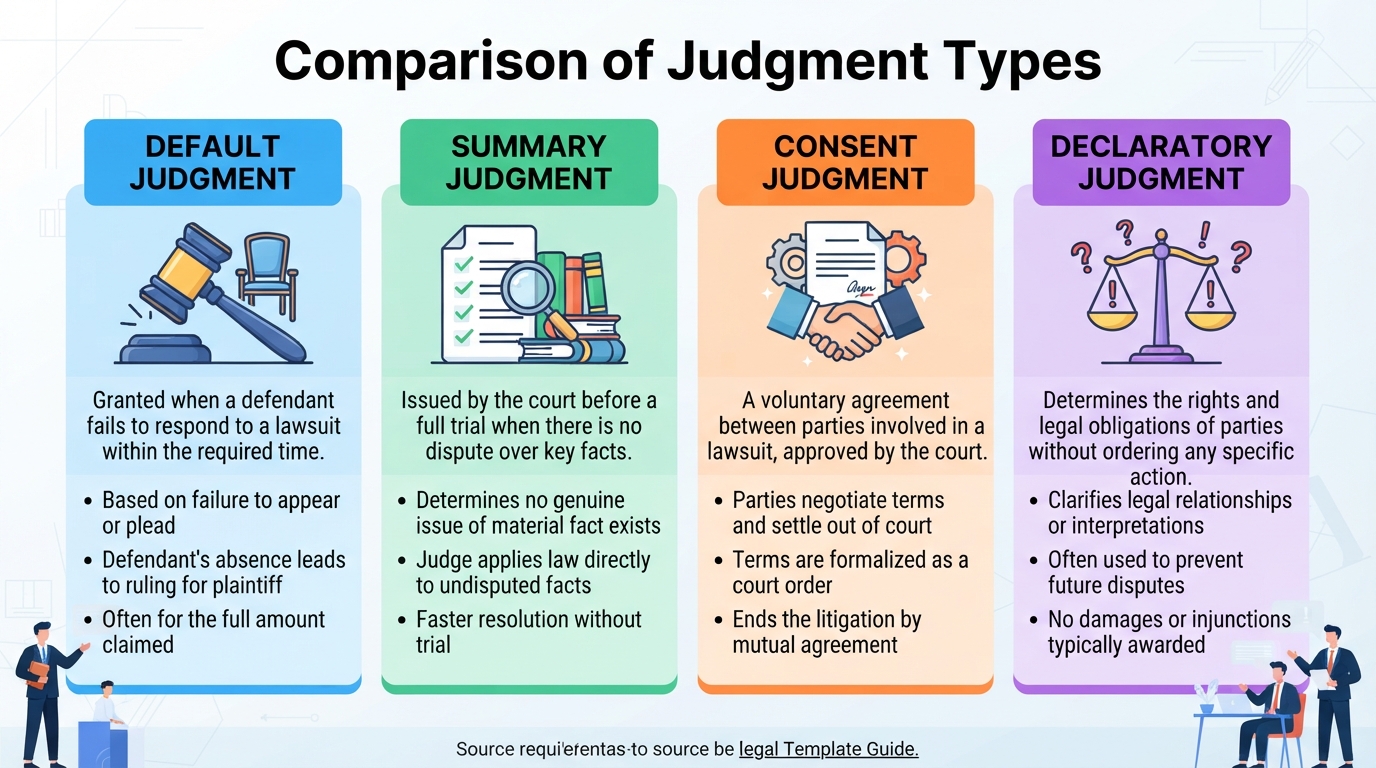
Courts issue several distinct types of judgments depending on the stage of litigation and the behavior of the parties involved:
- Default Judgment - A ruling entered against a party who has failed to defend against a claim or appear in court after receiving proper notice.
- Summary Judgment - A decision rendered by a court prior to trial when there are no disputed material facts, allowing the case to be decided as a matter of law.
- Consent Judgment - A binding agreement between opposing parties that is approved and signed by a judge, resolving the dispute without a trial.
- Declaratory Judgment - A binding determination that defines the legal relationship and rights of the parties without ordering specific action or awarding damages.
- Final Judgment - A ruling that completely resolves all outstanding claims of all parties in a lawsuit, leaving nothing further for the court to decide.
Key Elements of a Written Judgment
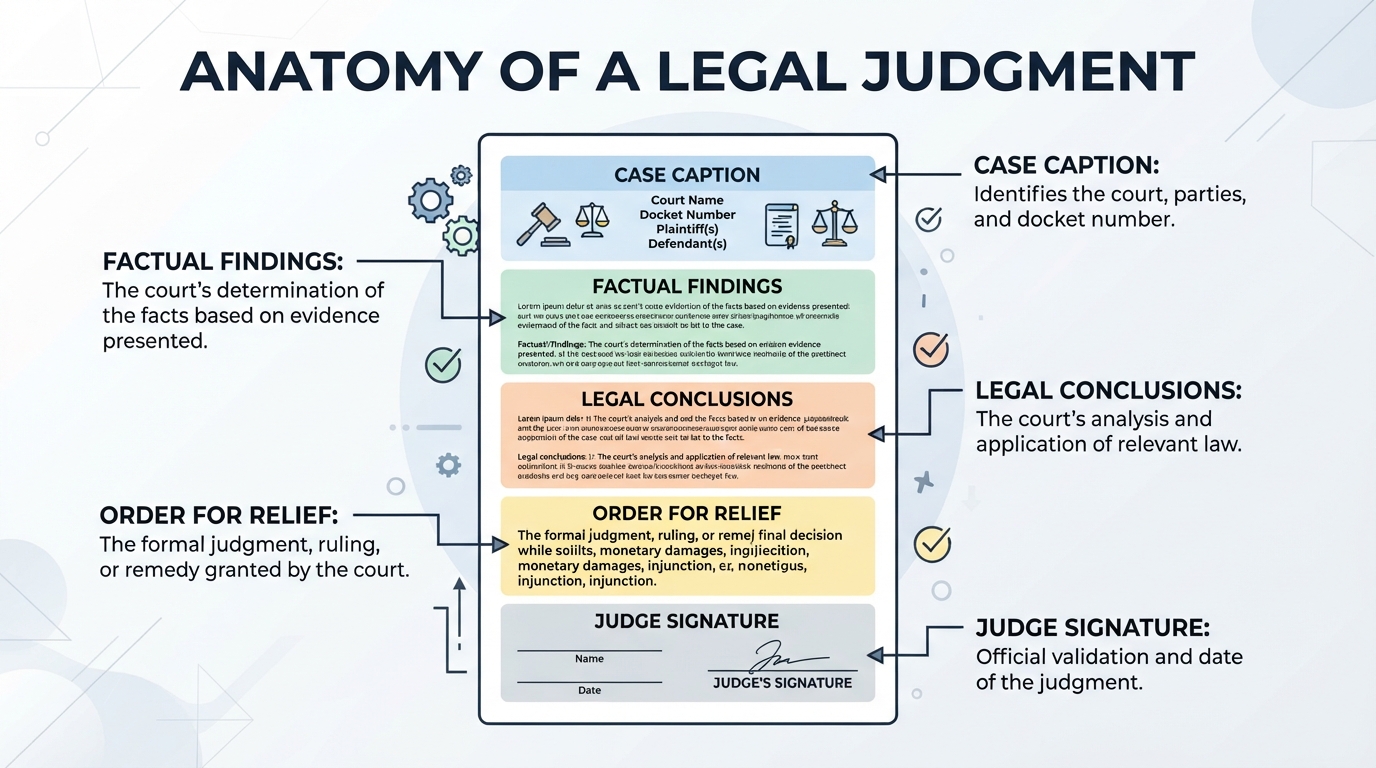
A legally binding judgment typically contains specific administrative and substantive components to ensure clarity and enforceability:
- Case Caption - The official heading identifying the court, the names of the plaintiff and defendant, and the unique case docket number.
- Factual Findings - The judge's official determination of the facts that were proven or accepted during the proceedings.
- Legal Conclusions - The specific laws, statutes, and legal precedents applied to the facts of the case.
- Order for Relief - The explicit directive stating the outcome, such as monetary damages, injunctive relief, or dismissal of the case.
- Judge Signature - The official signature of the presiding judge and the date the judgment is entered into the court record.
Enforcement of Monetary Judgments
Obtaining a judgment does not guarantee immediate payment, and judgment creditors often must utilize statutory mechanisms to collect the awarded funds:
- Writ of Execution - A court order directing a sheriff or marshal to seize and sell the debtor's non-exempt assets to satisfy the debt.
- Wage Garnishment - A legal process requiring an employer to withhold a portion of the debtor's earnings and pay them directly to the creditor.
- Judgment Lien - A legal claim placed on the real property of the debtor, preventing them from selling or refinancing without satisfying the debt.
- Bank Levy - A directive ordering a financial institution to freeze and transfer funds from the debtor's account to the creditor.
Legal Framework and Statutory Limitations
The creation, registration, and duration of judgments are governed by specific procedural rules and statutory timelines:
- Federal Rules of Civil Procedure Rule 54 - Defines the scope, entry, and costs associated with judgments in federal court litigation (Fed. R. Civ. P. 54).
- Federal Rules of Civil Procedure Rule 58 - Requires every judgment to be set out in a separate document to ensure formal entry (Fed. R. Civ. P. 58).
- Full Faith and Credit Clause - Mandates that judgments entered by a court in one state must be recognized and enforced by courts in other states (U.S. Const. art. IV, § 1).
- Uniform Enforcement of Foreign Judgments Act - Establishes a streamlined process for registering and enforcing out-of-state judgments in participating jurisdictions (UEFJA § 2).
The Judgment Entry and Appeal Process
The transition from a trial verdict to a final, enforceable judgment involves several formal procedural steps:
- Drafting the Proposed Judgment - The prevailing party or court staff prepares the formal written document detailing the terms of the decision.
- Signing by the Judge - The presiding judge reviews the draft, makes any necessary modifications, and signs the document.
- Filing and Docketing - The court clerk enters the signed judgment into the official court ledger, which triggers the formal post-judgment timelines.
- Serving Notice of Entry - The prevailing party serves a formal notice of the judgment entry on all other parties to initiate the appeal clock.
- Filing Post-Trial Motions - Parties may submit motions for a new trial or to alter the judgment within strict statutory deadlines.
- Initiating an Appeal - The losing party files a notice of appeal within the designated timeframe to seek review by a higher court.
Frequently Asked Questions
A verdict is the finding of fact made by a jury at the conclusion of a trial. A judgment is the official decree entered by the judge that legally binds the parties and makes the decision enforceable.
The expiration period varies significantly by state, typically ranging from five to twenty years. Many jurisdictions allow creditors to renew the judgment before it expires to extend its validity.
Credit reporting agencies generally do not list civil judgments on standard consumer credit reports under current reporting standards. Public records of judgments remain accessible through court archives and background checks.
An individual is considered judgment proof when they lack sufficient income or assets that can be legally seized to satisfy a debt. Creditors hold the valid judgment but cannot successfully enforce collection actions against the debtor.
A judgment is satisfied when the debtor pays the full amount owed or complies with the court ordered terms. The creditor must then file a formal satisfaction of judgment document with the court to close the record.
Related Documents
Forms commonly used with Judgment.
Not the form you're looking for?
Try our legal document generator to create a custom document
Disclaimer: The templates available on this website are provided for general informational purposes only and do not constitute legal advice. They are not intended to be, and should not be interpreted as, compliant with any specific legal, regulatory, or privacy requirements. These templates are not a replacement for professional legal guidance and should not be relied upon for any particular matter or circumstance. Users are strongly encouraged to seek advice from a qualified attorney licensed in their jurisdiction before using, modifying, or relying on any template.
All templates are provided on an "as is," "with all faults," and "as available" basis. The provider disclaims any and all warranties of any kind, whether express, implied, statutory, or otherwise, including without limitation warranties of merchantability, fitness for a particular purpose, title, or non-infringement.
LegalTemplates.com makes no guarantees or representations regarding the accuracy, completeness, expected outcomes, or reliability of the materials contained in these templates or any materials referenced or linked from them.