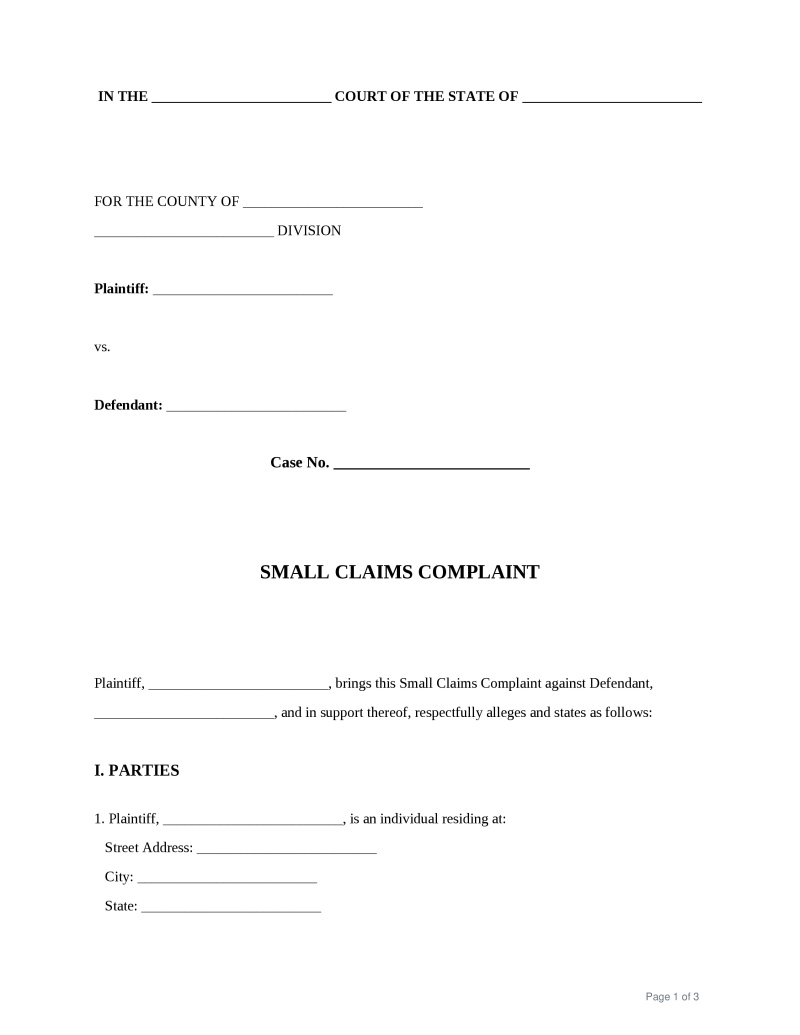
Small Claims Complaint
A Small Claims Complaint is an official legal pleading filed by a plaintiff in a court of limited jurisdiction to initiate a civil lawsuit for recovering minor monetary damages or resolving small-scale disputes.
Claim Category
Choose the closest category. This helps tailor the factual details needed for the complaint.
Use a short label for the dispute category.
Table of Contents
What is a Small Claims Complaint?
A Small Claims Complaint is a formal legal document filed by an individual or entity to initiate a civil lawsuit in a small claims court. This document outlines the legal dispute, identifies the parties involved, and specifies the monetary damages or remedy requested. Designed for simplified and expedited resolution of minor disputes, it allows parties to represent themselves without mandatory legal counsel.
Purpose and Jurisdictional Limits
Small claims courts resolve disputes involving relatively small amounts of money under simplified rules. The specific rules and limits depend on the state and local jurisdiction:
- Monetary Thresholds - Jurisdictions restrict the maximum amount a plaintiff can seek, such as up to $5,000 in Suffolk County, New York.
- Age Requirements - Plaintiffs must be at least 18 years old to file a claim independently, as required in jurisdictions like Solano County, California.
- Guardian Representative - Individuals under the age of 18 must have an appointed guardian ad litem file the claim on their behalf.
- Business Plaintiffs - Entities conducting business under a fictitious name must submit a Fictitious Business Name Declaration when filing.
Selecting the Correct Court Jurisdiction
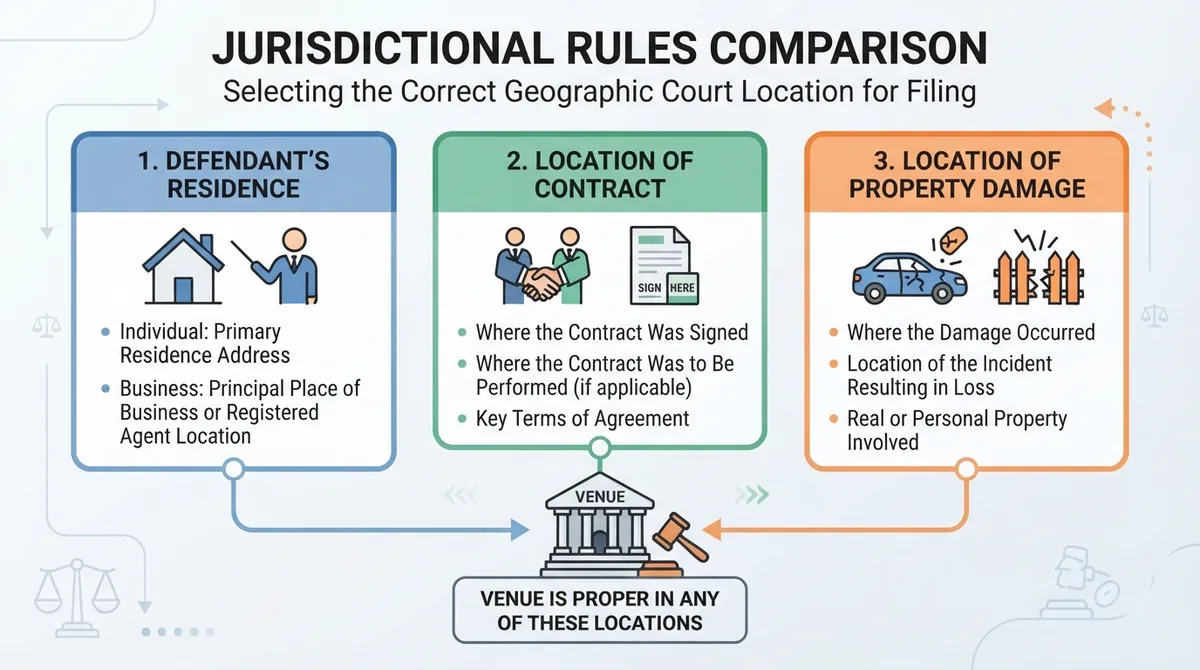
Plaintiffs must file their claim in the correct geographic location to ensure the court has jurisdiction over the case:
- Defendant Residence - The court located in the county or district where the defendant currently resides or conducts business.
- Contract Execution - The geographic area where the contract was signed or was intended to be performed.
- Injury or Damage Location - The specific county or district where the traffic accident, property damage, or dispute occurred.
Required Forms and Documentation
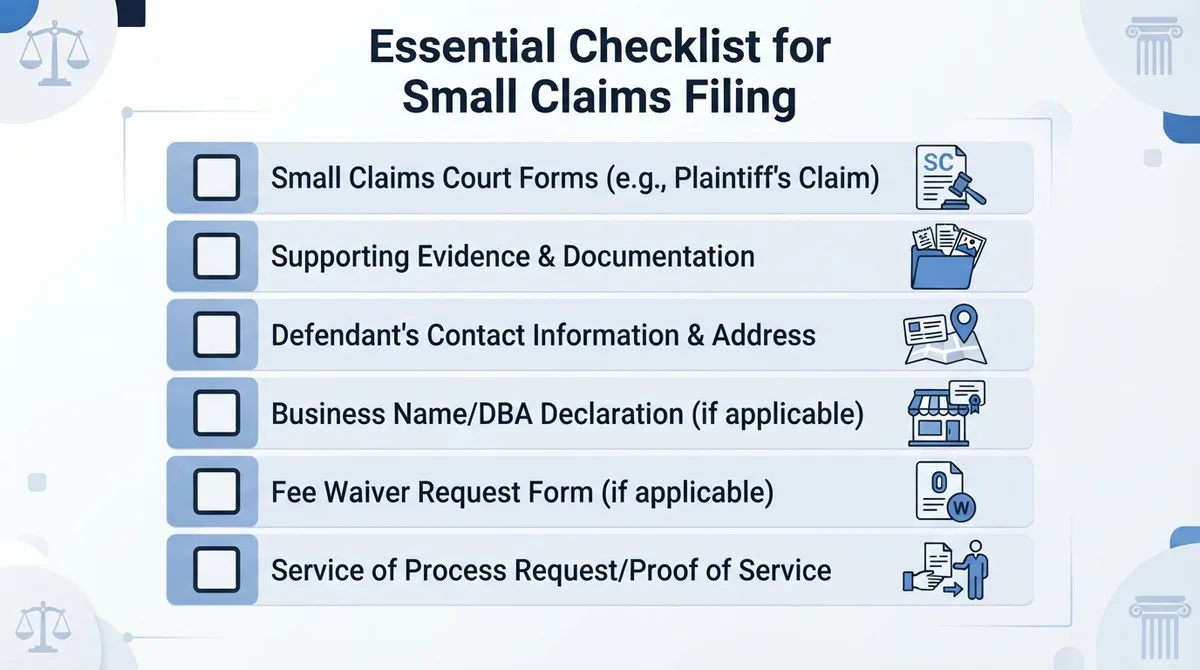
Filing a case requires specific standardized forms provided by state court systems:
- California Small Claims Initiating Form - Initiates a small claims case across California superior courts (Form SC-100).
- California Certified Mail Service Form - Requests the court clerk to serve the defendant via certified mail (Form SC-074).
- Fictitious Business Name Declaration - Required in San Mateo County for plaintiffs operating under an assumed business name.
- Suffolk County Complaint Form - Used in Suffolk County, New York, and must be completed in black ink with clear typing or block printing.
Key Elements of a Small Claims Complaint
To ensure a Small Claims Complaint is legally valid and accepted by the court clerk, the document must contain specific information:
- Party Identification - The full legal names, contact details, and physical addresses of both the plaintiff and the defendant.
- Claim Amount - The exact dollar amount being claimed, which must fall within the local court jurisdictional limit.
- Statement of Facts - A brief explanation of the dispute, including relevant dates, locations, and the reason the defendant owes the money.
- Service Preferences - Documentation indicating how the defendant will be served, such as certified mail or personal service.
Types of Small Claims Actions
Small claims courts handle various civil disputes, which are categorized by the nature of the claim:
- Breach of Contract - A claim arising from a failure to fulfill a written or oral agreement, such as unpaid loans or uncompleted services.
- Property Damage - An action seeking compensation for damage caused to personal property, such as a vehicle damaged in an accident.
- Landlord-Tenant Disputes - Cases involving the recovery of security deposits, unpaid rent, or minor property damage to rental units.
- Consumer Disputes - Claims filed by consumers against businesses for defective products, false advertising, or poor workmanship.
Filing and Service Procedures
Initiating a case involves several administrative steps that plaintiffs must follow to comply with local court rules:
- Obtain the Correct Forms - Secure the necessary local forms from the county superior court or district court website.
- Complete the Documentation - Fill out the forms using black ink, clear typing, or block letters as required by the jurisdiction.
- File with the Court Clerk - Submit the completed forms to the clerk in the appropriate geographic jurisdiction and pay the required filing fee.
- Serve the Defendant - Arrange for legal delivery of the complaint to the defendant using certified mail, a process server, or a sheriff.
Frequently Asked Questions
Sources
- Small Claims Complaint Form Instructions | New York Courts - Provides detailed instructions for completing the Small Claims Complaint Form in Suffolk County, New York.
- Small Claims Forms | Superior Court of California - County of San Diego - Offers a collection of forms related to Small Claims cases in San Diego County, California.
- Small Claims Forms | Superior Court of California - County of San Mateo - Provides forms and instructions for filing Small Claims cases in San Mateo County, California.
- Small Claims Forms | California Courts | Self Help Guide - Offers a comprehensive guide to Small Claims forms used across California courts.
- Small Claims - Filing Instructions | Superior Court of California - County of Solano - Provides filing instructions for Small Claims cases in Solano County, California.
Not the form you're looking for?
Try our legal document generator to create a custom document
Disclaimer: The templates available on this website are provided for general informational purposes only and do not constitute legal advice. They are not intended to be, and should not be interpreted as, compliant with any specific legal, regulatory, or privacy requirements. These templates are not a replacement for professional legal guidance and should not be relied upon for any particular matter or circumstance. Users are strongly encouraged to seek advice from a qualified attorney licensed in their jurisdiction before using, modifying, or relying on any template.
All templates are provided on an "as is," "with all faults," and "as available" basis. The provider disclaims any and all warranties of any kind, whether express, implied, statutory, or otherwise, including without limitation warranties of merchantability, fitness for a particular purpose, title, or non-infringement.
LegalTemplates.com makes no guarantees or representations regarding the accuracy, completeness, expected outcomes, or reliability of the materials contained in these templates or any materials referenced or linked from them.