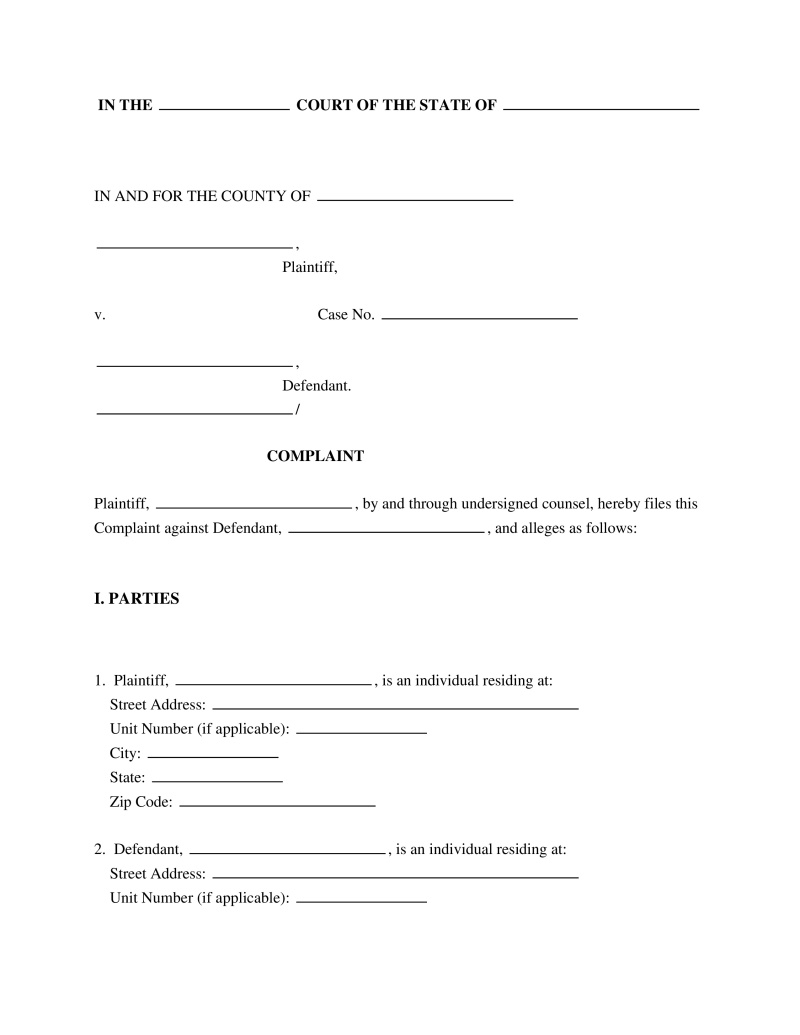
Complaint
Create Complaint
Complaint
A Complaint is the initial pleading filed by a plaintiff in a civil lawsuit, setting forth factual allegations and legal claims against a defendant.
Answer the question(s) below to create your Complaint
Is Case New Or Existing
Select 'New case' if this Complaint starts a lawsuit. Select 'Existing case' if it is being filed in a case with an assigned number.
Table of Contents
What is a Complaint?
A Complaint serves as the initial document filed by a plaintiff or petitioner to commence a lawsuit. Its primary purpose is to formally notify the court and the defendant(s) of the plaintiff's claims, outlining the factual basis and legal theories upon which relief is sought. This foundational pleading establishes the parties, the jurisdiction of the court, the specific allegations of wrongdoing, and the requested remedies from the court. It is a critical instrument in civil litigation, setting the stage for the judicial process.
Legal Requirements and Validity
For a Complaint to be legally valid and withstand initial challenges, it must adhere to specific procedural and substantive requirements mandated by the relevant jurisdiction's rules of civil procedure. These requirements ensure that the defendant receives adequate notice of the claims against them and that the court has the proper authority to hear the case. Failure to comply with these stipulations can lead to the dismissal of the action, either with or without prejudice.
- Jurisdiction - The Complaint must establish both subject matter jurisdiction (the court's authority to hear the type of case) and personal jurisdiction (the court's authority over the specific parties involved).
- Venue - It must indicate that the lawsuit is being brought in the proper geographical location, typically where the events giving rise to the claim occurred or where the parties reside.
- Parties - The Complaint must clearly identify the plaintiff(s) and defendant(s), specifying their roles and, where necessary, their capacities to sue or be sued.
- Statement of Facts - A clear, concise, and plausible narrative of the factual allegations that form the basis of the claim must be presented, usually in numbered paragraphs.
- Causes of Action - Each specific legal theory or claim (e.g., breach of contract, negligence, fraud) must be articulated, demonstrating how the alleged facts support the elements of that claim.
- Demand for Relief - The Complaint must specify the remedies or relief sought by the plaintiff, which may include monetary damages, injunctive relief, specific performance, or declaratory judgments.
- Signature - The document must be signed by the attorney of record or by the plaintiff if they are representing themselves (pro se), certifying that the pleading is not frivolous and is well-grounded in fact and law.
- Filing Fees - Proper court filing fees must be paid at the time of submission, unless a fee waiver (in forma pauperis) is granted by the court.
How to Draft and File a Complaint
Drafting and filing a Complaint is a multi-step process that requires careful attention to detail and adherence to legal formalities. Each step is crucial for establishing a sound legal foundation for the lawsuit and ensuring proper notification to all parties involved.
- Identify Parties, Jurisdiction, and Venue - Begin by clearly identifying all parties involved in the dispute, including their full legal names and addresses. Determine which court has the appropriate subject matter jurisdiction over the type of case and personal jurisdiction over the defendants. Research the correct venue, which dictates the specific geographic location where the lawsuit should be filed, often based on where the defendant resides or where the events occurred.
- State Factual Allegations Concisely - Develop a clear and chronological narrative of the events that led to the dispute. Present the facts in numbered paragraphs, ensuring each paragraph contains a single, concise allegation or statement. Focus on providing enough detail to inform the defendant of the nature of the claims without including excessive evidentiary material, ensuring the allegations are plausible and directly relevant to the causes of action.
- Articulate Specific Causes of Action - For each legal theory under which the plaintiff seeks relief, clearly state the elements of that cause of action and explain how the factual allegations satisfy each element. For instance, if alleging negligence, demonstrate duty, breach, causation, and damages. Each cause of action should be presented as a separate count within the Complaint, providing clarity for both the court and the defendant.
- Formulate a Demand for Relief - Clearly specify the remedies or relief that the plaintiff is seeking from the court. This section, often called the "Prayer for Relief," can include requests for monetary damages (compensatory, punitive), equitable relief such as injunctions (ordering a party to do or stop doing something), specific performance (requiring a party to fulfill a contract), or declaratory judgments (a legal determination of rights).
- Sign and Verify the Document - The Complaint must be signed by the plaintiff's attorney or by the plaintiff if they are representing themselves. This signature certifies that the filing is made in good faith, is factually supported, and is warranted by existing law or a non-frivolous argument for changing the law. Some jurisdictions or specific types of cases may also require a verification, where the plaintiff attests under oath that the statements in the Complaint are true to the best of their knowledge.
- File with the Court and Arrange for Service - Submit the original Complaint, along with any required copies and filing fees, to the clerk of the appropriate court. After filing, a summons will typically be issued. The plaintiff is then responsible for arranging for proper service of process, which involves formally delivering copies of the Complaint and summons to each named defendant according to strict legal rules. This ensures the defendant receives official notice of the lawsuit and an opportunity to respond.
Rights and Obligations of Parties Involved
The filing of a Complaint initiates a structured legal process that assigns specific rights and obligations to both the plaintiff and the defendant, as well as the presiding court. Adherence to these roles is essential for maintaining due process and the integrity of the judicial system.
- Plaintiff's Rights - The plaintiff has the right to present their claims to the court, seek discovery to gather evidence, and pursue legal remedies for alleged harms. They are entitled to a fair hearing and an impartial decision from the court.
- Plaintiff's Obligations - The plaintiff is obligated to file a Complaint that is truthful and well-grounded in law and fact, avoiding frivolous or vexatious litigation. They must properly serve the defendant with the Complaint and summons, actively participate in discovery, and comply with all court orders and procedural rules throughout the litigation.
- Defendant's Rights - The defendant has a fundamental right to receive proper notice of the lawsuit through service of process, allowing them an opportunity to respond. They have the right to challenge the Complaint's legal sufficiency, present defenses, conduct discovery, and defend themselves against the allegations. They are also entitled to a fair trial and an impartial judicial process.
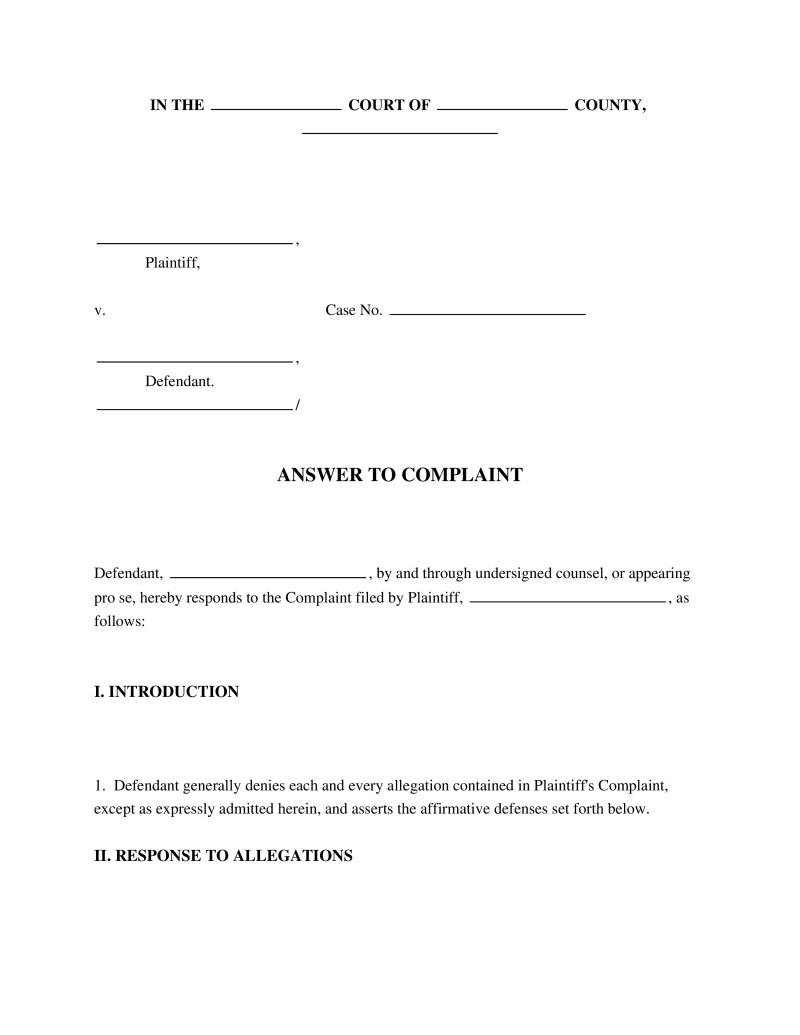
- Defendant's Obligations - Upon receiving a Complaint, the defendant is obligated to respond within a specified timeframe, either by filing an Answer to the allegations or by filing a motion to dismiss the Complaint. Failure to respond can result in a default judgment against them. The defendant must also participate in discovery honestly and comply with all court orders.
- Court's Role and Obligations - The court's primary obligation is to preside over the proceedings impartially, apply the law correctly, and ensure that due process is afforded to all parties. The court manages the case flow, rules on motions, interprets legal arguments, and ultimately issues judgments or facilitates settlements, upholding the rule of law.
Federal and State Laws Governing Complaints
The framework for drafting and filing a Complaint is primarily established by rules of civil procedure, which exist at both the federal and state levels. These rules ensure uniformity, fairness, and efficiency in the litigation process.
Federal Rules of Civil Procedure
At the federal level, the process is governed by the Federal Rules of Civil Procedure (FRCP), which apply in all U.S. District Courts. Key rules pertaining to Complaints include:
- Rule 7 (Pleadings Allowed) - Specifies that a Complaint is one of the primary pleadings allowed in federal court, along with an answer, counterclaim, crossclaim, and third-party complaint.
- Rule 8 (General Rules of Pleading) - Requires a Complaint to contain a short and plain statement of the grounds for the court's jurisdiction, a short and plain statement of the claim showing that the pleader is entitled to relief, and a demand for the relief sought. This rule emphasizes notice pleading.
- Rule 10 (Form of Pleadings) - Dictates the general format of a Complaint, including requirements for a caption, numbered paragraphs, and separate statements for each claim or defense.
- Rule 11 (Signing Pleadings, Motions, and Other Papers; Representations to the Court; Sanctions) - Mandates that every pleading, written motion, and other paper must be signed by an attorney or unrepresented party, certifying that the filing is not presented for an improper purpose, is warranted by existing law, and has evidentiary support.
- Rule 12 (Defenses and Objections: When and How Presented; Motion for Judgment on the Pleadings; Consolidating Motions; Waiving Defenses; Pretrial Hearing) - Outlines the methods and timing for defendants to respond to a Complaint, including filing an Answer or various pre-answer motions, such as a motion to dismiss for failure to state a claim.
- Rule 15 (Amended and Supplemental Pleadings) - Provides guidelines for amending a Complaint, which may be done as a matter of course early in the litigation or with leave of court or the opposing party's written consent later in the process.
State Civil Procedure Rules
Each state has its own code of civil procedure, which largely mirrors the Federal Rules of Civil Procedure but often includes state-specific nuances and requirements. Examples include the California Code of Civil Procedure, the New York Civil Practice Law and Rules, and the Texas Rules of Civil Procedure. These state rules address:
- Pleading Standards - While many states follow "notice pleading" similar to FRCP Rule 8, some jurisdictions may require more detailed "fact pleading," demanding a higher level of specificity in the factual allegations.
- Service of Process - State rules often detail specific methods for serving a Complaint and summons, which can vary from personal service to service by mail or publication under certain circumstances.
- Statutes of Limitations - State laws dictate the time limits within which a Complaint must be filed after a cause of action accrues. Failure to file within this period can result in the claim being barred permanently.
- Specific Pleading Requirements - Certain types of claims, such as those involving fraud or special damages, may have heightened pleading requirements under state law, demanding greater particularity in the Complaint.
Penalties for Non-Compliance
Non-compliance with the rules governing Complaints can lead to significant penalties, impacting the outcome of the lawsuit for both plaintiffs and defendants:
- Dismissal of Complaint - If a Complaint fails to meet fundamental legal requirements (e.g., lack of jurisdiction, failure to state a claim), a court may dismiss it, potentially with prejudice, meaning the plaintiff cannot refile the same claim.
- Sanctions under Rule 11 (or State Equivalents) - If a Complaint is deemed frivolous, brought for an improper purpose, or lacks factual or legal basis, the court may impose sanctions on the attorney or pro se litigant. These can include monetary fines, payment of the opposing party's attorney's fees, or other non-monetary directives.
- Default Judgment - If a defendant fails to file a timely response to a properly served Complaint, the court may enter a default judgment against them, granting the plaintiff the relief requested in the Complaint without a trial.
- Waiver of Defenses - A defendant's failure to raise certain defenses in their initial response to a Complaint may result in the waiver of those defenses, preventing them from being asserted later in the litigation.
Frequently Asked Questions
The primary purpose of a complaint is to formally initiate a lawsuit, notifying the court and the defendant(s) of the plaintiff's claims, the factual basis for those claims, and the specific relief being sought.
A complaint is filed by the plaintiff or petitioner, who is the party bringing the lawsuit. This can be an individual, a corporation, a government entity, or any other legal person seeking legal remedies.
After a complaint is filed, a summons is typically issued by the court. The plaintiff then arranges for the complaint and summons to be formally served on the defendant, who must then respond within a specified period, usually by filing an answer or a motion to dismiss.
Yes, a complaint can often be amended. Under federal and most state rules, a plaintiff may have the right to amend their complaint once as a matter of course early in the litigation, or later with the court's permission or the opposing party's consent.
A complaint is the document that states the plaintiff's claims and requested relief, while a summons is a formal court order notifying the defendant that a lawsuit has been filed against them and that they must appear or respond by a certain date.
A 'cause of action' refers to the specific legal theory or claim that entitles the plaintiff to seek judicial relief. It outlines the legal elements that must be proven based on the alleged facts to succeed in the lawsuit.
Filing a frivolous complaint, one that lacks a factual or legal basis, can lead to severe consequences, including dismissal of the case and the imposition of sanctions on the filing party or their attorney under rules like Federal Rule of Civil Procedure 11.
While individuals can file a complaint pro se (representing themselves), it is generally advisable to consult with or retain an attorney. Legal professionals possess the expertise to navigate complex procedural rules, draft legally sound complaints, and represent the plaintiff's interests effectively.
Complaint Sample
0% Complete
0/0 Fields
Related Documents
Forms commonly used with Complaint.
Not the form you're looking for?
Try our legal document generator to create a custom document
Disclaimer: The templates available on this website are provided for general informational purposes only and do not constitute legal advice. They are not intended to be, and should not be interpreted as, compliant with any specific legal, regulatory, or privacy requirements. These templates are not a replacement for professional legal guidance and should not be relied upon for any particular matter or circumstance. Users are strongly encouraged to seek advice from a qualified attorney licensed in their jurisdiction before using, modifying, or relying on any template.
All templates are provided on an "as is," "with all faults," and "as available" basis. The provider disclaims any and all warranties of any kind, whether express, implied, statutory, or otherwise, including without limitation warranties of merchantability, fitness for a particular purpose, title, or non-infringement.
LegalTemplates.com makes no guarantees or representations regarding the accuracy, completeness, expected outcomes, or reliability of the materials contained in these templates or any materials referenced or linked from them.